
The Role of Motion Cues in Simulation Testing

- Slides: 13
The Role of Motion Cues in Simulation Testing Gregory Davis FHWA Office of Safety RD&T
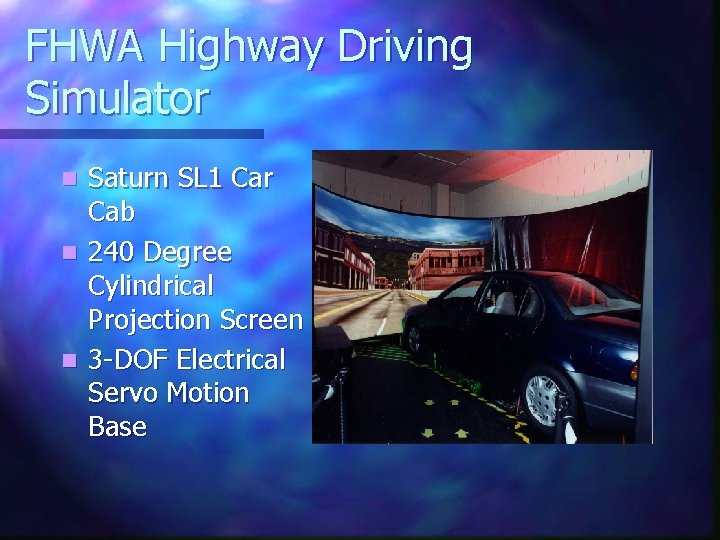
FHWA Highway Driving Simulator Saturn SL 1 Car Cab n 240 Degree Cylindrical Projection Screen n 3 -DOF Electrical Servo Motion Base n
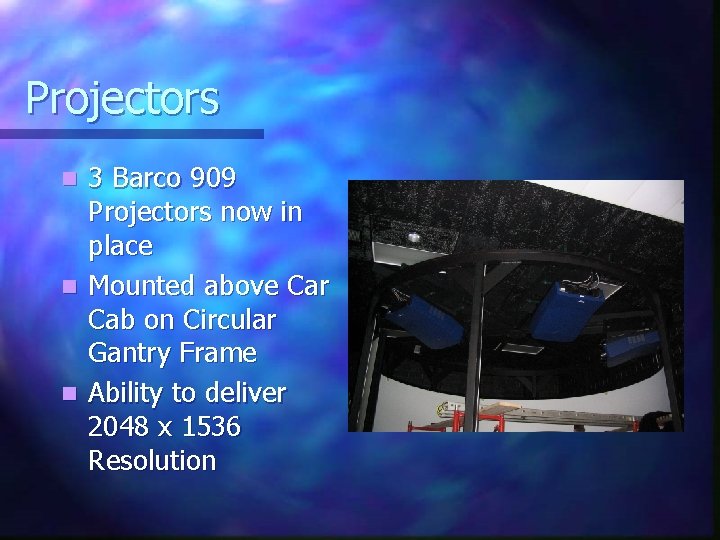
HDS Upgrade n Current Upgrade of System Hardware and Software is in Progress n SGI Onyx Infinite Reality has been replaced with Dell PCs n One Electro. Home Projector replaced with 3 Barco Projectors n Complete upgrade will total 5 Barcos for 240 Degree Field of View (’ 05)
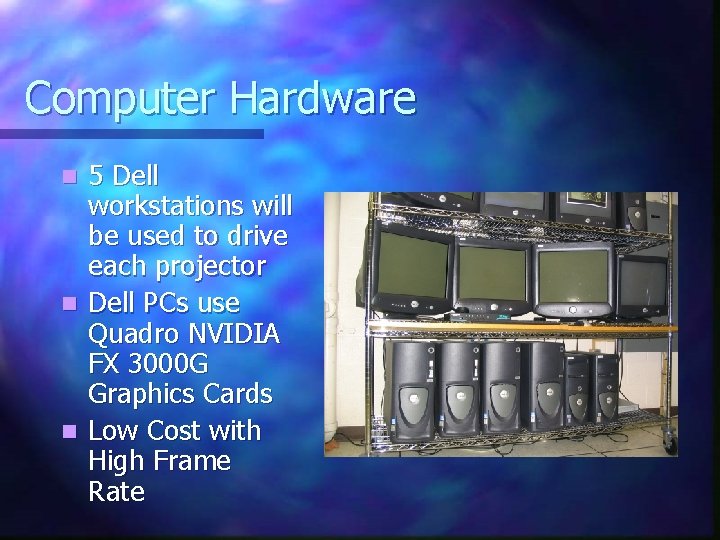
Computer Hardware 5 Dell workstations will be used to drive each projector n Dell PCs use Quadro NVIDIA FX 3000 G Graphics Cards n Low Cost with High Frame Rate n
Projectors 3 Barco 909 Projectors now in place n Mounted above Car Cab on Circular Gantry Frame n Ability to deliver 2048 x 1536 Resolution n
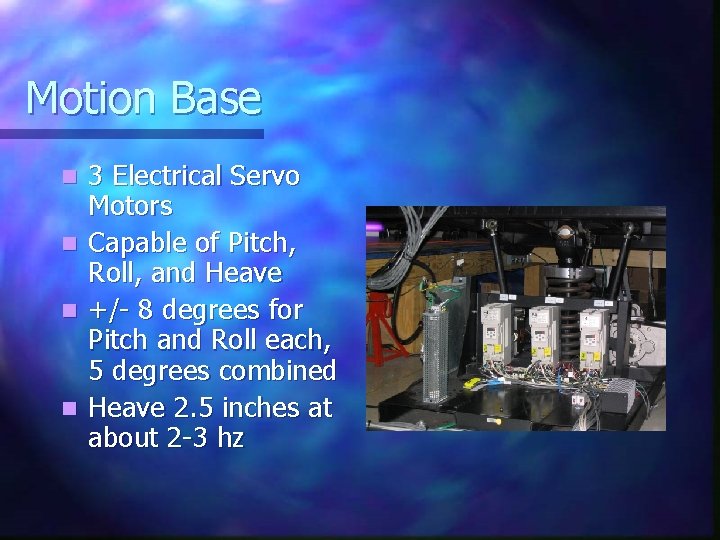
Motion Base n n 3 Electrical Servo Motors Capable of Pitch, Roll, and Heave +/- 8 degrees for Pitch and Roll each, 5 degrees combined Heave 2. 5 inches at about 2 -3 hz
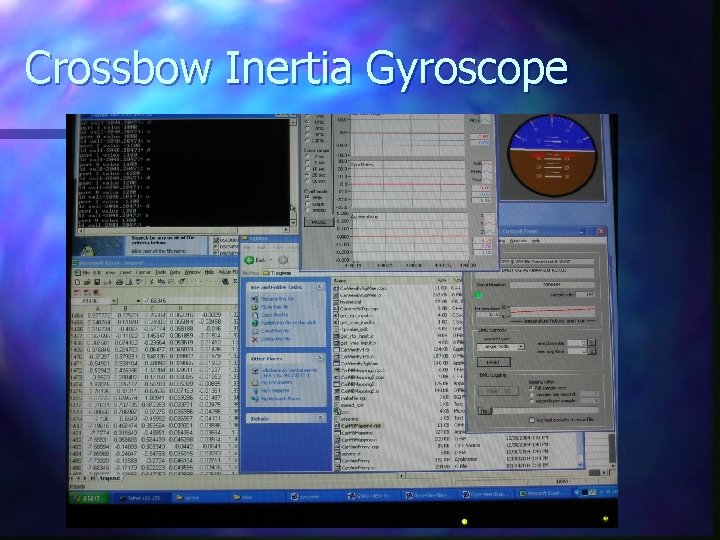
Crossbow Inertia Gyroscope
Vehicle Dynamics Model n n n 6 DOF Equations (although capable of only 3) Simplified model of 4 speed Auto Transmission Tire Skid Limits on side force and braking force Steering wheel disturbances (force feedback) Motion Base Control Roadway Surface Conditions
Issues and Questions? Which types of experiments require motion based cues? n Studies on Braking? Reaction Time=maybe not. Brake force=yes. n Studies on lane keeping-speed = yes n Studies on roadway design or sign comprehension = maybe, depends on experimental design
…And More Questions? If motion cues are required, how much motion is needed to achieve the desired effect? n Which method of motion is more conducive to achieving accurate and reliable results in a simulator, the traditional method or the vector substitution method? (e. g. tilting the car cab down {traditional} or up {vector substitution} during vehicle braking n Does the appropriate motion contribute to or mitigate motion sickness? n
Finally Do we need standards for motion cues?
Acknowledgements Special Thanks to: Jason Williams (AAI Eng. ) John Molino (SAIC)