
THE ROLE OF MASSIVE STARS IN STAR FORMATION
![STRATEGY Ø MULTIWALENGTH APPROACH (BVIJHK[3. 6], [4. 5], [5. 8], [8. 0], X-RAYs) Ø](https://slidetodoc.com/presentation_image/ed75d3efaaef6aae1aa55fb3f23802a0/image-4.jpg "STRATEGY Ø MULTIWALENGTH APPROACH (BVIJHK[3. 6], [4. 5], [5. 8], [8. 0], X-RAYs) Ø")
![EXAMPLE: QVIJ[3. 6] vs. J-[3. 6] TOTAL OF STARS SELECTED IN M 16 WITH](https://slidetodoc.com/presentation_image/ed75d3efaaef6aae1aa55fb3f23802a0/image-9.jpg "EXAMPLE: QVIJ[3. 6] vs. J-[3. 6] TOTAL OF STARS SELECTED IN M 16 WITH")


- Slides: 31
THE ROLE OF MASSIVE STARS IN STAR FORMATION DISK PHOTOEVAPORATION AND STAR FORMATION HYSTORY IN THE EAGLE NEBULA Mario Giuseppe Guarcello UNIPA- Università degli studi di Palermo INAF- Osservatorio Astronomico di Palermo G. Micela – F. Damiani – G. Peres – L. Prisinzano – S. Sciortino
AIMS OF THE STUDY Ø EVIDENCES OF PHOTOEVAPORATION OF CIRCUMSTELLAR DISKS INDUCED BY NEARBY MASSIVE STARS Ø HISTORY OF STAR FORMATION IN MASSIVE STARS FORMING REGIONS (SFR)
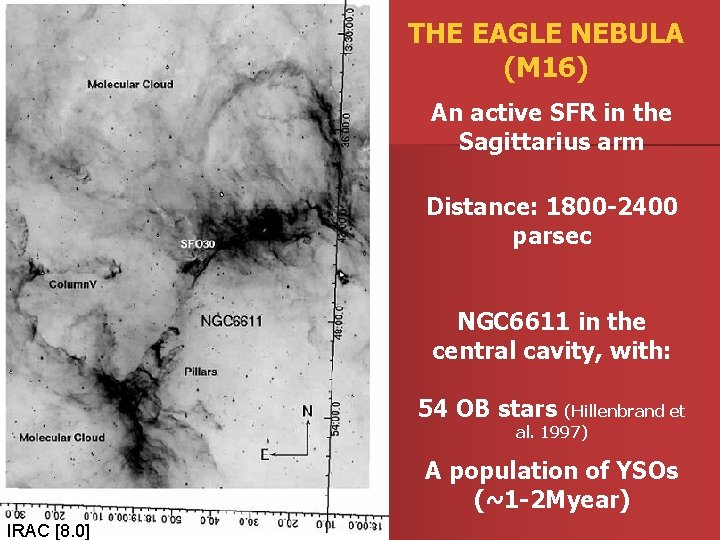
THE EAGLE NEBULA (M 16) An active SFR in the Sagittarius arm Distance: 1800 -2400 parsec NGC 6611 in the central cavity, with: 54 OB stars (Hillenbrand et al. 1997) A population of YSOs (~1 -2 Myear) IRAC [8. 0]
STRATEGY Ø MULTIWALENGTH APPROACH (BVIJHK[3. 6], [4. 5], [5. 8], [8. 0], X-RAYs) Ø DISK-BEARING YSOs SELECTED BY INFRARED EXCESSES Ø DISK-LESS YSOs SELECTED BY THE X-RAY EMISSION AND OPTICAL COLORS Ø PHOTOEVAPORATION: SPATIAL VARIATION OF DISK FREQUENCY IN NGC 6611 Ø SF HISTORY: CHRONOLOGY OF STAR FORMATION IN M 16
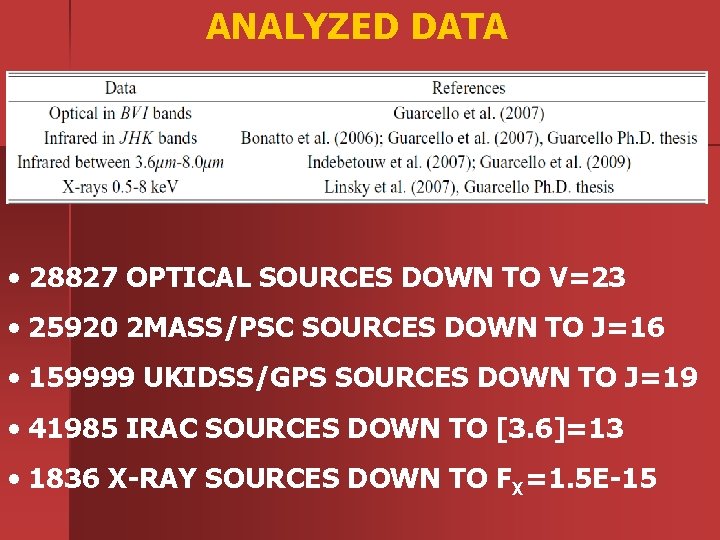
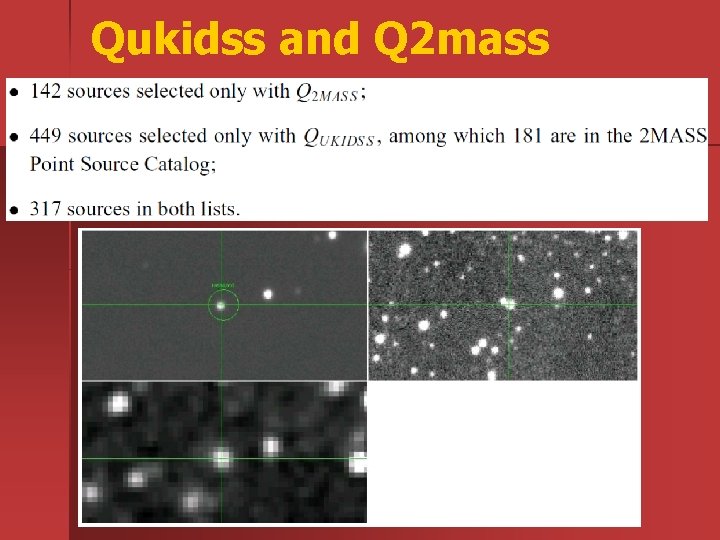
ANALYZED DATA • 28827 OPTICAL SOURCES DOWN TO V=23 • 25920 2 MASS/PSC SOURCES DOWN TO J=16 • 159999 UKIDSS/GPS SOURCES DOWN TO J=19 • 41985 IRAC SOURCES DOWN TO [3. 6]=13 • 1836 X-RAY SOURCES DOWN TO FX=1. 5 E-15
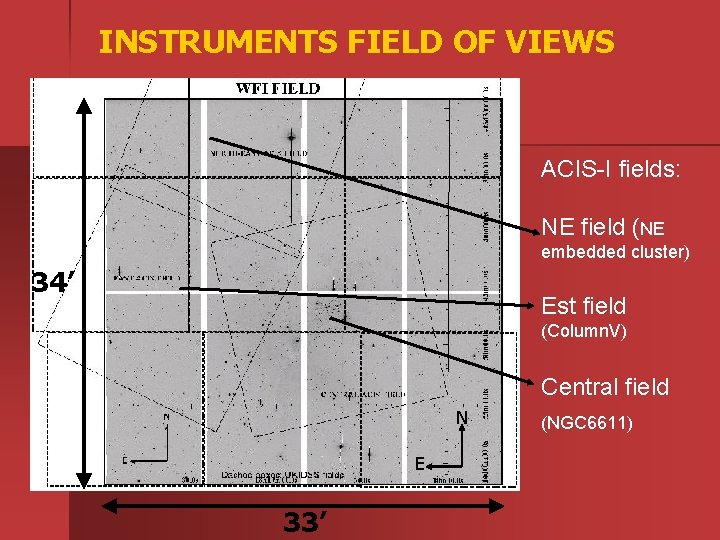
INSTRUMENTS FIELD OF VIEWS ACIS-I fields: NE field (NE embedded cluster) 34’ Est field (Column. V) Central field N E 33’ (NGC 6611)
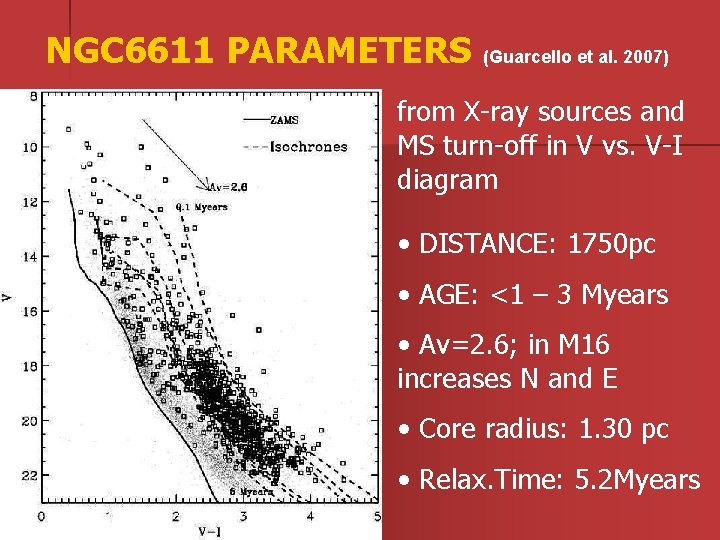
NGC 6611 PARAMETERS (Guarcello et al. 2007) from X-ray sources and MS turn-off in V vs. V-I diagram • DISTANCE: 1750 pc X-ray sources • AGE: <1 – 3 Myears • Av=2. 6; in M 16 increases N and E • Core radius: 1. 30 pc • Relax. Time: 5. 2 Myears
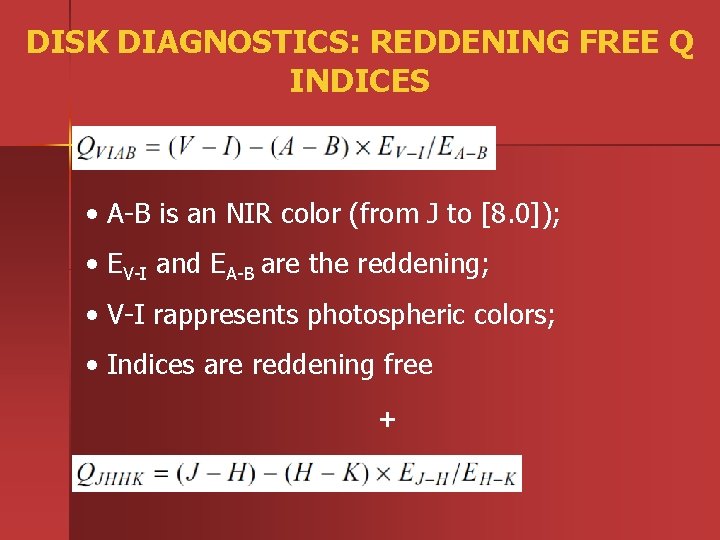
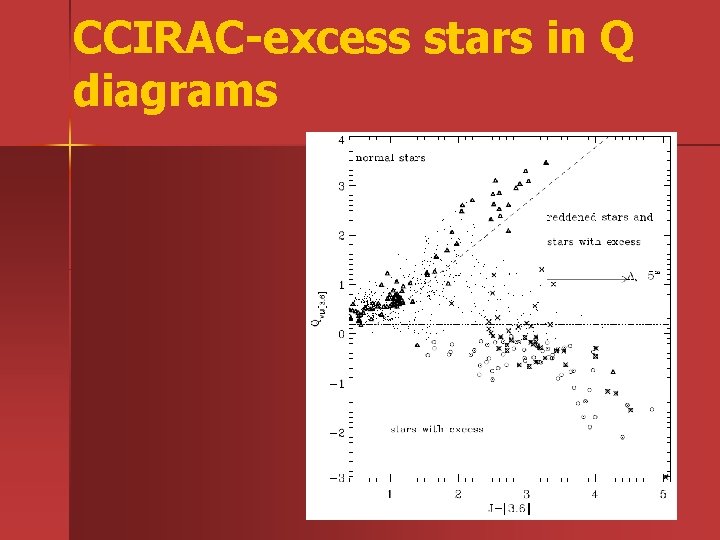
DISK DIAGNOSTICS: REDDENING FREE Q INDICES • A-B is an NIR color (from J to [8. 0]); • EV-I and EA-B are the reddening; • V-I rappresents photospheric colors; • Indices are reddening free +
EXAMPLE: QVIJ[3. 6] vs. J-[3. 6] TOTAL OF STARS SELECTED IN M 16 WITH Q INDICES: • 660 down to 0. 2 solar masses • 290 fainter probable cluster members Optical sources with normal colors: Δ X-ray sources: + Stars with excess in [3. 6]: ο
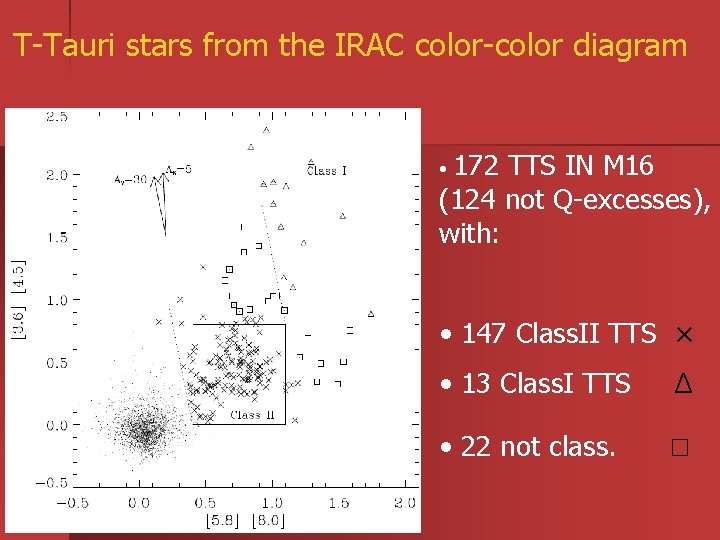
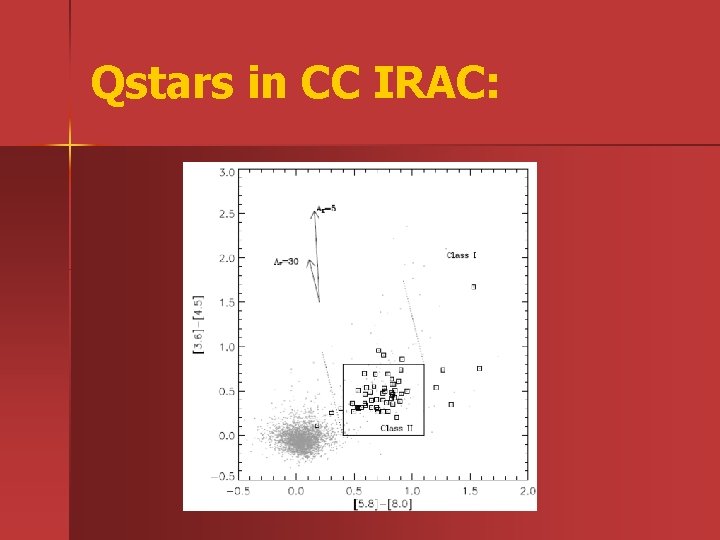
T-Tauri stars from the IRAC color-color diagram 172 TTS IN M 16 (124 not Q-excesses), with: • • 147 Class. II TTS × • 13 Class. I TTS Δ • 22 not class. □
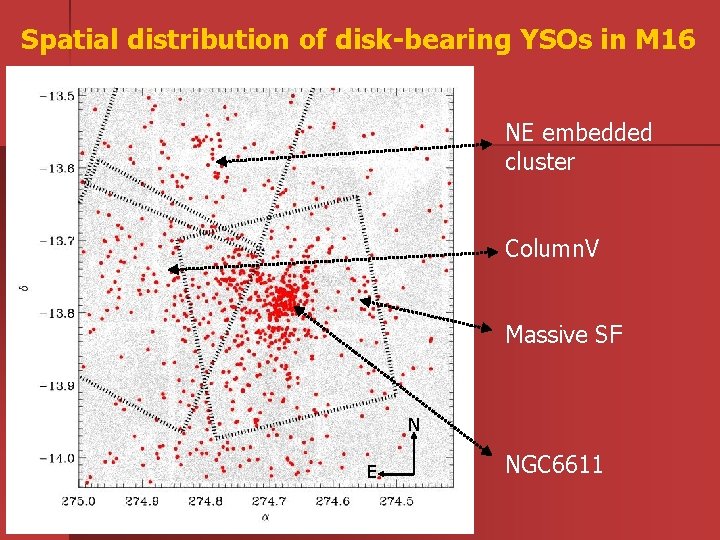
Spatial distribution of disk-bearing YSOs in M 16 NE embedded cluster Column. V Massive SF N E NGC 6611
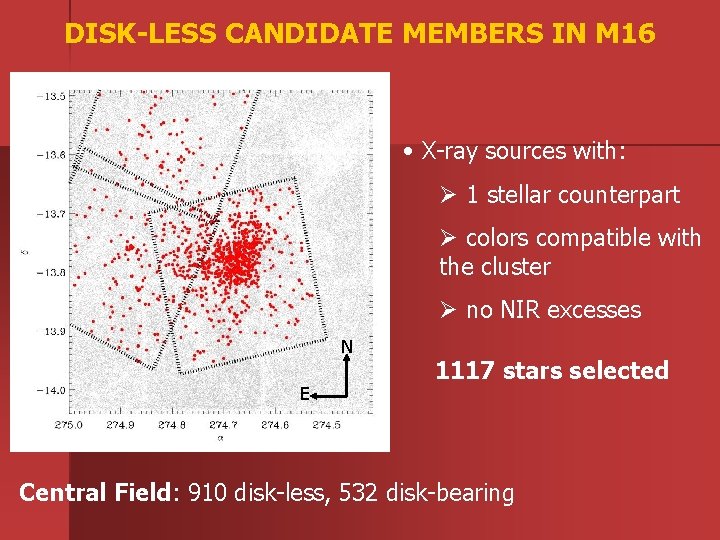
DISK-LESS CANDIDATE MEMBERS IN M 16 • X-ray sources with: Ø 1 stellar counterpart Ø colors compatible with the cluster Ø no NIR excesses N E 1117 stars selected Central Field: 910 disk-less, 532 disk-bearing
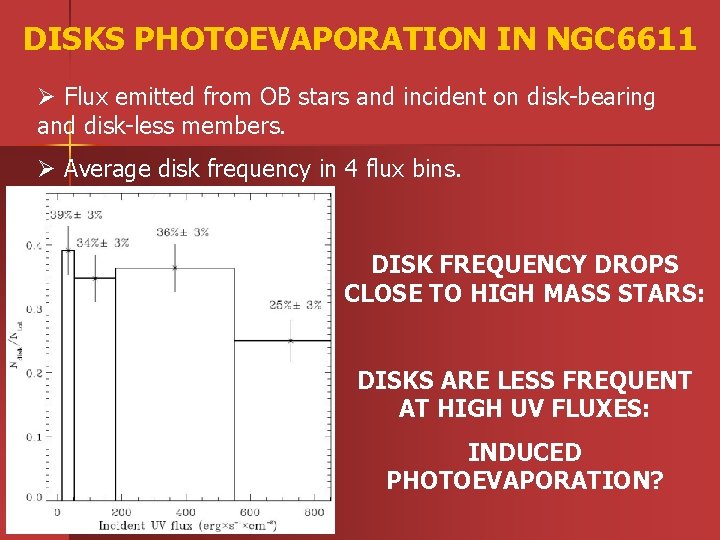
DISKS PHOTOEVAPORATION IN NGC 6611 Ø Flux emitted from OB stars and incident on disk-bearing and disk-less members. Ø Average disk frequency in 4 flux bins. DISK FREQUENCY DROPS CLOSE TO HIGH MASS STARS: DISKS ARE LESS FREQUENT AT HIGH UV FLUXES: INDUCED PHOTOEVAPORATION?
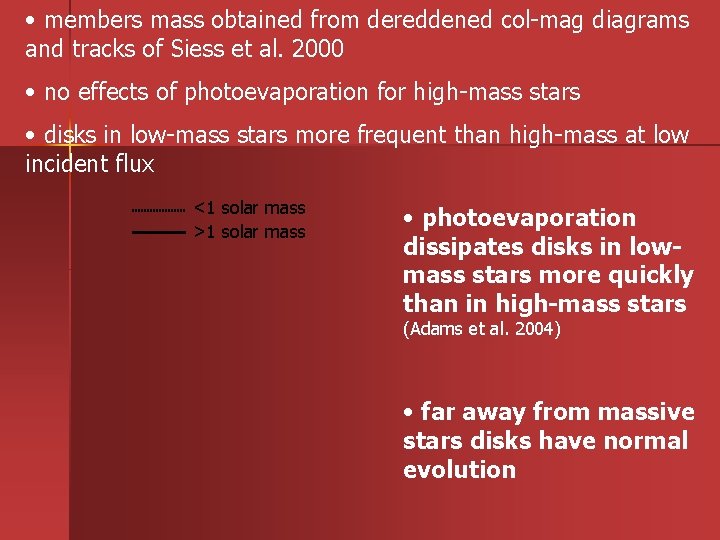
• members mass obtained from dereddened col-mag diagrams and tracks of Siess et al. 2000 • no effects of photoevaporation for high-mass stars • disks in low-mass stars more frequent than high-mass at low incident flux <1 solar mass >1 solar mass • photoevaporation dissipates disks in lowmass stars more quickly than in high-mass stars (Adams et al. 2004) • far away from massive stars disks have normal evolution
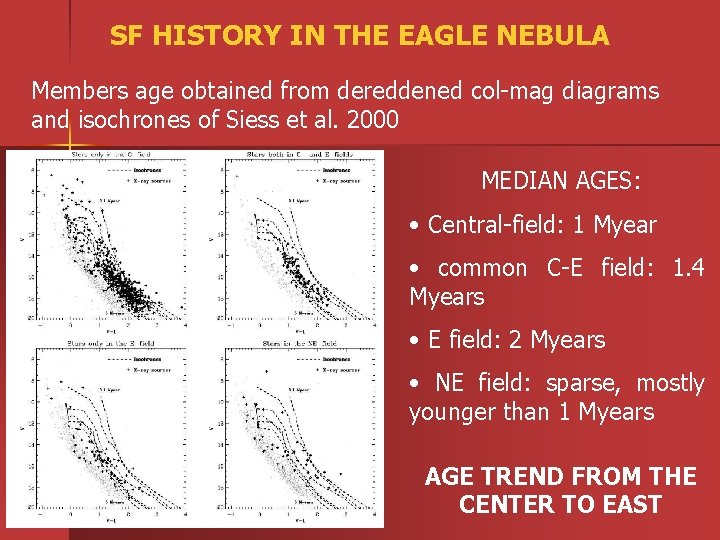
SF HISTORY IN THE EAGLE NEBULA Members age obtained from dereddened col-mag diagrams and isochrones of Siess et al. 2000 MEDIAN AGES: • Central-field: 1 Myear • common C-E field: 1. 4 Myears • E field: 2 Myears • NE field: sparse, mostly younger than 1 Myears AGE TREND FROM THE CENTER TO EAST
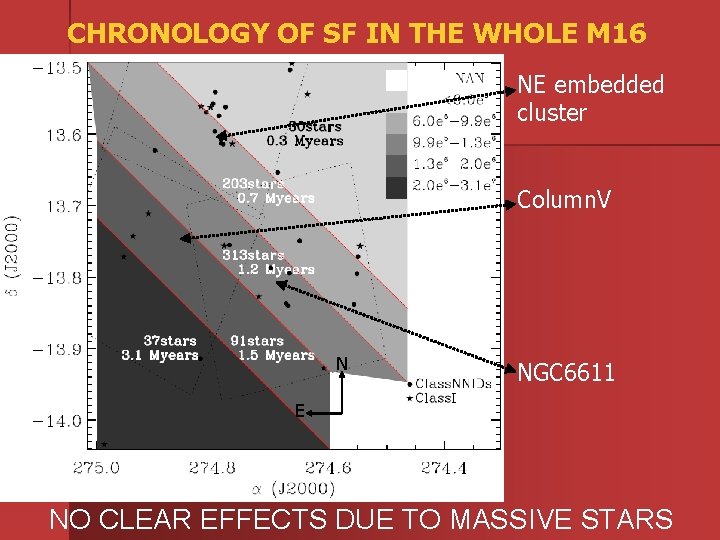
CHRONOLOGY OF SF IN THE WHOLE M 16 NE embedded cluster Column. V N NGC 6611 E NO CLEAR EFFECTS DUE TO MASSIVE STARS
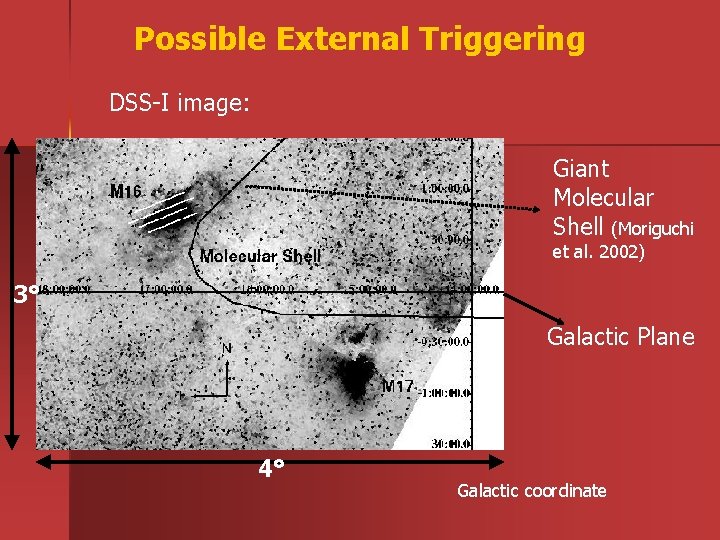
Possible External Triggering DSS-I image: Giant Molecular Shell (Moriguchi et al. 2002) 3° Galactic Plane 4° Galactic coordinate
Summary and Conclusions • Disk-bearing and disk-less YSOs identified in the whole Eagle Nebula • Photoevaporation efficient in low-mass stars close to massive stars in NGC 6611 • Chronology of SF not compatible with triggering by massive stars • Externally induced SF first events at South. East by giant molecular shell?
BWE stars
King’s profile
Multiband catalogs
Minima excesses
Qstars in CC IRAC:
CCIRAC-excess stars in Q diagrams
Qukidss and Q 2 mass
Xmedian energy for Class. III and Class. I/II
Disk Frequency across M 16
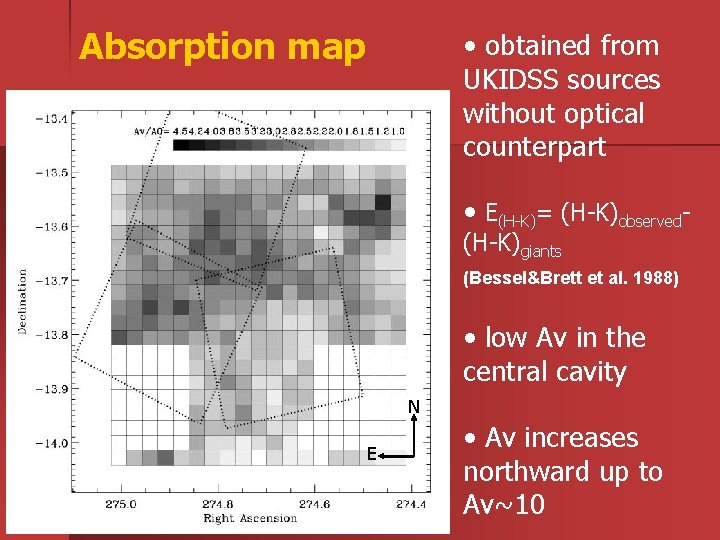
Absorption map • obtained from UKIDSS sources without optical counterpart • E(H-K)= (H-K)observed(H-K)giants (Bessel&Brett et al. 1988) • low Av in the central cavity N E • Av increases northward up to Av~10