
The role of journals and publishers in reproducible
The role of journals and publishers in reproducible research CASIM Reproducible Research Workshop, 27 th November 2015 Iain Hrynaszkiewicz Head of Data and HSS Publishing, Open Research Nature Publishing Group & Palgrave Macmillan iain. hrynaszkiewicz@nature. com @iainh_z
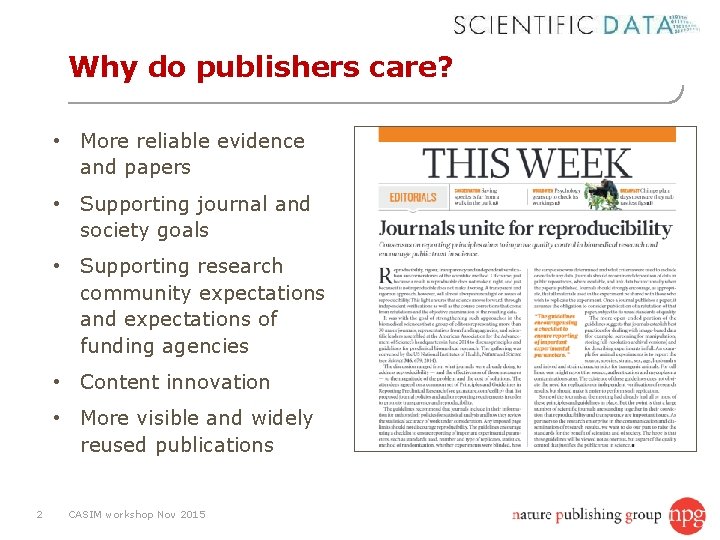
Why do publishers care? • More reliable evidence and papers • Supporting journal and society goals • Supporting research community expectations and expectations of funding agencies • Content innovation • More visible and widely reused publications 2 CASIM workshop Nov 2015
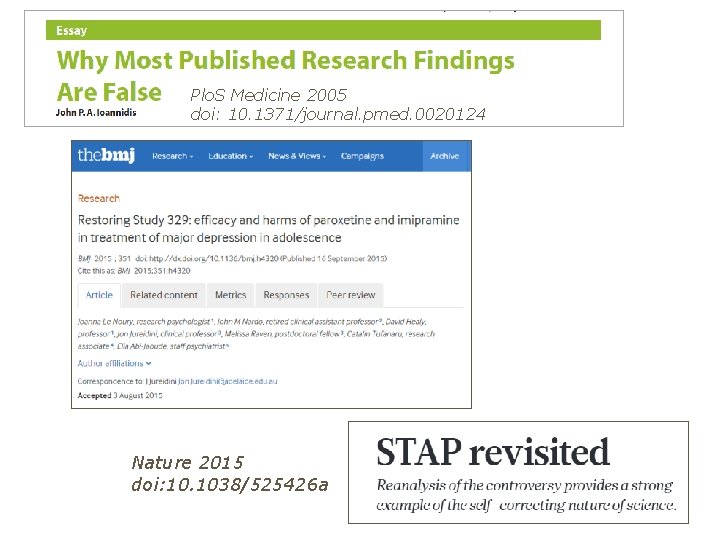
Plo. S Medicine 2005 doi: 10. 1371/journal. pmed. 0020124 Nature 2015 doi: 10. 1038/525426 a
Irreproducibility: underlying issues Misconduct Publication bias and refutations – where? Experimental design Statistics Lab supervision and training Reporting and sharing information Gels, microscopy images Statistical reporting Methods description Data deposition 4

Transparency vs. Reproducibility • Both require significant effort but transparency more pragmatic/achievable • Promoting transparency and reuse helps reproducibility • Access to materials to reduce bias and support reproducible research: 5 • Methods • Protocols • Code • Data • Pre-registration CASIM workshop Nov 2015 Miguel et al. (2014). Promoting transparency in social science research. Science (New York, N. Y. ), 343(6166), 30– 1. doi: 10. 1126/science. 1245317
Reproducibility: roles for publishers • Content • Policies • Incentives • Licenses • Access • Reliability • Innovation Image credit: DS Pugh [CC-BY-SA-2. 0 (http: //creativecommons. org/licenses/by-sa/2. 0)], via Wikimedia Commons. http: //commons. wikimedia. org/wiki/File%3 AHarlow_Carr_-_geograph. org. uk_-_32309. jpg Further reading: Hrynaszkiewicz I, Li P, Edmunds SC: Open science and the role of publishers in reproducible research. In: Implementing Reproducible Research. Edited by Stodden V, Leisch F, Peng RD. Chapman & Hall/CRC; 2014 6 CASIM workshop Nov 2015
Reproducibility: Content - details • Glasziou et al. (2008) BMJ – inadequate methods descriptions for medical interventions BMJ 2008; 336: 1472 • Length restrictions removed on Methods (Nature) • No length restrictions in open access journals • Reporting guidelines e. g. MIAME but implementation/enforcement is patchy 7 • Format of content also important when literature used a resource for research e. g. structured XML versions of articles in Pub. Med CASIM workshop Nov 2015
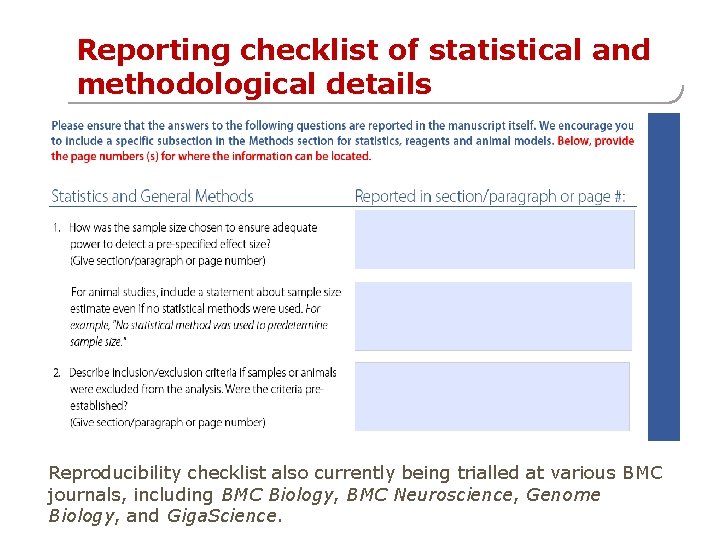
Reporting checklist of statistical and methodological details Reproducibility checklist also currently being trialled at various BMC journals, including BMC Biology, BMC Neuroscience, Genome Biology, and Giga. Science.
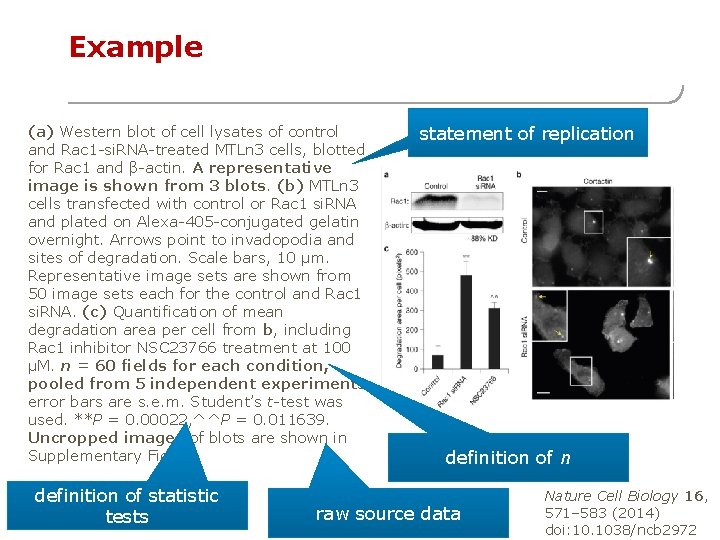
Example (a) Western blot of cell lysates of control and Rac 1 -si. RNA-treated MTLn 3 cells, blotted for Rac 1 and β-actin. A representative image is shown from 3 blots. (b) MTLn 3 cells transfected with control or Rac 1 si. RNA and plated on Alexa-405 -conjugated gelatin overnight. Arrows point to invadopodia and sites of degradation. Scale bars, 10 μm. Representative image sets are shown from 50 image sets each for the control and Rac 1 si. RNA. (c) Quantification of mean degradation area per cell from b, including Rac 1 inhibitor NSC 23766 treatment at 100 μM. n = 60 fields for each condition, pooled from 5 independent experiments; error bars are s. e. m. Student’s t-test was used. **P = 0. 00022, ^ ^P = 0. 011639. Uncropped images of blots are shown in Supplementary Fig. 9. definition of statistic 9 CASIM workshop Nov 2015 tests statement of replication definition of n raw source data Nature Cell Biology 16, 571– 583 (2014) doi: 10. 1038/ncb 2972
Reproducibility: Content - format • Format of content also important when literature used a resource for research e. g. structured XML versions of articles in Pub. Med Central • Building a “Gen. Bank for the published literature” (Roberts, Varmus et al Science, 2001) • Growing amount of open access articles (e. g. >60% of articles at NPG in 2015) 10 CASIM workshop Nov 2015
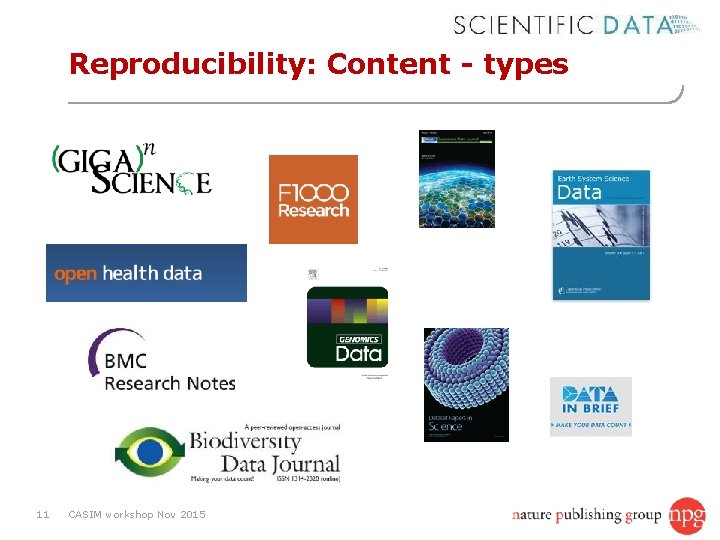
Reproducibility: Content - types 11 CASIM workshop Nov 2015
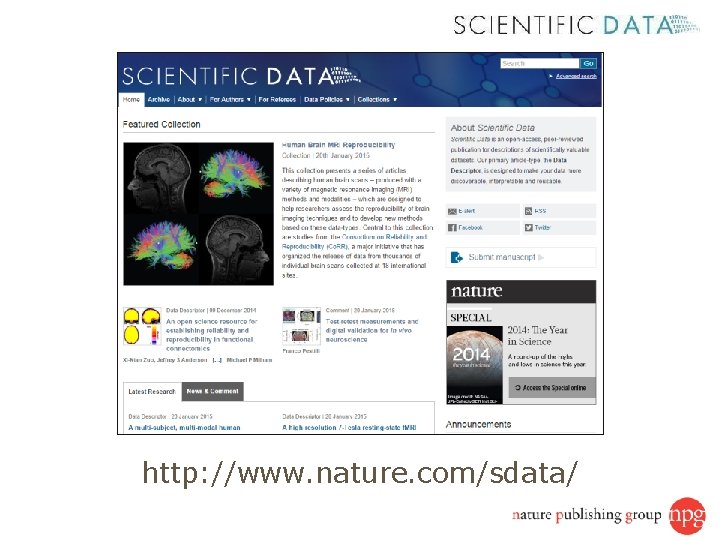
http: //www. nature. com/sdata/
Get Credit for Sharing Your Data Publications will be indexed and citeable. Open-access Creative Commons licenses (CC-BY/CC-BY-NC) for the main Data Descriptor. Each publication supported by CCO metadata. Focused on Data Reuse All the information others need to reuse the data; no interpretative analysis, or hypothesis testing Peer-reviewed Rigorous peer-review focused on technical data quality and reuse value Promoting Community Data Repositories Not a new data repository; data stored in community data repositories 13
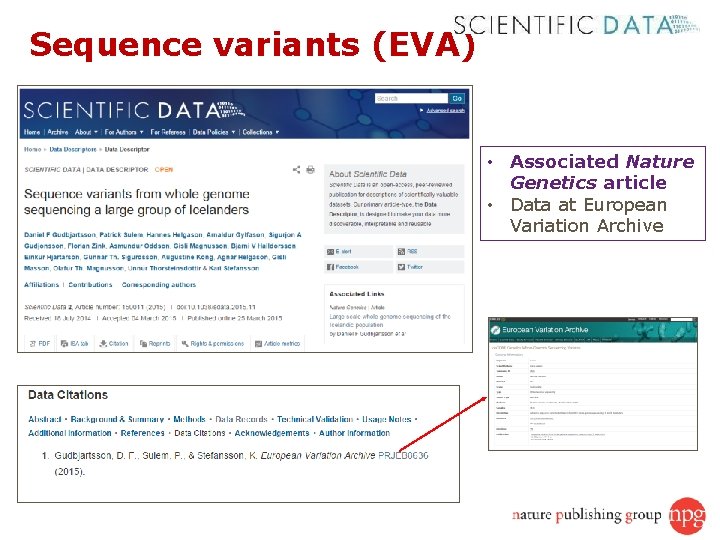
Sequence variants (EVA) • Associated Nature Genetics article • Data at European Variation Archive
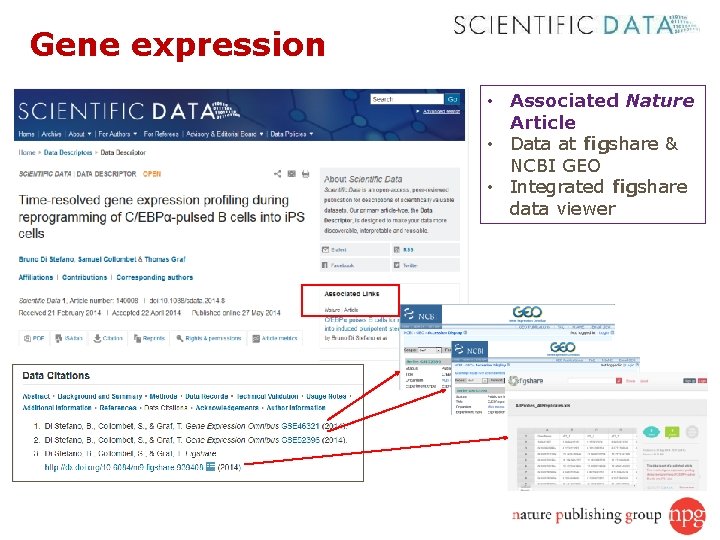
Gene expression • Associated Nature Article • Data at figshare & NCBI GEO • Integrated figshare data viewer
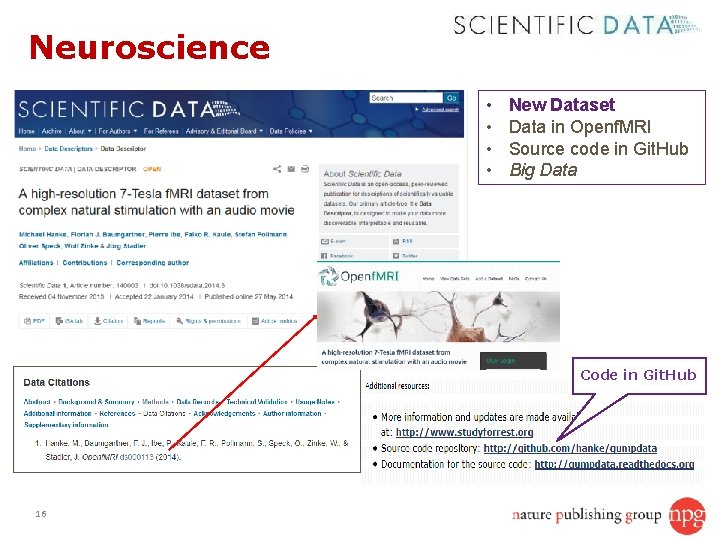
Neuroscience • • New Dataset Data in Openf. MRI Source code in Git. Hub Big Data Code in Git. Hub 16
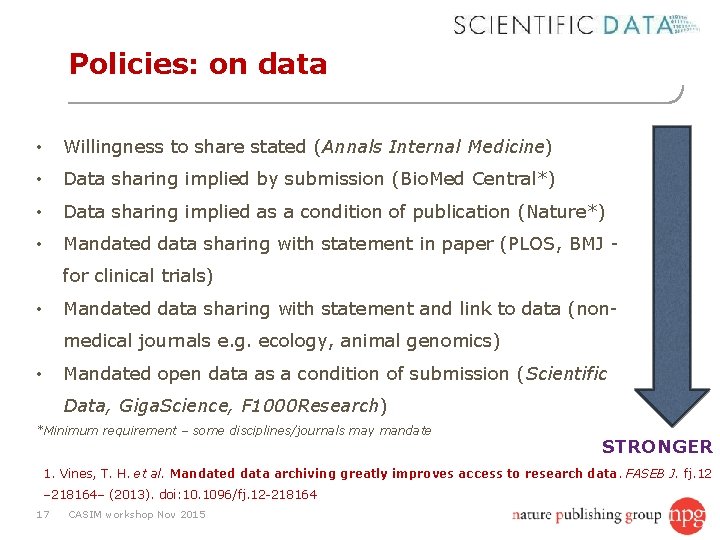
Policies: on data • Willingness to share stated (Annals Internal Medicine) • Data sharing implied by submission (Bio. Med Central*) • Data sharing implied as a condition of publication (Nature*) • Mandated data sharing with statement in paper (PLOS, BMJ for clinical trials) Mandated data sharing with statement and link to data (non- • medical journals e. g. ecology, animal genomics) Mandated open data as a condition of submission (Scientific • Data, Giga. Science, F 1000 Research) *Minimum requirement – some disciplines/journals may mandate STRONGER 1. Vines, T. H. et al. Mandated data archiving greatly improves access to research data. FASEB J. fj. 12 – 218164– (2013). doi: 10. 1096/fj. 12 -218164 17 CASIM workshop Nov 2015
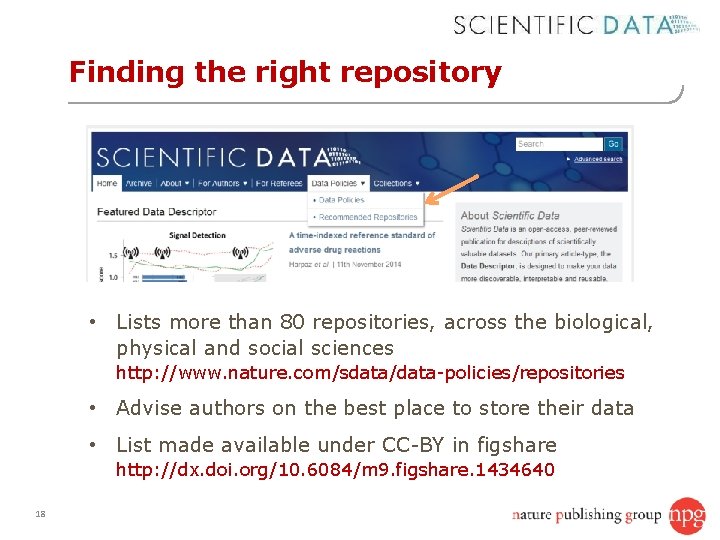
Finding the right repository • Lists more than 80 repositories, across the biological, physical and social sciences http: //www. nature. com/sdata/data-policies/repositories • Advise authors on the best place to store their data • List made available under CC-BY in figshare http: //dx. doi. org/10. 6084/m 9. figshare. 1434640 18
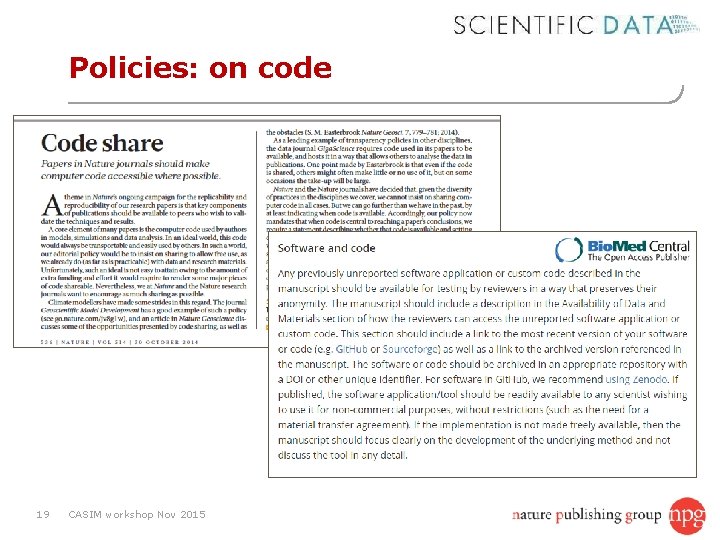
Policies: on code 19 CASIM workshop Nov 2015
Policies: it’s in the implementation • Meta-analysis fails when <40% data available Systematic Reviews 2014, 3: 97 doi: 10. 1186/2046 -4053 -3 -97 • Poor availability of psychological datasets (64/249 available) American Psychologist, Vol 61(7), Oct 2006, 726 -728. doi: 10. 1037/0003 -066 X. 61. 7. 726 • Data received from 1/10 PLOS Medicine and PLOS Clinical Trials authors PLo. S ONE 4(9): e 7078. doi: 10. 1371/journal. pone. 0007078 • 38% of 394 researchers contacted sent their data Collabra 2015 1(1) doi: 10. 1525/collabra. 13 20 CASIM workshop Nov 2015
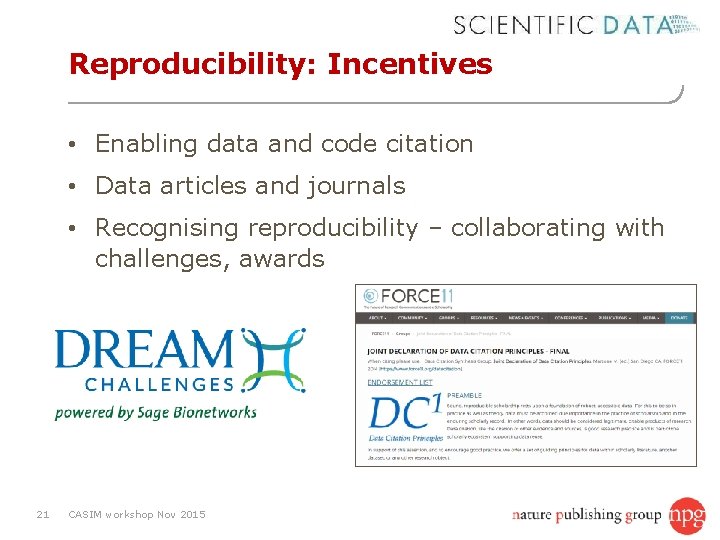
Reproducibility: Incentives • Enabling data and code citation • Data articles and journals • Recognising reproducibility – collaborating with challenges, awards 21 CASIM workshop Nov 2015
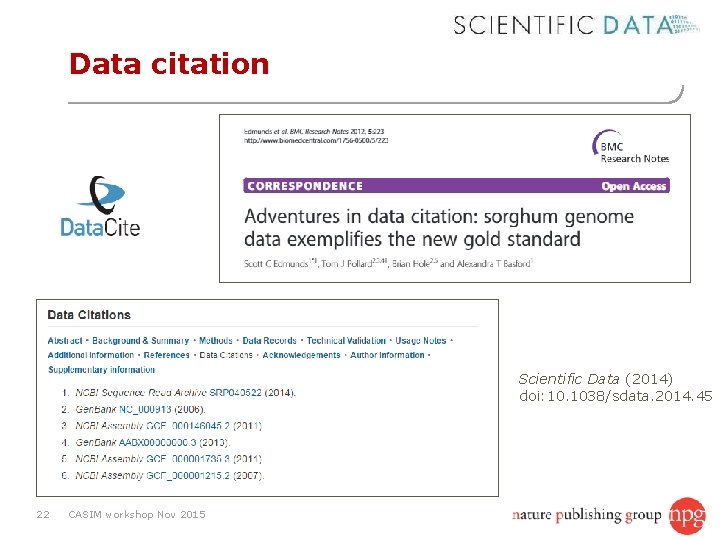
Data citation Scientific Data (2014) doi: 10. 1038/sdata. 2014. 45 22 CASIM workshop Nov 2015
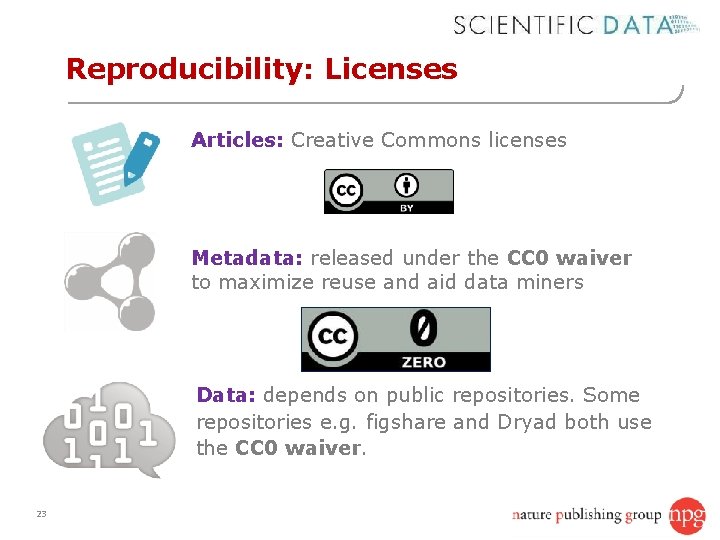
Reproducibility: Licenses Articles: Creative Commons licenses Metadata: released under the CC 0 waiver to maximize reuse and aid data miners Data: depends on public repositories. Some repositories e. g. figshare and Dryad both use the CC 0 waiver. 23
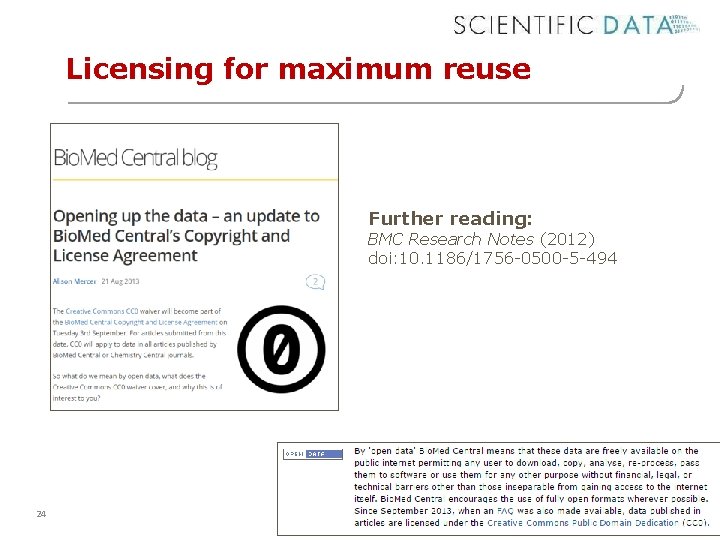
Licensing for maximum reuse Further reading: BMC Research Notes (2012) doi: 10. 1186/1756 -0500 -5 -494 24
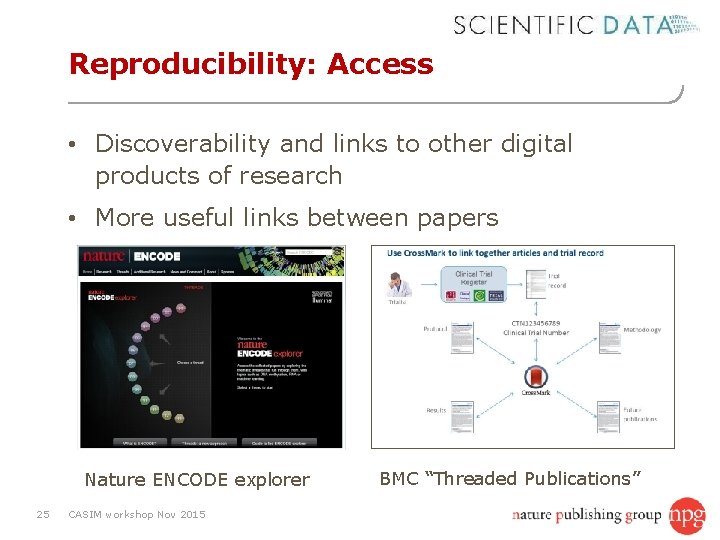
Reproducibility: Access • Discoverability and links to other digital products of research • More useful links between papers Nature ENCODE explorer 25 CASIM workshop Nov 2015 BMC “Threaded Publications”
Reproducibility: Reliability/quality Peer review at Scientific Data focuses on: • Completeness (can others reproduce? ) • Consistency (were community standards followed? ) • Integrity (are data in the best repository? ) • Experimental rigour and technical quality (were the methods sound? ) Does not focus on: • Perceived impact/importance • Size/complexity of data 26
Reproducibility: Innovation • Collaboration between publishers and software/tools for science • Connect doing with communicating • Data and article submission integration (figshare, Dryad) • Various publisher-repository partnerships 27
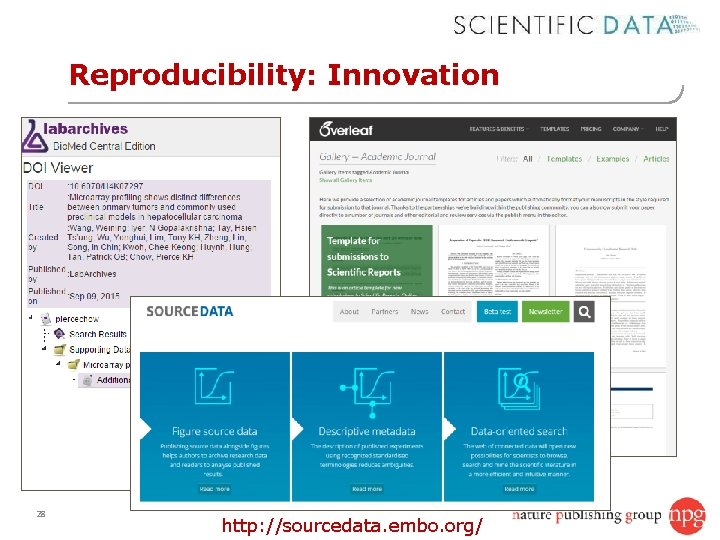
Reproducibility: Innovation 28 http: //sourcedata. embo. org/
Thank you for listening Iain Hrynaszkiewicz Head of Data and HSS Publishing, Open Research Nature Publishing Group & Palgrave Macmillan iain. hrynaszkiewicz@nature. com @iainh_z
- Slides: 29