
THE ROLE OF INTANGIBLES FOR PRODUCTIVITY DISPERSION Alexander

THE ROLE OF INTANGIBLES FOR PRODUCTIVITY DISPERSION Alexander HIMBERT (OECD/STI) joint with Carol Corrado (The Conference Board), Chiara Criscuolo (OECD/STI), Jonathan Haskel (Imperial College and the Bank of England) and Cecilia Jona. Lasinio (ISTAT and LUISS University)
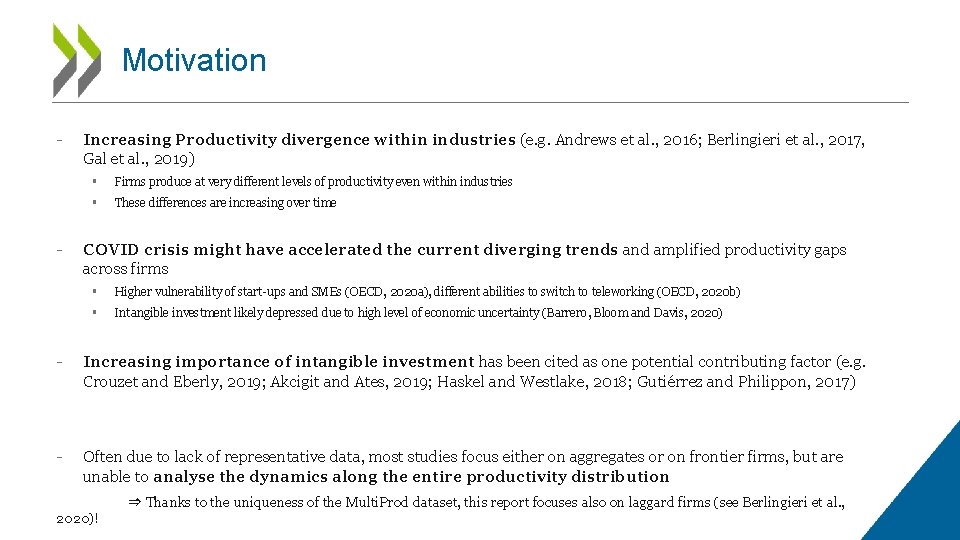
Motivation - - Increasing Productivity divergence within industries (e. g. Andrews et al. , 2016; Berlingieri et al. , 2017, Gal et al. , 2019) § Firms produce at very different levels of productivity even within industries § These differences are increasing over time COVID crisis might have accelerated the current diverging trends and amplified productivity gaps across firms § Higher vulnerability of start-ups and SMEs (OECD, 2020 a), different abilities to switch to teleworking (OECD, 2020 b) § Intangible investment likely depressed due to high level of economic uncertainty (Barrero, Bloom and Davis, 2020) - Increasing importance of intangible investment has been cited as one potential contributing factor (e. g. Crouzet and Eberly, 2019; Akcigit and Ates, 2019; Haskel and Westlake, 2018; Gutiérrez and Philippon, 2017) - Often due to lack of representative data, most studies focus either on aggregates or on frontier firms, but are unable to analyse the dynamics along the entire productivity distribution ⇒ Thanks to the uniqueness of the Multi. Prod dataset, this report focuses also on laggard firms (see Berlingieri et al. , 2020)!
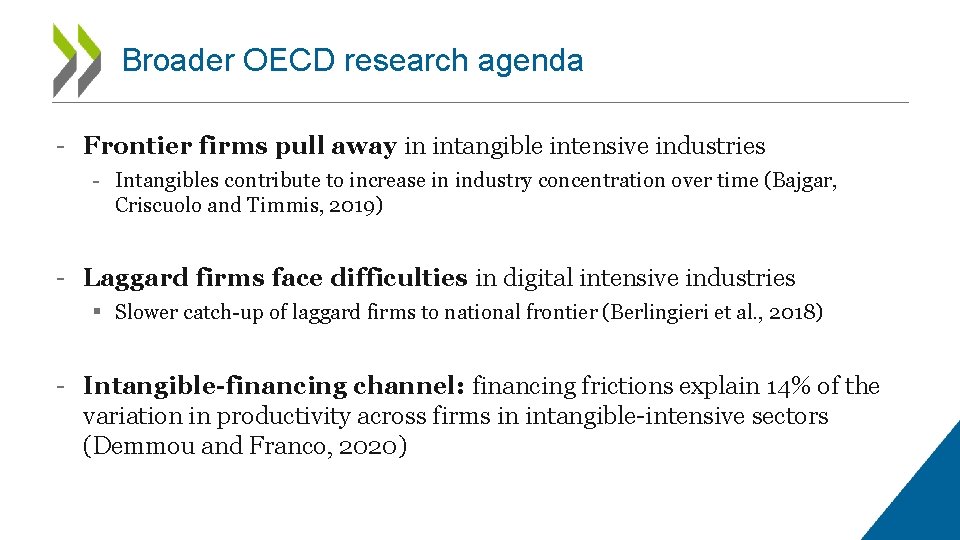
Broader OECD research agenda - Frontier firms pull away in intangible intensive industries - Intangibles contribute to increase in industry concentration over time (Bajgar, Criscuolo and Timmis, 2019) - Laggard firms face difficulties in digital intensive industries § Slower catch-up of laggard firms to national frontier (Berlingieri et al. , 2018) - Intangible-financing channel: financing frictions explain 14% of the variation in productivity across firms in intangible-intensive sectors (Demmou and Franco, 2020)
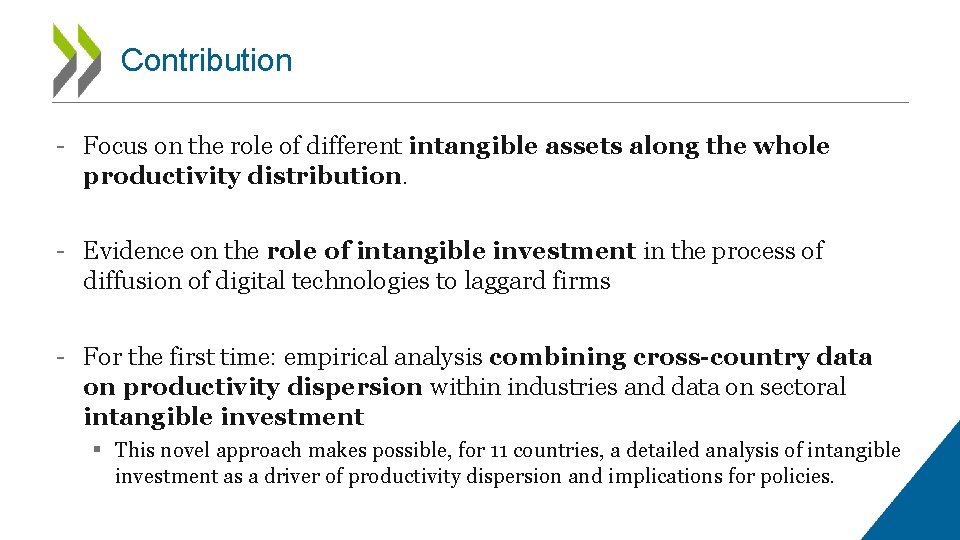
Contribution - Focus on the role of different intangible assets along the whole productivity distribution. - Evidence on the role of intangible investment in the process of diffusion of digital technologies to laggard firms - For the first time: empirical analysis combining cross-country data on productivity dispersion within industries and data on sectoral intangible investment § This novel approach makes possible, for 11 countries, a detailed analysis of intangible investment as a driver of productivity dispersion and implications for policies.
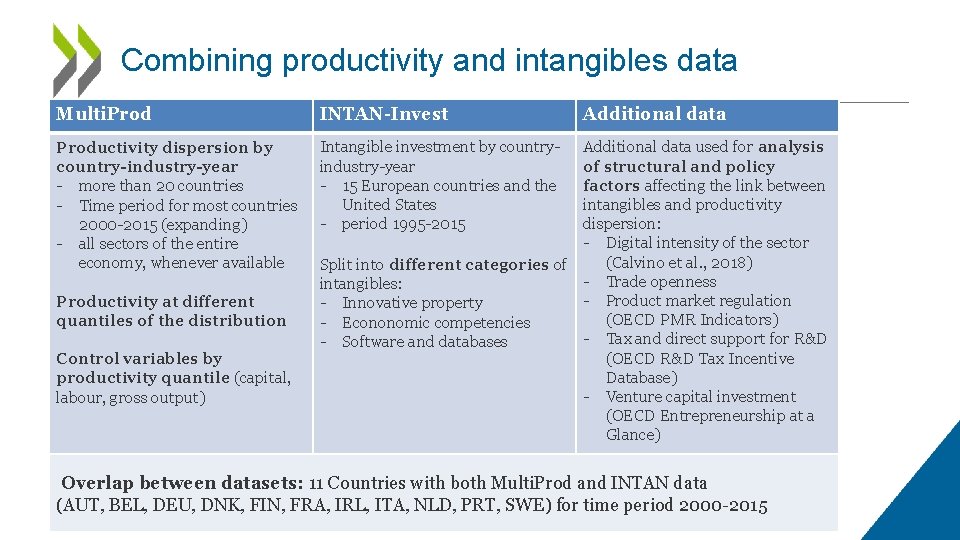
Combining productivity and intangibles data Multi. Prod INTAN-Invest Productivity dispersion by country-industry-year - more than 20 countries - Time period for most countries 2000 -2015 (expanding) - all sectors of the entire economy, whenever available Intangible investment by countryindustry-year - 15 European countries and the United States - period 1995 -2015 Productivity at different quantiles of the distribution Control variables by productivity quantile (capital, labour, gross output) Additional data used for analysis of structural and policy factors affecting the link between intangibles and productivity dispersion: - Digital intensity of the sector (Calvino et al. , 2018) Split into different categories of - Trade openness intangibles: - Product market regulation - Innovative property (OECD PMR Indicators) - Econonomic competencies - Tax and direct support for R&D - Software and databases (OECD R&D Tax Incentive Database) - Venture capital investment (OECD Entrepreneurship at a Glance) Overlap between datasets: 11 Countries with both Multi. Prod and INTAN data (AUT, BEL, DEU, DNK, FIN, FRA, IRL, ITA, NLD, PRT, SWE) for time period 2000 -2015
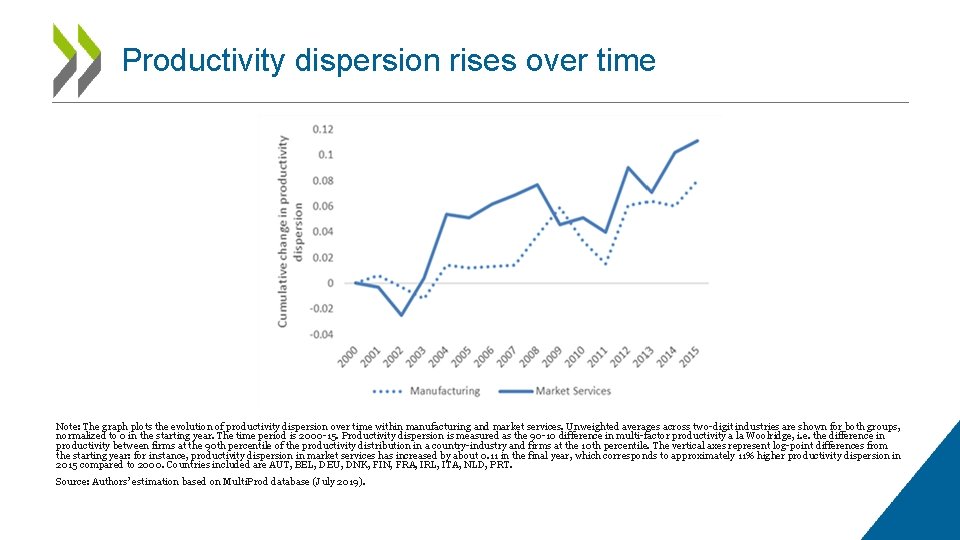
Productivity dispersion rises over time Note: The graph plots the evolution of productivity dispersion over time within manufacturing and market services. Unweighted averages across two-digit industries are shown for both groups, normalized to 0 in the starting year. The time period is 2000 -15. Productivity dispersion is measured as the 90 -10 difference in multi-factor productivity a la Woolridge, i. e. the difference in productivity between firms at the 90 th percentile of the productivity distribution in a country-industry and firms at the 10 th percentile. The vertical axes represent log-point differences from the starting year: for instance, productivity dispersion in market services has increased by about 0. 11 in the final year, which corresponds to approximately 11% higher productivity dispersion in 2015 compared to 2000. Countries included are AUT, BEL, DEU, DNK, FIN, FRA, IRL, ITA, NLD, PRT. Source: Authors’ estimation based on Multi. Prod database (July 2019).

Evolution of intangible investment intensity Note: The graph plots the evolution of intangible investment intensity (defined as intangible investment divided by gross output) for manufacturing and market services, normalized to the base year 2000. The time period is 2000 -15. Countries included are AUT, BEL, DEU, DNK, FIN, FRA, IRL, ITA, NLD, PRT. Source: Authors’ estimations based on Multi. Prod database (November 2019) and INTAN-Invest database.
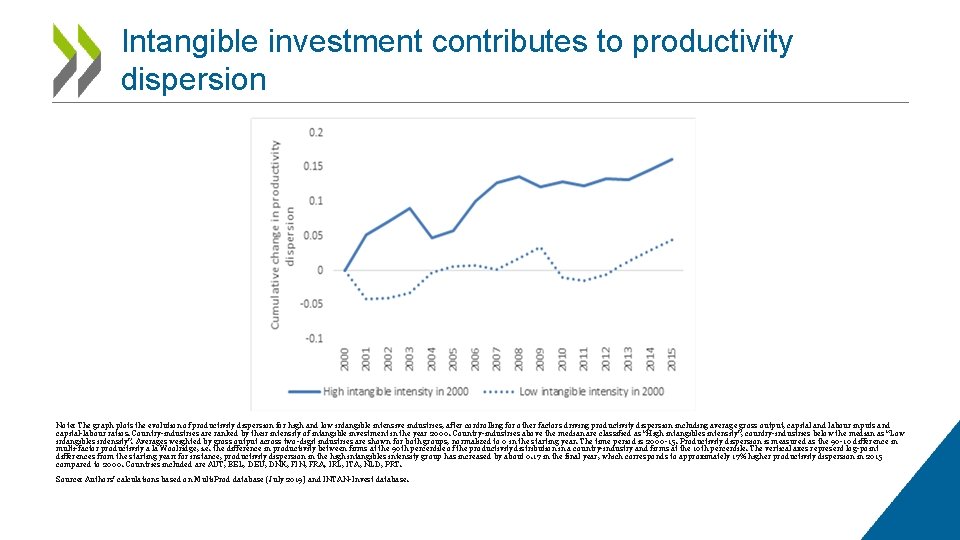
Intangible investment contributes to productivity dispersion Note: The graph plots the evolution of productivity dispersion for high and low intangible intensive industries, after controlling for other factors driving productivity dispersion including average gross output, capital and labour inputs and capital-labour ratios. Country-industries are ranked by their intensity of intangible investment in the year 2000. Country-industries above the median are classified as “High intangibles intensity”, country-industries below the median as “Low intangibles intensity”. Averages weighted by gross output across two-digit industries are shown for both groups, normalized to 0 in the starting year. The time period is 2000 -15. Productivity dispersion is measured as the 90 -10 difference in multi-factor productivity a la Woolridge, i. e. the difference in productivity between firms at the 90 th percentile of the productivity distribution in a country-industry and firms at the 10 th percentile. The vertical axes represent log-point differences from the starting year: for instance, productivity dispersion in the high intangibles intensity group has increased by about 0. 17 in the final year, which corresponds to approximately 17% higher productivity dispersion in 2015 compared to 2000. Countries included are AUT, BEL, DEU, DNK, FIN, FRA, IRL, ITA, NLD, PRT. Source: Authors’ calculations based on Multi. Prod database (July 2019) and INTAN-Invest database.
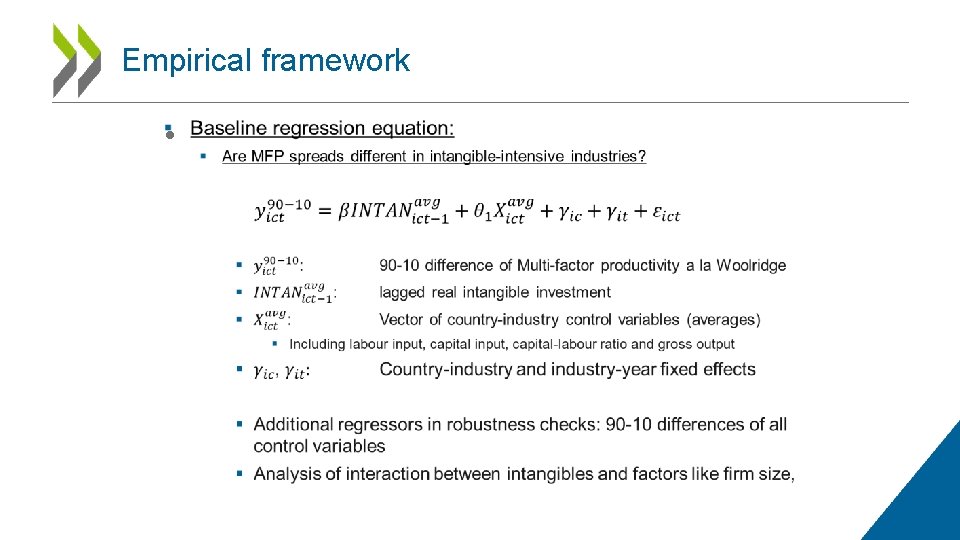
Empirical framework •
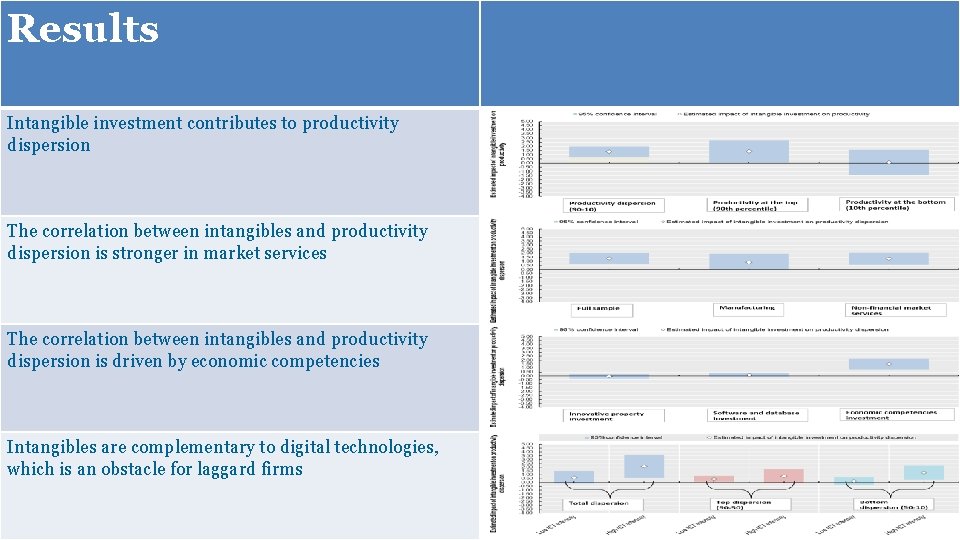
Results Intangible investment contributes to productivity dispersion The correlation between intangibles and productivity dispersion is stronger in market services The correlation between intangibles and productivity dispersion is driven by economic competencies Intangibles are complementary to digital technologies, which is an obstacle for laggard firms
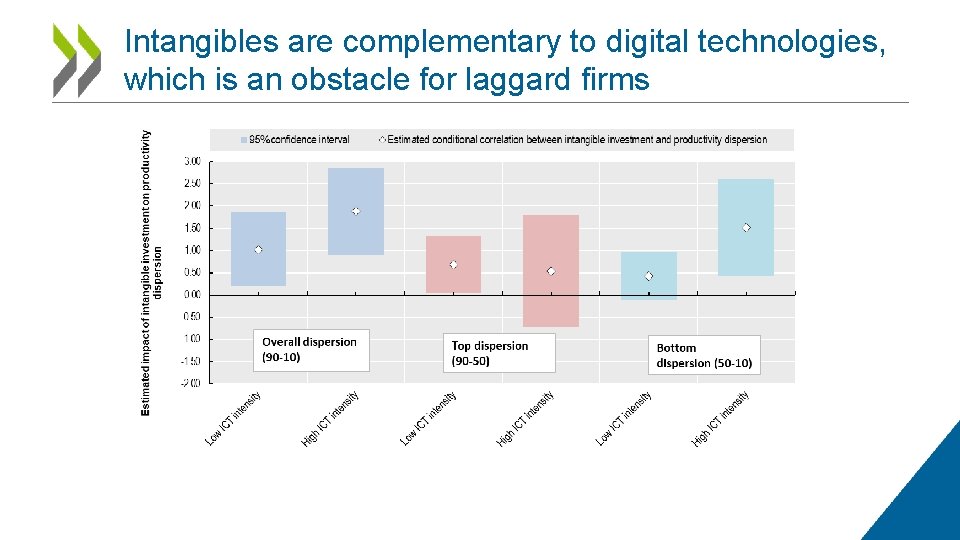
Intangibles are complementary to digital technologies, which is an obstacle for laggard firms
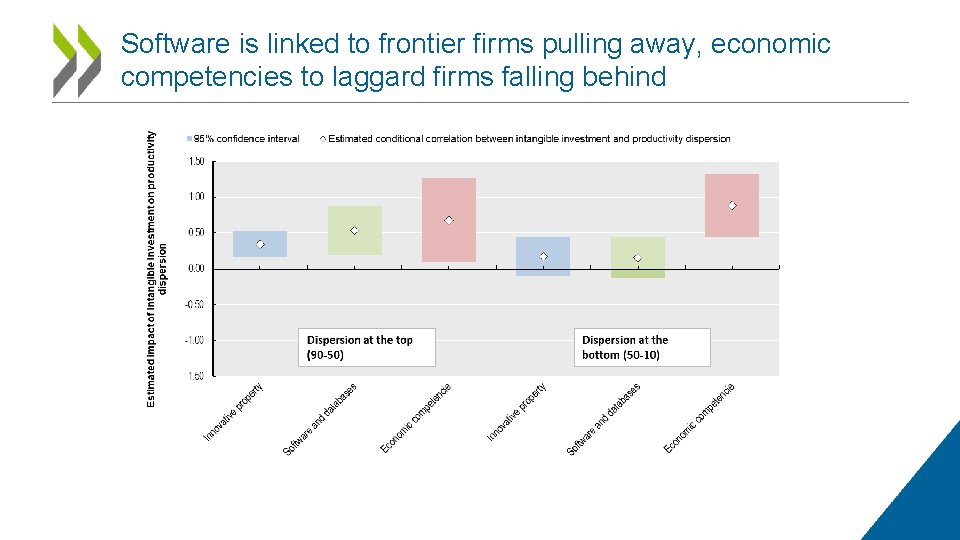
Software is linked to frontier firms pulling away, economic competencies to laggard firms falling behind
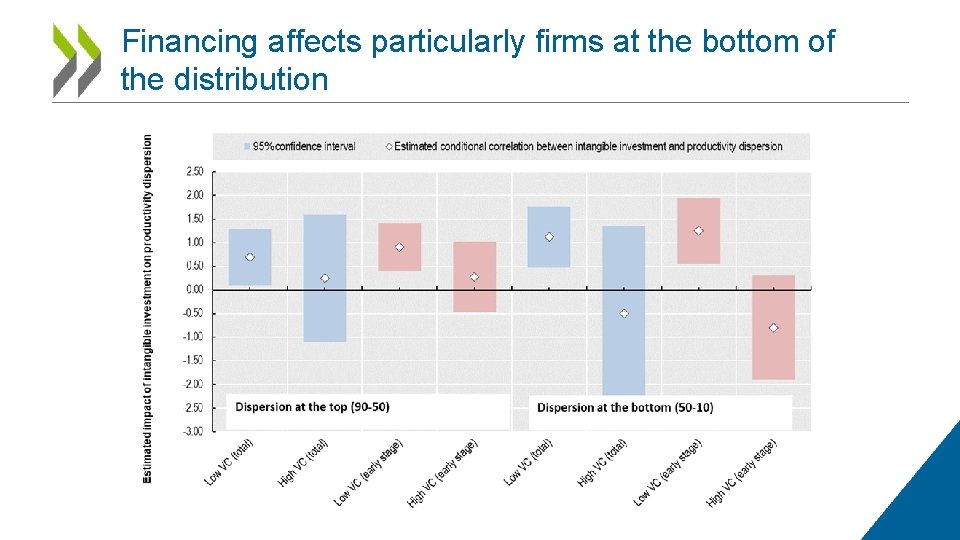
Financing affects particularly firms at the bottom of the distribution
Takeaways and Policy Conclusions (1) - Laggard firms face difficulties in financing needed intangible capital and can therefore not reap the full benefit of digital technologies Importance of policy to level the playing field! - Different types of intangible capital affect different parts of the productivity distribution - Lack of economic competencies leads to laggards falling behind - Investment in innovative property and software and databases leads to frontier firms pulling away (i. e. higher market concentration, with few firms benefitting) Importance of regulations (software inter operability and data portability, transparent IP)
Takeaways and Policy Conclusions (2): financing of intangible asset - Venture capital markets particularly suited for start-up firms strongly relying on intangibles (Haskel and Westlake, 2017) - Link between intangibles and dispersion less pronounced when venture capital is easily available - Provision of funds by stage reduces uncertainty for investors - Improve pledgeability of intangible capital - Firms under financial constraints give preference to pledgeable assets (Munro and Lamb, 2020, Paunov and Planes-Satorra, 2020) - IP backed loans in several countries (see Demmou and Franco, 2020) - Problem of availability of secondary market - Tailored government support for start-ups and SMEs investing in intangible assets - Examples: fund to support start-up liquidity in France, tailored start-up aid programme in Germany, cofinancing fund for innovative companies facing financial difficulties in the UK (Calvino et al. , 2020)
Takeaways and Policy Conclusions (3): regulatory framework - Competition policy can create incentives to improve management and efficiency thus increasing investment in organisational capital (see Hao and Haskel, 2011) - Economic competencies and organizational capital drive most of the correlation between intangibles and productivity dispersion - Including software interoperability as a criterion government procurement processes - Effective IPR legislation to stimulate intangible investment (Guo-Fitoussi et al. , 2019)

THANK YOU! All comments and questions are welcome
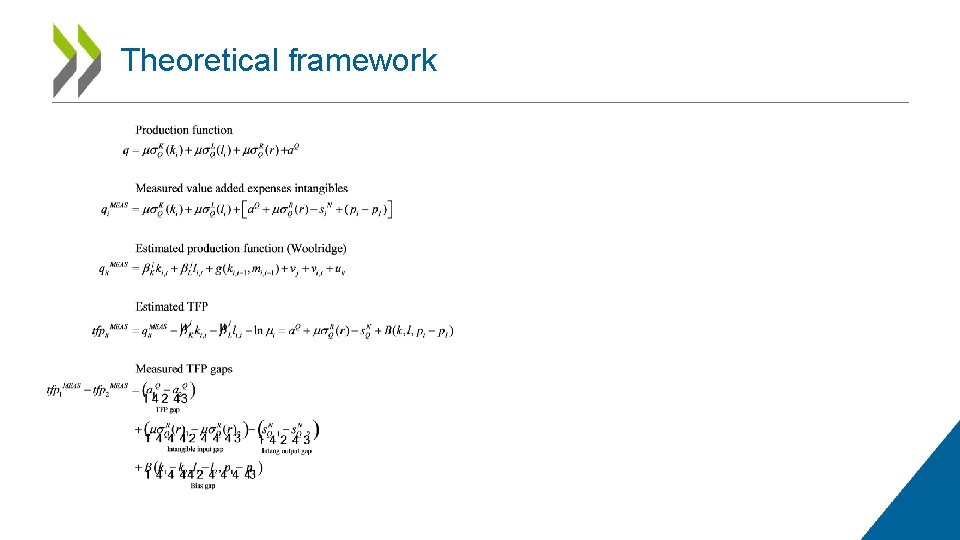
Theoretical framework
- Slides: 18