
The role of insectary plants in promoting pest
- Slides: 1
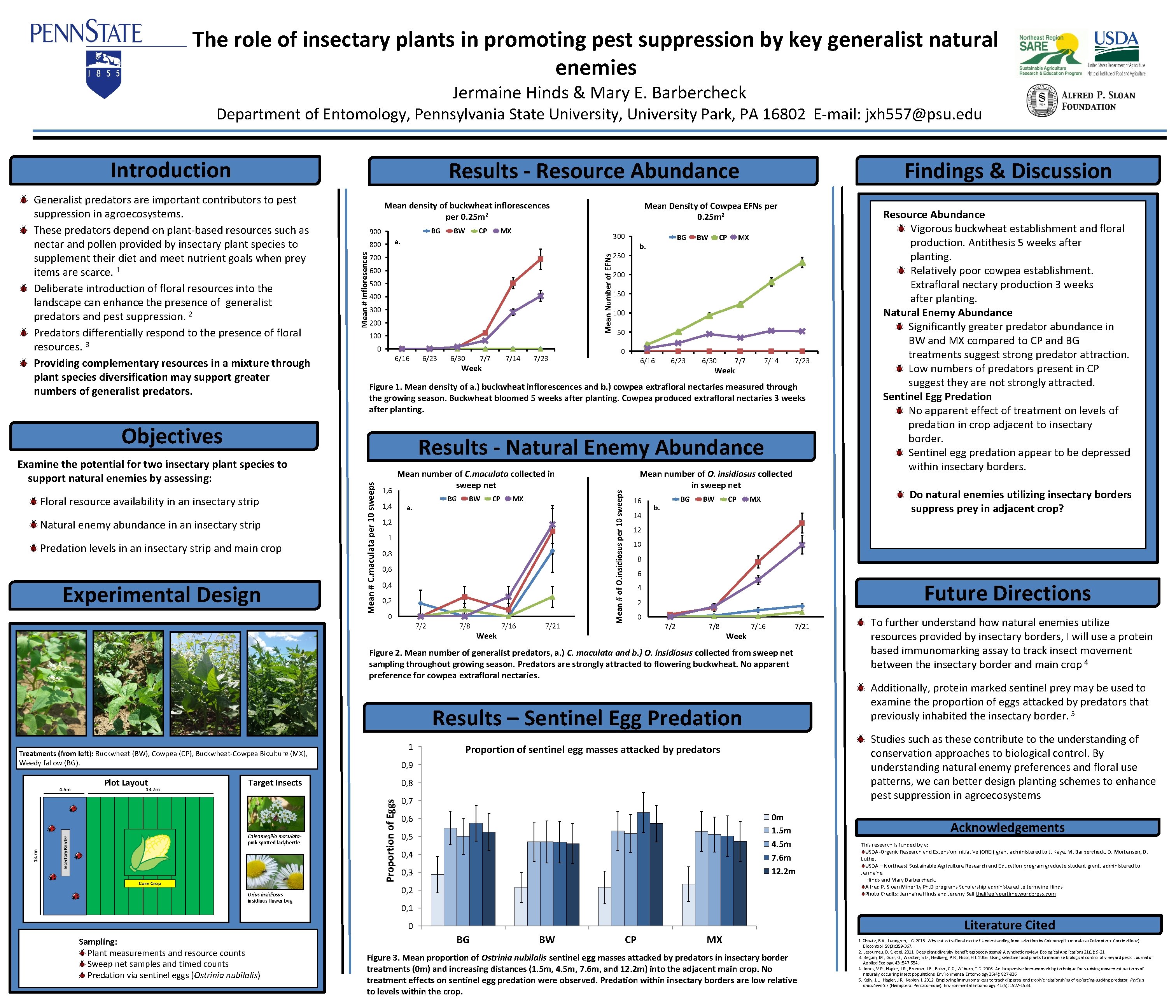
The role of insectary plants in promoting pest suppression by key generalist natural enemies Jermaine Hinds & Mary E. Barbercheck Department of Entomology, Pennsylvania State University, University Park, PA 16802 E-mail: jxh 557@psu. edu Introduction Findings & Discussion Results - Resource Abundance Mean density of buckwheat inflorescences per 0. 25 m 2 BG 900 Predation levels in an insectary strip and main crop Experimental Design 300 Mean Number of EFNs 500 400 300 200 100 0 6/16 6/23 6/30 7/7 7/14 Week 7/23 BG b. 250 BW CP MX 200 150 100 50 0 6/16 6/23 6/30 7/7 7/14 Week 7/23 Figure 1. Mean density of a. ) buckwheat inflorescences and b. ) cowpea extrafloral nectaries measured through the growing season. Buckwheat bloomed 5 weeks after planting. Cowpea produced extrafloral nectaries 3 weeks after planting. Results - Natural Enemy Abundance 1, 6 1, 4 Mean number of C. maculata collected in sweep net BG a. BW CP MX 1, 2 1 0, 8 0, 6 0, 4 0, 2 0 7/2 7/8 Week 7/16 7/21 Mean # of O. insidiosus per 10 sweeps Natural enemy abundance in an insectary strip MX 600 Mean # C. maculata per 10 sweeps Floral resource availability in an insectary strip CP 700 Objectives Examine the potential for two insectary plant species to support natural enemies by assessing: BW Mean Density of Cowpea EFNs per 0. 25 m 2 a. 800 Mean # Infloresences Generalist predators are important contributors to pest suppression in agroecosystems. These predators depend on plant-based resources such as nectar and pollen provided by insectary plant species to supplement their diet and meet nutrient goals when prey items are scarce. 1 Deliberate introduction of floral resources into the landscape can enhance the presence of generalist predators and pest suppression. 2 Predators differentially respond to the presence of floral resources. 3 Providing complementary resources in a mixture through plant species diversification may support greater numbers of generalist predators. Mean number of O. insidiosus collected in sweep net 16 14 BG b. BW CP Do natural enemies utilizing insectary borders suppress prey in adjacent crop? MX 12 10 8 6 Future Directions 4 2 0 7/2 7/8 Week 7/16 7/21 Figure 2. Mean number of generalist predators, a. ) C. maculata and b. ) O. insidiosus collected from sweep net sampling throughout growing season. Predators are strongly attracted to flowering buckwheat. No apparent preference for cowpea extrafloral nectaries. Results – Sentinel Egg Predation 1 Treatments (from left): Buckwheat (BW), Cowpea (CP), Buckwheat-Cowpea Biculture (MX), Weedy fallow (BG). Target Insects Coleomegilla maculatapink spotted ladybeetle Orius insidiosus insidious flower bug Proportion of sentinel egg masses attacked by predators 0, 8 0, 7 0 m 1. 5 m 4. 5 m 7. 6 m 12. 2 m 0, 6 0, 5 0, 4 0, 3 0, 2 Additionally, protein marked sentinel prey may be used to examine the proportion of eggs attacked by predators that previously inhabited the insectary border. 5 Acknowledgements This research is funded by a: USDA-Organic Research and Extension Initiative (OREI) grant administered to J. Kaye, M. Barbercheck, D. Mortensen, D. Luthe. USDA – Northeast Sustainable Agriculture Research and Education program graduate student grant. administered to Jermaine Hinds and Mary Barbercheck. Alfred P. Sloan Minority Ph. D programs Scholarship administered to Jermaine Hinds Photo Credits: Jermaine Hinds and Jeremy Sell thelifeofyourtime. wordpress. com 0, 1 0 Sampling: Plant measurements and resource counts Sweep net samples and timed counts Predation via sentinel eggs (Ostrinia nubilalis) To further understand how natural enemies utilize resources provided by insectary borders, I will use a protein based immunomarking assay to track insect movement between the insectary border and main crop 4 Studies such as these contribute to the understanding of conservation approaches to biological control. By understanding natural enemy preferences and floral use patterns, we can better design planting schemes to enhance pest suppression in agroecosystems 0, 9 Proportion of Eggs Plot Layout Resource Abundance Vigorous buckwheat establishment and floral production. Antithesis 5 weeks after planting. Relatively poor cowpea establishment. Extrafloral nectary production 3 weeks after planting. Natural Enemy Abundance Significantly greater predator abundance in BW and MX compared to CP and BG treatments suggest strong predator attraction. Low numbers of predators present in CP suggest they are not strongly attracted. Sentinel Egg Predation No apparent effect of treatment on levels of predation in crop adjacent to insectary border. Sentinel egg predation appear to be depressed within insectary borders. BG BW CP MX Figure 3. Mean proportion of Ostrinia nubilalis sentinel egg masses attacked by predators in insectary border treatments (0 m) and increasing distances (1. 5 m, 4. 5 m, 7. 6 m, and 12. 2 m) into the adjacent main crop. No treatment effects on sentinel egg predation were observed. Predation within insectary borders are low relative to levels within the crop. Literature Cited 1. Choate, B. A. , Lundgren, J. G. 2013. Why eat extra floral nectar? Understanding food selection by Coleomegilla maculata (Coleoptera: Coccinellidae). Biocontrol. 58(3): 359 -367. 2. Letourneu, D. K, et al. 2011. Does plant diversity benefit agroecosystems? A synthetic review. Ecological Applications 21(1): 9 -21. 3. Begum, M. , Gurr, G. , Wratten, S. D. , Hedberg, P. R. , Nicol, H. I. 2006. Using selective food plants to maximize biological control of vineyard pests. Journal of Applied Ecology. 43: 547 -554. 4. Jones, V. P. , Hagler, J. R. , Brunner, J. F. , Baker, C. C. , Wilburn, T. D. 2006. An inexpensive immunomarking technique for studying movement patterns of naturally occurring insect populations. Environmental Entomology 35(4): 827 -836 5. Kelly, J. L. , Hagler, J. R. , Kaplan, I. 2012. Employing immunomarkers to track dispersal and trophic relationships of a piercing-sucking predator, Podisus maculiventris (Hemiptera: Pentatomidae). Environmental Entomology. 41(6): 1527 -1533.