
THE ROLE OF GNSS IN MODERN REFERENCE FRAMES

- Slides: 27
THE ROLE OF GNSS IN MODERN REFERENCE FRAMES • GNSS replacing classical methods on non-local scales – new space-based reference frame paradigm driven by major technology advances • GNSS now dominates International Terrestrial Reference Frame (ITRF) combination – only technique that gives autonomous user access to global frame – but some GNSS datum weaknesses remain • Easy user access to reference frame enables many applications – example of studying surface pressure loads discussed Jim Ray, NOAA/National Geodetic Survey China Satellite Navigation Conference, Wuhan, China, 15 May 2013
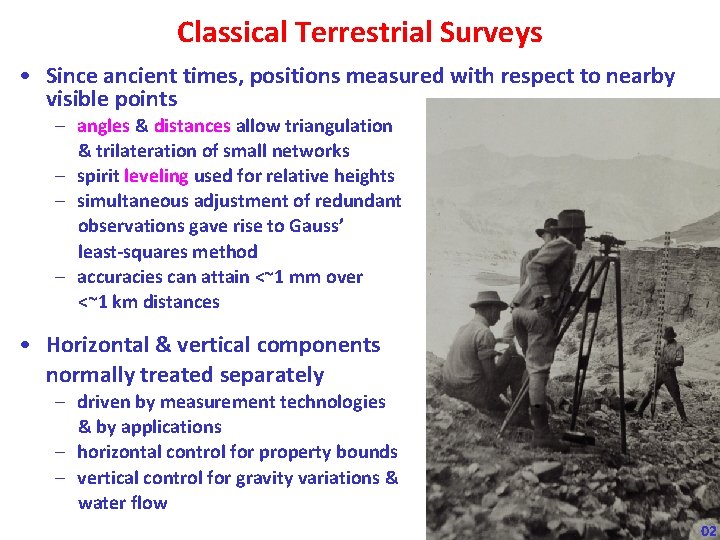
Classical Terrestrial Surveys • Since ancient times, positions measured with respect to nearby visible points – angles & distances allow triangulation & trilateration of small networks – spirit leveling used for relative heights – simultaneous adjustment of redundant observations gave rise to Gauss’ least-squares method – accuracies can attain <~1 mm over <~1 km distances • Horizontal & vertical components normally treated separately – driven by measurement technologies & by applications – horizontal control for property bounds – vertical control for gravity variations & water flow 02
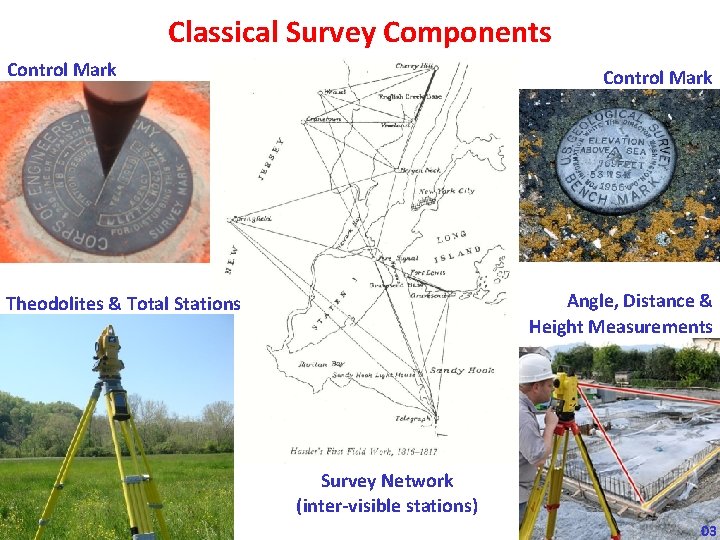
Classical Survey Components Control Mark Angle, Distance & Height Measurements Theodolites & Total Stations Survey Network (inter-visible stations) 03
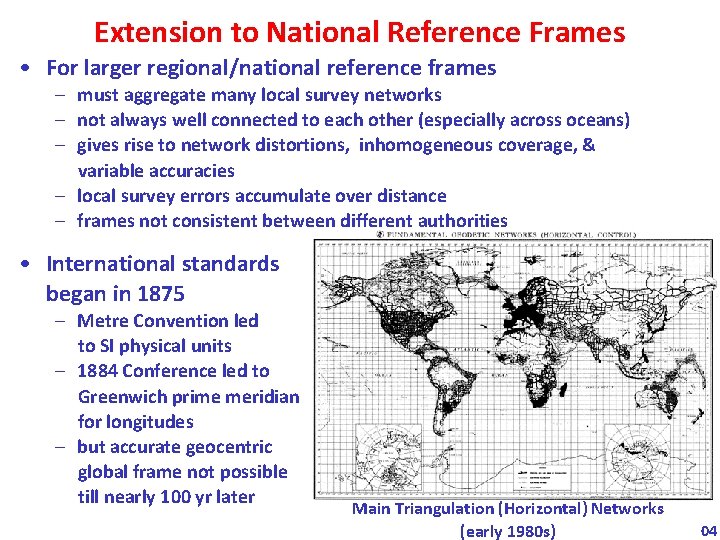
Extension to National Reference Frames • For larger regional/national reference frames – must aggregate many local survey networks – not always well connected to each other (especially across oceans) – gives rise to network distortions, inhomogeneous coverage, & variable accuracies – local survey errors accumulate over distance – frames not consistent between different authorities • International standards began in 1875 – Metre Convention led to SI physical units – 1884 Conference led to Greenwich prime meridian for longitudes – but accurate geocentric global frame not possible till nearly 100 yr later Main Triangulation (Horizontal) Networks (early 1980 s) 04
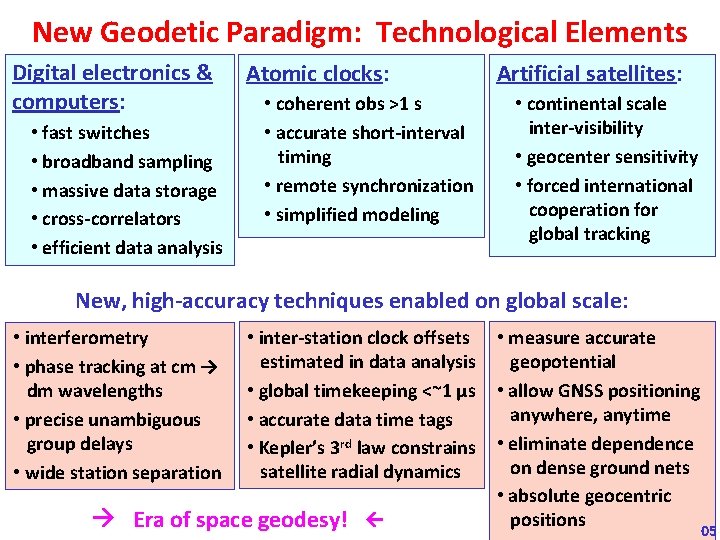
New Geodetic Paradigm: Technological Elements Digital electronics & computers: • fast switches • broadband sampling • massive data storage • cross-correlators • efficient data analysis Atomic clocks: • coherent obs >1 s • accurate short-interval timing • remote synchronization • simplified modeling Artificial satellites: • continental scale inter-visibility • geocenter sensitivity • forced international cooperation for global tracking New, high-accuracy techniques enabled on global scale: • inter-station clock offsets • measure accurate estimated in data analysis geopotential • global timekeeping <~1 µs • allow GNSS positioning anywhere, anytime • accurate data time tags • Kepler’s 3 rd law constrains • eliminate dependence on dense ground nets satellite radial dynamics • absolute geocentric positions Era of space geodesy! 05 • interferometry • phase tracking at cm → dm wavelengths • precise unambiguous group delays • wide station separation
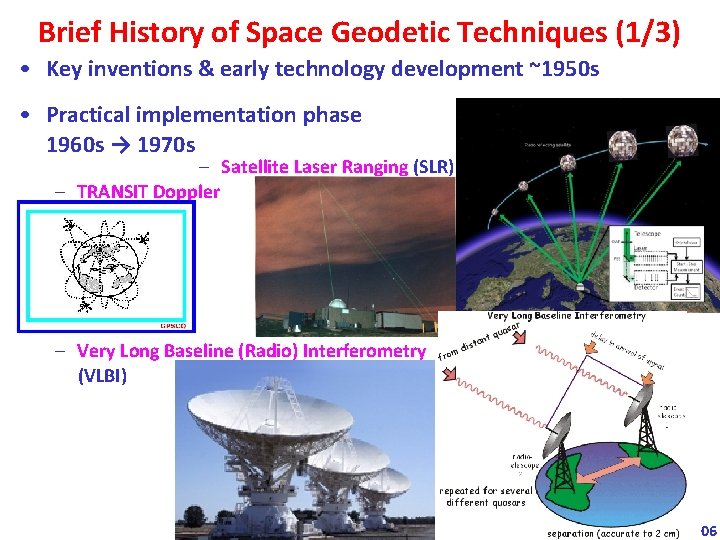
Brief History of Space Geodetic Techniques (1/3) • Key inventions & early technology development ~1950 s • Practical implementation phase 1960 s → 1970 s – Satellite Laser Ranging (SLR) – TRANSIT Doppler – Very Long Baseline (Radio) Interferometry (VLBI) 06
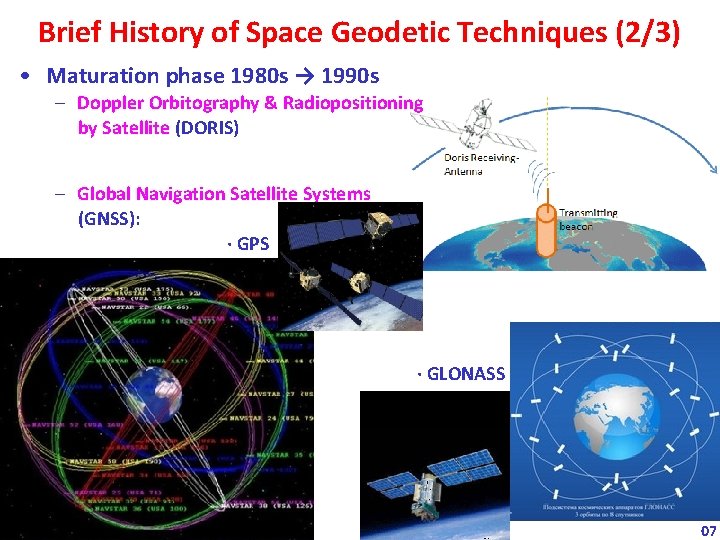
Brief History of Space Geodetic Techniques (2/3) • Maturation phase 1980 s → 1990 s – Doppler Orbitography & Radiopositioning by Satellite (DORIS) – Global Navigation Satellite Systems (GNSS): · GPS · GLONASS 07
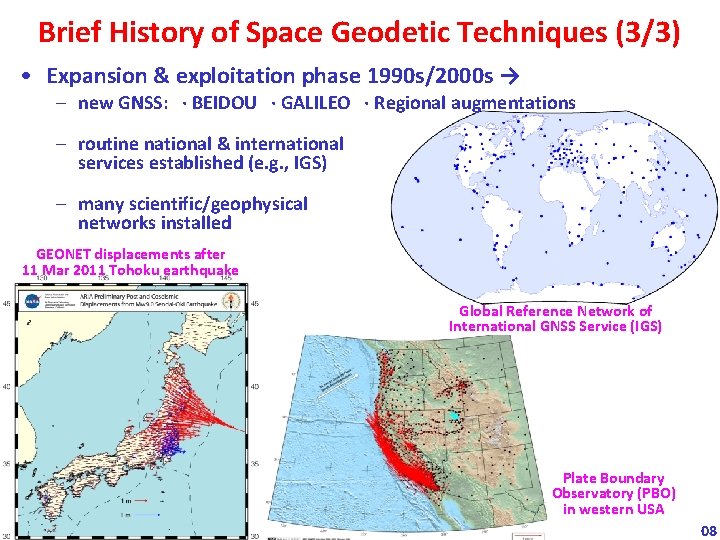
Brief History of Space Geodetic Techniques (3/3) • Expansion & exploitation phase 1990 s/2000 s → – new GNSS: · BEIDOU · GALILEO · Regional augmentations – routine national & international services established (e. g. , IGS) – many scientific/geophysical networks installed GEONET displacements after 11 Mar 2011 Tohoku earthquake Global Reference Network of International GNSS Service (IGS) Plate Boundary Observatory (PBO) in western USA 08
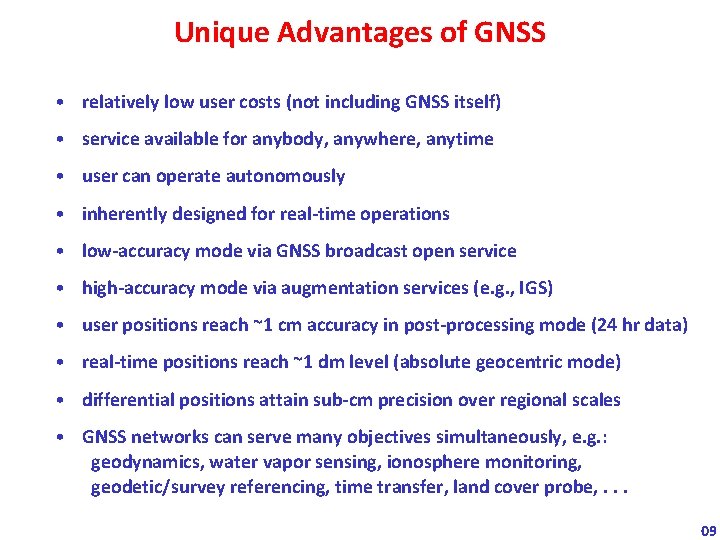
Unique Advantages of GNSS • relatively low user costs (not including GNSS itself) • service available for anybody, anywhere, anytime • user can operate autonomously • inherently designed for real-time operations • low-accuracy mode via GNSS broadcast open service • high-accuracy mode via augmentation services (e. g. , IGS) • user positions reach ~1 cm accuracy in post-processing mode (24 hr data) • real-time positions reach ~1 dm level (absolute geocentric mode) • differential positions attain sub-cm precision over regional scales • GNSS networks can serve many objectives simultaneously, e. g. : geodynamics, water vapor sensing, ionosphere monitoring, geodetic/survey referencing, time transfer, land cover probe, . . . 09
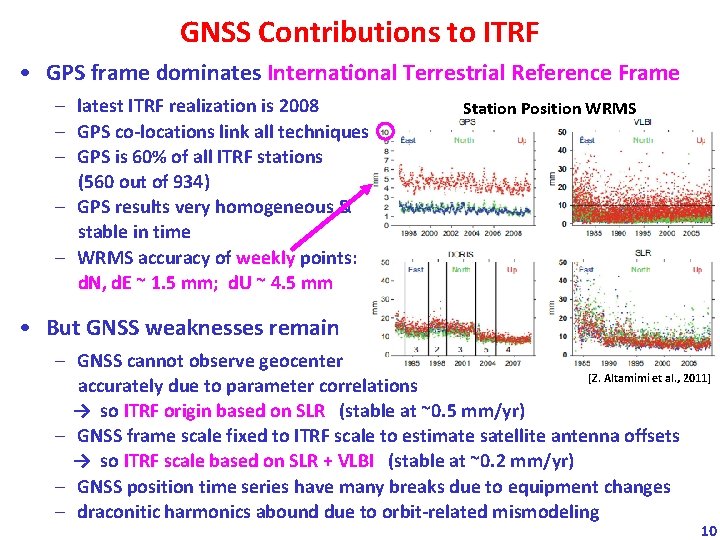
GNSS Contributions to ITRF • GPS frame dominates International Terrestrial Reference Frame – latest ITRF realization is 2008 – GPS co-locations link all techniques – GPS is 60% of all ITRF stations (560 out of 934) – GPS results very homogeneous & stable in time – WRMS accuracy of weekly points: d. N, d. E ~ 1. 5 mm; d. U ~ 4. 5 mm Station Position WRMS • But GNSS weaknesses remain – GNSS cannot observe geocenter [Z. Altamimi et al. , 2011] accurately due to parameter correlations → so ITRF origin based on SLR (stable at ~0. 5 mm/yr) – GNSS frame scale fixed to ITRF scale to estimate satellite antenna offsets → so ITRF scale based on SLR + VLBI (stable at ~0. 2 mm/yr) – GNSS position time series have many breaks due to equipment changes – draconitic harmonics abound due to orbit-related mismodeling 10
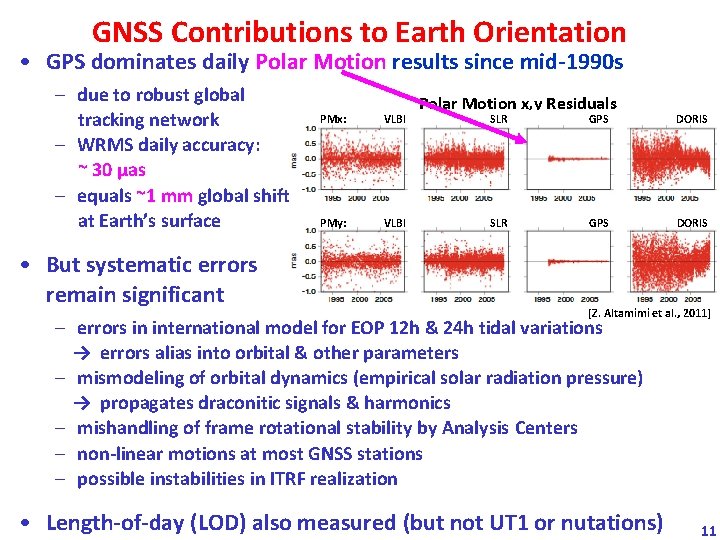
GNSS Contributions to Earth Orientation • GPS dominates daily Polar Motion results since mid-1990 s – due to robust global tracking network – WRMS daily accuracy: ~ 30 µas – equals ~1 mm global shift at Earth’s surface • But systematic errors remain significant PMx: VLBI PMy: VLBI Polar Motion x, y Residuals SLR GPS DORIS [Z. Altamimi et al. , 2011] – errors in international model for EOP 12 h & 24 h tidal variations → errors alias into orbital & other parameters – mismodeling of orbital dynamics (empirical solar radiation pressure) → propagates draconitic signals & harmonics – mishandling of frame rotational stability by Analysis Centers – non-linear motions at most GNSS stations – possible instabilities in ITRF realization • Length-of-day (LOD) also measured (but not UT 1 or nutations) 11
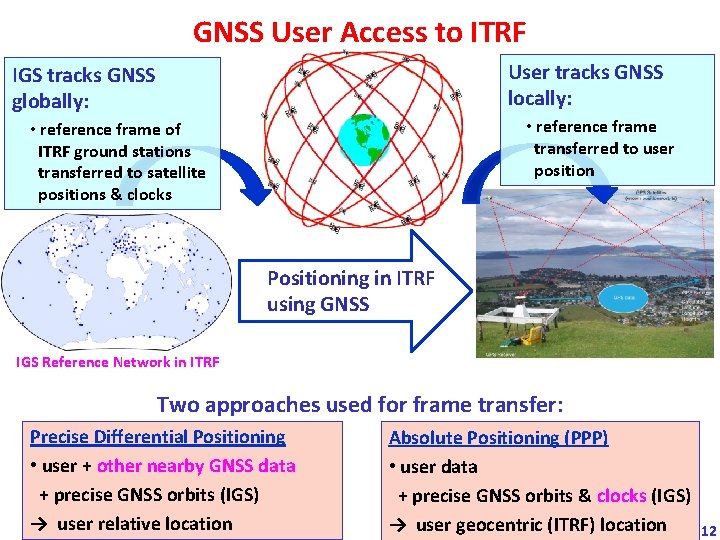
GNSS User Access to ITRF User tracks GNSS locally: IGS tracks GNSS globally: • reference frame transferred to user position • reference frame of ITRF ground stations transferred to satellite positions & clocks Positioning in ITRF using GNSS IGS Reference Network in ITRF Two approaches used for frame transfer: Precise Differential Positioning • user + other nearby GNSS data + precise GNSS orbits (IGS) → user relative location Absolute Positioning (PPP) • user data + precise GNSS orbits & clocks (IGS) → user geocentric (ITRF) location 12
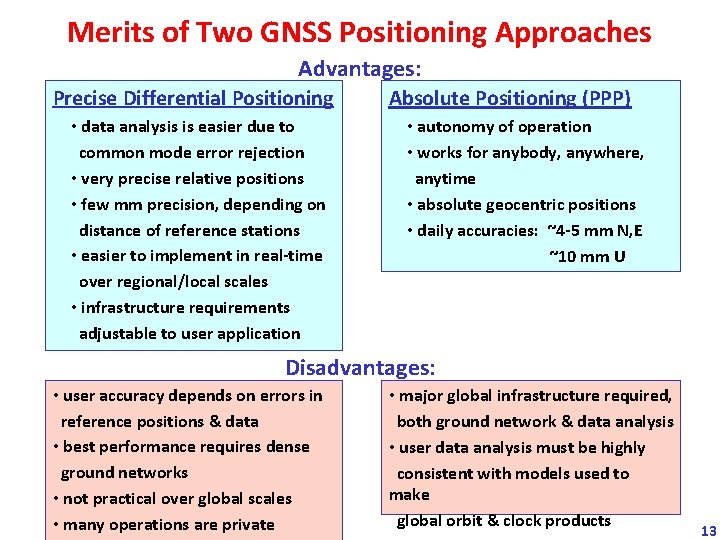
Merits of Two GNSS Positioning Approaches Advantages: Precise Differential Positioning • data analysis is easier due to common mode error rejection • very precise relative positions • few mm precision, depending on distance of reference stations • easier to implement in real-time over regional/local scales • infrastructure requirements adjustable to user application Absolute Positioning (PPP) • autonomy of operation • works for anybody, anywhere, anytime • absolute geocentric positions • daily accuracies: ~4 -5 mm N, E ~10 mm U Disadvantages: • user accuracy depends on errors in reference positions & data • best performance requires dense ground networks • not practical over global scales • many operations are private • major global infrastructure required, both ground network & data analysis • user data analysis must be highly consistent with models used to make global orbit & clock products 13
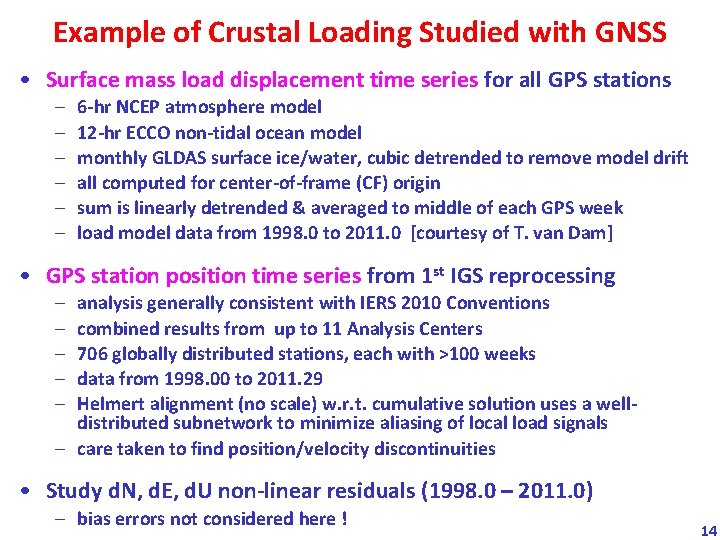
Example of Crustal Loading Studied with GNSS • Surface mass load displacement time series for all GPS stations – – – 6 -hr NCEP atmosphere model 12 -hr ECCO non-tidal ocean model monthly GLDAS surface ice/water, cubic detrended to remove model drift all computed for center-of-frame (CF) origin sum is linearly detrended & averaged to middle of each GPS week load model data from 1998. 0 to 2011. 0 [courtesy of T. van Dam] • GPS station position time series from 1 st IGS reprocessing – – – analysis generally consistent with IERS 2010 Conventions combined results from up to 11 Analysis Centers 706 globally distributed stations, each with >100 weeks data from 1998. 00 to 2011. 29 Helmert alignment (no scale) w. r. t. cumulative solution uses a welldistributed subnetwork to minimize aliasing of local load signals – care taken to find position/velocity discontinuities • Study d. N, d. E, d. U non-linear residuals (1998. 0 – 2011. 0) – bias errors not considered here ! 14
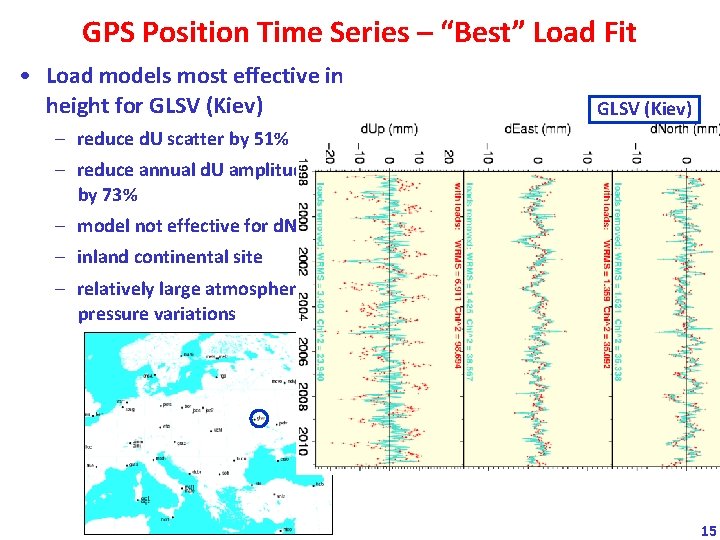
GPS Position Time Series – “Best” Load Fit • Load models most effective in height for GLSV (Kiev) – reduce d. U scatter by 51% – reduce annual d. U amplitude by 73% – model not effective for d. N, d. E – inland continental site – relatively large atmosphere pressure variations 15
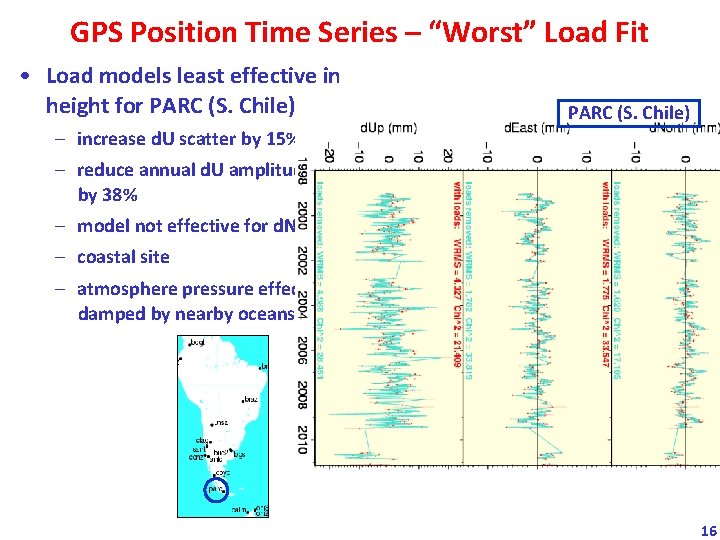
GPS Position Time Series – “Worst” Load Fit • Load models least effective in height for PARC (S. Chile) – increase d. U scatter by 15% – reduce annual d. U amplitude by 38% – model not effective for d. N, d. E – coastal site – atmosphere pressure effects damped by nearby oceans 16
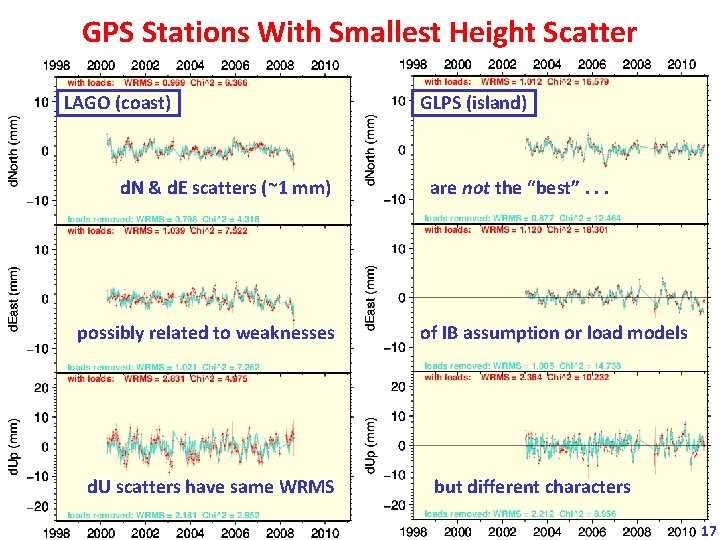
GPS Stations With Smallest Height Scatter LAGO (coast) d. N & d. E scatters (~1 mm) possibly related to weaknesses d. U scatters have same WRMS GLPS (island) are not the “best”. . . of IB assumption or load models but different characters 17
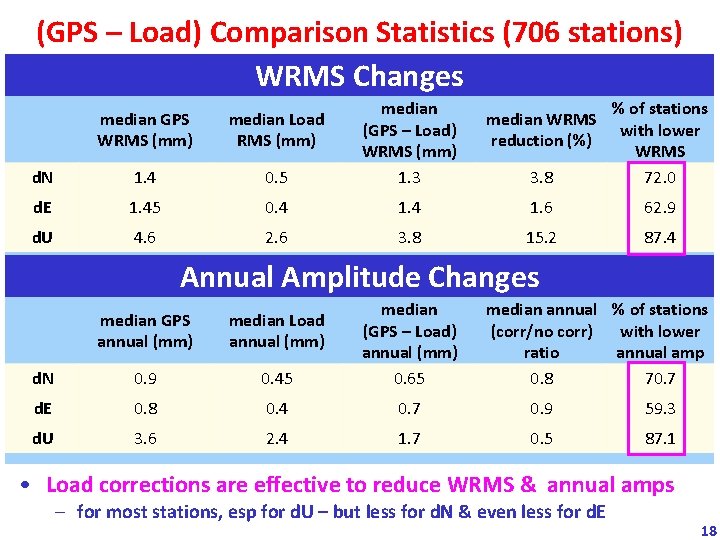
(GPS – Load) Comparison Statistics (706 stations) WRMS Changes median GPS WRMS (mm) median Load RMS (mm) d. N 1. 4 0. 5 median (GPS – Load) WRMS (mm) 1. 3 3. 8 % of stations with lower WRMS 72. 0 d. E 1. 45 0. 4 1. 6 62. 9 d. U 4. 6 2. 6 3. 8 15. 2 87. 4 median WRMS reduction (%) Annual Amplitude Changes median GPS annual (mm) median Load annual (mm) d. N 0. 9 0. 45 median (GPS – Load) annual (mm) 0. 65 median annual % of stations (corr/no corr) with lower ratio annual amp 0. 8 70. 7 d. E 0. 8 0. 4 0. 7 0. 9 59. 3 d. U 3. 6 2. 4 1. 7 0. 5 87. 1 • Load corrections are effective to reduce WRMS & annual amps – for most stations, esp for d. U – but less for d. N & even less for d. E 18
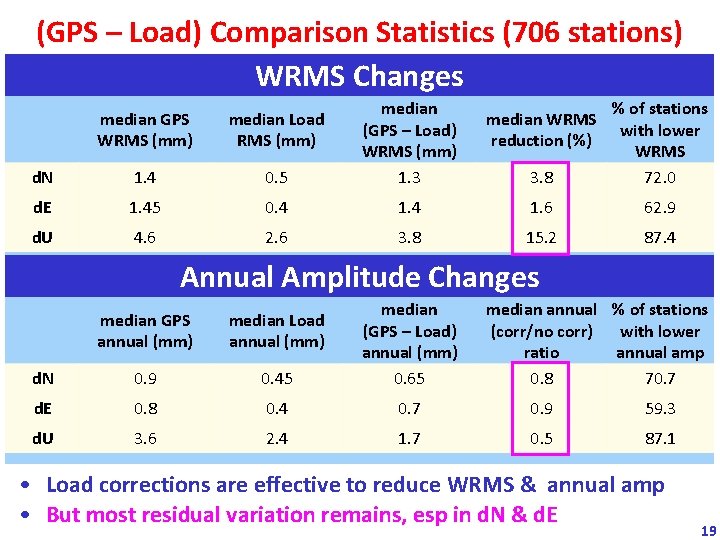
(GPS – Load) Comparison Statistics (706 stations) WRMS Changes median GPS WRMS (mm) median Load RMS (mm) d. N 1. 4 0. 5 median (GPS – Load) WRMS (mm) 1. 3 3. 8 % of stations with lower WRMS 72. 0 d. E 1. 45 0. 4 1. 6 62. 9 d. U 4. 6 2. 6 3. 8 15. 2 87. 4 median WRMS reduction (%) Annual Amplitude Changes median GPS annual (mm) median Load annual (mm) d. N 0. 9 0. 45 median (GPS – Load) annual (mm) 0. 65 median annual % of stations (corr/no corr) with lower ratio annual amp 0. 8 70. 7 d. E 0. 8 0. 4 0. 7 0. 9 59. 3 d. U 3. 6 2. 4 1. 7 0. 5 87. 1 • Load corrections are effective to reduce WRMS & annual amp • But most residual variation remains, esp in d. N & d. E 19
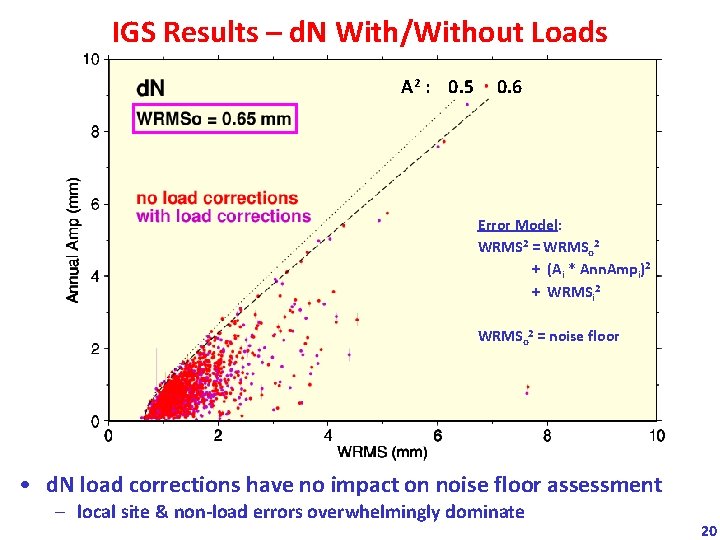
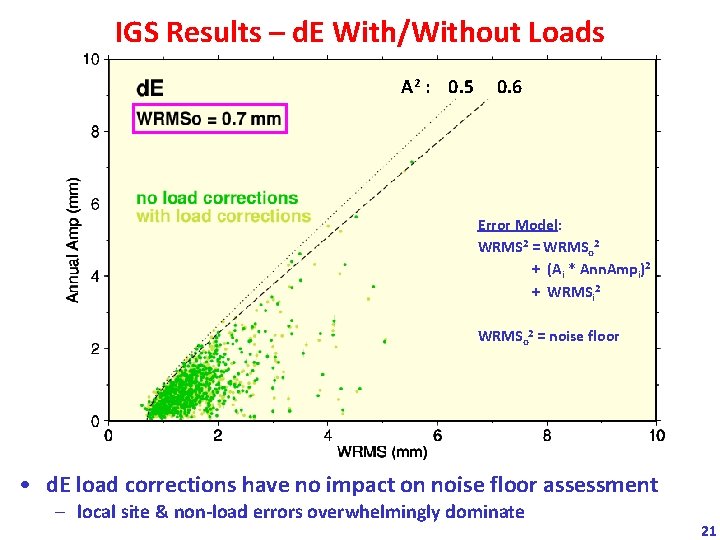
IGS Results – d. N With/Without Loads A 2 : 0. 5 0. 6 Error Model: WRMS 2 = WRMSo 2 + (Ai * Ann. Ampi)2 + WRMSi 2 WRMSo 2 = noise floor • d. N load corrections have no impact on noise floor assessment – local site & non-load errors overwhelmingly dominate 20
IGS Results – d. E With/Without Loads A 2 : 0. 5 0. 6 Error Model: WRMS 2 = WRMSo 2 + (Ai * Ann. Ampi)2 + WRMSi 2 WRMSo 2 = noise floor • d. E load corrections have no impact on noise floor assessment – local site & non-load errors overwhelmingly dominate 21
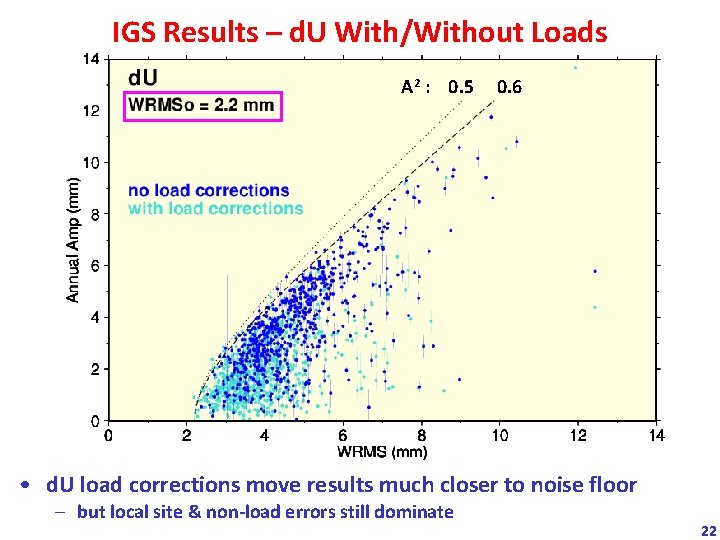
IGS Results – d. U With/Without Loads A 2 : 0. 5 0. 6 • d. U load corrections move results much closer to noise floor – but local site & non-load errors still dominate 22
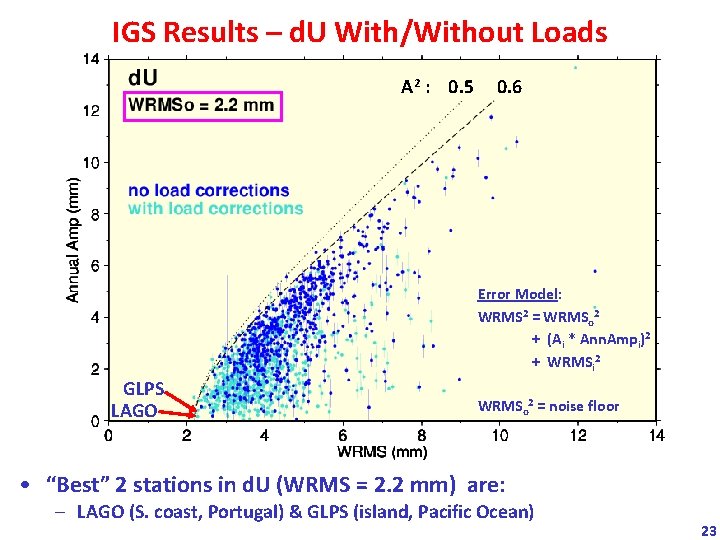
IGS Results – d. U With/Without Loads A 2 : 0. 5 0. 6 Error Model: WRMS 2 = WRMSo 2 + (Ai * Ann. Ampi)2 + WRMSi 2 GLPS LAGO WRMSo 2 = noise floor • “Best” 2 stations in d. U (WRMS = 2. 2 mm) are: – LAGO (S. coast, Portugal) & GLPS (island, Pacific Ocean) 23
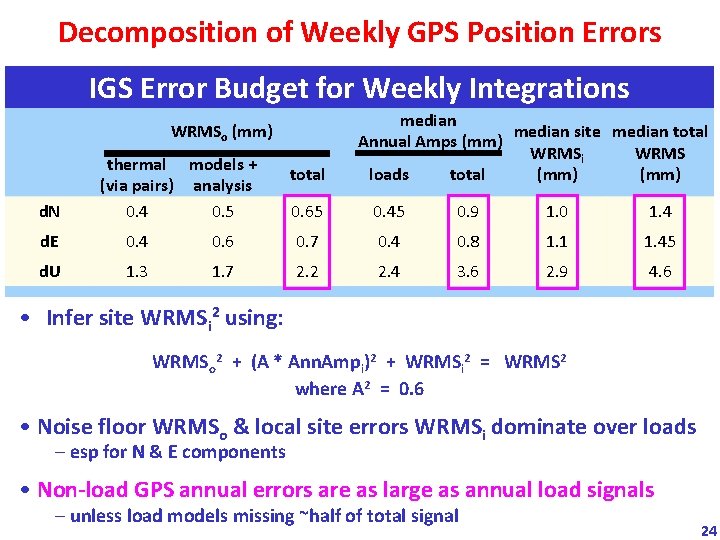
Decomposition of Weekly GPS Position Errors IGS Error Budget for Weekly Integrations WRMSo (mm) d. N thermal models + (via pairs) analysis 0. 4 0. 5 total median site median total Annual Amps (mm) WRMSi WRMS (mm) loads total 0. 65 0. 45 0. 9 1. 0 1. 4 d. E 0. 4 0. 6 0. 7 0. 4 0. 8 1. 1 1. 45 d. U 1. 3 1. 7 2. 2 2. 4 3. 6 2. 9 4. 6 • Infer site WRMSi 2 using: WRMSo 2 + (A * Ann. Ampi)2 + WRMSi 2 = WRMS 2 where A 2 = 0. 6 • Noise floor WRMSo & local site errors WRMSi dominate over loads – esp for N & E components • Non-load GPS annual errors are as large as annual load signals – unless load models missing ~half of total signal 24
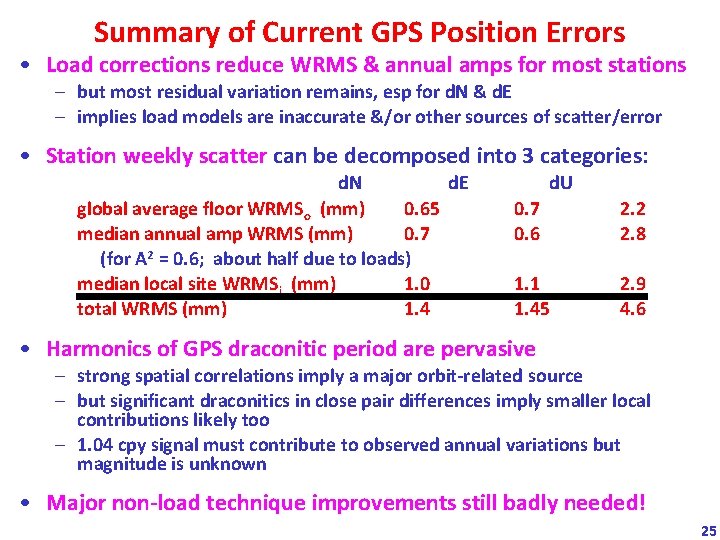
Summary of Current GPS Position Errors • Load corrections reduce WRMS & annual amps for most stations – but most residual variation remains, esp for d. N & d. E – implies load models are inaccurate &/or other sources of scatter/error • Station weekly scatter can be decomposed into 3 categories: d. N d. E global average floor WRMSo (mm) 0. 65 median annual amp WRMS (mm) 0. 7 (for A 2 = 0. 6; about half due to loads) median local site WRMSi (mm) 1. 0 total WRMS (mm) 1. 4 d. U 0. 7 0. 6 2. 2 2. 8 1. 1 1. 45 2. 9 4. 6 • Harmonics of GPS draconitic period are pervasive – strong spatial correlations imply a major orbit-related source – but significant draconitics in close pair differences imply smaller local contributions likely too – 1. 04 cpy signal must contribute to observed annual variations but magnitude is unknown • Major non-load technique improvements still badly needed! 25
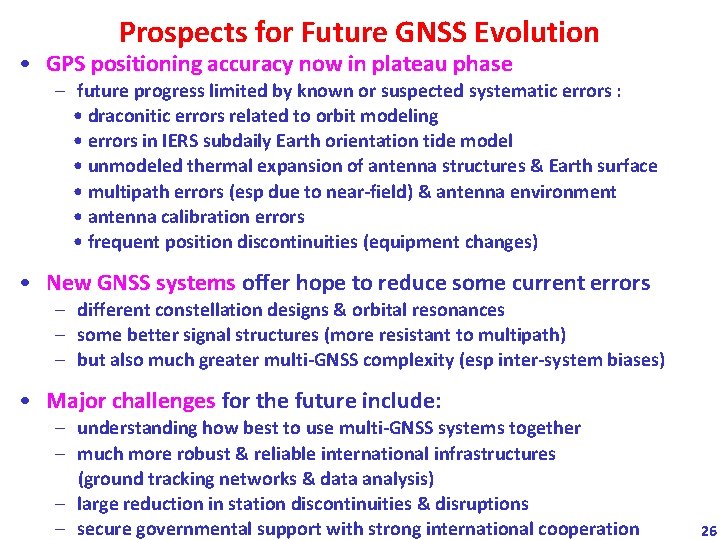
Prospects for Future GNSS Evolution • GPS positioning accuracy now in plateau phase – future progress limited by known or suspected systematic errors : • draconitic errors related to orbit modeling • errors in IERS subdaily Earth orientation tide model • unmodeled thermal expansion of antenna structures & Earth surface • multipath errors (esp due to near-field) & antenna environment • antenna calibration errors • frequent position discontinuities (equipment changes) • New GNSS systems offer hope to reduce some current errors – different constellation designs & orbital resonances – some better signal structures (more resistant to multipath) – but also much greater multi-GNSS complexity (esp inter-system biases) • Major challenges for the future include: – understanding how best to use multi-GNSS systems together – much more robust & reliable international infrastructures (ground tracking networks & data analysis) – large reduction in station discontinuities & disruptions – secure governmental support with strong international cooperation 26
Thank You!