
The Role of FacultyStudent Relationships on Student Success
- Slides: 1
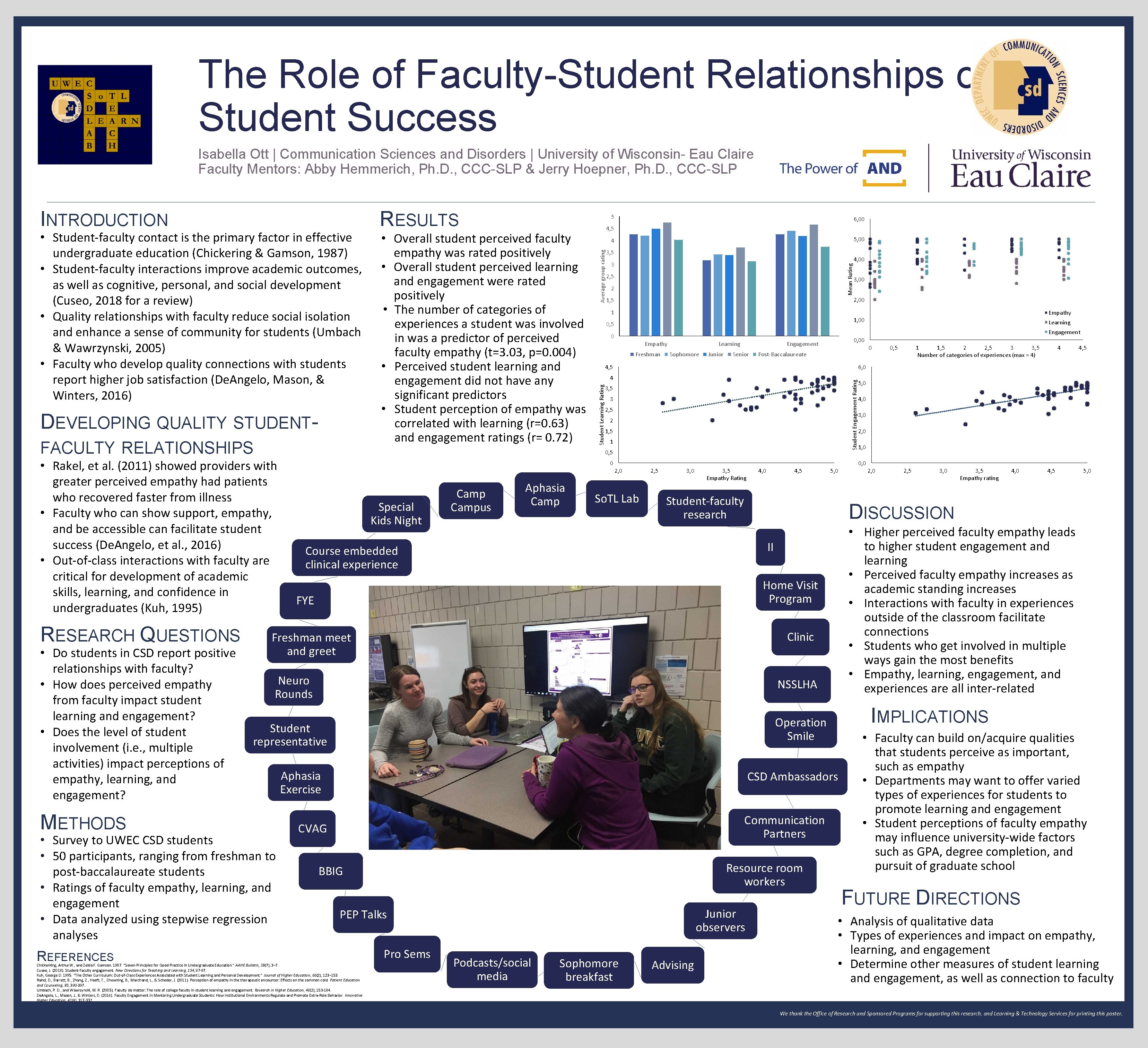
The Role of Faculty-Student Relationships on Student Success Isabella Ott | Communication Sciences and Disorders | University of Wisconsin- Eau Claire Faculty Mentors: Abby Hemmerich, Ph. D. , CCC-SLP & Jerry Hoepner, Ph. D. , CCC-SLP FACULTY RELATIONSHIPS • Do students in CSD report positive relationships with faculty? • How does perceived empathy from faculty impact student learning and engagement? • Does the level of student involvement (i. e. , multiple activities) impact perceptions of empathy, learning, and engagement? METHODS 4, 00 Mean Rating 3 2, 5 2 1 Special Kids Night Campus Empathy Freshman Learning Sophomore Junior 0, 00 Engagement Senior Post-Baccalaureate 4, 5 4 3, 5 3 2, 5 2 1, 5 1 2, 0 So. TL Lab 2, 5 3, 0 3, 5 Empathy Rating 4, 0 4, 5 5, 0 Student-faculty research 0, 5 1 1, 5 2 2, 5 3 3, 5 Number of categories of experiences (max = 4) 4 4, 5 FYE Neuro Rounds NSSLHA Student representative Operation Smile Aphasia Exercise Communication Partners Resource room workers Junior observers PEP Talks Sophomore breakfast Advising 3, 0 2, 0 1, 0 0, 0 2, 5 3, 0 3, 5 Empathy rating 4, 0 4, 5 5, 0 IMPLICATIONS CSD Ambassadors BBIG 4, 0 • Higher perceived faculty empathy leads to higher student engagement and learning • Perceived faculty empathy increases as academic standing increases • Interactions with faculty in experiences outside of the classroom facilitate connections • Students who get involved in multiple ways gain the most benefits • Empathy, learning, engagement, and experiences are all inter-related Clinic CVAG 5, 0 DISCUSSION II Podcasts/social media 0 6, 0 Home Visit Program Chickerking, Arthur. W. , and Zelda F. Gamson. 1987. “Seven Principles for Good Practice in Undergraduate Education. ” AAHE Bulletin, 39(7), 3– 7. Cuseo, J. (2018). Student-faculty engagement. New Directions for Teaching and Learning, 154, 87 -97. Kuh, George D. 1995. “The Other Curriculum: Out-of-Class Experiences Associated with Student Learning and Personal Development. ” Journal of Higher Education, 66(2), 123– 153. Rakel, D. , Barrett, B. , Zhang, Z. , Hoeft, T. , Chewning, B. , Marchand, L. , & Scheder, J. (2011). Perception of empathy in therapeutic encounter: Effects on the common cold. Patient Education and Counseling, 85, 390 -397. Umbach, P. D. , and Wawrzynski, M. R. (2005). Faculty do matter: The role of college faculty in student learning and engagement. Research in Higher Education, 46(2), 153 -184. De. Angelo, L. , Mason, J. , & Winters, D. (2016). Faculty Engagement in Mentoring Undergraduate Students: How Institutional Environments Regulate and Promote Extra-Role Behavior. Innovative Higher Education, 41(4), 317 -332. Learning Engagement 0 Course embedded clinical experience Pro Sems Empathy 1, 00 0, 5 0 Aphasia Camp 3, 00 2, 00 1, 5 Freshman meet and greet • Survey to UWEC CSD students • 50 participants, ranging from freshman to post-baccalaureate students • Ratings of faculty empathy, learning, and engagement • Data analyzed using stepwise regression analyses REFERENCES 3, 5 0, 5 • Rakel, et al. (2011) showed providers with greater perceived empathy had patients who recovered faster from illness • Faculty who can show support, empathy, and be accessible can facilitate student success (De. Angelo, et al. , 2016) • Out-of-class interactions with faculty are critical for development of academic skills, learning, and confidence in undergraduates (Kuh, 1995) RESEARCH QUESTIONS 5, 00 4 Student Engagement Rating DEVELOPING QUALITY STUDENT- • Overall student perceived faculty empathy was rated positively • Overall student perceived learning and engagement were rated positively • The number of categories of experiences a student was involved in was a predictor of perceived faculty empathy (t=3. 03, p=0. 004) • Perceived student learning and engagement did not have any significant predictors • Student perception of empathy was correlated with learning (r=0. 63) and engagement ratings (r= 0. 72) 6, 00 4, 5 Average group rating • Student-faculty contact is the primary factor in effective undergraduate education (Chickering & Gamson, 1987) • Student-faculty interactions improve academic outcomes, as well as cognitive, personal, and social development (Cuseo, 2018 for a review) • Quality relationships with faculty reduce social isolation and enhance a sense of community for students (Umbach & Wawrzynski, 2005) • Faculty who develop quality connections with students report higher job satisfaction (De. Angelo, Mason, & Winters, 2016) RESULTS Student Learning Rating INTRODUCTION 5 • Faculty can build on/acquire qualities that students perceive as important, such as empathy • Departments may want to offer varied types of experiences for students to promote learning and engagement • Student perceptions of faculty empathy may influence university-wide factors such as GPA, degree completion, and pursuit of graduate school FUTURE DIRECTIONS • Analysis of qualitative data • Types of experiences and impact on empathy, learning, and engagement • Determine other measures of student learning and engagement, as well as connection to faculty We thank the Office of Research and Sponsored Programs for supporting this research, and Learning & Technology Services for printing this poster.