
The role of external stakeholders from imaginary friends



- Slides: 12
The role of external stakeholders: from imaginary friends to non-interfering friends? António Magalhães Auckland conference Universities in the Knowledge Economy 10 – 13 February 2015
• Introduction • NPM and New Governance • Boardism in European universities • The role of external stakeholders • Concluding remarks
Introduction • In higher education the shift from governing to governance relied on the increased institutional autonomy, based on the assumption that the more autonomous institutions are the better they respond to change in their organisational environment and better is their performance • Universities reconceptualised as ‘complete organizations’ (Brunsson & Sahlin Adersen, 2000) mimicking corporations is driving the shift from a ‘republic of scholars’ to a ‘stakeholder organization’ (Bleiklie & Kogan, 2007)
• New Public Management driving governance reforms by introducing private sector management tools • The presence of external stakeholders became a mantra for the governance structures • To what extent external stakeholders influence the boards? (Perceptions of Rectors and Senates about the role external stakeholders actually perform and should perform)
New Governance • In interaction with and reaction to the most influential NPMdriven reforms, New Governance (Salamon, 2002) have been reframing the effects of NPM by emphasizing the collaborative features of ‘third-party government’ - accountability + collaboration
Boardism in European universities • Boardism: a distinctive governance praxis in higher education involving both normative assumptions and technical and practical elements stemming from corporate-like organisations in interaction/tension with academic self-governance. • It impinges on and legitimises the structure of governance and influences its practices. Featured by: - the decrease of academic self-governance - the increase of managerial governance - increase of external stakeholders influence.
Boardism in European universities • The implementation of boards in higher education reflects, according to the stakeholders’ theory, both a normative and instrumental approach to governance (Mainardes et al. , 2011). • The normative approach - how universities should operate on the basis of social and political values and principles? • The instrumental approach - how universities manage the core academic activities? • ‘External stakeholders’ representation unfold the normative stance emphasising that ‘boardism’ benefits management and governance and an instrumental stance as they are expected to bring into universities a clearer expression of the changes and needs of the organisational environment.
Boardism in European universities • Five parallel surveys administered in 2011 under the framework of TRUE project funded by ESF (EUROHESC). • Rectors and Senate members • 26 European higher education institutions in 8 countries (France, Germany, Italy, the Netherlands, Norway, Portugal, Switzerland, United Kingdom
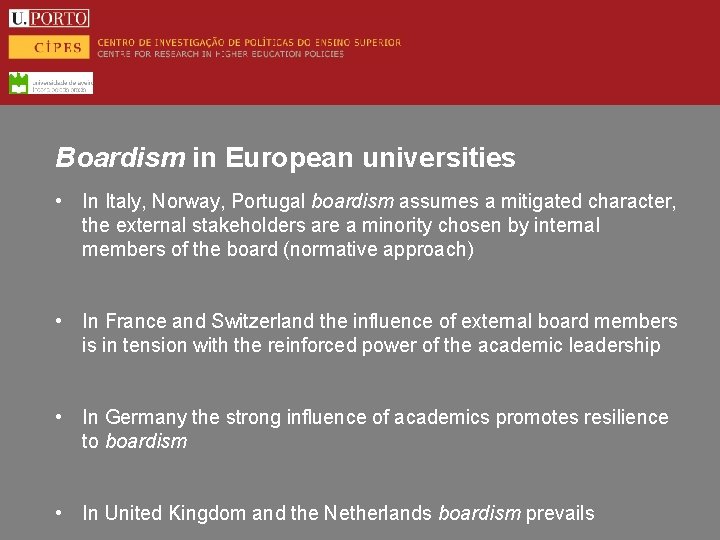
Boardism in European universities • In Italy, Norway, Portugal boardism assumes a mitigated character, the external stakeholders are a minority chosen by internal members of the board (normative approach) • In France and Switzerland the influence of external board members is in tension with the reinforced power of the academic leadership • In Germany the strong influence of academics promotes resilience to boardism • In United Kingdom and the Netherlands boardism prevails
The role of external stakeholders
The role of external stakeholders
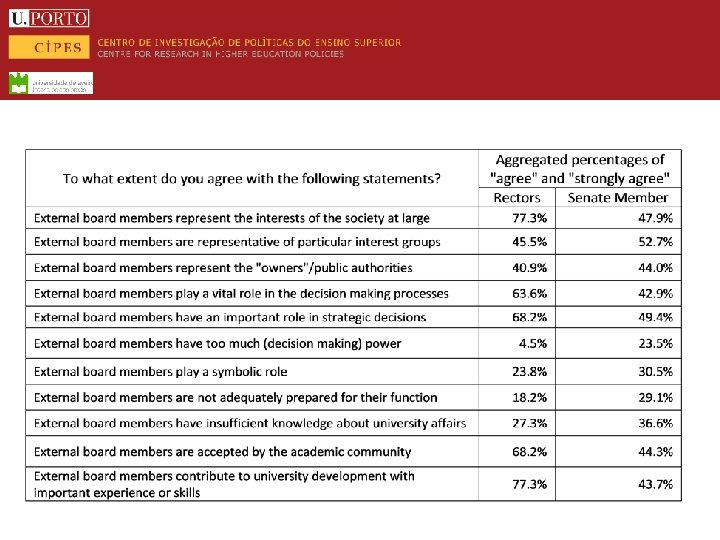
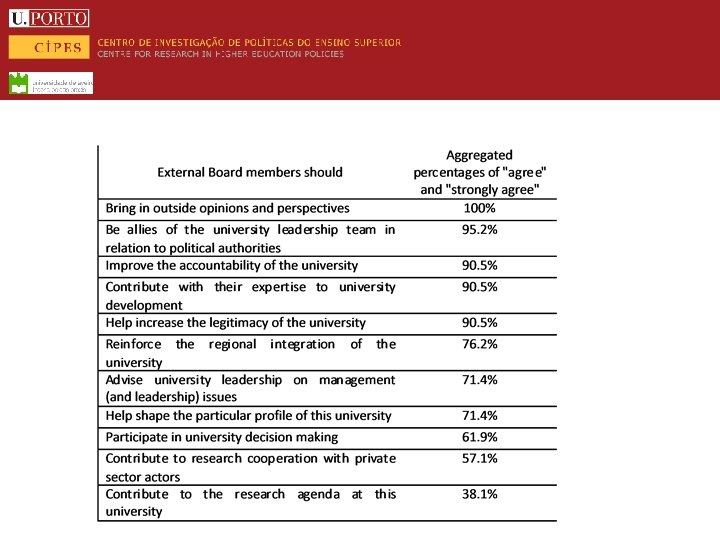
• Respondents views reflect the need to promote management efficiency and governance accountability to multiple stakeholders. • Rectors see external stakeholders representing the interests of the society at large and brining to the university outside beliefs and pressures (normative approach) • Rectors see external stakeholders bringing in important skills and experience (instrumental approach) • Senate members see external stakeholders as representing particular interests (instrumental approach) • Increasing influence of external stakeholders as non-interfering allies with teaching and research • FROM IMAGINARY FRIENDS TO NON-INTERFERING ALIES?