
The Role of Education in Sustainable Growth Contents
The Role of Education in Sustainable Growth
Contents 1. Overview of Korea Education 2. Importance of Education for Sustainable growth 3. Evolution of Human Capital Development System in Korea 4. Evaluation of Korean Education and Lessons 5. Korean Education System’s Contribution to the World
1. Keys to the Success of Korean Education • Expanding Compulsory Education and Education Investment • Educating Teachers and Welfare • Education Reform and Leadership • International Education • Industry-University Cooperation and Industry workforce Training
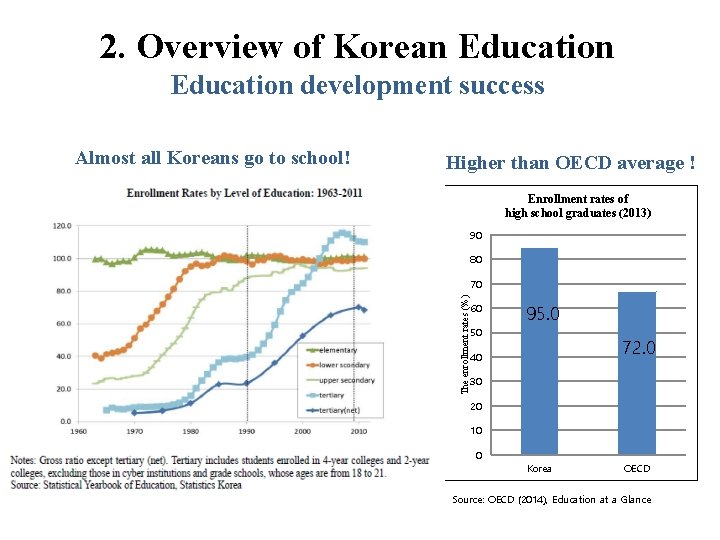
2. Overview of Korean Education development success Higher than OECD average ! Enrollment rates of high school graduates (2013) 90 80 70 The enrollment rates (%) Almost all Koreans go to school! 60 95. 0 50 72. 0 40 30 20 10 0 Korea OECD Source: OECD (2014), Education at a Glance
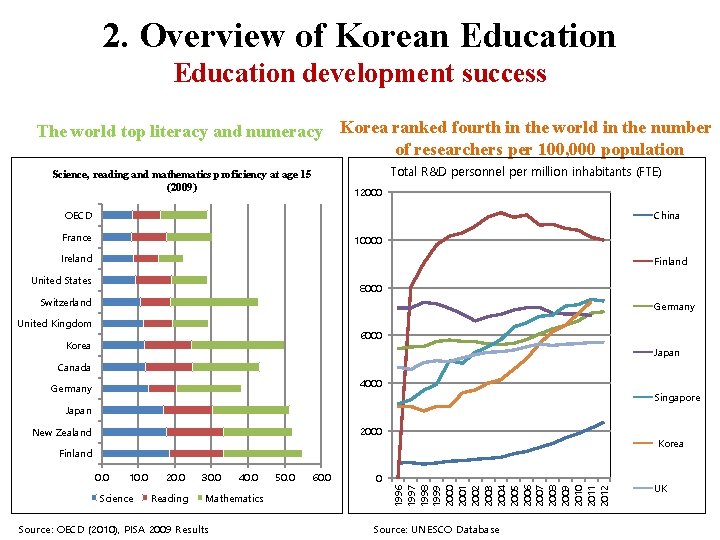
2. Overview of Korean Education development success The world top literacy and numeracy Korea ranked fourth in the world in the number of researchers per 100, 000 population Total R&D personnel per million inhabitants (FTE) Science, reading and mathematics proficiency at age 15 (2009) 12000 OECD China France 10000 Ireland Finland United States 8000 Switzerland Germany United Kingdom 6000 Korea Japan Canada 4000 Germany Singapore Japan 2000 New Zealand Korea Finland 10. 0 Science 20. 0 Reading 30. 0 40. 0 Mathematics Source: OECD (2010), PISA 2009 Results 50. 0 60. 0 0 1996 1997 1998 1999 2000 2001 2002 2003 2004 2005 2006 2007 2008 2009 2010 2011 2012 0. 0 Source: UNESCO Database UK
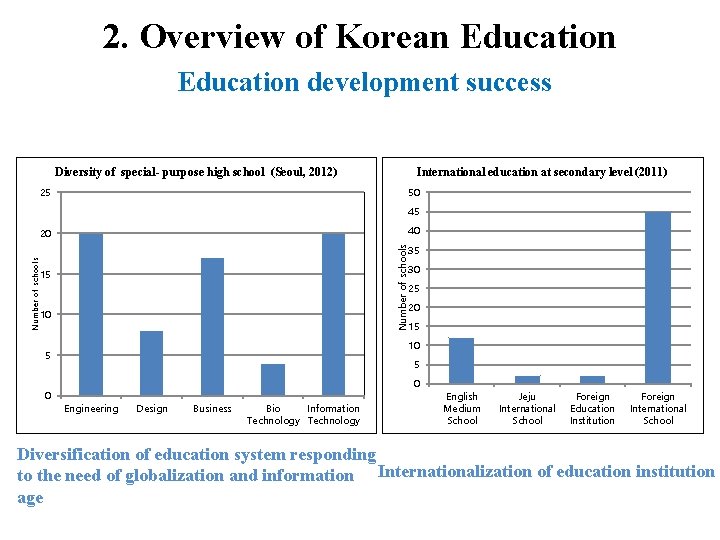
2. Overview of Korean Education development success Diversity of special- purpose high school (Seoul, 2012) 25 International education at secondary level (2011) 50 45 40 20 Number of schools 35 30 15 25 20 10 15 10 5 0 Engineering Design Business Bio Information Technology English Medium School Jeju International School Foreign Education Institution Foreign International School Diversification of education system responding to the need of globalization and information Internationalization of education institution age
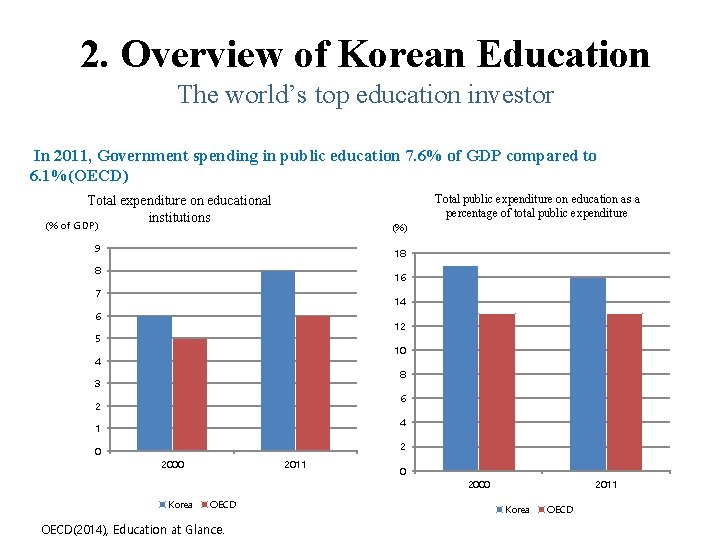
2. Overview of Korean Education The world’s top education investor In 2011, Government spending in public education 7. 6% of GDP compared to 6. 1%(OECD) Total expenditure on educational institutions (% of GDP) (%) 9 18 8 16 7 14 6 12 5 10 4 8 3 6 2 4 1 0 Total public expenditure on education as a percentage of total public expenditure 2 2000 Korea 2011 OECD(2014), Education at Glance. 0 2000 2011 Korea OECD
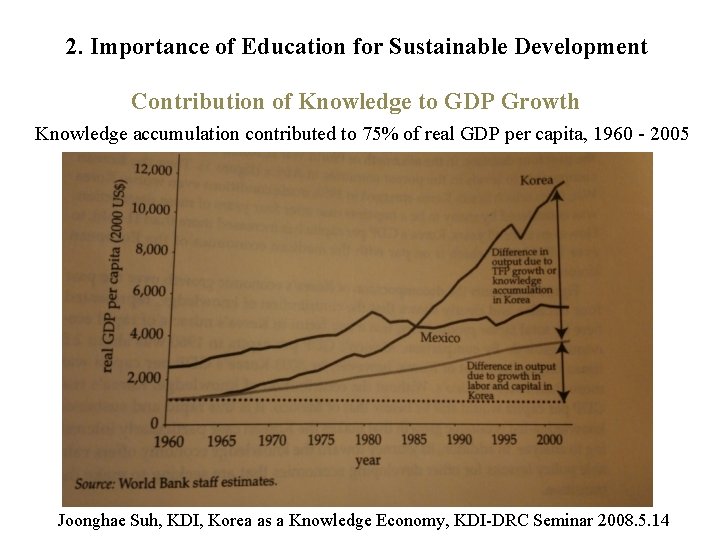
2. Importance of Education for Sustainable Development Contribution of Knowledge to GDP Growth Knowledge accumulation contributed to 75% of real GDP per capita, 1960 - 2005 Joonghae Suh, KDI, Korea as a Knowledge Economy, KDI-DRC Seminar 2008. 5. 14
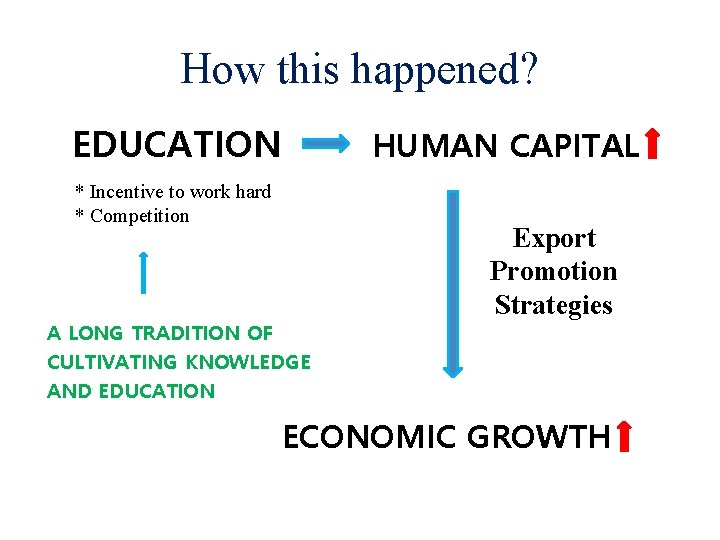
How this happened? EDUCATION HUMAN CAPITAL * Incentive to work hard * Competition A LONG TRADITION OF CULTIVATING KNOWLEDGE AND EDUCATION Export Promotion Strategies ECONOMIC GROWTH
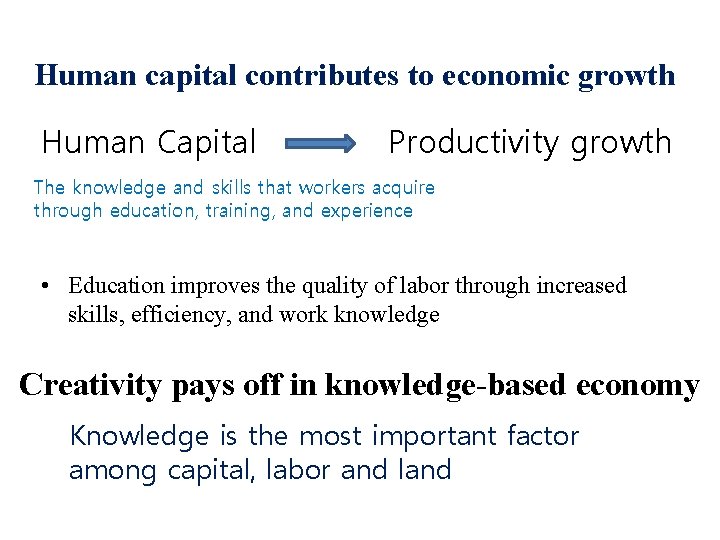
Human capital contributes to economic growth Human Capital Productivity growth The knowledge and skills that workers acquire through education, training, and experience • Education improves the quality of labor through increased skills, efficiency, and work knowledge Creativity pays off in knowledge-based economy Knowledge is the most important factor among capital, labor and land
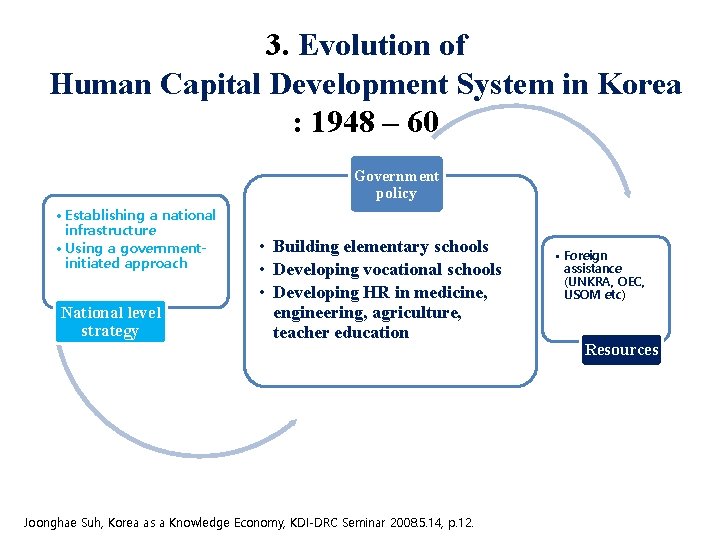
3. Evolution of Human Capital Development System in Korea : 1948 – 60 Government policy • Establishing a national infrastructure • Using a governmentinitiated approach National level strategy • Building elementary schools • Developing vocational schools • Developing HR in medicine, engineering, agriculture, teacher education Joonghae Suh, Korea as a Knowledge Economy, KDI-DRC Seminar 2008. 5. 14, p. 12. • Foreign assistance (UNKRA, OEC, USOM etc) Resources
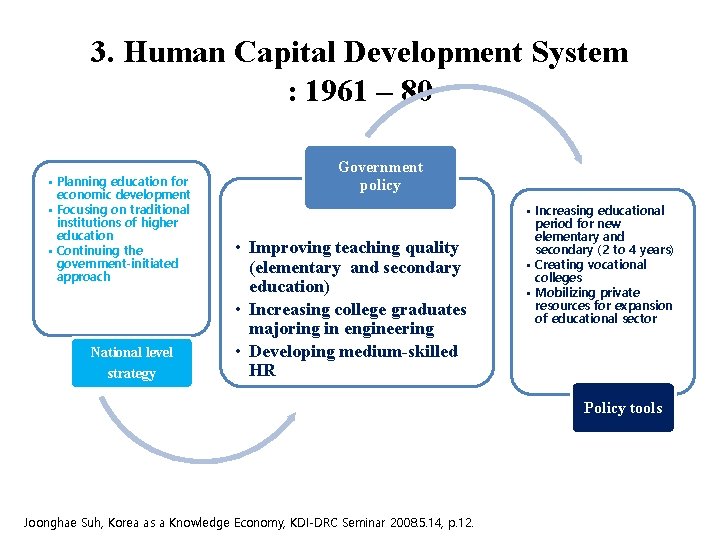
3. Human Capital Development System : 1961 – 80 • Planning education for economic development • Focusing on traditional institutions of higher education • Continuing the government-initiated approach National level strategy Government policy • Improving teaching quality (elementary and secondary education) • Increasing college graduates majoring in engineering • Developing medium-skilled HR • Increasing educational period for new elementary and secondary (2 to 4 years) • Creating vocational colleges • Mobilizing private resources for expansion of educational sector Policy tools Joonghae Suh, Korea as a Knowledge Economy, KDI-DRC Seminar 2008. 5. 14, p. 12.
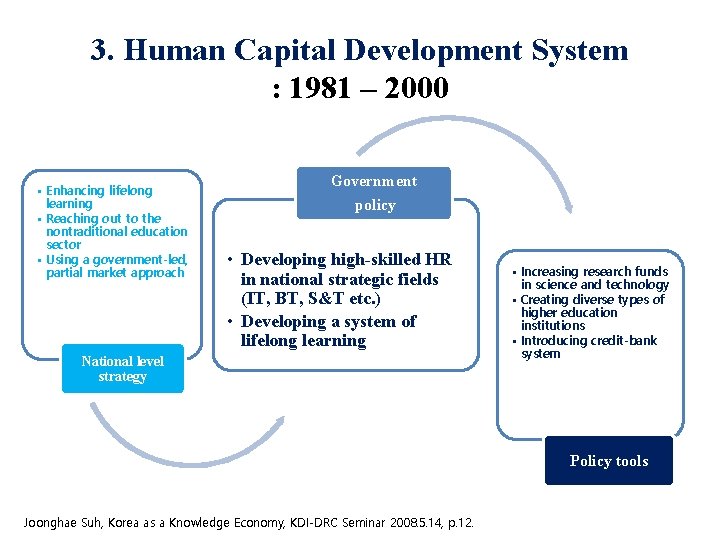
3. Human Capital Development System : 1981 – 2000 • Enhancing lifelong learning • Reaching out to the nontraditional education sector • Using a government-led, partial market approach Government policy • Developing high-skilled HR in national strategic fields (IT, BT, S&T etc. ) • Developing a system of lifelong learning National level strategy • Increasing research funds in science and technology • Creating diverse types of higher education institutions • Introducing credit-bank system Policy tools Joonghae Suh, Korea as a Knowledge Economy, KDI-DRC Seminar 2008. 5. 14, p. 12.
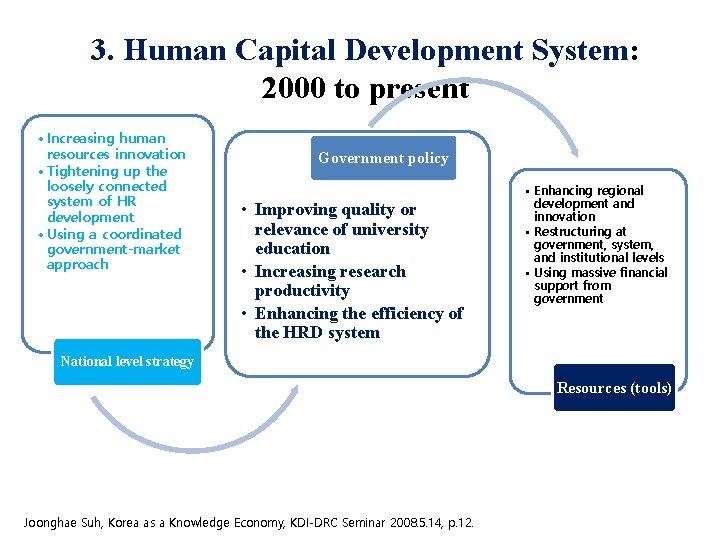
3. Human Capital Development System: 2000 to present • Increasing human resources innovation • Tightening up the loosely connected system of HR development • Using a coordinated government-market approach Government policy • Improving quality or relevance of university education • Increasing research productivity • Enhancing the efficiency of the HRD system • Enhancing regional development and innovation • Restructuring at government, system, and institutional levels • Using massive financial support from government National level strategy Resources (tools) Joonghae Suh, Korea as a Knowledge Economy, KDI-DRC Seminar 2008. 5. 14, p. 12.
4. Evaluation of Korean education and Lessons A TRADITION OF CULTIVATING KNOWLEDGE The Origin of Education Fever • Korea’s first public school/education system – Koguryŏ Dynasty, 372 A. C (Taehak, 太學) • Koryŏ Dynasty – Enthusiasm for education was highly praised by Chinese diplomats who visited Kaesung (capital of Koryŏ)
• Chosŏn Dynasty (1392 – 1910) – A country of Sun-bi(선비, 士, gentry) who has comparative advantage in creating knowledge and creativity – “The pen (文) has been mightier than the sword (武)” throughout the Korean history – Civil service exam(科擧) tradition : All citizens have the legal right to be the candidates of civil servant √ ”Before 1971 children were taught in two shifts because school-building could not keep up with the numbers!”
The Root of Strong Private Education System and High Education Investment by Private Sector In Koryŏ dynasty (King Sungjong), the Twelve Private School (私學十二徒) was known as a competent education system better than public schools Massive education investment by private sector originated from a culture of selling cows to send kids to schools and to prepare civil service exam (科擧) ☞ In 2010 s, private education investment person is around $3000 = 10% of GDP per capita!
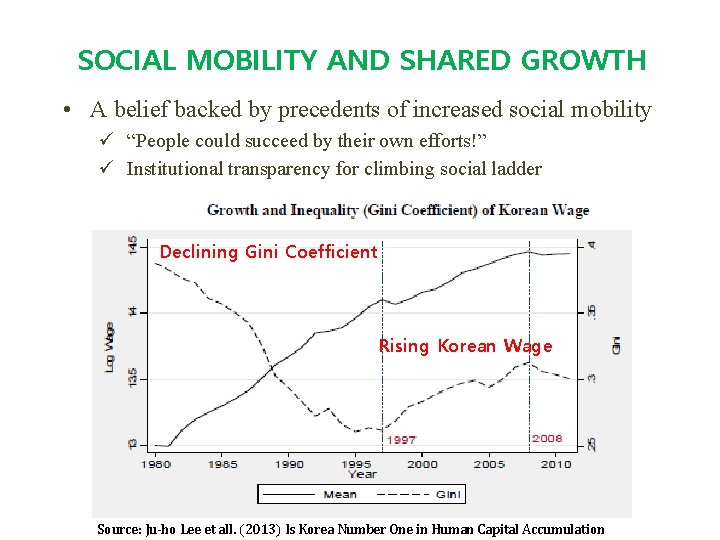
SOCIAL MOBILITY AND SHARED GROWTH • A belief backed by precedents of increased social mobility ü “People could succeed by their own efforts!” ü Institutional transparency for climbing social ladder Declining Gini Coefficient Rising Korean Wage Source: Ju-ho Lee et all. (2013) Is Korea Number One in Human Capital Accumulation
Investment in Education Infrastructure for Greater Social Cohesion • Improving teachers quality ☞ Qualification of teachers stipulated in law ☞ Fierce competition of teacher qualification exam • Software and Hardware of education infrastructure ☞ Software : curriculum, teacher, evaluation method, career guide ☞ Hardware : textbooks, school buildings and other physical equipment √ The post-1997 wage inequality worsened allegedly due to huge investment in English education by private sector since public investment in English education has been somewhat inefficient.
KEY TO LINKING EDUCATION TO GROWTH • The smooth transition of “Education to Employment” ü The rapid industrialization facilitated the employment of educated labor, enhancing industrial productivity and consolidating social cohesion. • Providing human capital in need for export targeted industry ü Creating virtuous cycle between building high-skilled human capital and economic growth • Pre-emptive changes in education policy pertinent to development strategies ü Foster growth to keep up with the globalization and information revolution.
5. Korean Education System’s Contribution to the World • Significance of human capital for sustainable growth • Education investment as a means of shared growth and greater fairness • Role model for achieving universal primary education (MDG) and 6 goals of “Education for All’
President Park Geun-Hye on educational lessons from Korea (GEFI Keynote Speech, September 2014) • First, Korea provided through a government centered strategy an equal education opportunity to its people, regardless of where they live and which social class they belong to, while ensuring a minimum level of education quality at a time when the private sector lacked capabilities. • Second, Korea made sure that education policy and economic development policy reinforced each other, focusing on meeting the demand for primary and secondary education with special attention paid to promotion of female manpower. • Third, popular attitude toward education emphasizing education even under economic hardship was the engine of successful educational development, which made possible a cycle of inclusive growth by promoting social mobility and narrowing the income gap between rich and poor.
Knowledge Eleanor Farjeon Your mind is a meadow To plant for your needs; You are the farmer, With knowledge for seeds. Don’t leave your meadow Unplanted and bare, Sow it with knowledge And tend it with care Don’t be a know-nothing! Plant in the spring, And see what a harvest The summer will bring
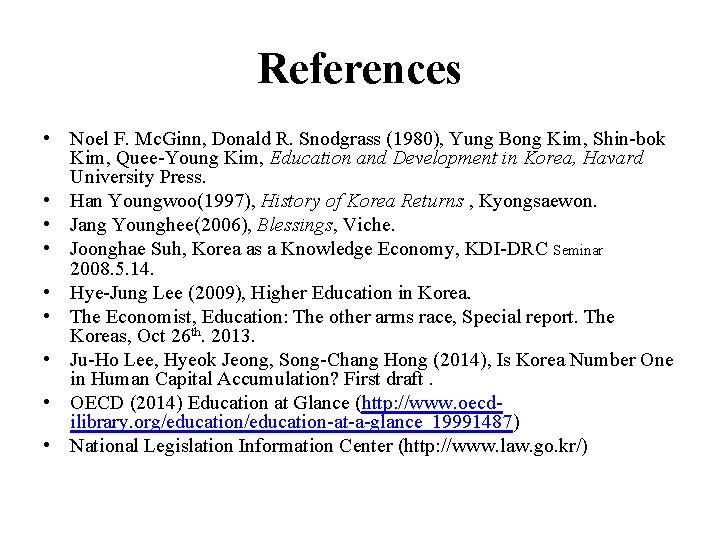
References • Noel F. Mc. Ginn, Donald R. Snodgrass (1980), Yung Bong Kim, Shin-bok Kim, Quee-Young Kim, Education and Development in Korea, Havard University Press. • Han Youngwoo(1997), History of Korea Returns , Kyongsaewon. • Jang Younghee(2006), Blessings, Viche. • Joonghae Suh, Korea as a Knowledge Economy, KDI-DRC Seminar 2008. 5. 14. • Hye-Jung Lee (2009), Higher Education in Korea. • The Economist, Education: The other arms race, Special report. The Koreas, Oct 26 th. 2013. • Ju-Ho Lee, Hyeok Jeong, Song-Chang Hong (2014), Is Korea Number One in Human Capital Accumulation? First draft. • OECD (2014) Education at Glance (http: //www. oecdilibrary. org/education-at-a-glance_19991487) • National Legislation Information Center (http: //www. law. go. kr/)
- Slides: 25