
The Role of Education Functionalism The New Right
- Slides: 18
The Role of Education Functionalism / The New Right / Marxism
Functionalism
What do we know already about the functionalist view of society?
Durkheim Emile DURKHEIM (1903) identified two main functions of education: Creation of social solidarity Teaching specialist skills Education is seen as a key role in preparing young people for adulthood, citizenship and working life, providing them with the means for improving their lives and life chances through upward social mobility and preparing them for a rapidly changing society.
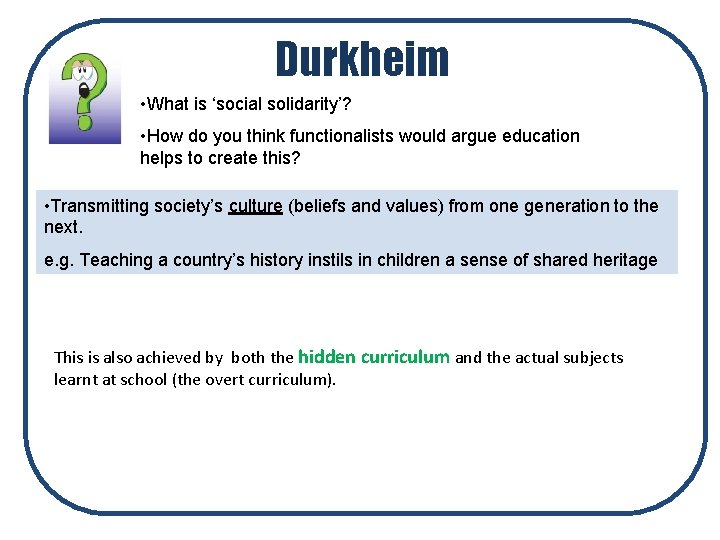
Durkheim • What is ‘social solidarity’? • How do you think functionalists would argue education helps to create this? • Transmitting society’s culture (beliefs and values) from one generation to the next. e. g. Teaching a country’s history instils in children a sense of shared heritage This is also achieved by both the hidden curriculum and the actual subjects learnt at school (the overt curriculum).
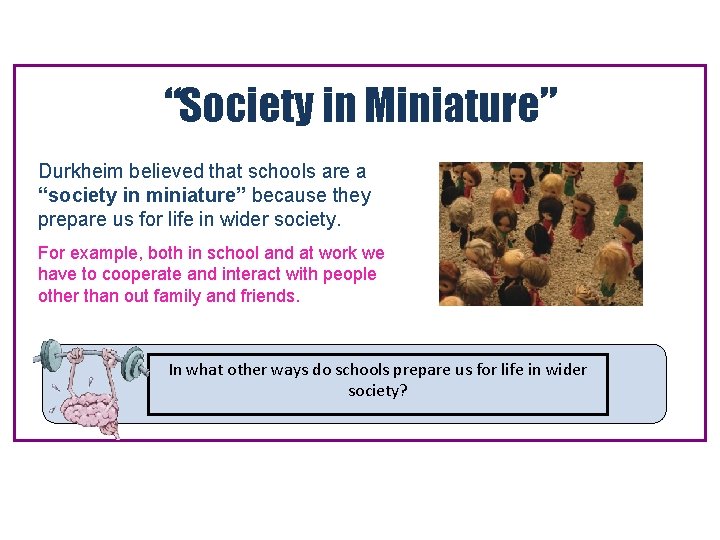
“Society in Miniature” Durkheim believed that schools are a “society in miniature” because they prepare us for life in wider society. For example, both in school and at work we have to cooperate and interact with people other than out family and friends. In what other ways do schools prepare us for life in wider society?
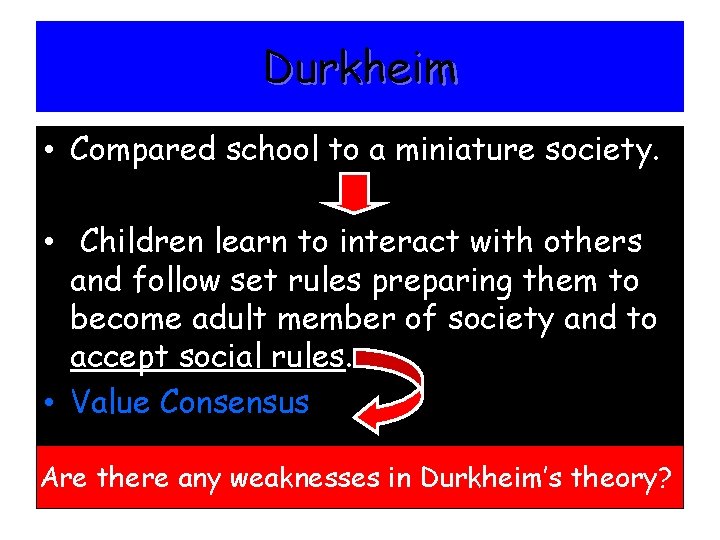
Durkheim • Compared school to a miniature society. • Children learn to interact with others and follow set rules preparing them to become adult member of society and to accept social rules. • Value Consensus Are there any weaknesses in Durkheim’s theory?
Weaknesses in Durkheim’s Theory Things to consider : • How successful is Education in teaching the norms and values of society? • Does everyone share the same norms and values?
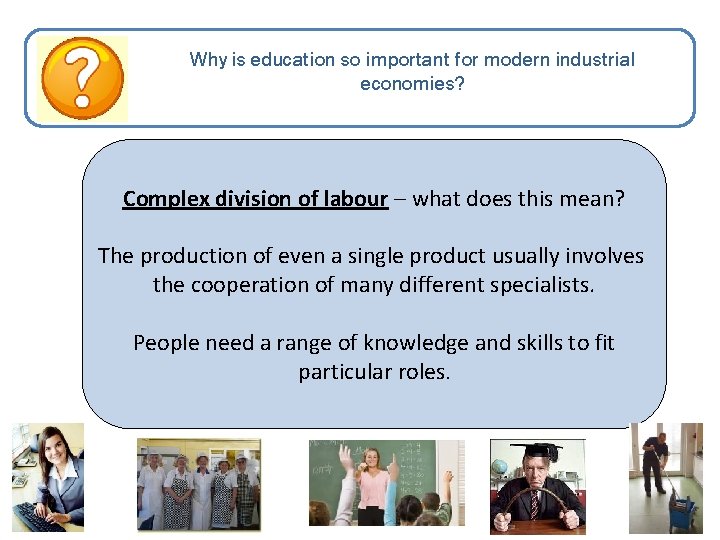
Why is education so important for modern industrial economies? Complex division of labour – what does this mean? The production of even a single product usually involves the cooperation of many different specialists. People need a range of knowledge and skills to fit particular roles.
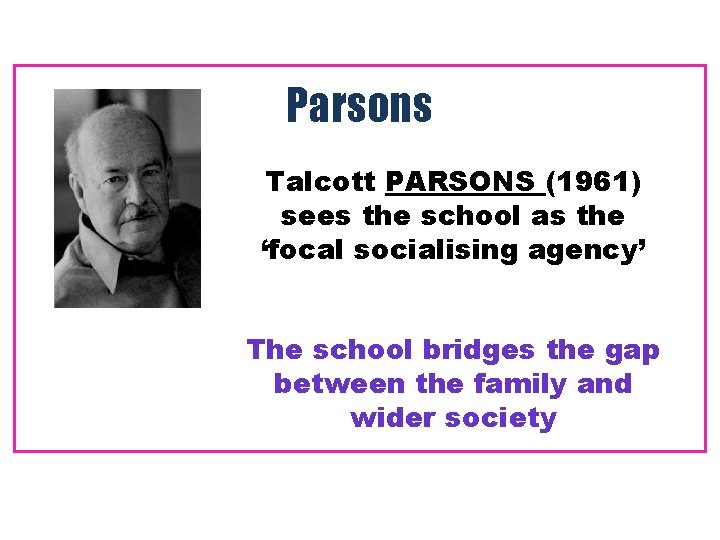
Parsons Talcott PARSONS (1961) sees the school as the ‘focal socialising agency’ The school bridges the gap between the family and wider society
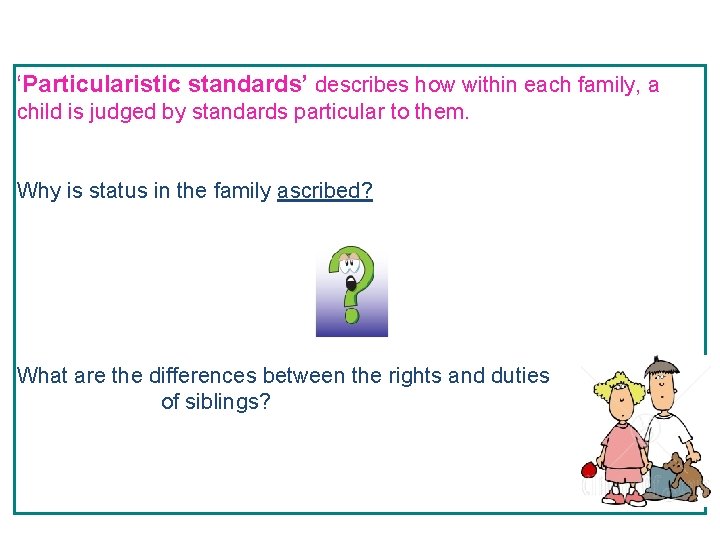
‘Particularistic standards’ describes how within each family, a child is judged by standards particular to them. Why is status in the family ascribed? What are the differences between the rights and duties of siblings?
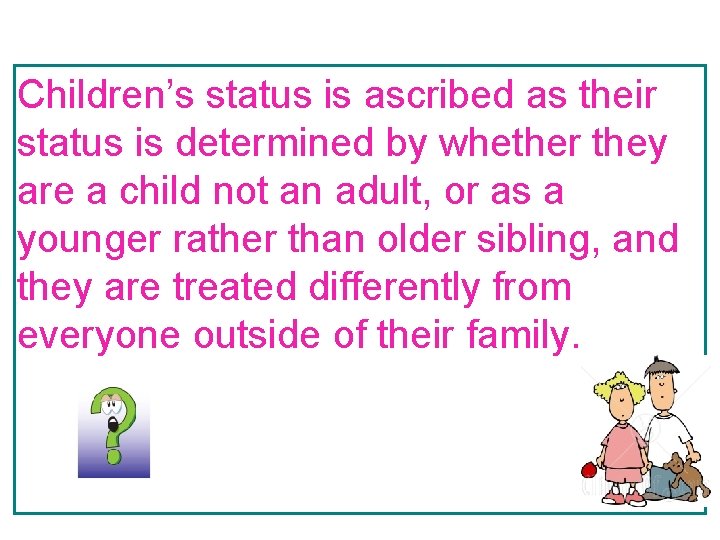
Children’s status is ascribed as their status is determined by whether they are a child not an adult, or as a younger rather than older sibling, and they are treated differently from everyone outside of their family.
‘Universalistic standards’ describes the impersonal standards that are applied in the same way to everyone, as in wider society. In school, each pupil is judged against the same standards (e. g. sit same exams with same marking criteria). What is meant by ‘meritocracy’?
Parsons claims school and society are based on meritocratic principles. Everyone is given an equal opportunity to achieve rewards through their own effort and ability. In this way, school is preparation to move from the family to wider society.
Davis and Moore • Necessary to ensure most important social roles filled by most talented people • Inefficient and dangerous to have less able people be pilots and surgeons • Not everyone is equally talented so society must offer greatest rewards for most important jobs
Davis and Moore • Education system provides “human capital”: enables each person to be allocated to the job best suited to their abilities • Makes most effective use of talents and maximises their productivity
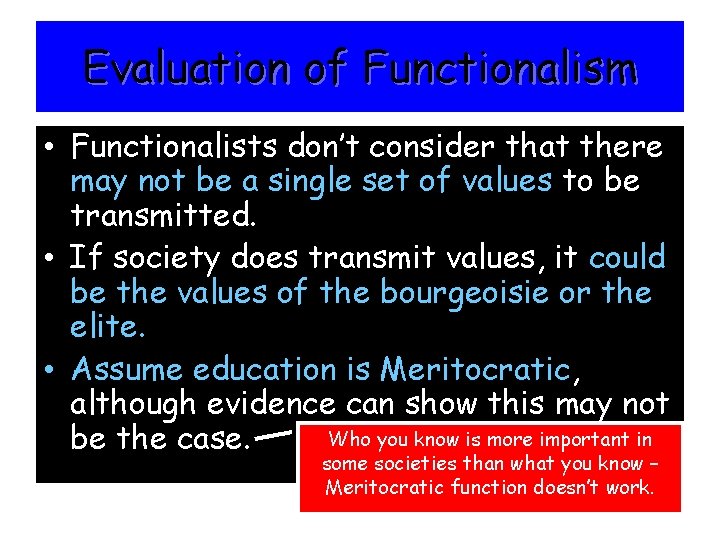
Evaluation of Functionalism • Functionalists don’t consider that there may not be a single set of values to be transmitted. • If society does transmit values, it could be the values of the bourgeoisie or the elite. • Assume education is Meritocratic, although evidence can show this may not Who you know is more important in be the case. some societies than what you know – Meritocratic function doesn’t work.
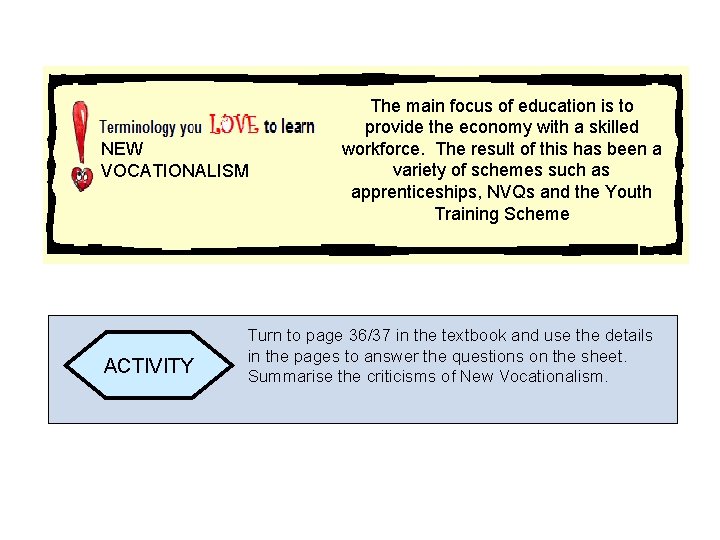
NEW VOCATIONALISM ACTIVITY The main focus of education is to provide the economy with a skilled workforce. The result of this has been a variety of schemes such as apprenticeships, NVQs and the Youth Training Scheme Turn to page 36/37 in the textbook and use the details in the pages to answer the questions on the sheet. Summarise the criticisms of New Vocationalism.