
THE ROLE OF ECOSYSTEM VALUATION IN DECISION MAKING
- Slides: 36
THE ROLE OF ECOSYSTEM VALUATION IN DECISION MAKING & POLICY DEVELOPMENT UNDP/GEF MAIN STREAMS OF LIFE – WETLAND PA SYSTEM STRENGTHENING FOR BIODIVERSITY CONSERVATION PROGRAMME. Dr Camille Bann, 8 June 2012
Overview of presentation Why value ecosystem ? Some examples Economic inputs to the project document
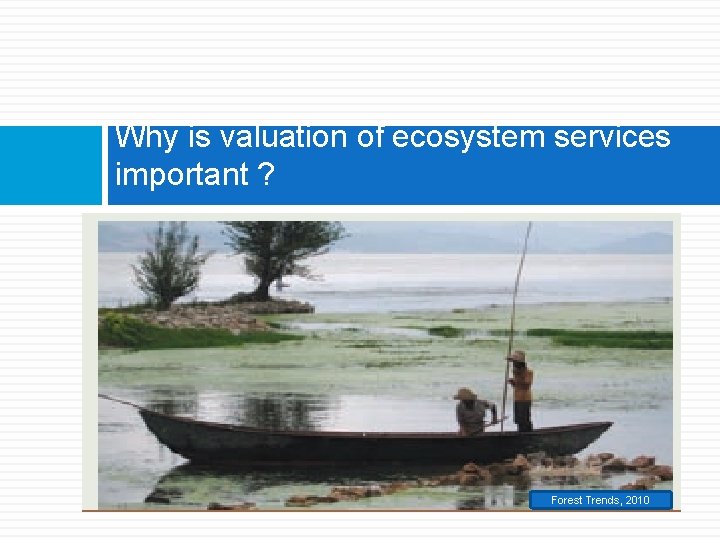
Why is valuation of ecosystem services important ? Forest Trends, 2010
Uses of Ecosystem Valuation / Economic Analysis 4 Raise awareness Improve decision making (policies, planning, projects) � Requires understanding, measuring and quantifying the trade-offs Facilitate effective management including sustainable financing options Valuation underpins the design of ecocompensation mechanisms such as PES
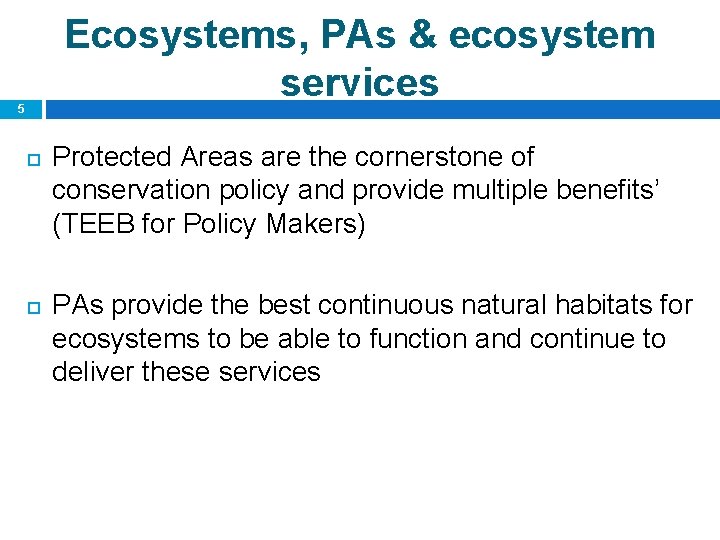
Ecosystems, PAs & ecosystem services 5 Protected Areas are the cornerstone of conservation policy and provide multiple benefits’ (TEEB for Policy Makers) PAs provide the best continuous natural habitats for ecosystems to be able to function and continue to deliver these services
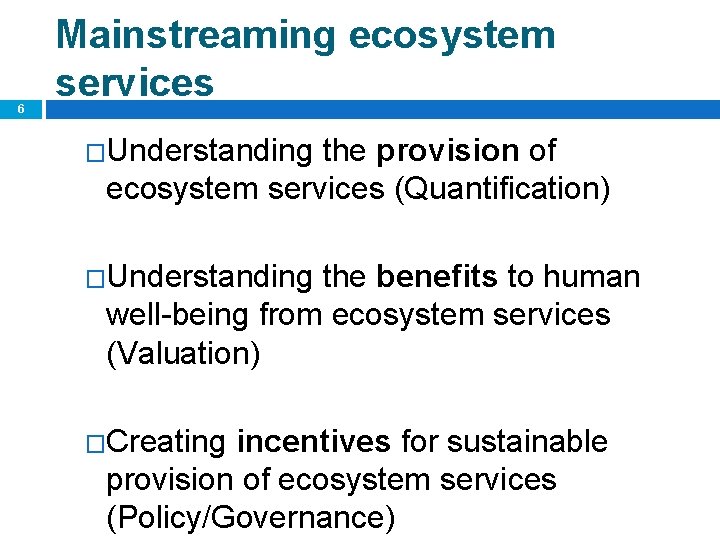
6 Mainstreaming ecosystem services �Understanding the provision of ecosystem services (Quantification) �Understanding the benefits to human well-being from ecosystem services (Valuation) �Creating incentives for sustainable provision of ecosystem services (Policy/Governance)
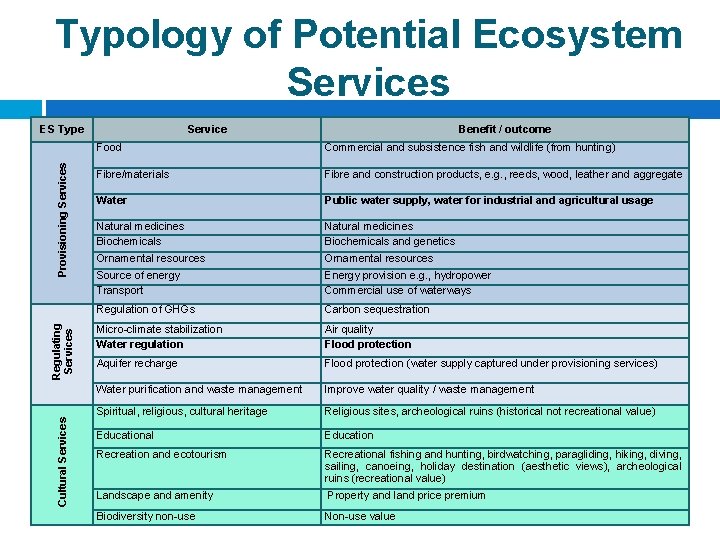
Typology of Potential Ecosystem Services Cultural Services Regulating Services Provisioning Services ES Type Service Benefit / outcome Food Commercial and subsistence fish and wildlife (from hunting) Fibre/materials Fibre and construction products, e. g. , reeds, wood, leather and aggregate Water Public water supply, water for industrial and agricultural usage Natural medicines Biochemicals and genetics Ornamental resources Source of energy Transport Energy provision e. g. , hydropower Commercial use of waterways Regulation of GHGs Carbon sequestration Micro-climate stabilization Water regulation Air quality Flood protection Aquifer recharge Flood protection (water supply captured under provisioning services) Water purification and waste management Improve water quality / waste management Spiritual, religious, cultural heritage Religious sites, archeological ruins (historical not recreational value) Educational Education Recreation and ecotourism Recreational fishing and hunting, birdwatching, paragliding, hiking, diving, sailing, canoeing, holiday destination (aesthetic views), archeological ruins (recreational value) Landscape and amenity Property and land price premium Biodiversity non-use Non-use value
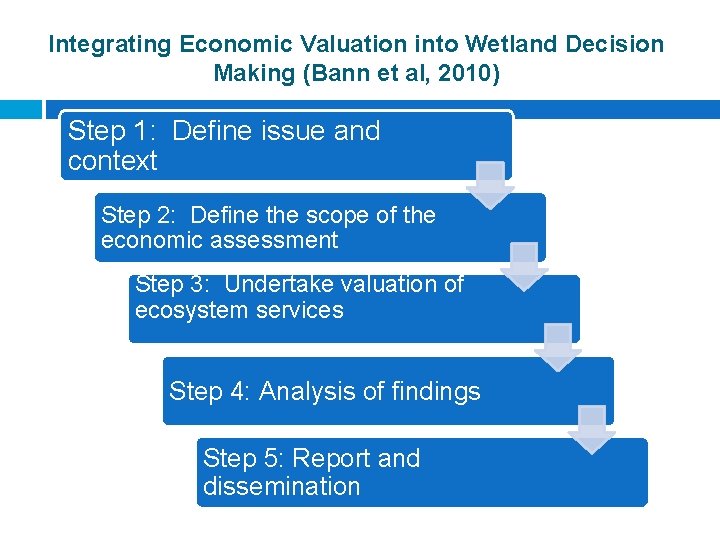
Integrating Economic Valuation into Wetland Decision Making (Bann et al, 2010) Step 1: Define issue and context Step 2: Define the scope of the economic assessment Step 3: Undertake valuation of ecosystem services Step 4: Analysis of findings Step 5: Report and dissemination
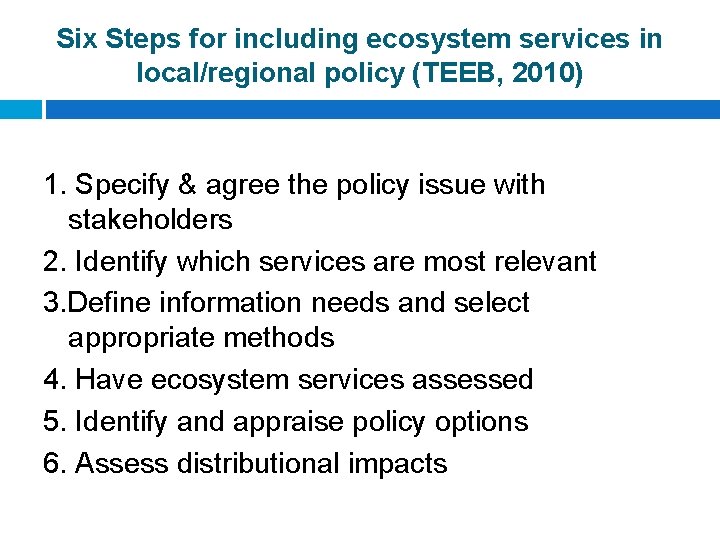
Six Steps for including ecosystem services in local/regional policy (TEEB, 2010) 1. Specify & agree the policy issue with stakeholders 2. Identify which services are most relevant 3. Define information needs and select appropriate methods 4. Have ecosystem services assessed 5. Identify and appraise policy options 6. Assess distributional impacts
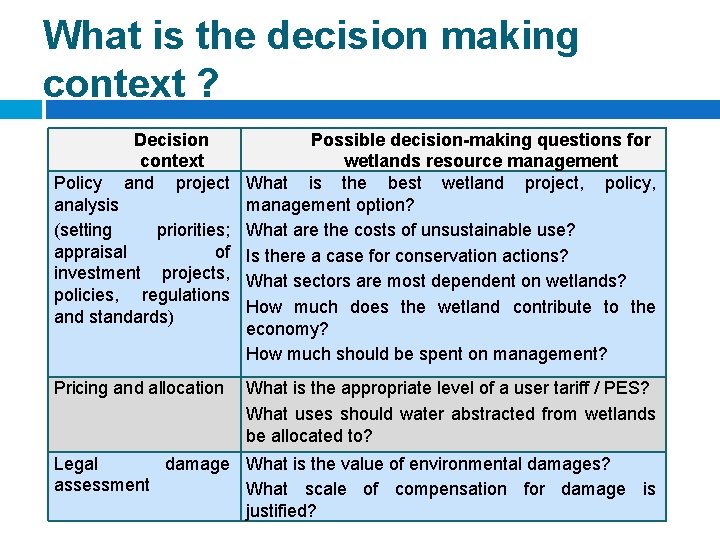
What is the decision making context ? Decision context Policy and project analysis (setting priorities; appraisal of investment projects, policies, regulations and standards) Possible decision-making questions for wetlands resource management What is the best wetland project, policy, management option? What are the costs of unsustainable use? Is there a case for conservation actions? What sectors are most dependent on wetlands? How much does the wetland contribute to the economy? How much should be spent on management? Pricing and allocation What is the appropriate level of a user tariff / PES? What uses should water abstracted from wetlands be allocated to? Legal damage What is the value of environmental damages? assessment What scale of compensation for damage is justified?
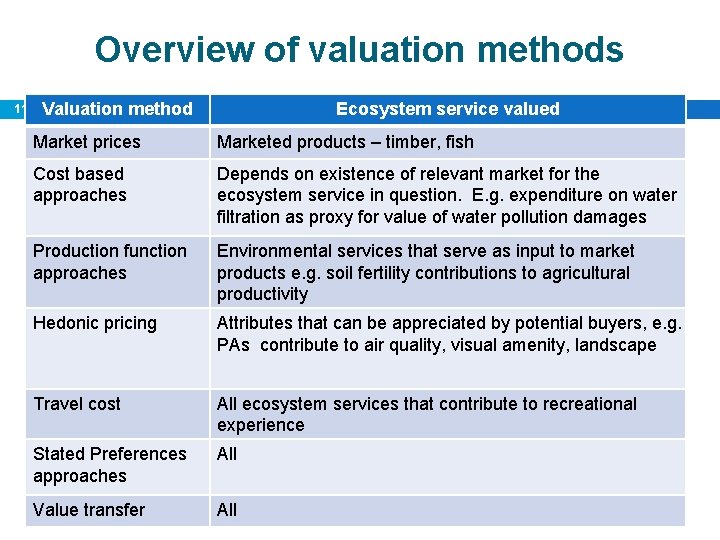
Overview of valuation methods 11 Valuation method Ecosystem service valued Market prices Marketed products – timber, fish Cost based approaches Depends on existence of relevant market for the ecosystem service in question. E. g. expenditure on water filtration as proxy for value of water pollution damages Production function approaches Environmental services that serve as input to market products e. g. soil fertility contributions to agricultural productivity Hedonic pricing Attributes that can be appreciated by potential buyers, e. g. PAs contribute to air quality, visual amenity, landscape Travel cost All ecosystem services that contribute to recreational experience Stated Preferences approaches All Value transfer All
Examples of Wetland Ecosystem Values and Economic Appraisal Approaches Key regulating services • CBA • Sector Scenario Approach
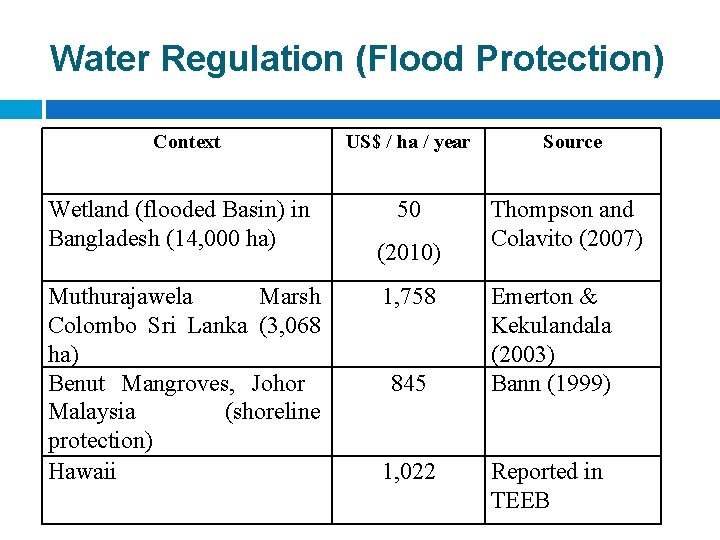
Water Regulation (Flood Protection) Context Wetland (flooded Basin) in Bangladesh (14, 000 ha) Muthurajawela Marsh Colombo Sri Lanka (3, 068 ha) Benut Mangroves, Johor Malaysia (shoreline protection) Hawaii US$ / ha / year Source 50 Thompson and Colavito (2007) (2010) 1, 758 845 1, 022 Emerton & Kekulandala (2003) Bann (1999) Reported in TEEB
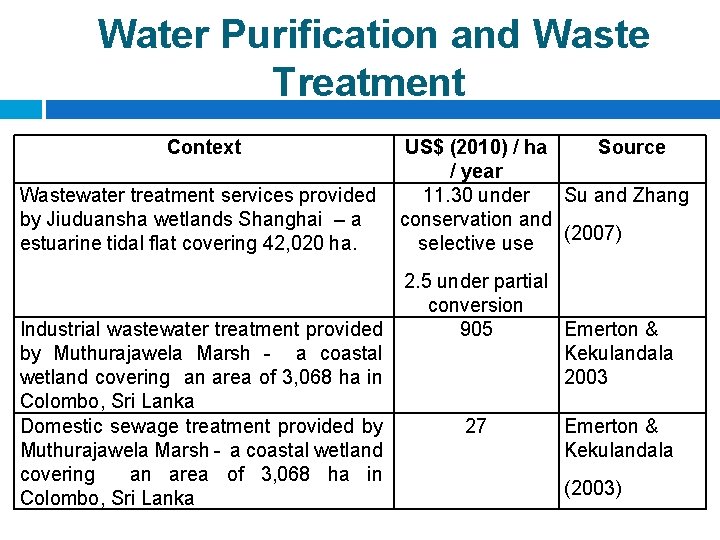
Water Purification and Waste Treatment Context US$ (2010) / ha Source / year Wastewater treatment services provided 11. 30 under Su and Zhang by Jiuduansha wetlands Shanghai – a conservation and (2007) estuarine tidal flat covering 42, 020 ha. selective use 2. 5 under partial conversion Industrial wastewater treatment provided 905 Emerton & by Muthurajawela Marsh - a coastal Kekulandala wetland covering an area of 3, 068 ha in 2003 Colombo, Sri Lanka Domestic sewage treatment provided by 27 Emerton & Muthurajawela Marsh - a coastal wetland Kekulandala covering an area of 3, 068 ha in (2003) Colombo, Sri Lanka
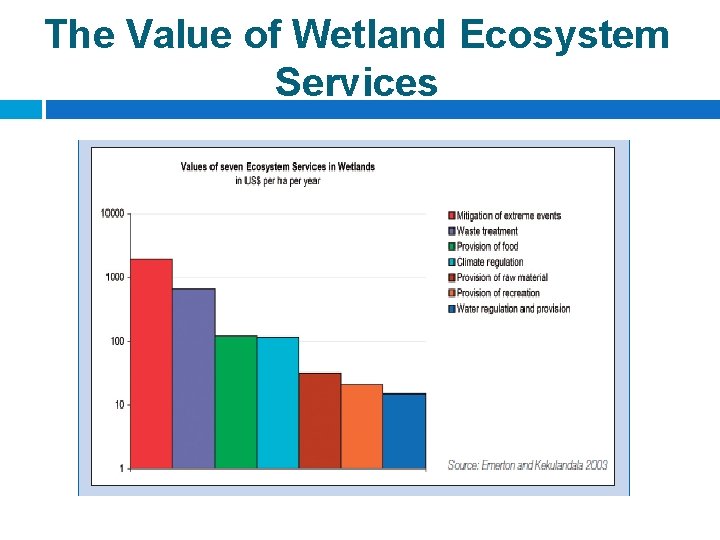
The Value of Wetland Ecosystem Services
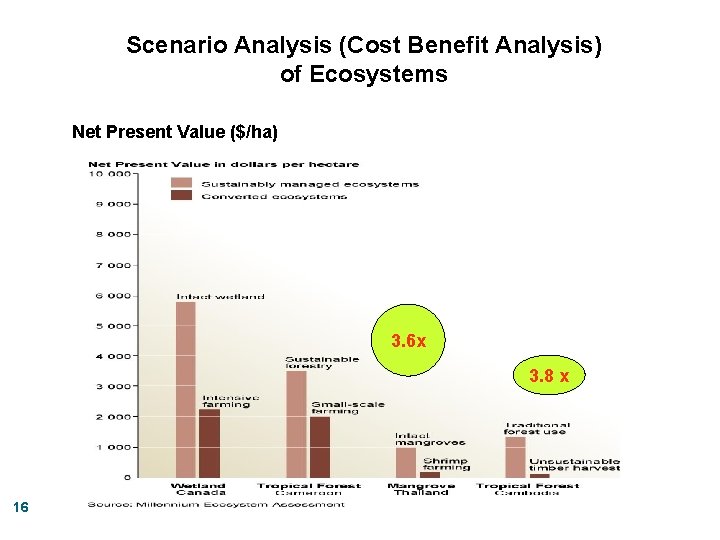
Scenario Analysis (Cost Benefit Analysis) of Ecosystems Net Present Value ($/ha) 3. 6 x 3. 8 x 16
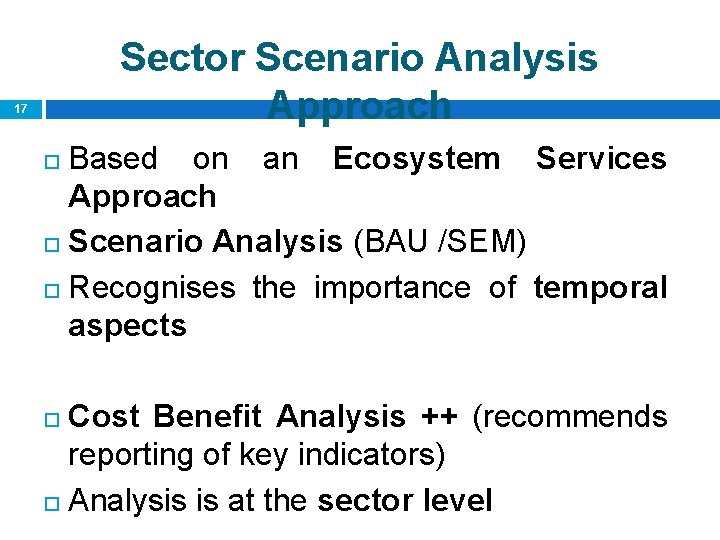
Sector Scenario Analysis Approach 17 Based on an Ecosystem Services Approach Scenario Analysis (BAU /SEM) Recognises the importance of temporal aspects Cost Benefit Analysis ++ (recommends reporting of key indicators) Analysis is at the sector level
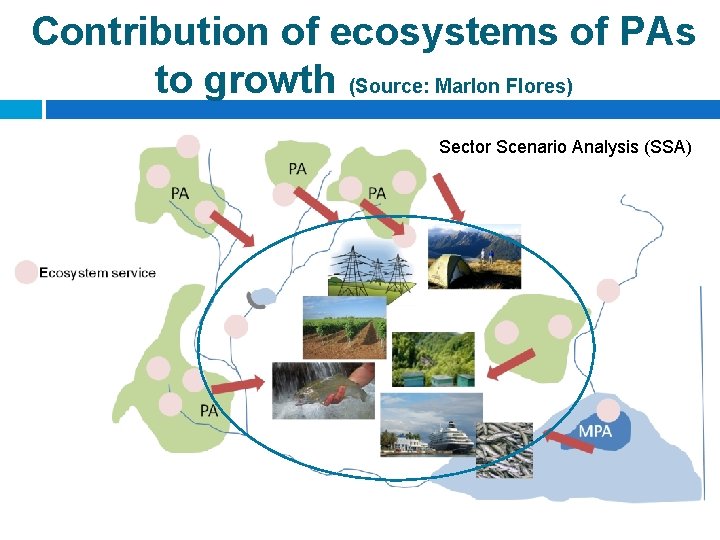
Contribution of ecosystems of PAs to growth (Source: Marlon Flores) Sector Scenario Analysis (SSA)
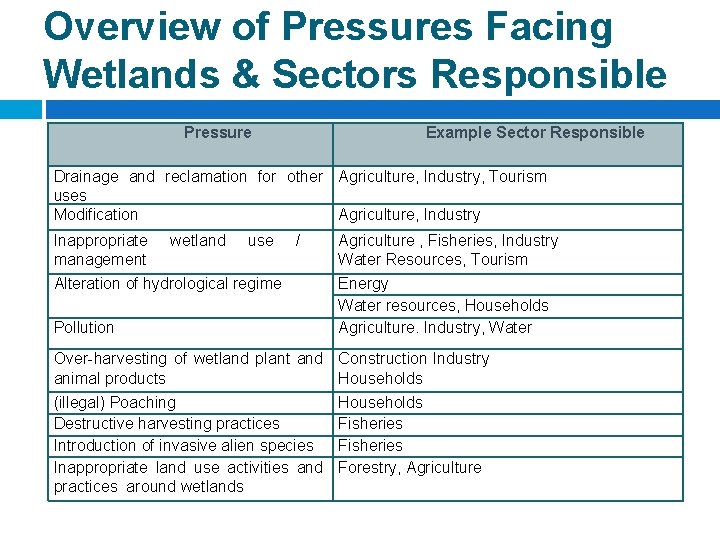
Overview of Pressures Facing Wetlands & Sectors Responsible Pressure Example Sector Responsible Drainage and reclamation for other Agriculture, Industry, Tourism uses Modification Agriculture, Industry Inappropriate management wetland use / Agriculture , Fisheries, Industry Water Resources, Tourism Alteration of hydrological regime Pollution Energy Water resources, Households Agriculture. Industry, Water Over-harvesting of wetland plant and Construction Industry animal products Households (illegal) Poaching Destructive harvesting practices Introduction of invasive alien species Inappropriate land use activities and practices around wetlands Households Fisheries Forestry, Agriculture
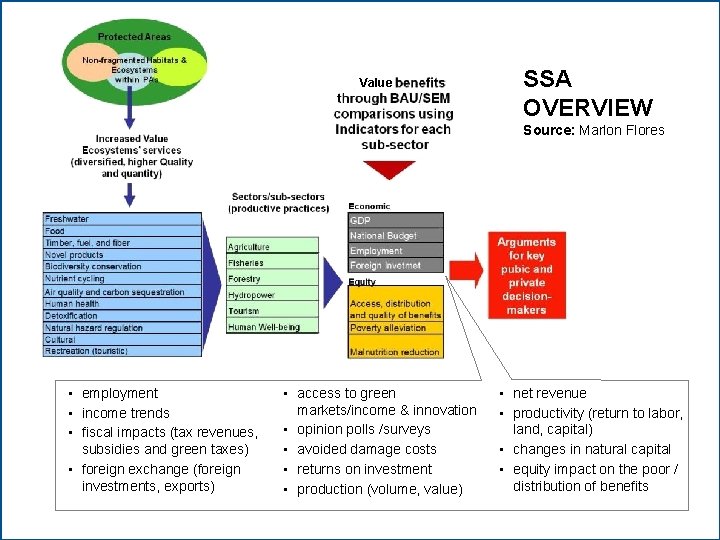
Value SSA OVERVIEW Source: Marlon Flores • employment • income trends • fiscal impacts (tax revenues, subsidies and green taxes) • foreign exchange (foreign investments, exports) • access to green markets/income & innovation • opinion polls /surveys • avoided damage costs • returns on investment • production (volume, value) • net revenue • productivity (return to labor, land, capital) • changes in natural capital • equity impact on the poor / distribution of benefits 20
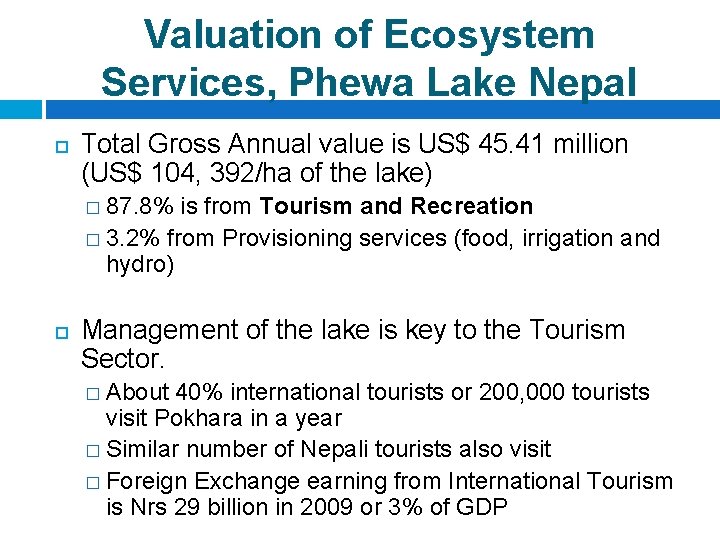
Valuation of Ecosystem Services, Phewa Lake Nepal Total Gross Annual value is US$ 45. 41 million (US$ 104, 392/ha of the lake) � 87. 8% is from Tourism and Recreation � 3. 2% from Provisioning services (food, irrigation and hydro) Management of the lake is key to the Tourism Sector. � About 40% international tourists or 200, 000 tourists visit Pokhara in a year � Similar number of Nepali tourists also visit � Foreign Exchange earning from International Tourism is Nrs 29 billion in 2009 or 3% of GDP
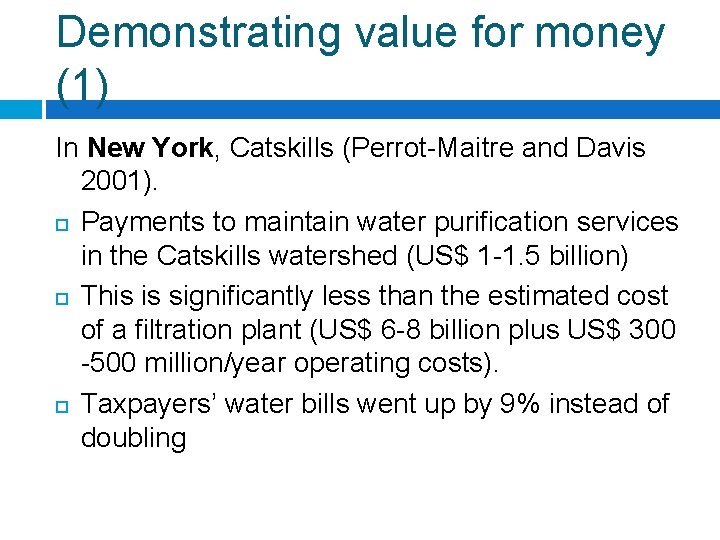
Demonstrating value for money (1) In New York, Catskills (Perrot-Maitre and Davis 2001). Payments to maintain water purification services in the Catskills watershed (US$ 1 -1. 5 billion) This is significantly less than the estimated cost of a filtration plant (US$ 6 -8 billion plus US$ 300 -500 million/year operating costs). Taxpayers’ water bills went up by 9% instead of doubling
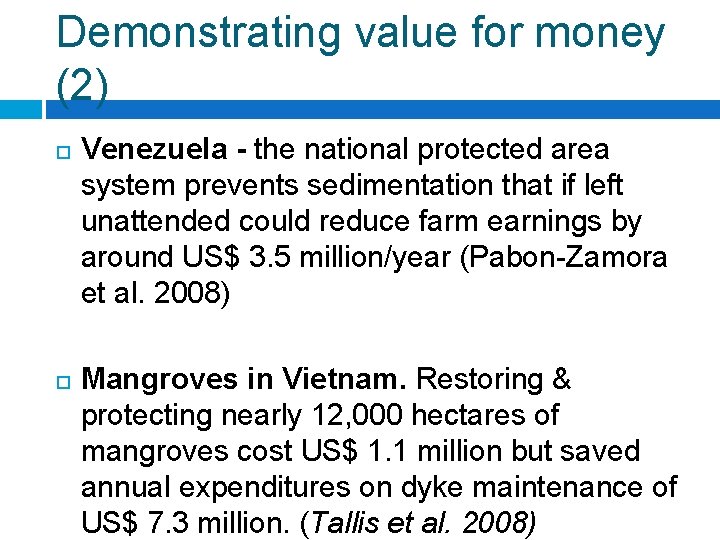
Demonstrating value for money (2) Venezuela - the national protected area system prevents sedimentation that if left unattended could reduce farm earnings by around US$ 3. 5 million/year (Pabon-Zamora et al. 2008) Mangroves in Vietnam. Restoring & protecting nearly 12, 000 hectares of mangroves cost US$ 1. 1 million but saved annual expenditures on dyke maintenance of US$ 7. 3 million. (Tallis et al. 2008)
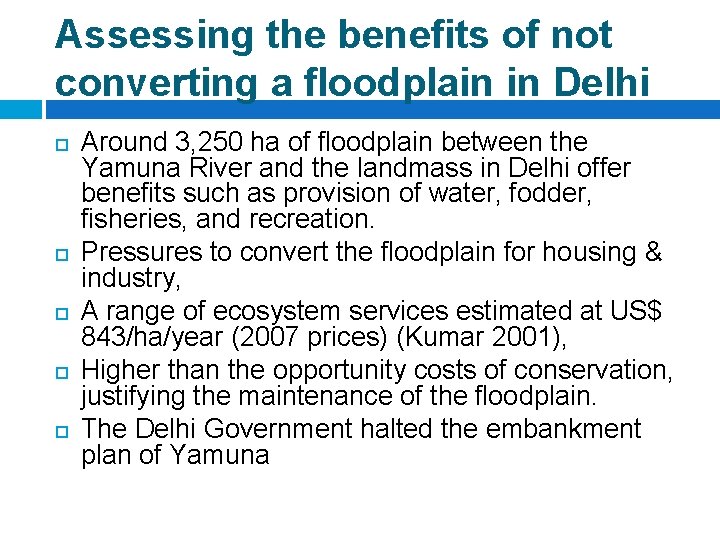
Assessing the benefits of not converting a floodplain in Delhi Around 3, 250 ha of floodplain between the Yamuna River and the landmass in Delhi offer benefits such as provision of water, fodder, fisheries, and recreation. Pressures to convert the floodplain for housing & industry, A range of ecosystem services estimated at US$ 843/ha/year (2007 prices) (Kumar 2001), Higher than the opportunity costs of conservation, justifying the maintenance of the floodplain. The Delhi Government halted the embankment plan of Yamuna
The Wetlands Reserve Program, USA A voluntary program offering landowners an opportunity to establish long-term conservation and wildlife protection in exchange for retiring eligible land from cultivation. The USDA Natural Resources Conservation Service (NRCS) goal is to achieve the greatest wetland functions and values, along with optimum wildlife habitat, on every acre enrolled in the program. There were 229 contracts in 1992 and 485 contracts in 2008. Funding for the WRP program was fairly steady between 2002 and 2008, averaging roughly US$246 million per year.
Key messages ! 26 Wetland Protected Areas represent natural capital If they are properly managed they provide a flow of vital services – water, flood control and recreation If they are badly managed these benefits are reduced or lost at an economic cost to society Sustainable management requires the integration of ecosystem services into planning to ensure trade-offs are properly evaluated Ecosystem services valuation underpins the
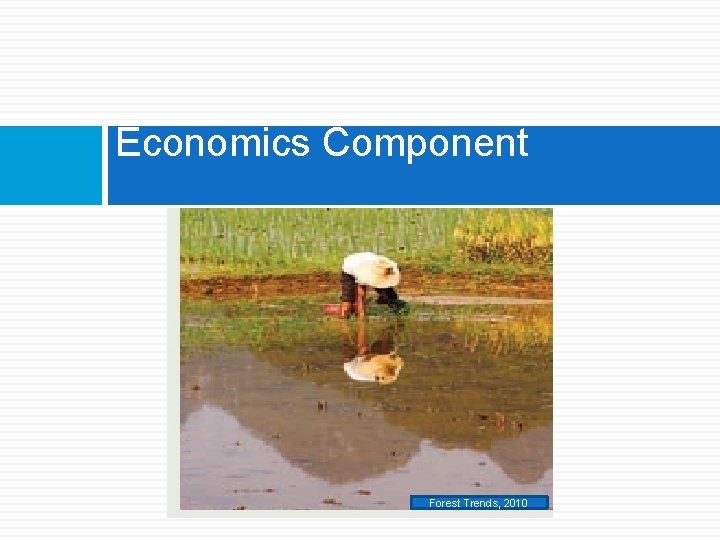
Economics Component F Forest Trends, 2010
Valuation Review of existing wetland valuation studies in China � Priority gaps � Evidence of value added of well functioning wetlands � Evidence of rates of return investment wetland conservation � Identify successful international experiences of internalising wetland values into national planning process Assess potential for adopting and institutionalising existing valuation tools & methodologies by the project
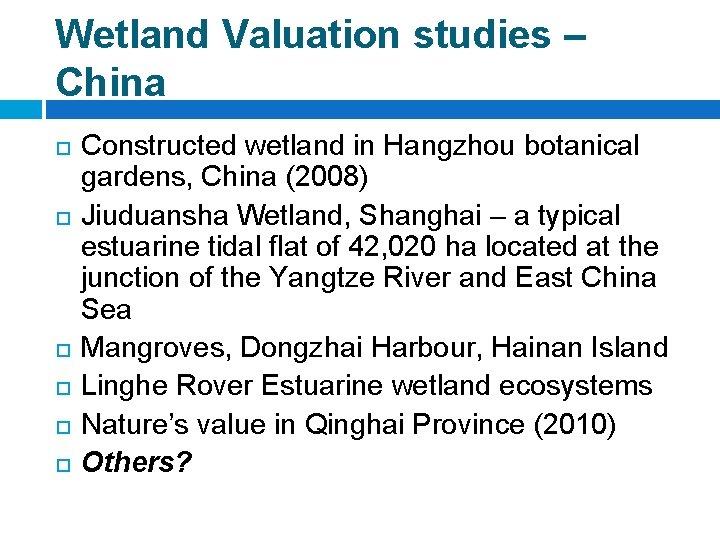
Wetland Valuation studies – China Constructed wetland in Hangzhou botanical gardens, China (2008) Jiuduansha Wetland, Shanghai – a typical estuarine tidal flat of 42, 020 ha located at the junction of the Yangtze River and East China Sea Mangroves, Dongzhai Harbour, Hainan Island Linghe Rover Estuarine wetland ecosystems Nature’s value in Qinghai Province (2010) Others?
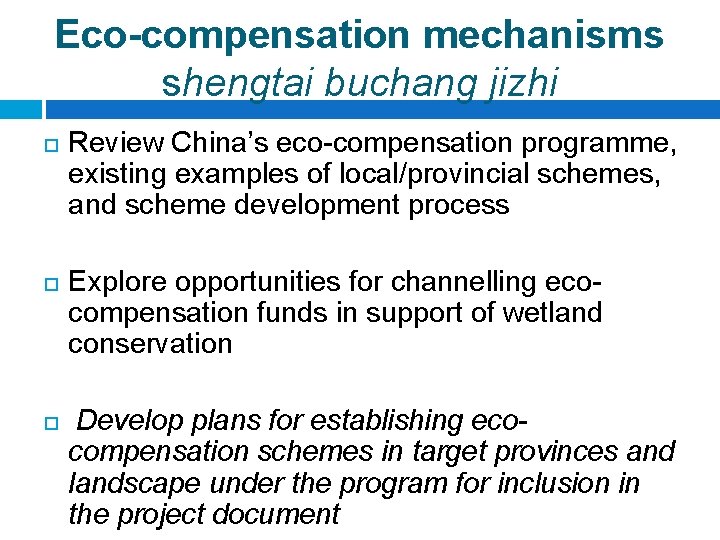
Eco-compensation mechanisms shengtai buchang jizhi Review China’s eco-compensation programme, existing examples of local/provincial schemes, and scheme development process Explore opportunities for channelling ecocompensation funds in support of wetland conservation Develop plans for establishing ecocompensation schemes in target provinces and landscape under the program for inclusion in the project document
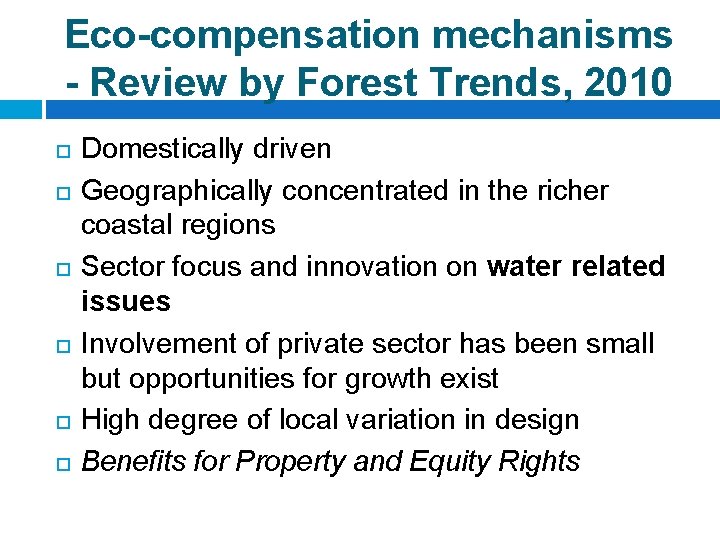
Eco-compensation mechanisms - Review by Forest Trends, 2010 Domestically driven Geographically concentrated in the richer coastal regions Sector focus and innovation on water related issues Involvement of private sector has been small but opportunities for growth exist High degree of local variation in design Benefits for Property and Equity Rights
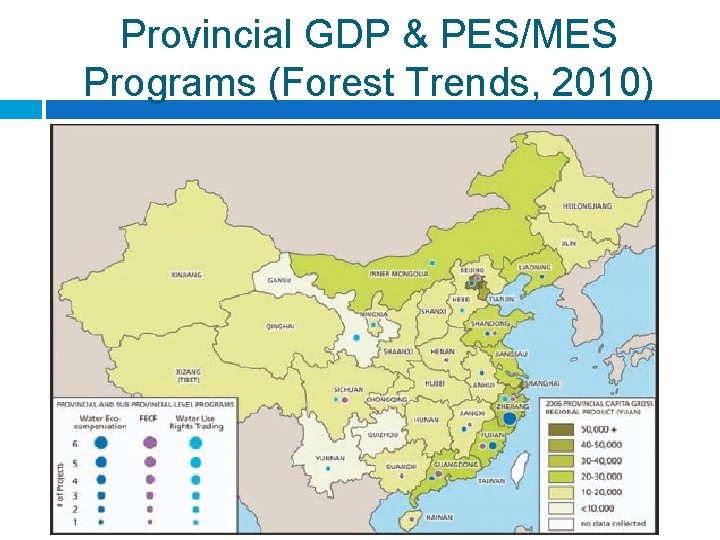
Provincial GDP & PES/MES Programs (Forest Trends, 2010)
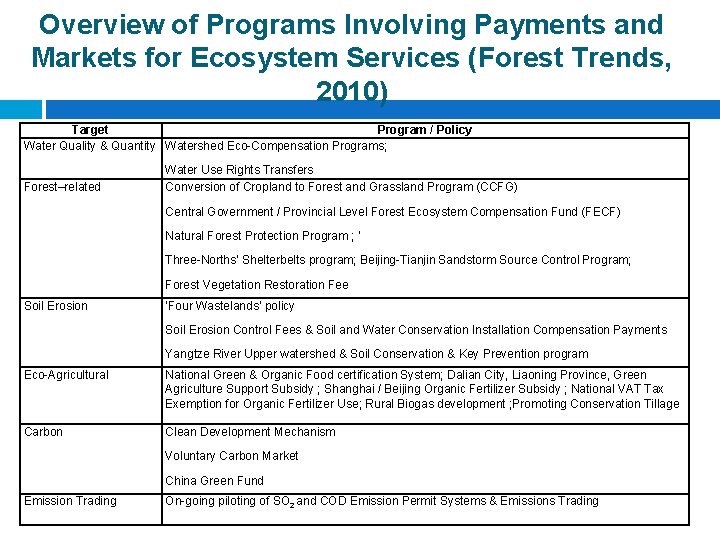
Overview of Programs Involving Payments and Markets for Ecosystem Services (Forest Trends, 2010) Target Program / Policy Water Quality & Quantity Watershed Eco-Compensation Programs; Forest–related Water Use Rights Transfers Conversion of Cropland to Forest and Grassland Program (CCFG) Central Government / Provincial Level Forest Ecosystem Compensation Fund (FECF) Natural Forest Protection Program ; ‘ Three-Norths’ Shelterbelts program; Beijing-Tianjin Sandstorm Source Control Program; Forest Vegetation Restoration Fee Soil Erosion ‘Four Wastelands’ policy Soil Erosion Control Fees & Soil and Water Conservation Installation Compensation Payments Yangtze River Upper watershed & Soil Conservation & Key Prevention program Eco-Agricultural National Green & Organic Food certification System; Dalian City, Liaoning Province, Green Agriculture Support Subsidy ; Shanghai / Beijing Organic Fertilizer Subsidy ; National VAT Tax Exemption for Organic Fertilizer Use; Rural Biogas development ; Promoting Conservation Tillage Carbon Clean Development Mechanism Voluntary Carbon Market China Green Fund Emission Trading On-going piloting of SO 2 and COD Emission Permit Systems & Emissions Trading
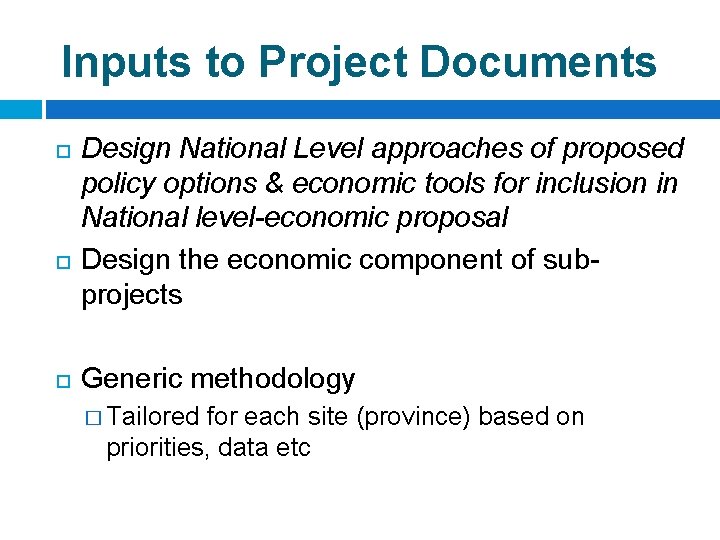
Inputs to Project Documents Design National Level approaches of proposed policy options & economic tools for inclusion in National level-economic proposal Design the economic component of subprojects Generic methodology � Tailored for each site (province) based on priorities, data etc
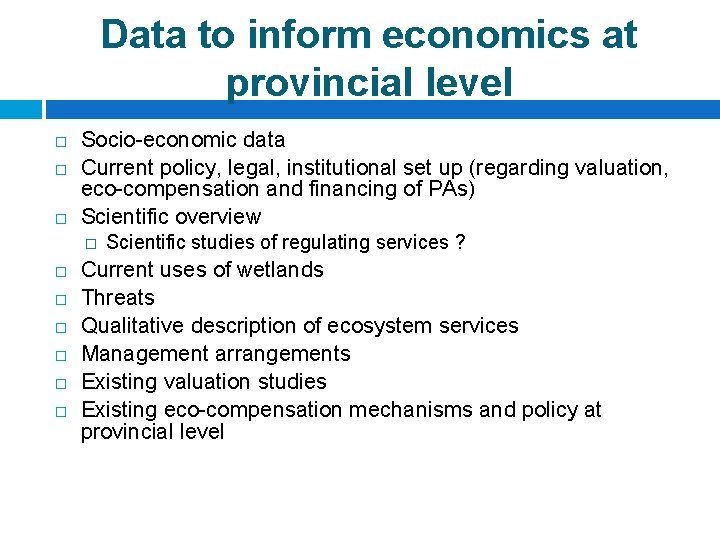
Data to inform economics at provincial level Socio-economic data Current policy, legal, institutional set up (regarding valuation, eco-compensation and financing of PAs) Scientific overview � Scientific studies of regulating services ? Current uses of wetlands Threats Qualitative description of ecosystem services Management arrangements Existing valuation studies Existing eco-compensation mechanisms and policy at provincial level
Thank you Camille. bann@envecconsulting. com The Nature Conservancy, 2012