
The role of DG Trisynaptic circuit in the


- Slides: 34
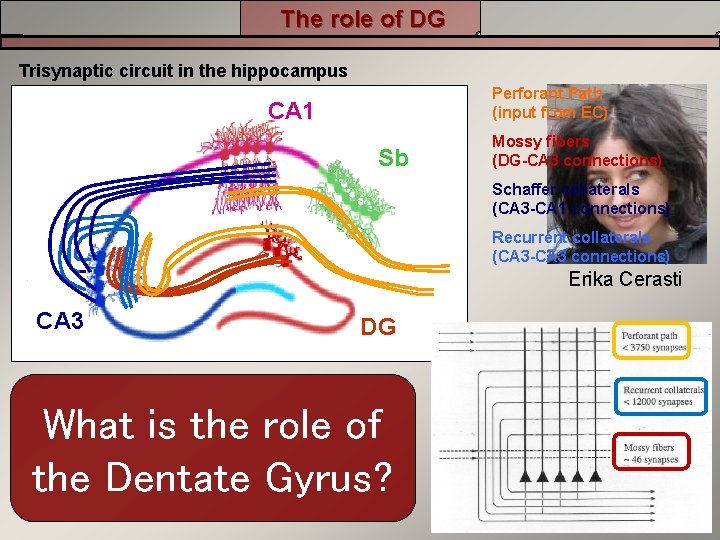
The role of DG Trisynaptic circuit in the hippocampus Perforant Path (input from EC) CA 1 Sb Mossy fibers (DG-CA 3 connections) Schaffer collaterals (CA 3 -CA 1 connections) Recurrent collaterals (CA 3 -CA 3 connections) Erika Cerasti CA 3 DG What is the role of the Dentate Gyrus? Introduction
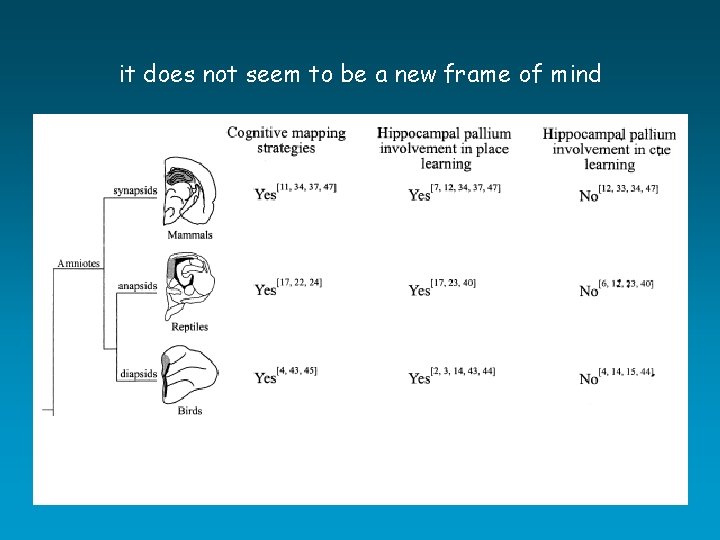
it does not seem to be a new frame of mind Rodriguez et al, 2002 and others from the Sevilla group
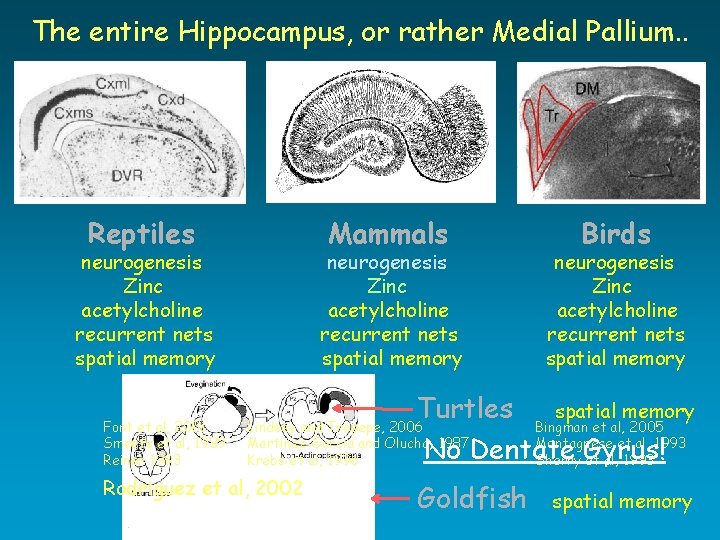
The entire Hippocampus, or rather Medial Pallium. . Reptiles Mammals neurogenesis Zinc acetylcholine recurrent nets spatial memory Font et al, 2001 Smeets et al, 1989 Reiner 1993 neurogenesis Zinc acetylcholine recurrent nets spatial memory Birds neurogenesis Zinc acetylcholine recurrent nets spatial memory Turtles Bingman spatial memory et al, 2005 Montagnese et al, 1993 No Dentate Sherry Gyrus! et al, 1993 Lindsey and Tropepe, 2006 Martinez-Garcia and Olucha, 1987 Krebs et al, 1996 Rodriguez et al, 2002 Goldfish spatial memory
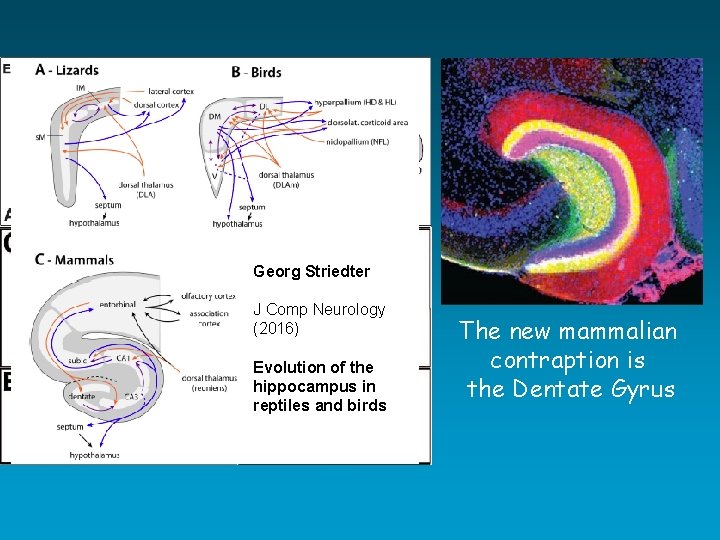
Georg Striedter J Comp Neurology (2016) Evolution of the hippocampus in reptiles and birds The new mammalian contraption is the Dentate Gyrus
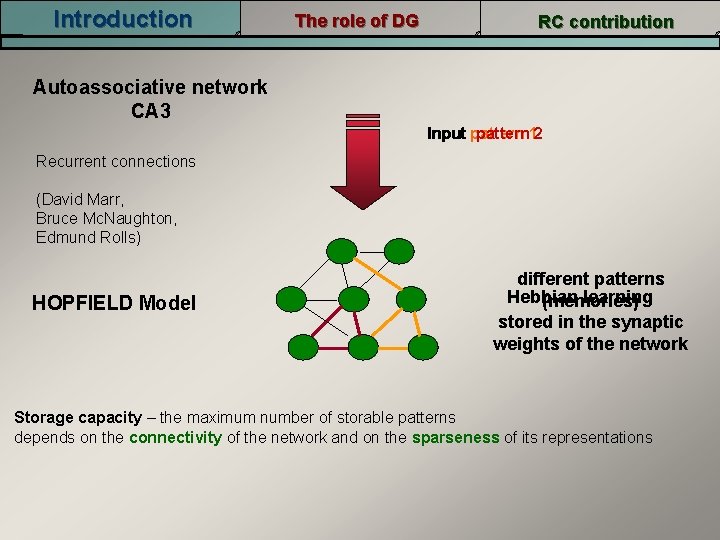
Introduction The role of DG RC contribution Autoassociative network CA 3 Input pattern 12 Recurrent connections (David Marr, Bruce Mc. Naughton, Edmund Rolls) HOPFIELD Model different patterns Hebbian learning (memories) stored in the synaptic weights of the network Storage capacity – the maximum number of storable patterns depends on the connectivity of the network and on the sparseness of its representations
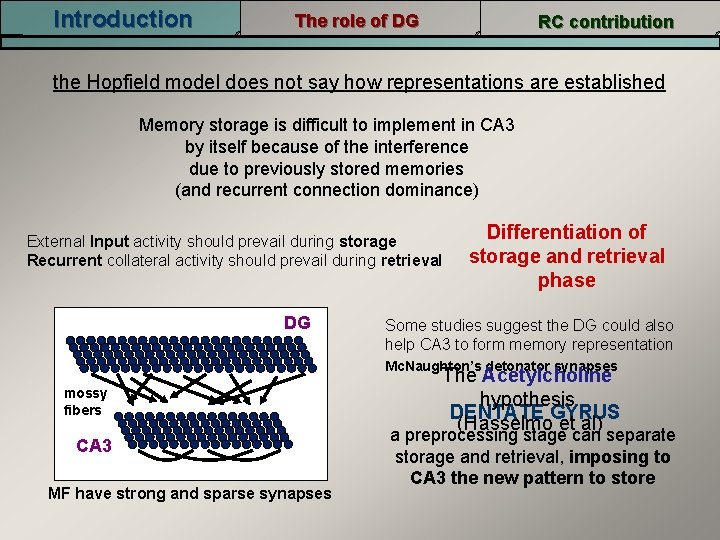
Introduction The role of DG RC contribution the Hopfield model does not say how representations are established Memory storage is difficult to implement in CA 3 by itself because of the interference due to previously stored memories (and recurrent connection dominance) External Input activity should prevail during storage Recurrent collateral activity should prevail during retrieval DG External input Differentiation of storage and retrieval phase Some studies suggest the DG could also help CA 3 to form memory representation Mc. Naughton’s detonator synapses mossy fibers CA 3 MF have strong and sparse synapses The Acetylcholine hypothesis DENTATE GYRUS (Hasselmo et al) a preprocessing stage can separate storage and retrieval, imposing to CA 3 the new pattern to store
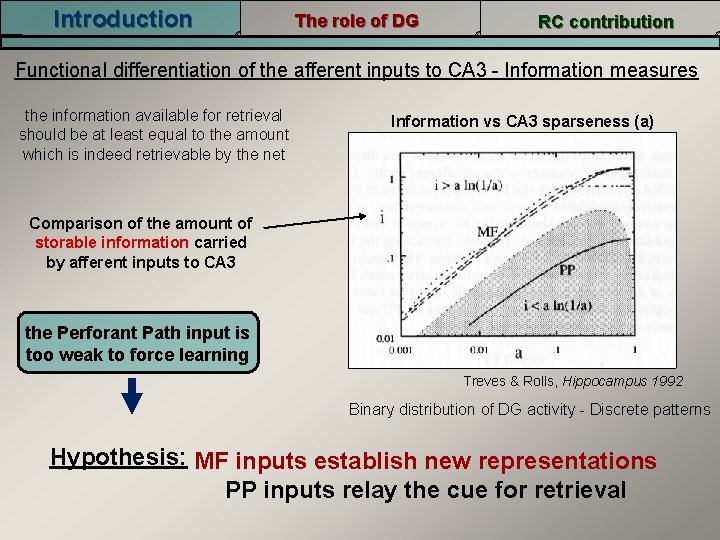
Introduction The role of DG RC contribution Functional differentiation of the afferent inputs to CA 3 - Information measures the information available for retrieval should be at least equal to the amount which is indeed retrievable by the net Information vs CA 3 sparseness (a) Comparison of the amount of storable information carried by afferent inputs to CA 3 the Perforant Path input is too weak to force learning Treves & Rolls, Hippocampus 1992 Binary distribution of DG activity - Discrete patterns Hypothesis: MF inputs establish new representations PP inputs relay the cue for retrieval
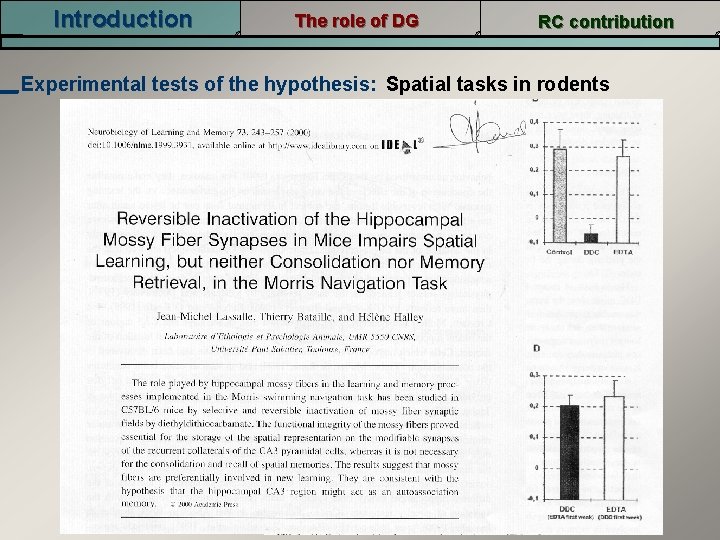
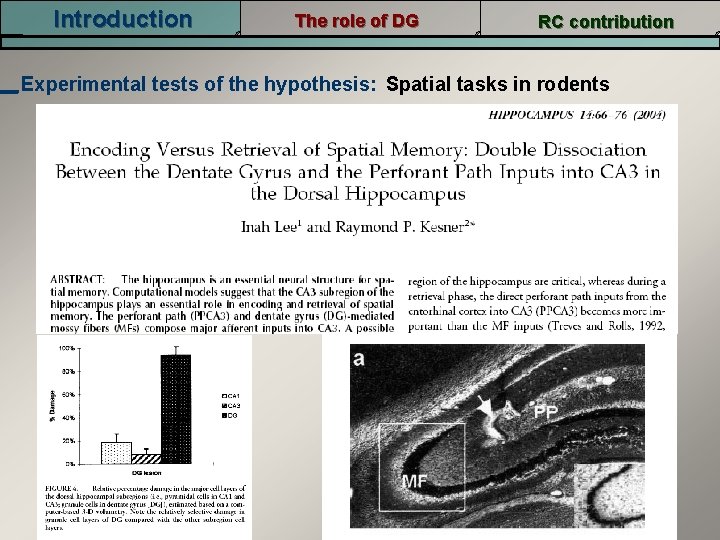
Introduction The role of DG RC contribution Experimental tests of the hypothesis: Spatial tasks in rodents
Introduction The role of DG RC contribution Experimental tests of the hypothesis: Spatial tasks in rodents
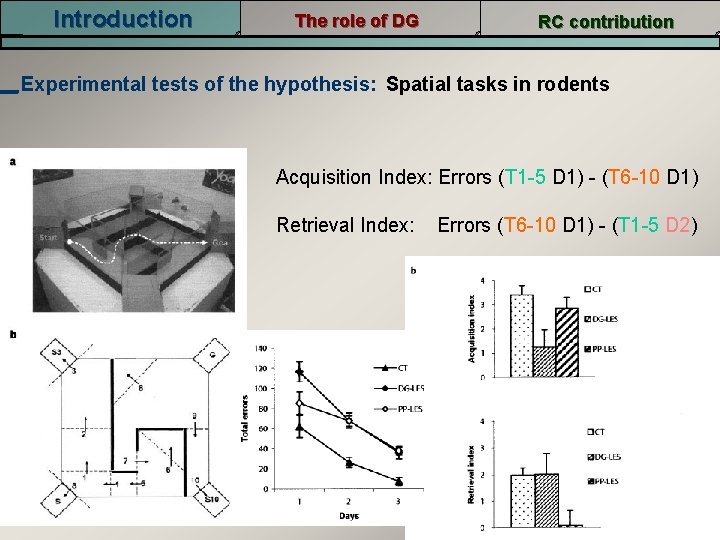
Introduction The role of DG RC contribution Experimental tests of the hypothesis: Spatial tasks in rodents Acquisition Index: Errors (T 1 -5 D 1) - (T 6 -10 D 1) Retrieval Index: Errors (T 6 -10 D 1) - (T 1 -5 D 2)
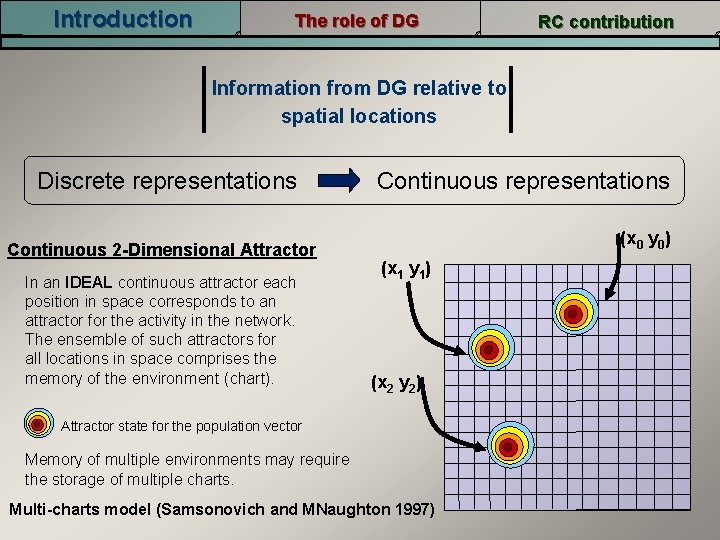
Introduction The role of DG RC contribution Information from DG relative to spatial locations Discrete representations Continuous 2 -Dimensional Attractor In an IDEAL continuous attractor each position in space corresponds to an attractor for the activity in the network. The ensemble of such attractors for all locations in space comprises the memory of the environment (chart). Continuous representations (x 0 y 0) (x 1 y 1) (x 2 y 2) Attractor state for the population vector Memory of multiple environments may require the storage of multiple charts. Multi-charts model (Samsonovich and MNaughton 1997)
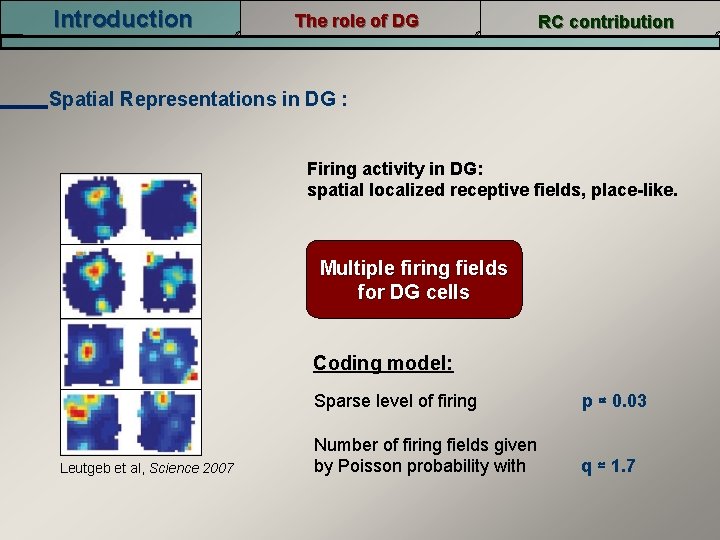
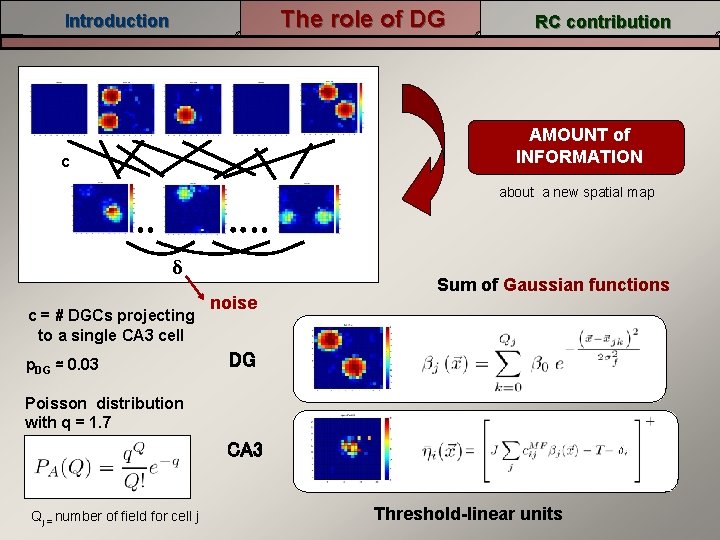
Introduction The role of DG RC contribution Spatial Representations in DG : Firing activity in DG: spatial localized receptive fields, place-like. Multiple firing fields for DG cells Coding model: Leutgeb et al, Science 2007 Sparse level of firing p ≃ 0. 03 Number of firing fields given by Poisson probability with q ≃ 1. 7
Model
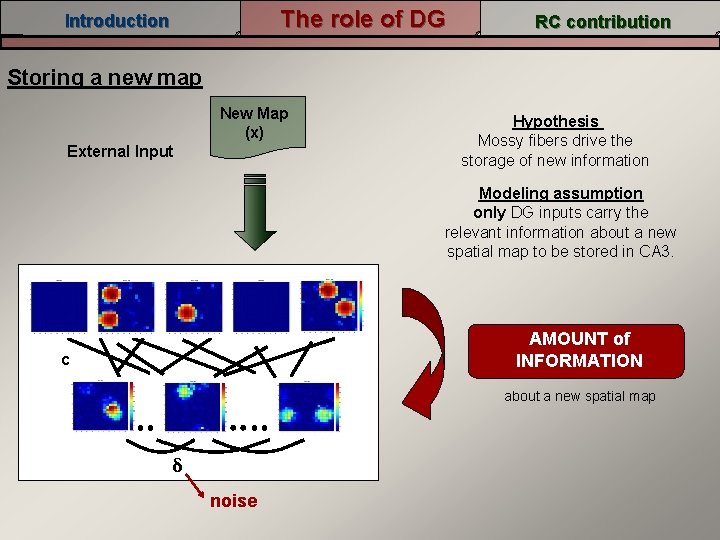
The role of DG Introduction RC contribution Storing a new map New Map (x) Hypothesis Mossy fibers drive the storage of new information External Input Modeling assumption only DG inputs carry the relevant information about a new spatial map to be stored in CA 3. DG AMOUNT of INFORMATION c mossy fibers about a new spatial map CA 3 δ noise
The role of DG Introduction RC contribution DG AMOUNT of INFORMATION c c about a new spatial map CA 3 δ c = # DGCs projecting to a single CA 3 cell p. DG ≃ 0. 03 noise Sum of Gaussian functions DG Poisson distribution with q = 1. 7 CA 3 Qj = number of field for cell j Threshold-linear units
Analytical Calculation
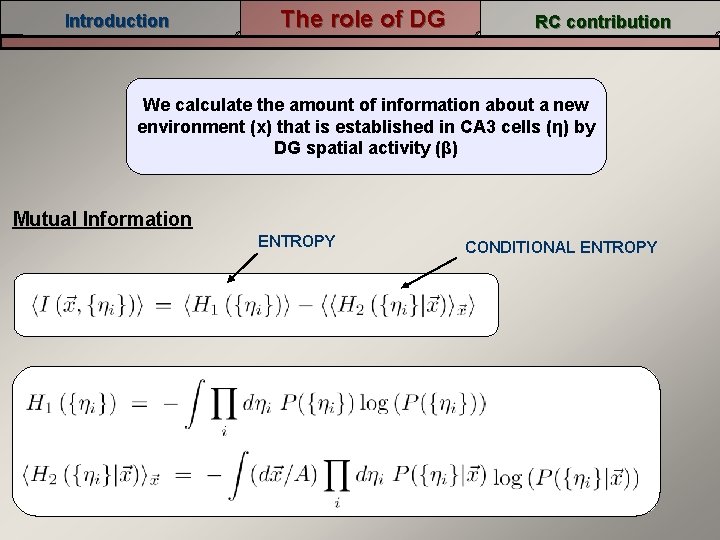
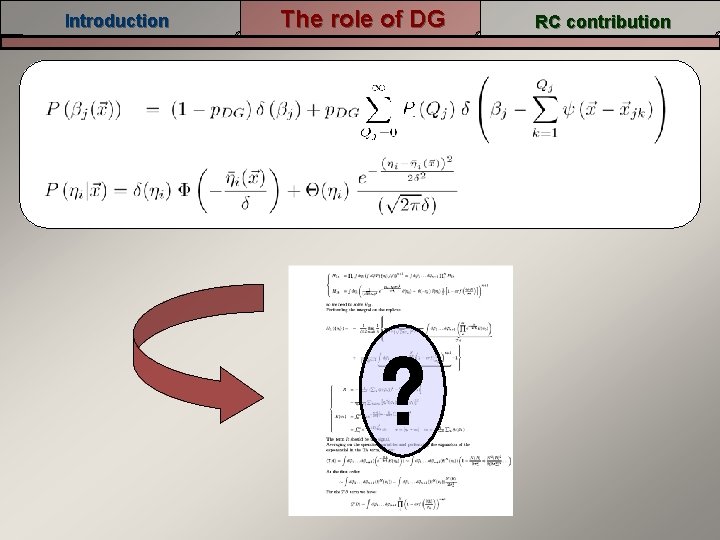
Introduction The role of DG RC contribution We calculate the amount of information about a new environment (x) that is established in CA 3 cells (η) by DG spatial activity (β) Mutual Information ENTROPY CONDITIONAL ENTROPY
Introduction The role of DG ? RC contribution
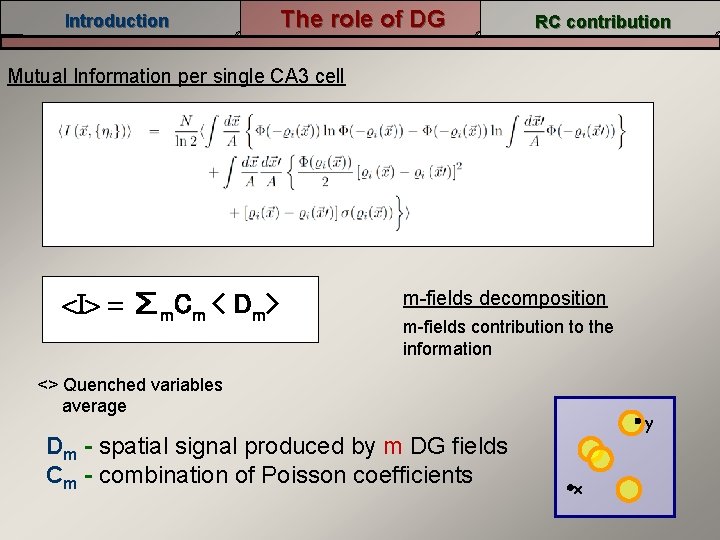
Introduction The role of DG RC contribution Mutual Information per single CA 3 cell <I> = ∑m. Cm < Dm> m-fields decomposition m-fields contribution to the information <> Quenched variables average Dm - spatial signal produced by m DG fields Cm - combination of Poisson coefficients y x
Simulations
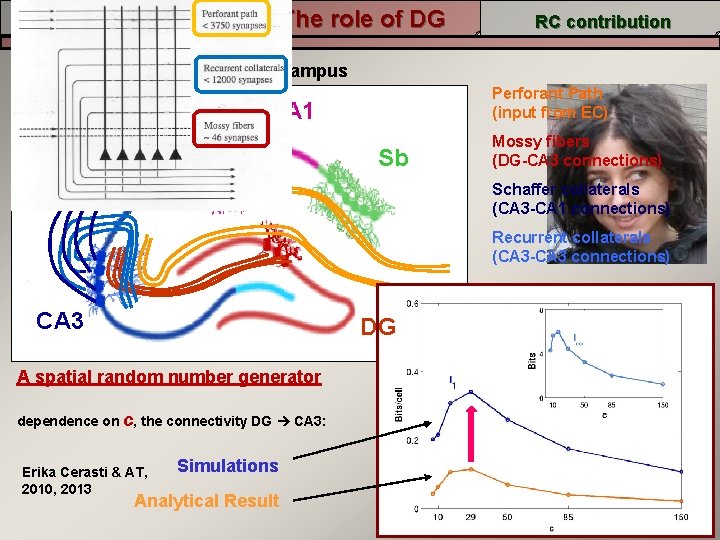
The role of DG Introduction RC contribution Trisynaptic circuit in the hippocampus Perforant Path (input from EC) CA 1 Sb Mossy fibers (DG-CA 3 connections) Schaffer collaterals (CA 3 -CA 1 connections) Recurrent collaterals (CA 3 -CA 3 connections) CA 3 DG A spatial random number generator dependence on c, the connectivity DG CA 3: Erika Cerasti & AT, 2010, 2013 Simulations Analytical Result
Adding Recurrent Collaterals Continuous Attractors? Pre-wired vs self-organized
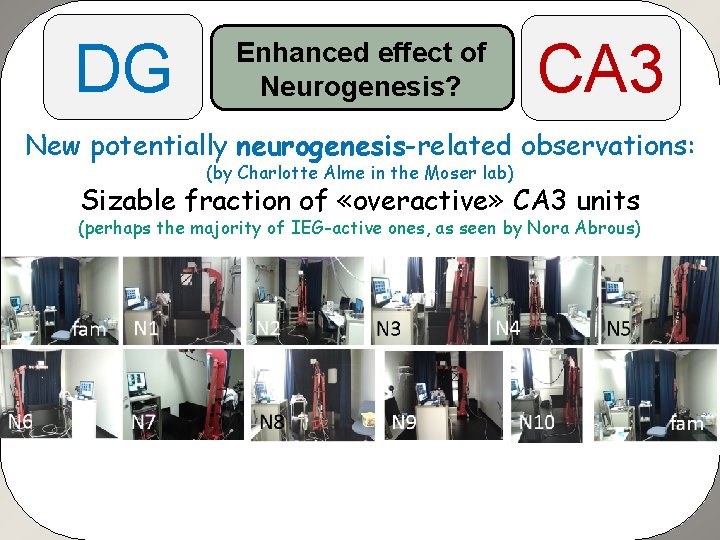
DG Enhanced effect of Neurogenesis? CA 3 New potentially neurogenesis-related observations: (by Charlotte Alme in the Moser lab) Sizable fraction of «overactive» CA 3 units (perhaps the majority of IEG-active ones, as seen by Nora Abrous)
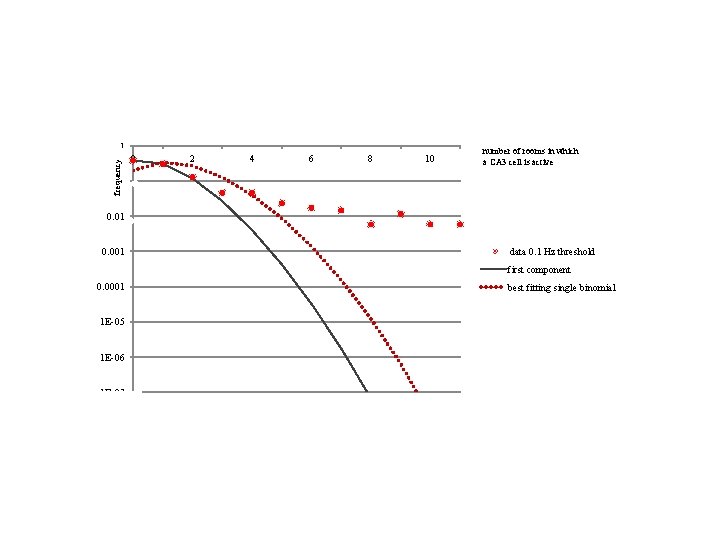
frequency 1 0 2 4 6 8 10 number of rooms in which a CA 3 cell is active 0. 1 0. 001 data 0. 1 Hz threshold first component 0. 0001 1 E-05 1 E-06 1 E-07 best fitting single binomial
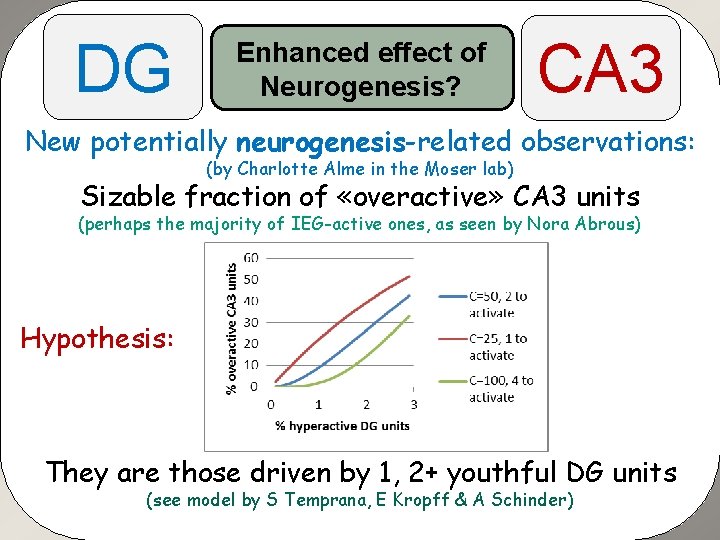
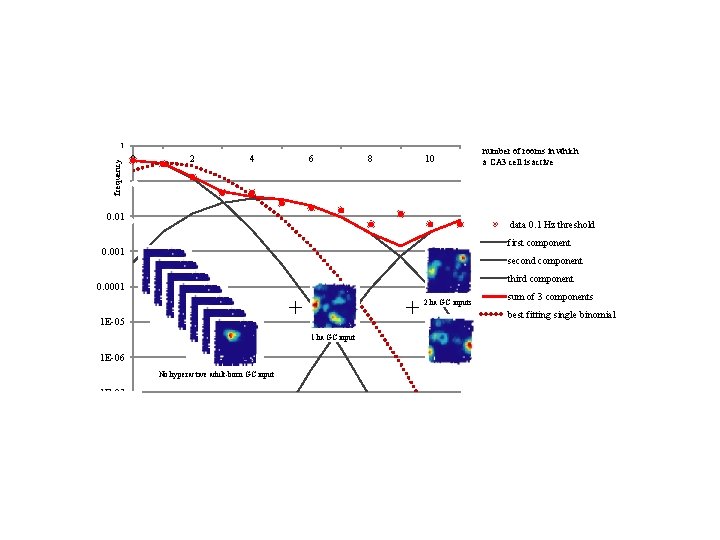
DG Enhanced effect of Neurogenesis? CA 3 New potentially neurogenesis-related observations: (by Charlotte Alme in the Moser lab) Sizable fraction of «overactive» CA 3 units (perhaps the majority of IEG-active ones, as seen by Nora Abrous) Hypothesis: They are those driven by 1, 2+ youthful DG units (see model by S Temprana, E Kropff & A Schinder)
frequency 1 0 2 4 6 8 10 number of rooms in which a CA 3 cell is active 0. 1 0. 01 data 0. 1 Hz threshold first component 0. 001 second component third component 0. 0001 + + 1 E-05 1 ha GC input 1 E-06 No hyperactive adult-born GC input 1 E-07 2 ha GC inputs sum of 3 components best fitting single binomial
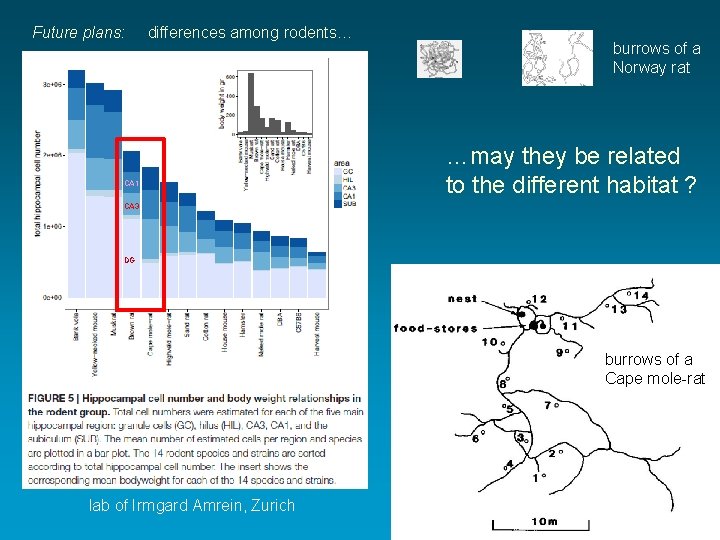
Future plans: differences among rodents… CA 1 burrows of a Norway rat …may they be related to the different habitat ? CA 3 DG burrows of a Cape mole-rat lab of Irmgard Amrein, Zurich
If not before, then stop here, please.
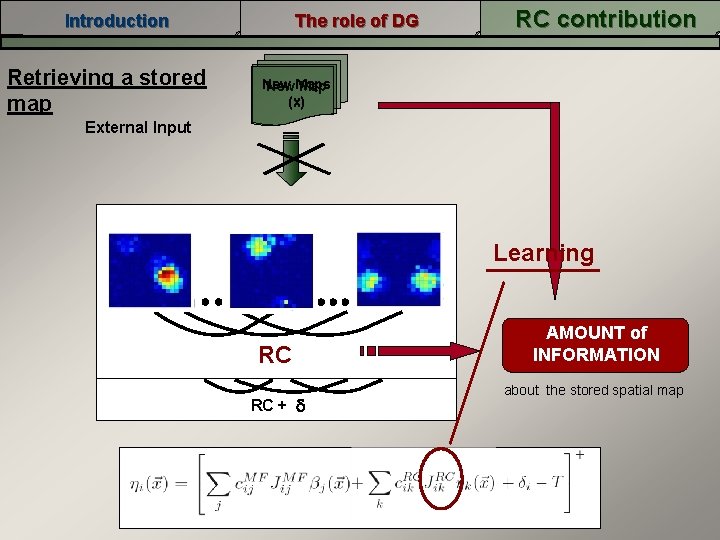
Introduction Retrieving a stored map The role of DG RC contribution New. Maps Map (x) External Input Learning c MF RC RC + AMOUNT of INFORMATION about the stored spatial map
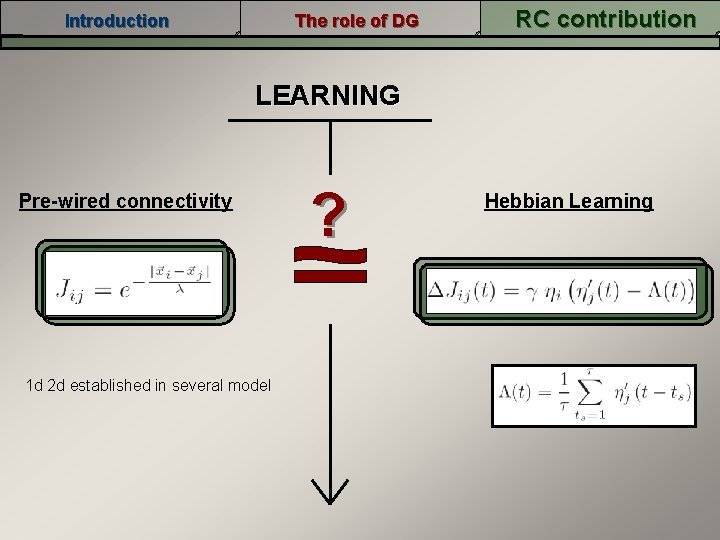
Introduction The role of DG RC contribution LEARNING Pre-wired connectivity 1 d 2 d established in several model ? Hebbian Learning
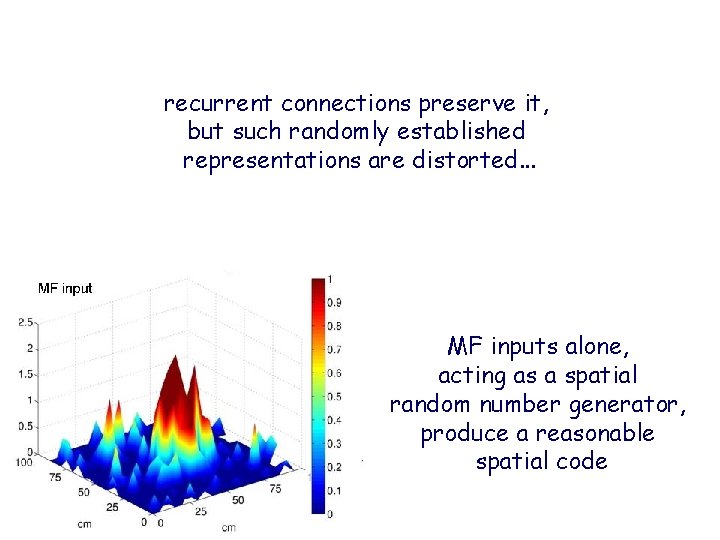
accurate distorted recurrent connections preserve it, but such randomly established representations are distorted. . . MF inputs alone, acting as a spatial random number generator, produce a reasonable spatial code
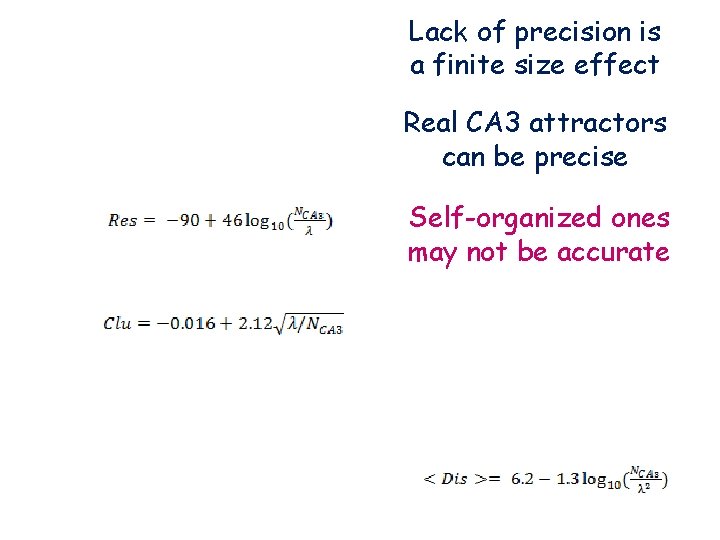
Lack of precision is a finite size effect λ=1 self-org λ=2 Real CA 3 attractors can be precise Self-organized ones may not be accurate
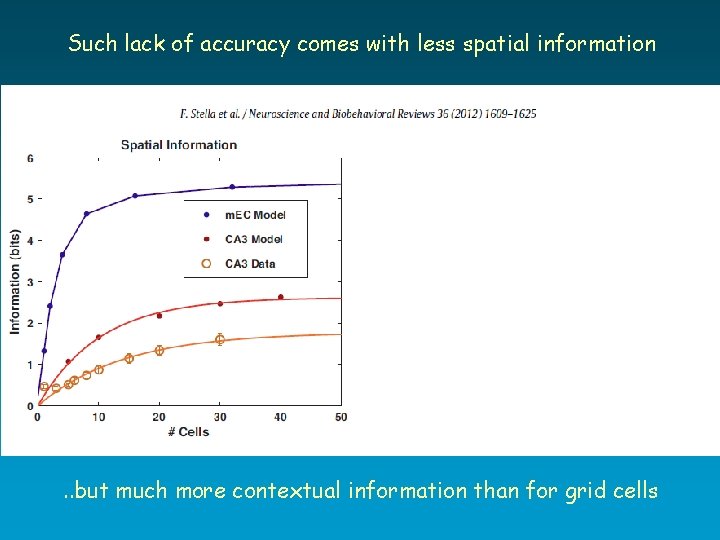
Such lack of accuracy comes with less spatial information . . but much more contextual information than for grid cells
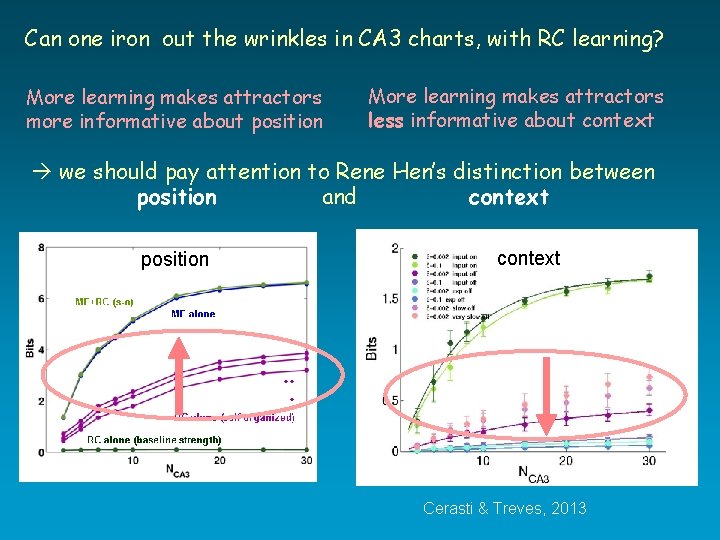
Can one iron out the wrinkles in CA 3 charts, with RC learning? More learning makes attractors more informative about position More learning makes attractors less informative about context we should pay attention to Rene Hen’s distinction between position and context position context Cerasti & Treves, 2013