
THE ROLE OF DBE IN DELIVERING THE CURRICULUM
THE ROLE OF DBE IN DELIVERING THE CURRICULUM: PHYSICAL EDUCATION
INTRODUCTION • Prior to 1994, Physical Education (PE) was recognized as an approved subject but it was approached differently by the separate education departments. • A lack of qualified teachers and resources mitigated against the roll-out of an effective Physical Education programme in all schools. • More time was given to subjects like Mathematics and Science than to Physical Education.
INTRODUCTION • The merging of the previously separate education departments brought about the introduction of a single curriculum. As a result, Physical Education forms a compulsory part of the South African school curriculum in all grades. • In Curriculum 2005 (C 2005) and the National Curriculum Statement (NCS) Physical Education (PE) was re-introduced as part of Life Orientation. • Presently in the Curriculum and Assessment Policy Statement (CAPS) PE is included in Life Skills in Grades R-6 and in Life Orientation in Grades 7 -12.
POLICY: CAPS LIFE SKILLS/LIFE ORIENTATION • The Life Skills/Life Orientation curriculum is central to the holistic development of learners. • It is concerned with the social, personal, intellectual, emotional and physical growth of learners. • The Life Skills/Life Orientation curriculum addresses the development skills, knowledge, values and attitudes that enable learners to make informed decisions about their personal lifestyles, civic responsibilities, physical wellbeing, careers etc.
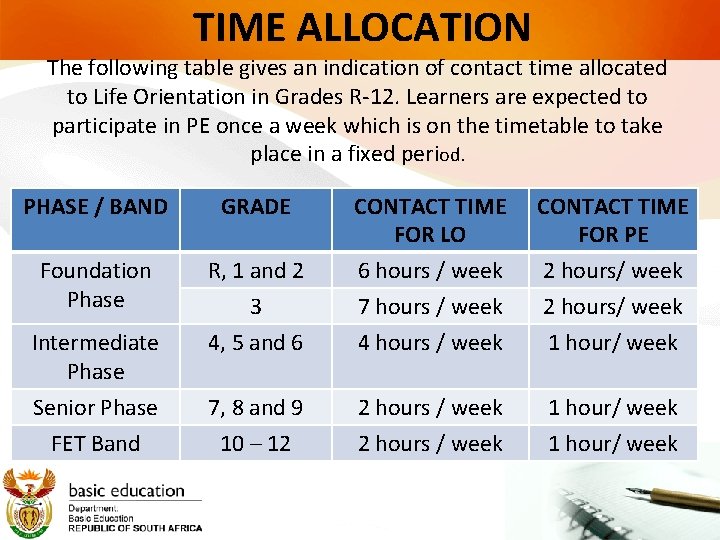
TIME ALLOCATION The following table gives an indication of contact time allocated to Life Orientation in Grades R-12. Learners are expected to participate in PE once a week which is on the timetable to take place in a fixed period. PHASE / BAND GRADE R, 1 and 2 3 CONTACT TIME FOR LO 6 hours / week 7 hours / week CONTACT TIME FOR PE 2 hours/ week Foundation Phase Intermediate Phase Senior Phase FET Band 4, 5 and 6 4 hours / week 1 hour/ week 7, 8 and 9 10 – 12 2 hours / week 1 hour/ week
TOPICS AND CONTENT PER GRADE • The content for PE across the phases relates to each other. • Each phase focuses on similar areas of skills, knowledge and values and prepares learners to continue with the subject in other grades – thus ensuring continuity. • The tables that follow highlight the topics/focus areas for PE in each of the grades/phases.
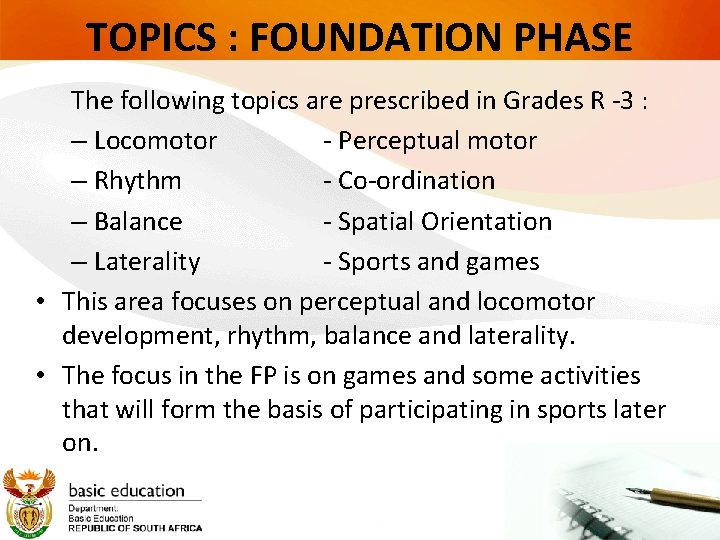
TOPICS : FOUNDATION PHASE The following topics are prescribed in Grades R -3 : – Locomotor - Perceptual motor – Rhythm - Co-ordination – Balance - Spatial Orientation – Laterality - Sports and games • This area focuses on perceptual and locomotor development, rhythm, balance and laterality. • The focus in the FP is on games and some activities that will form the basis of participating in sports later on.
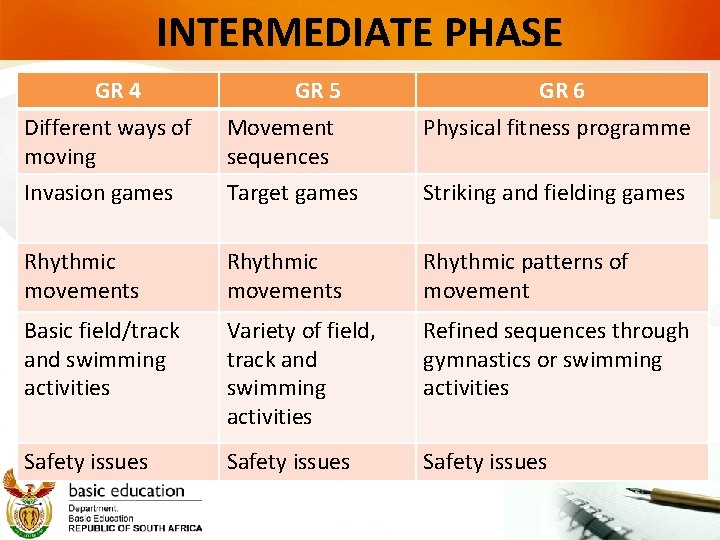
INTERMEDIATE PHASE GR 4 GR 5 GR 6 Different ways of moving Invasion games Movement sequences Target games Physical fitness programme Rhythmic movements Rhythmic patterns of movement Basic field/track and swimming activities Variety of field, track and swimming activities Refined sequences through gymnastics or swimming activities Safety issues Striking and fielding games
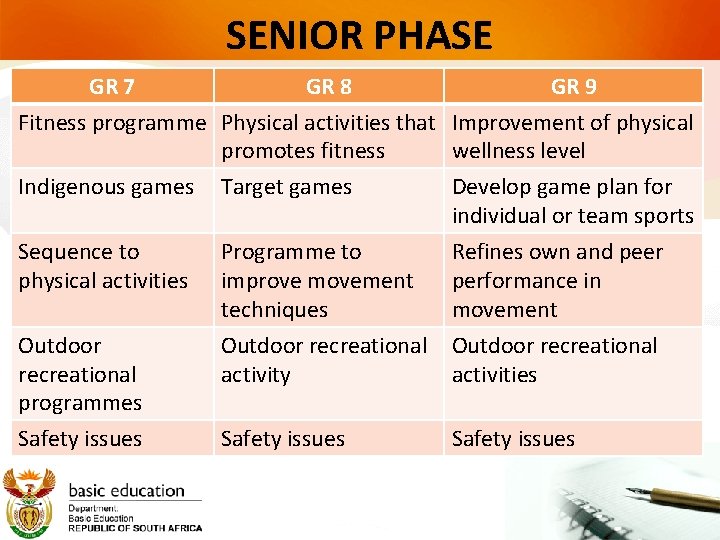
SENIOR PHASE GR 7 GR 8 GR 9 Fitness programme Physical activities that Improvement of physical promotes fitness wellness level Indigenous games Target games Develop game plan for individual or team sports Sequence to physical activities Outdoor recreational programmes Safety issues Programme to improve movement techniques Outdoor recreational activity Refines own and peer performance in movement Outdoor recreational activities Safety issues
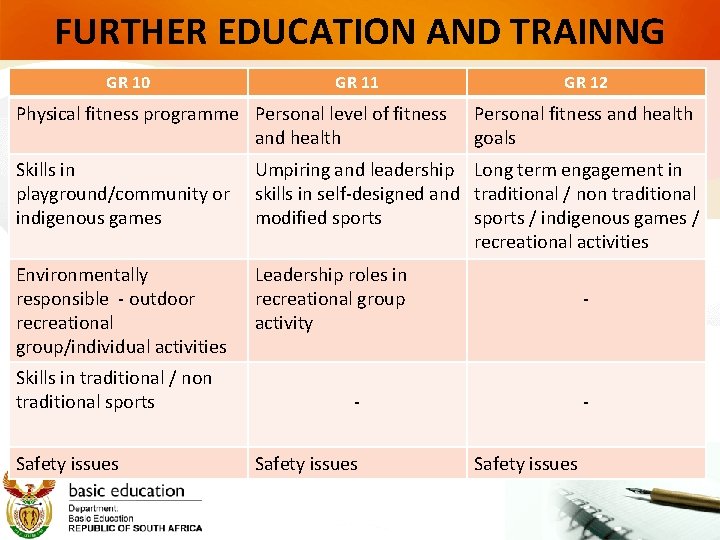
FURTHER EDUCATION AND TRAINNG GR 10 GR 11 Physical fitness programme Personal level of fitness and health GR 12 Personal fitness and health goals Skills in playground/community or indigenous games Umpiring and leadership Long term engagement in skills in self-designed and traditional / non traditional modified sports / indigenous games / recreational activities Environmentally responsible - outdoor recreational group/individual activities Leadership roles in recreational group activity Skills in traditional / non traditional sports Safety issues - Safety issues
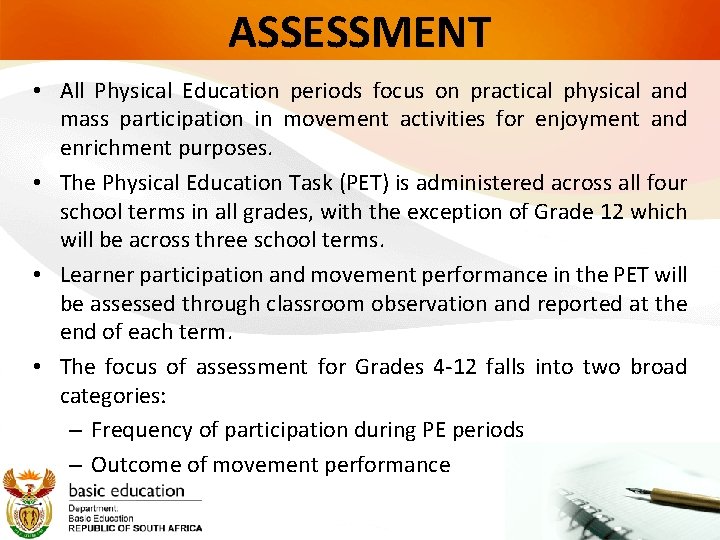
ASSESSMENT • All Physical Education periods focus on practical physical and mass participation in movement activities for enjoyment and enrichment purposes. • The Physical Education Task (PET) is administered across all four school terms in all grades, with the exception of Grade 12 which will be across three school terms. • Learner participation and movement performance in the PET will be assessed through classroom observation and reported at the end of each term. • The focus of assessment for Grades 4 -12 falls into two broad categories: – Frequency of participation during PE periods – Outcome of movement performance
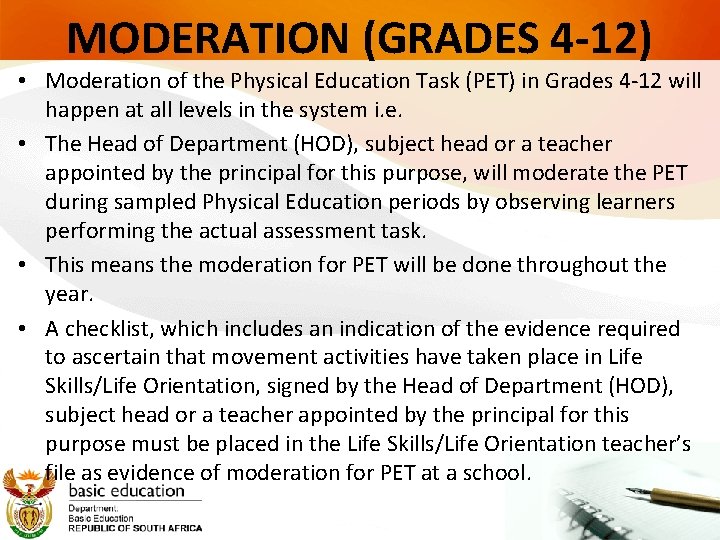
MODERATION (GRADES 4 -12) • Moderation of the Physical Education Task (PET) in Grades 4 -12 will happen at all levels in the system i. e. • The Head of Department (HOD), subject head or a teacher appointed by the principal for this purpose, will moderate the PET during sampled Physical Education periods by observing learners performing the actual assessment task. • This means the moderation for PET will be done throughout the year. • A checklist, which includes an indication of the evidence required to ascertain that movement activities have taken place in Life Skills/Life Orientation, signed by the Head of Department (HOD), subject head or a teacher appointed by the principal for this purpose must be placed in the Life Skills/Life Orientation teacher’s file as evidence of moderation for PET at a school.
INCLUSIVITY • CAPS makes provision for all learners to be accommodated in PE. • Learners with disabilities need to experience the same quality of PE and be offered equivalent opportunities for physical activity that are offered to other learners, but with modification to meet their needs. • Some activities will have more restrictions than others and some will be less vigorous than others depending on the needs.
INCLUSIVITY • The teacher in conjunction with other supporting staff will decide if the PE programme requires mild, moderate or limited participation. • Teachers adapt, modify and change the activity and or equipment to meet the special needs of learners. • The goal is to ensure the learner is progressing and having some form of success.
SHORTAGE OF RESOURCES • Not all schools have the basic equipment and facilities required to present movement activities. • Teachers should be trained in the improvisation of equipment and the effective use of available facilities until such time schools are fully equipped with such resources. • Initiatives are currently in place to address the shortfall of equipment and facilities in schools.
SUPPORTING PHYSICAL EDUCATION Shortage of teachers with a PE qualification • Not all teachers who currently teach Life Skills/Life Orientation are qualified to teach the Physical Education component of the Life Skills/Life Orientation curriculum. • While the movement outcome is a compulsory focus area, many teachers still do not feel confident to teach and assess it.
LONG-TERM PARTICIPANT DEVELOPMENT MODEL • South African Sport for Life (SAS 4 L) Long-Term Participant Development Model (LTPD) is a strategic initiative to enhance the following: – Health, wellness and personal fitness – Participation in physical activity and recreational activities – Participation in sport training and high performance sports by the citizens of South Africa • It is based on the concept of physical literacy which is the foundation of participation and performance. 17
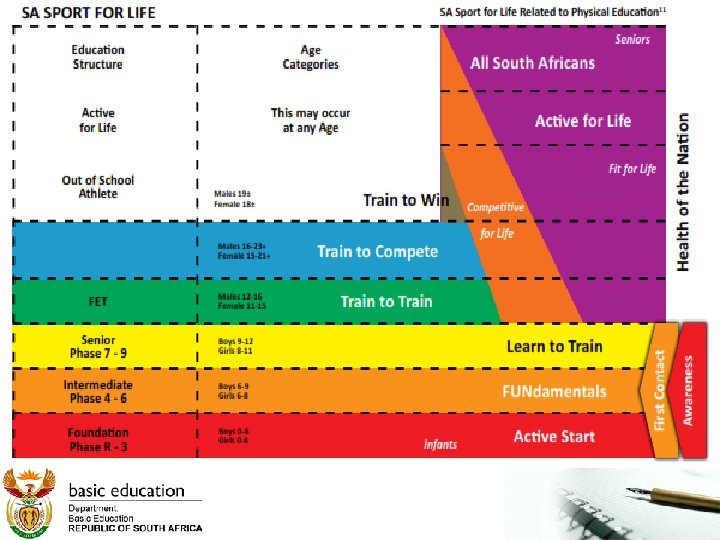
LONG-TERM PARTICIPANT DEVELOPMENT MODEL • The first 3 stages encourage physical literacy and sport for all and are centralized around the school system: – ECD - Active Start – FUNdamentals – Learning to Train • The next 3 stages focus on excellence: – Training to Train – Training to Compete – Training to Win • The final stage encourages life-long physical activity: – Active for life 19
LONG-TERM PARTICIPANT DEVELOPMENT MODEL • The Long Term Participant Development (LTPD) is an inclusive model that encourages individuals to get involved in life-long physical activity. • It does this by connecting and integrating Physical Education programmes in the school system with elite sport programmes and with recreational sport programmes in the community. • LTPD ensures that all children correctly learn the fundamental movement skills (through Physical Education and modified sports) and that these skills are introduced during the optimum point in their physical development. 20
CONCLUSION Physical fitness is not only one of the most important keys to a healthy body, it is the basis of dynamic and creative intellectual activity. John F. Kennedy
THANK YOU
- Slides: 23