
The Role of Data Systems to Enable Open
The Role of Data Systems to Enable Open Science Rahul Ramachandran NASA/MSFC, Kaylin Bugbee UAH, Kevin Murphy NASA/HQ EGU 2020 May 5, 2020
Open Science Definition(s) Science is both a body of knowledge as well as a systematic method of knowing something Open science definitions • Open science is the idea that scientific knowledge of all kinds be openly shared as early as it is practical in the discovery process (Narrow) • Open science can be defined as any activity that covers anything about the future of knowledge creation and dissemination (Broad) Need to distinguish between Open science versus reproducible science • Transparency is a key driver for reproducible science and reproducible science as such is a key sub-component of this shift in culture to open science Objective of this presentation • Provide an overview of different open science activities • Highlight how Earth science’s path to Open Science is deeply intertwined with data programs • This is still very much a work in progress
Drivers for expanding Open Science While science has in some measure been open since the 1700 s, technology advancements, big data and complex science questions have pushed science to become more open Three factors pushing open science • Technology has opened new possibilities on both how the process of science is more efficient and sharing and communicating knowledge with each other • The volume and velocity of data being collected is disrupting existing data systems as well as the traditional means of analysis • As researchers tackle more complex problems, the approach has migrated from individual researchers to a collaborative team of researchers. In addition, the glut of data is also forcing collaboration and sharing of expertise
Open Science Focus Areas (1) Make science accessible to the broader community including the general public ● ● Making the scientific research process accessible by including the broader community in different stages of the scientific process Enabling broader comprehension of research results by deconstructing complex research results into easily digestible bits of information Make science knowledge products accessible and available to everyone ● Open data sharing - prevents duplication in the collection of data and significantly increases the data use and reuse ● Open code - open-source software culture is slowly taking root within the Earth sciences ● Open access - Some journal publishers have modified their publication models to meet the need for accessibility to research publications ○ Some have moved to a gold model of publication ○ Added new policies that allow authors to self-archive (green publication)
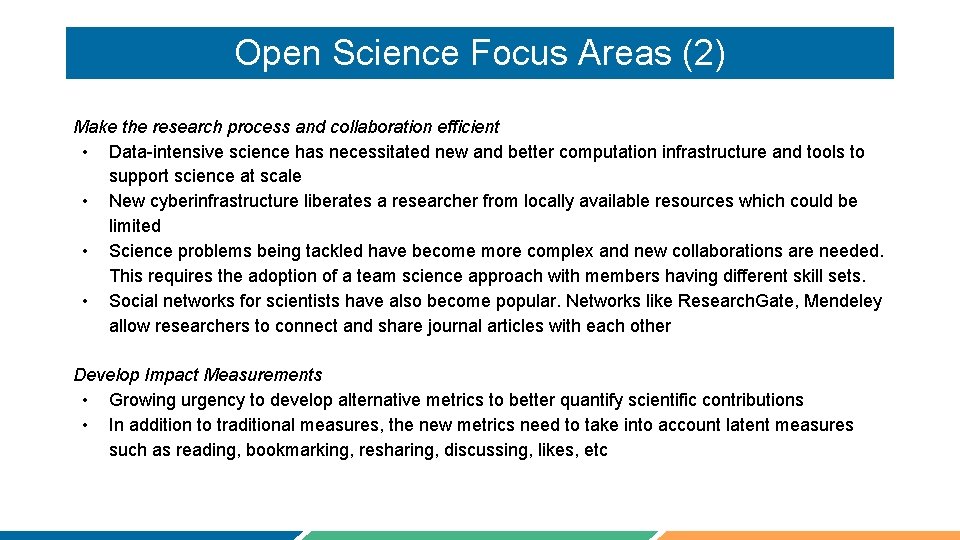
Open Science Focus Areas (2) Make the research process and collaboration efficient • Data-intensive science has necessitated new and better computation infrastructure and tools to support science at scale • New cyberinfrastructure liberates a researcher from locally available resources which could be limited • Science problems being tackled have become more complex and new collaborations are needed. This requires the adoption of a team science approach with members having different skill sets. • Social networks for scientists have also become popular. Networks like Research. Gate, Mendeley allow researchers to connect and share journal articles with each other Develop Impact Measurements • Growing urgency to develop alternative metrics to better quantify scientific contributions • In addition to traditional measures, the new metrics need to take into account latent measures such as reading, bookmarking, resharing, discussing, likes, etc
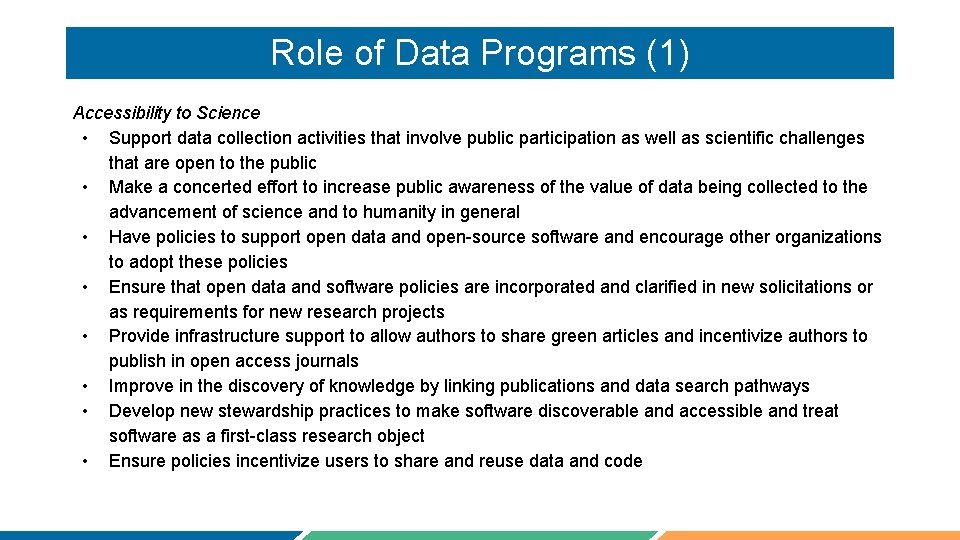
Role of Data Programs (1) Accessibility to Science • Support data collection activities that involve public participation as well as scientific challenges that are open to the public • Make a concerted effort to increase public awareness of the value of data being collected to the advancement of science and to humanity in general • Have policies to support open data and open-source software and encourage other organizations to adopt these policies • Ensure that open data and software policies are incorporated and clarified in new solicitations or as requirements for new research projects • Provide infrastructure support to allow authors to share green articles and incentivize authors to publish in open access journals • Improve in the discovery of knowledge by linking publications and data search pathways • Develop new stewardship practices to make software discoverable and accessible and treat software as a first-class research object • Ensure policies incentivize users to share and reuse data and code
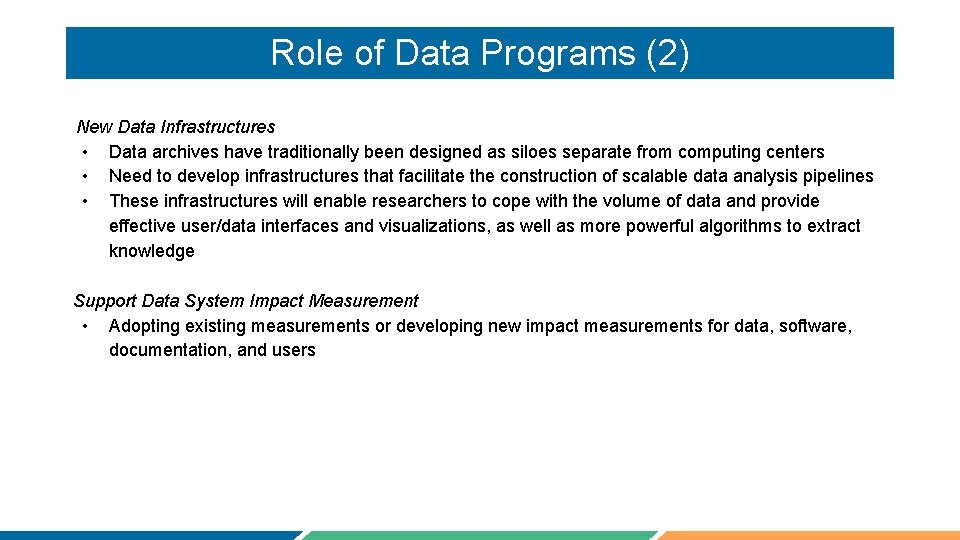
Role of Data Programs (2) New Data Infrastructures • Data archives have traditionally been designed as siloes separate from computing centers • Need to develop infrastructures that facilitate the construction of scalable data analysis pipelines • These infrastructures will enable researchers to cope with the volume of data and provide effective user/data interfaces and visualizations, as well as more powerful algorithms to extract knowledge Support Data System Impact Measurement • Adopting existing measurements or developing new impact measurements for data, software, documentation, and users
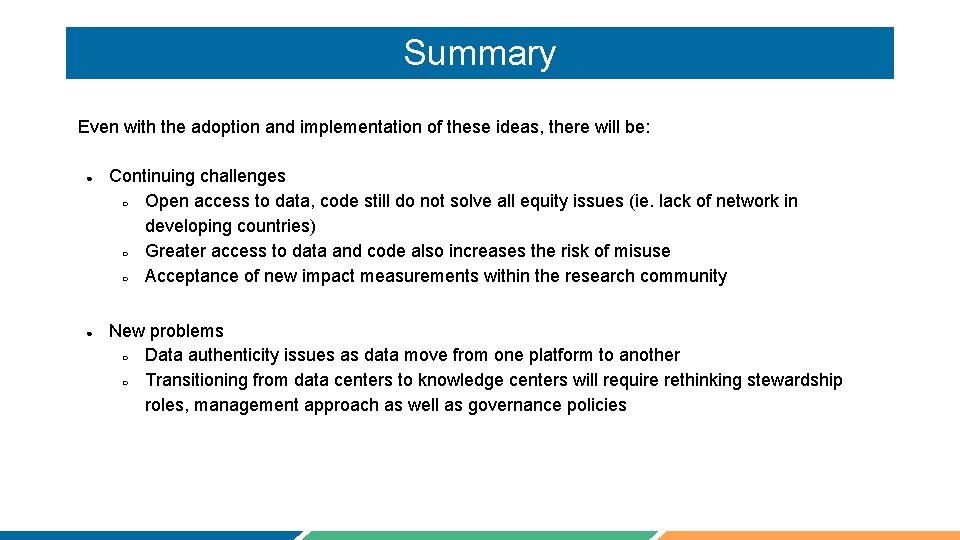
Summary Even with the adoption and implementation of these ideas, there will be: ● ● Continuing challenges ○ Open access to data, code still do not solve all equity issues (ie. lack of network in developing countries) ○ Greater access to data and code also increases the risk of misuse ○ Acceptance of new impact measurements within the research community New problems ○ Data authenticity issues as data move from one platform to another ○ Transitioning from data centers to knowledge centers will require rethinking stewardship roles, management approach as well as governance policies
Contact and Questions Rahul Ramachandran rahul. ramachandran@nasa. gov Questions?
- Slides: 9