
The Role of Cyberknife Stereotactic Body Radiation Therapy

The Role of Cyberknife Stereotactic Body Radiation Therapy in the Treatment of Prostate Cancer Jay L. Friedland, MD
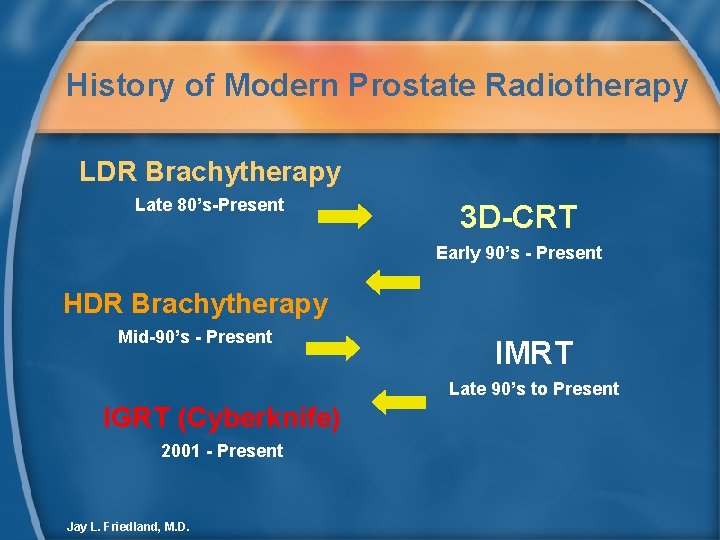
History of Modern Prostate Radiotherapy LDR Brachytherapy Late 80’s-Present 3 D-CRT Early 90’s - Present HDR Brachytherapy Mid-90’s - Present IMRT Late 90’s to Present IGRT (Cyberknife) 2001 - Present Jay L. Friedland, M. D.
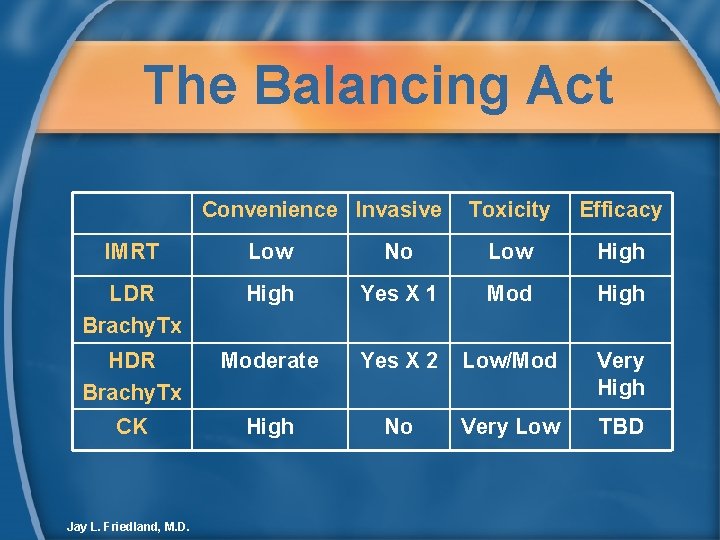
The Balancing Act Convenience Invasive Toxicity Efficacy IMRT Low No Low High LDR Brachy. Tx High Yes X 1 Mod High HDR Brachy. Tx Moderate Yes X 2 Low/Mod Very High CK High No Very Low TBD Jay L. Friedland, M. D.
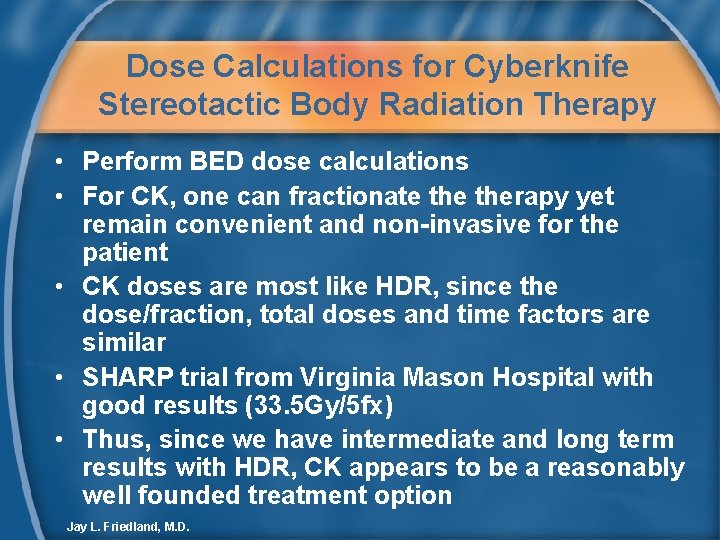
Dose Calculations for Cyberknife Stereotactic Body Radiation Therapy • Perform BED dose calculations • For CK, one can fractionate therapy yet remain convenient and non-invasive for the patient • CK doses are most like HDR, since the dose/fraction, total doses and time factors are similar • SHARP trial from Virginia Mason Hospital with good results (33. 5 Gy/5 fx) • Thus, since we have intermediate and long term results with HDR, CK appears to be a reasonably well founded treatment option Jay L. Friedland, M. D.
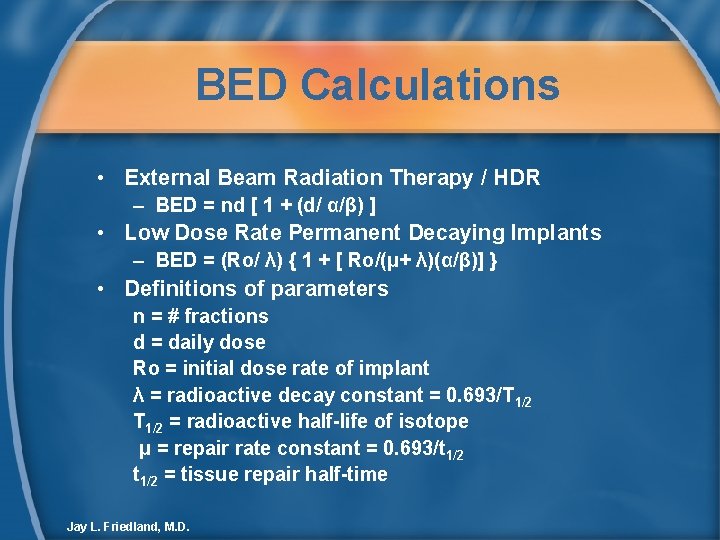
BED Calculations • External Beam Radiation Therapy / HDR – BED = nd [ 1 + (d/ α/β) ] • Low Dose Rate Permanent Decaying Implants – BED = (Ro/ λ) { 1 + [ Ro/(μ+ λ)(α/β)] } • Definitions of parameters n = # fractions d = daily dose Ro = initial dose rate of implant λ = radioactive decay constant = 0. 693/T 1/2 = radioactive half-life of isotope μ = repair rate constant = 0. 693/t 1/2 = tissue repair half-time Jay L. Friedland, M. D.
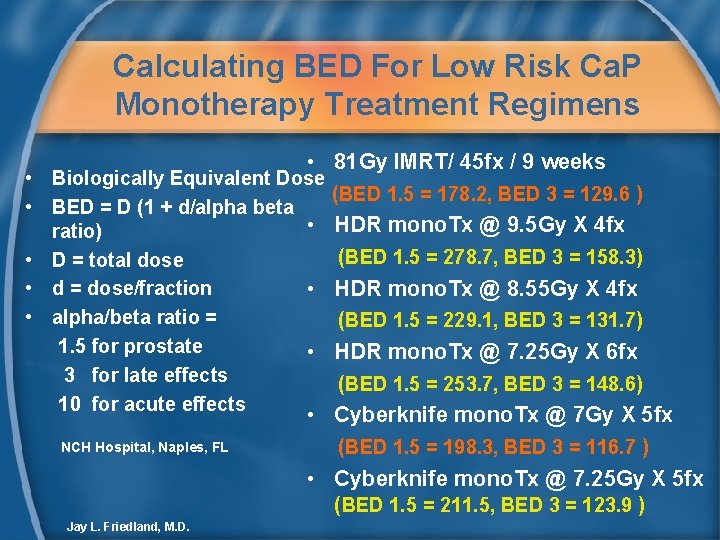
Calculating BED For Low Risk Ca. P Monotherapy Treatment Regimens • • • 81 Gy IMRT/ 45 fx / 9 weeks Biologically Equivalent Dose (BED 1. 5 = 178. 2, BED 3 = 129. 6 ) BED = D (1 + d/alpha beta • HDR mono. Tx @ 9. 5 Gy X 4 fx ratio) (BED 1. 5 = 278. 7, BED 3 = 158. 3) D = total dose d = dose/fraction • HDR mono. Tx @ 8. 55 Gy X 4 fx alpha/beta ratio = (BED 1. 5 = 229. 1, BED 3 = 131. 7) 1. 5 for prostate • HDR mono. Tx @ 7. 25 Gy X 6 fx 3 for late effects (BED 1. 5 = 253. 7, BED 3 = 148. 6) 10 for acute effects • Cyberknife mono. Tx @ 7 Gy X 5 fx NCH Hospital, Naples, FL (BED 1. 5 = 198. 3, BED 3 = 116. 7 ) • Cyberknife mono. Tx @ 7. 25 Gy X 5 fx (BED 1. 5 = 211. 5, BED 3 = 123. 9 ) Jay L. Friedland, M. D.
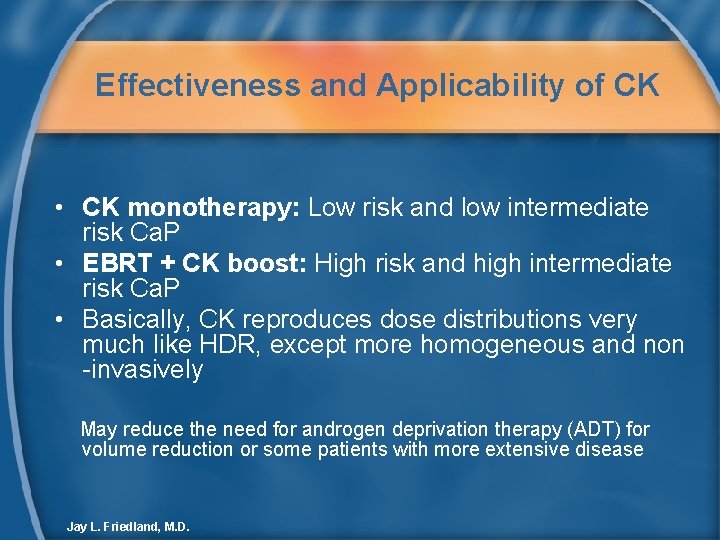
Effectiveness and Applicability of CK • CK monotherapy: Low risk and low intermediate risk Ca. P • EBRT + CK boost: High risk and high intermediate risk Ca. P • Basically, CK reproduces dose distributions very much like HDR, except more homogeneous and non -invasively May reduce the need for androgen deprivation therapy (ADT) for volume reduction or some patients with more extensive disease Jay L. Friedland, M. D.
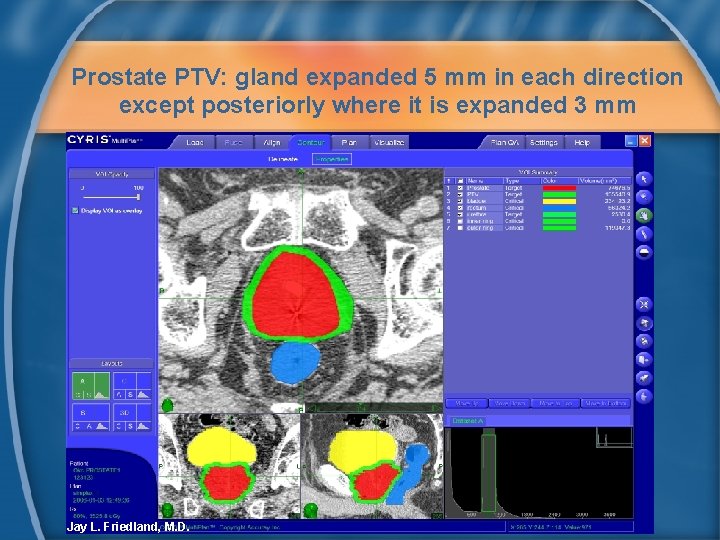
Prostate PTV: gland expanded 5 mm in each direction except posteriorly where it is expanded 3 mm Jay L. Friedland, M. D.

Cyberknife Stereotactic Body Radiation Therapy Part 2: Results
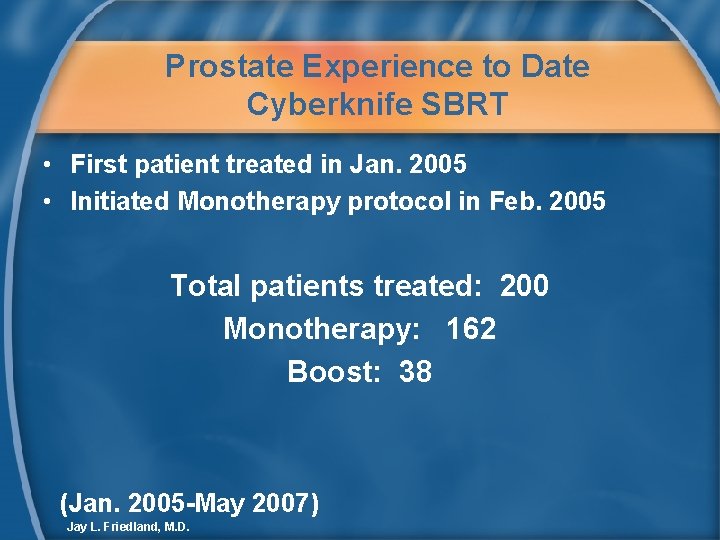
Prostate Experience to Date Cyberknife SBRT • First patient treated in Jan. 2005 • Initiated Monotherapy protocol in Feb. 2005 Total patients treated: 200 Monotherapy: 162 Boost: 38 (Jan. 2005 -May 2007) Jay L. Friedland, M. D.
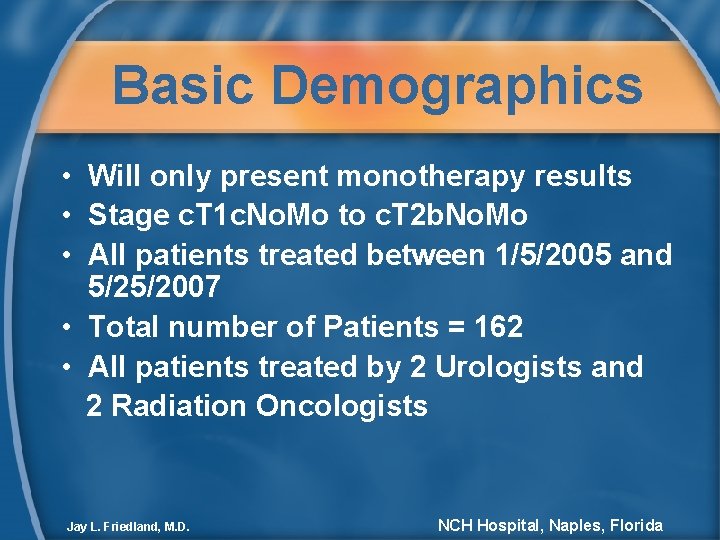
Basic Demographics • Will only present monotherapy results • Stage c. T 1 c. No. Mo to c. T 2 b. No. Mo • All patients treated between 1/5/2005 and 5/25/2007 • Total number of Patients = 162 • All patients treated by 2 Urologists and 2 Radiation Oncologists Jay L. Friedland, M. D. NCH Hospital, Naples, Florida
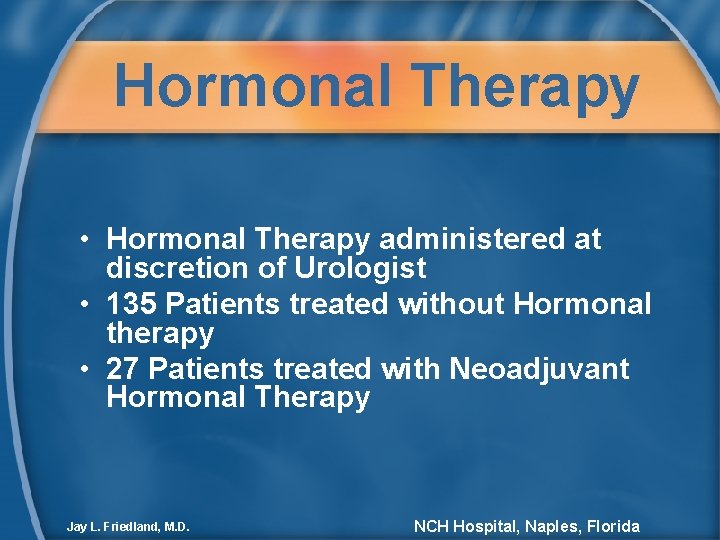
Hormonal Therapy • Hormonal Therapy administered at discretion of Urologist • 135 Patients treated without Hormonal therapy • 27 Patients treated with Neoadjuvant Hormonal Therapy Jay L. Friedland, M. D. NCH Hospital, Naples, Florida
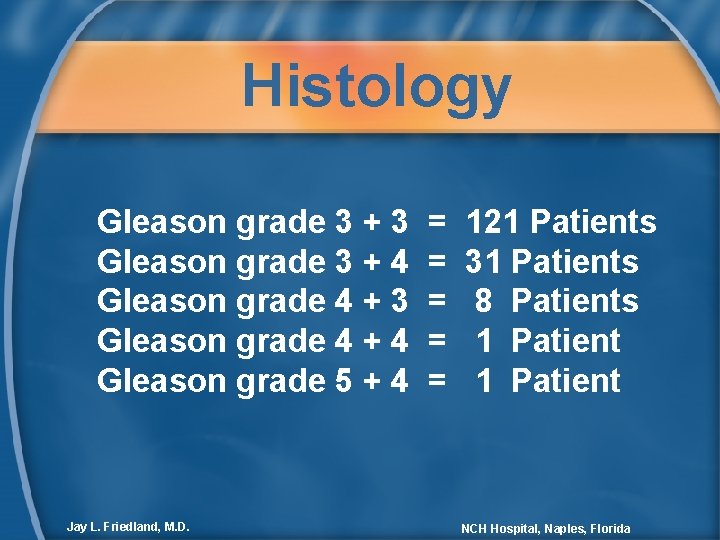
Histology Gleason grade 3 + 3 Gleason grade 3 + 4 Gleason grade 4 + 3 Gleason grade 4 + 4 Gleason grade 5 + 4 Jay L. Friedland, M. D. = = = 121 Patients 31 Patients 8 Patients 1 Patient NCH Hospital, Naples, Florida
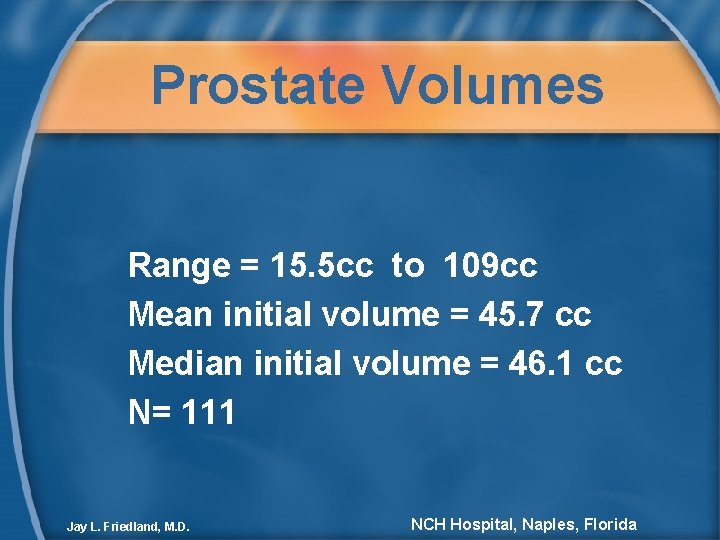
Prostate Volumes Range = 15. 5 cc to 109 cc Mean initial volume = 45. 7 cc Median initial volume = 46. 1 cc N= 111 Jay L. Friedland, M. D. NCH Hospital, Naples, Florida
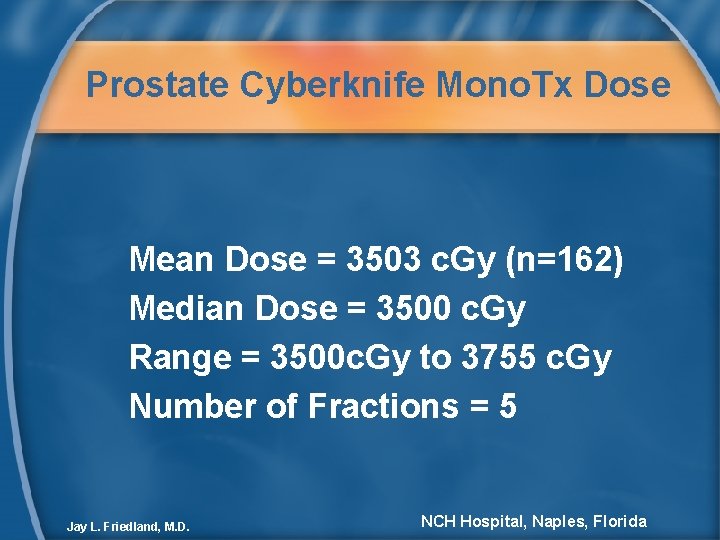
Prostate Cyberknife Mono. Tx Dose Mean Dose = 3503 c. Gy (n=162) Median Dose = 3500 c. Gy Range = 3500 c. Gy to 3755 c. Gy Number of Fractions = 5 Jay L. Friedland, M. D. NCH Hospital, Naples, Florida
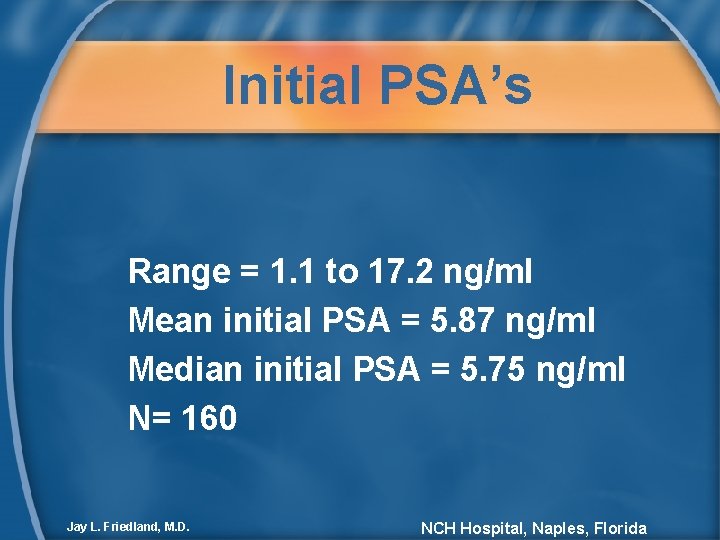
Initial PSA’s Range = 1. 1 to 17. 2 ng/ml Mean initial PSA = 5. 87 ng/ml Median initial PSA = 5. 75 ng/ml N= 160 Jay L. Friedland, M. D. NCH Hospital, Naples, Florida
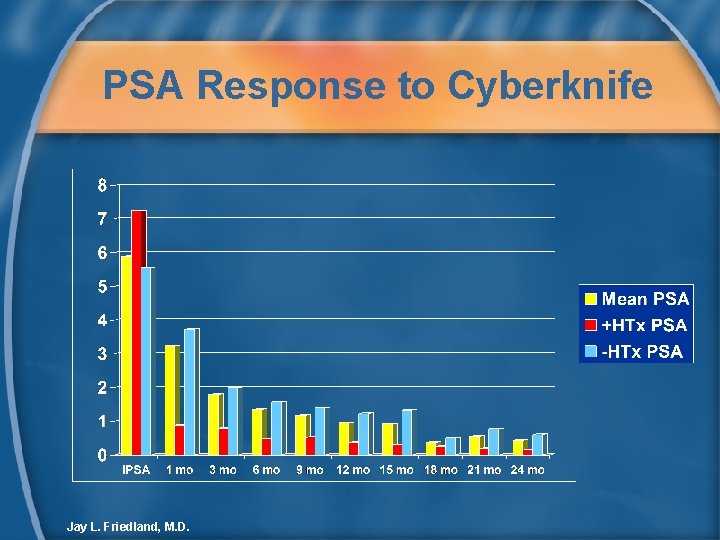
PSA Response to Cyberknife Jay L. Friedland, M. D.
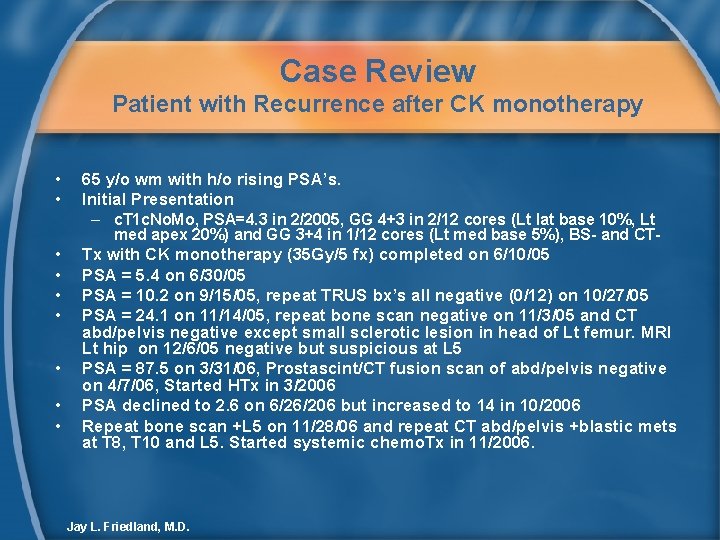
Case Review Patient with Recurrence after CK monotherapy • • 65 y/o wm with h/o rising PSA’s. Initial Presentation – c. T 1 c. No. Mo, PSA=4. 3 in 2/2005, GG 4+3 in 2/12 cores (Lt lat base 10%, Lt med apex 20%) and GG 3+4 in 1/12 cores (Lt med base 5%), BS- and CT- • • Tx with CK monotherapy (35 Gy/5 fx) completed on 6/10/05 PSA = 5. 4 on 6/30/05 PSA = 10. 2 on 9/15/05, repeat TRUS bx’s all negative (0/12) on 10/27/05 PSA = 24. 1 on 11/14/05, repeat bone scan negative on 11/3/05 and CT abd/pelvis negative except small sclerotic lesion in head of Lt femur. MRI Lt hip on 12/6/05 negative but suspicious at L 5 PSA = 87. 5 on 3/31/06, Prostascint/CT fusion scan of abd/pelvis negative on 4/7/06, Started HTx in 3/2006 PSA declined to 2. 6 on 6/26/206 but increased to 14 in 10/2006 Repeat bone scan +L 5 on 11/28/06 and repeat CT abd/pelvis +blastic mets at T 8, T 10 and L 5. Started systemic chemo. Tx in 11/2006. Jay L. Friedland, M. D.
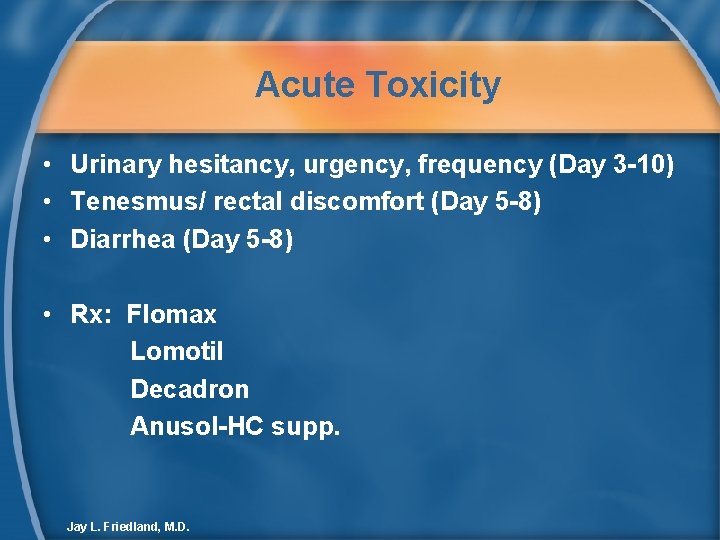
Acute Toxicity • Urinary hesitancy, urgency, frequency (Day 3 -10) • Tenesmus/ rectal discomfort (Day 5 -8) • Diarrhea (Day 5 -8) • Rx: Flomax Lomotil Decadron Anusol-HC supp. Jay L. Friedland, M. D.
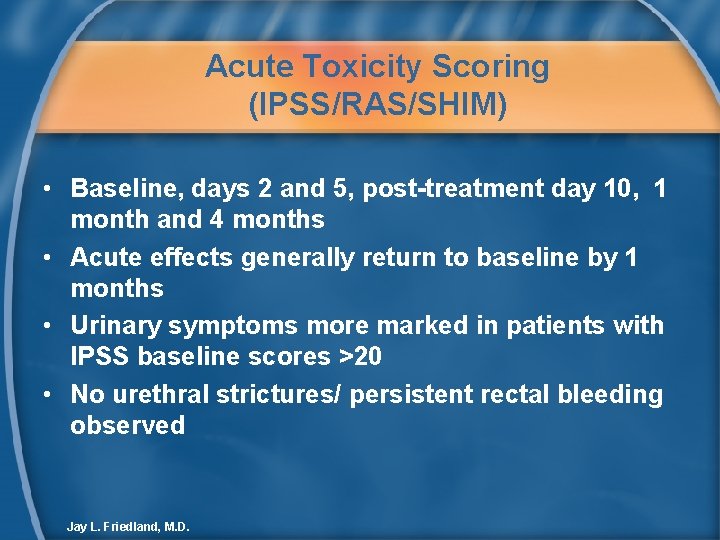
Acute Toxicity Scoring (IPSS/RAS/SHIM) • Baseline, days 2 and 5, post-treatment day 10, 1 month and 4 months • Acute effects generally return to baseline by 1 months • Urinary symptoms more marked in patients with IPSS baseline scores >20 • No urethral strictures/ persistent rectal bleeding observed Jay L. Friedland, M. D.
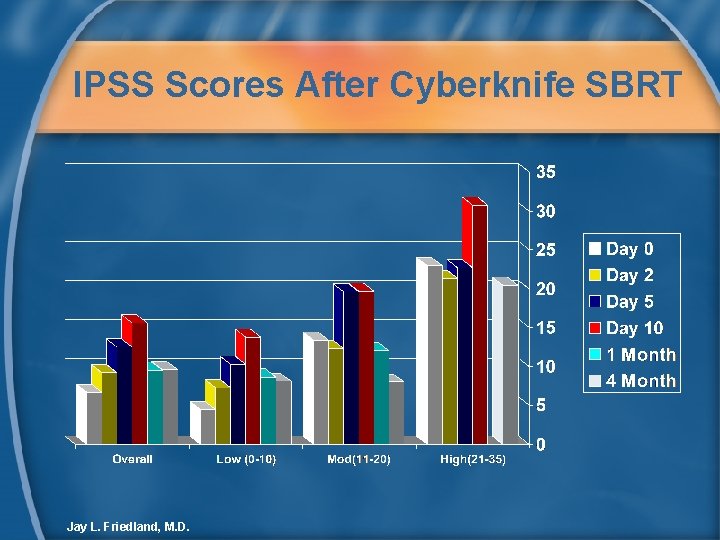
IPSS Scores After Cyberknife SBRT Jay L. Friedland, M. D.
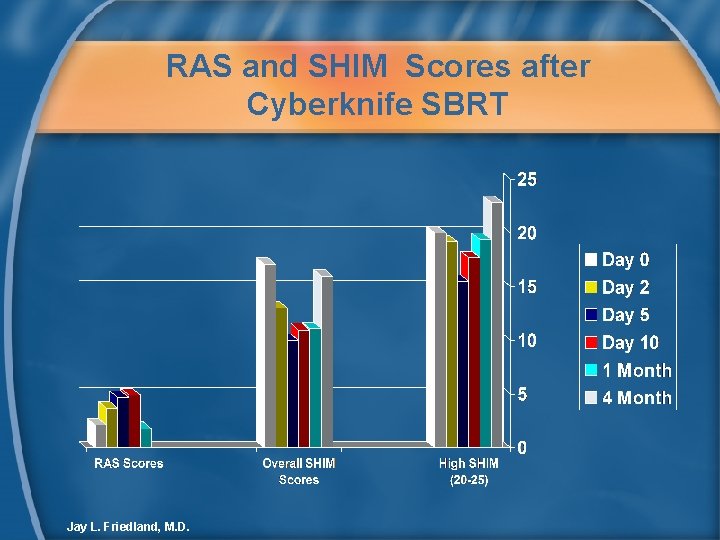
RAS and SHIM Scores after Cyberknife SBRT Jay L. Friedland, M. D.
Summary • Cyberknife is a new and innovative treatment technique for prostate cancer. • Cyberknife monotherapy appears to produce a reasonable early decline of PSA’s in low risk patients. • The acute toxicity of Cyberknife monotherapy is acceptable. • Cyberknife therapy is a noninvasive and convenient treatment option for patients with early stage prostate cancer. • Prostate cancer patients treated with Cyberknife should be enrolled on research protocols, and the data collectively analyzed. Jay L. Friedland, M. D.

Thank You for Your Kind Attention
- Slides: 24