
The Role of Cultural Health Beliefs on Health
The Role of Cultural Health Beliefs on Health Behaviors among Chinese, Korean, & Mexican American Breast Cancer Survivors PI’s: Drs. Patricia Gonzalez, Jung-Wong Lim & Ming Wang Students: Suirong Li & Mee Yon Yum Advisor: Dr. Kimlin Ashing-Giwa December 11, 2008 1
Background ► Breast cancer (BC) is the most frequently diagnosed cancer in Asian-and Latina-American women. ► Favorable survivorship outcomes for women with BC may be attributed to lifestyles and behavioral factors. ► Given the growing ethnic minority populations in the U. S. , and emerging health disparity issues in cancer outcomes, cultural factors of ethnic minorities need to be considered 2
Overall Goal ► Examine the relationships among cultural health beliefs, health behaviors, and factors influencing them among Chinese, Korean and Mexican breast cancer survivors (BCS). ► Explore the differences and/or similarities in cultural health beliefs & health behaviors among Chinese-, Korean- & Mexican-American BCS. 3
Phase I Specific Aims 1. Examine how acculturation is related to cultural health beliefs 2. Examine whether cultural health beliefs are related to treatment-related decisions, doctor-patient relationships, and health behaviors. 3. Examine whether treatment-related decisions and doctorpatient relationships mediate the relationship between cultural health beliefs and health behaviors. 4. Examine the differences and/or similarities in acculturation, cultural health beliefs, treatment-related decisions, doctorpatient relationships, and health behaviors among Chinese-, Korean-, and Mexican-American BCS. 4
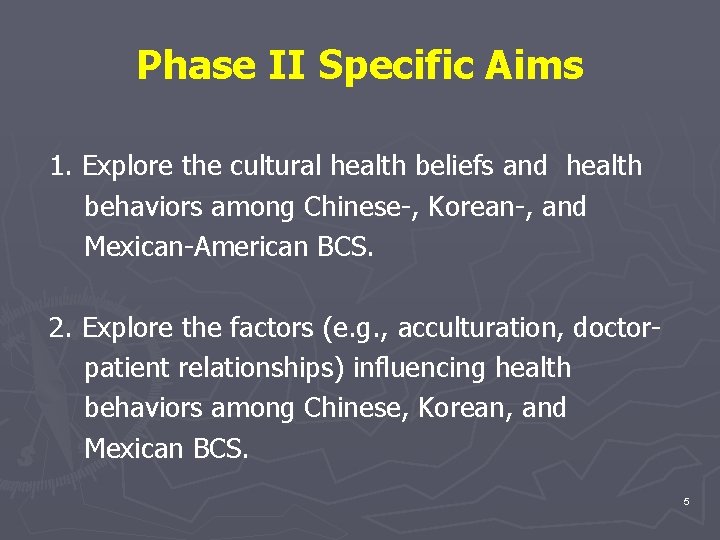
Phase II Specific Aims 1. Explore the cultural health beliefs and health behaviors among Chinese-, Korean-, and Mexican-American BCS. 2. Explore the factors (e. g. , acculturation, doctorpatient relationships) influencing health behaviors among Chinese, Korean, and Mexican BCS. 5
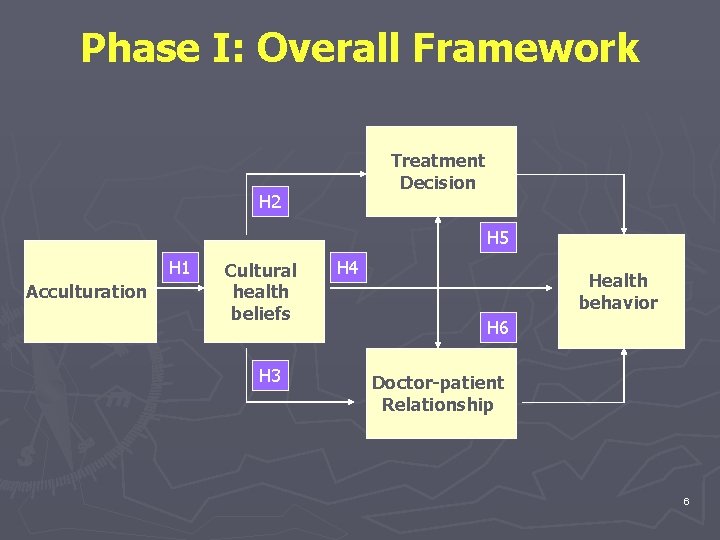
Phase I: Overall Framework Treatment Decision H 2 H 5 H 1 Acculturation Cultural health beliefs H 3 H 4 Health behavior H 6 Doctor-patient Relationship 6
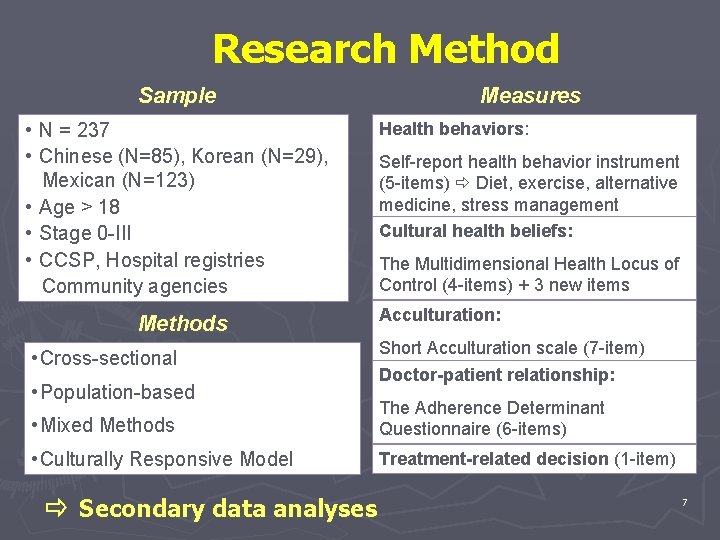
Research Method Sample • N = 237 • Chinese (N=85), Korean (N=29), Mexican (N=123) • Age > 18 • Stage 0 -III • CCSP, Hospital registries Community agencies Methods • Cross-sectional • Population-based Measures Health behaviors: Self-report health behavior instrument (5 -items) Diet, exercise, alternative medicine, stress management Cultural health beliefs: The Multidimensional Health Locus of Control (4 -items) + 3 new items Acculturation: Short Acculturation scale (7 -item) Doctor-patient relationship: • Mixed Methods The Adherence Determinant Questionnaire (6 -items) • Culturally Responsive Model Treatment-related decision (1 -item) Secondary data analyses 7
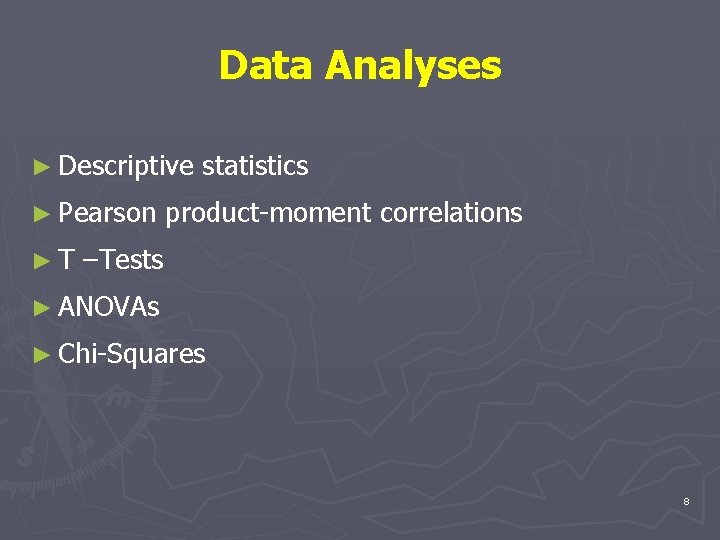
Data Analyses ► Descriptive ► Pearson ►T statistics product-moment correlations –Tests ► ANOVAs ► Chi-Squares 8
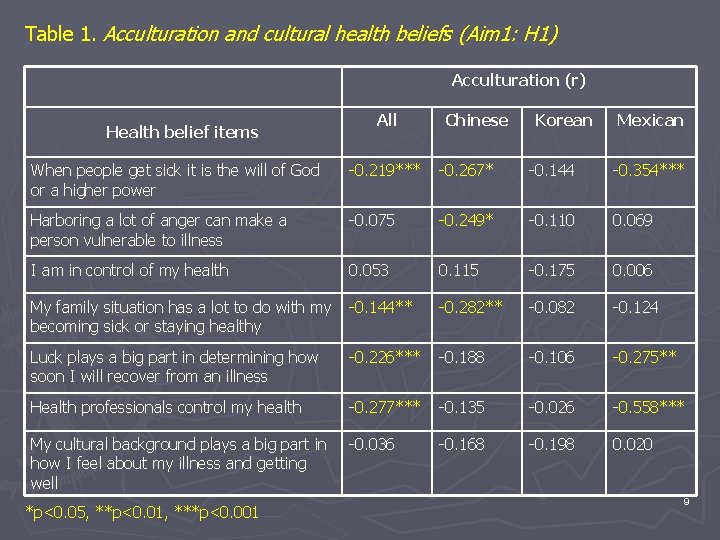
Table 1. Acculturation and cultural health beliefs (Aim 1: H 1) Acculturation (r) Health belief items All Chinese Korean Mexican When people get sick it is the will of God or a higher power -0. 219*** -0. 267* -0. 144 -0. 354*** Harboring a lot of anger can make a person vulnerable to illness -0. 075 -0. 249* -0. 110 0. 069 I am in control of my health 0. 053 0. 115 -0. 175 0. 006 My family situation has a lot to do with my becoming sick or staying healthy -0. 144** -0. 282** -0. 082 -0. 124 Luck plays a big part in determining how soon I will recover from an illness -0. 226*** -0. 188 -0. 106 -0. 275** Health professionals control my health -0. 277*** -0. 135 -0. 026 -0. 558*** My cultural background plays a big part in how I feel about my illness and getting well -0. 036 -0. 168 -0. 198 0. 020 *p<0. 05, **p<0. 01, ***p<0. 001 9
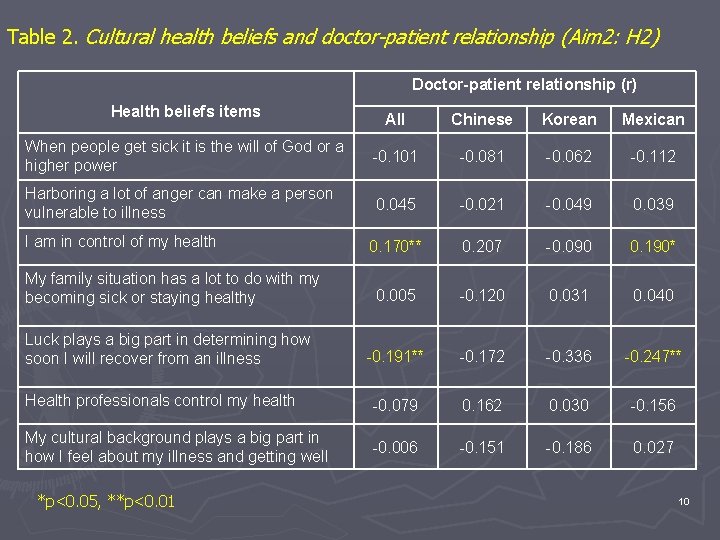
Table 2. Cultural health beliefs and doctor-patient relationship (Aim 2: H 2) Doctor-patient relationship (r) Health beliefs items All Chinese Korean Mexican When people get sick it is the will of God or a higher power -0. 101 -0. 081 -0. 062 -0. 112 Harboring a lot of anger can make a person vulnerable to illness 0. 045 -0. 021 -0. 049 0. 039 0. 170** 0. 207 -0. 090 0. 190* 0. 005 -0. 120 0. 031 0. 040 -0. 191** -0. 172 -0. 336 -0. 247** Health professionals control my health -0. 079 0. 162 0. 030 -0. 156 My cultural background plays a big part in how I feel about my illness and getting well -0. 006 -0. 151 -0. 186 0. 027 I am in control of my health My family situation has a lot to do with my becoming sick or staying healthy Luck plays a big part in determining how soon I will recover from an illness *p<0. 05, **p<0. 01 10
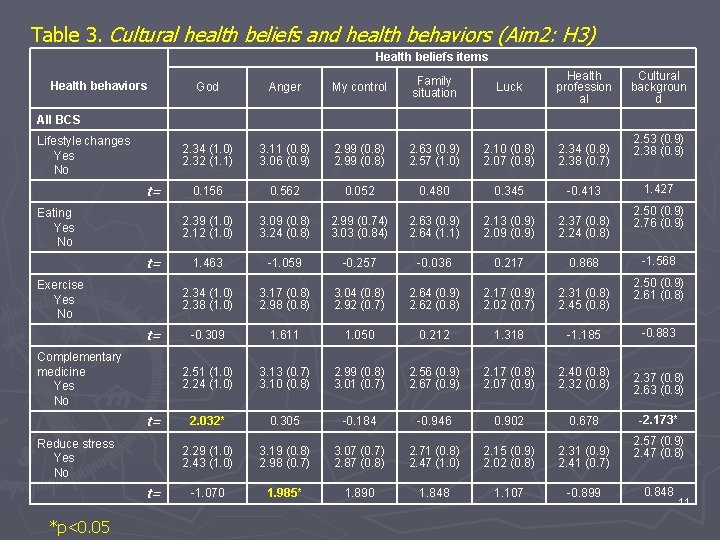
Table 3. Cultural health beliefs and health behaviors (Aim 2: H 3) Health beliefs items Health behaviors God Anger My control Family situation Luck Health profession al Cultural backgroun d 2. 34 (1. 0) 2. 32 (1. 1) 3. 11 (0. 8) 3. 06 (0. 9) 2. 99 (0. 8) 2. 63 (0. 9) 2. 57 (1. 0) 2. 10 (0. 8) 2. 07 (0. 9) 2. 34 (0. 8) 2. 38 (0. 7) 0. 156 0. 562 0. 052 0. 480 0. 345 -0. 413 2. 39 (1. 0) 2. 12 (1. 0) 3. 09 (0. 8) 3. 24 (0. 8) 2. 99 (0. 74) 3. 03 (0. 84) 2. 63 (0. 9) 2. 64 (1. 1) 2. 13 (0. 9) 2. 09 (0. 9) 2. 37 (0. 8) 2. 24 (0. 8) 1. 463 -1. 059 -0. 257 -0. 036 0. 217 0. 868 2. 34 (1. 0) 2. 38 (1. 0) 3. 17 (0. 8) 2. 98 (0. 8) 3. 04 (0. 8) 2. 92 (0. 7) 2. 64 (0. 9) 2. 62 (0. 8) 2. 17 (0. 9) 2. 02 (0. 7) 2. 31 (0. 8) 2. 45 (0. 8) -0. 309 1. 611 1. 050 0. 212 1. 318 -1. 185 -0. 883 2. 51 (1. 0) 2. 24 (1. 0) 3. 13 (0. 7) 3. 10 (0. 8) 2. 99 (0. 8) 3. 01 (0. 7) 2. 56 (0. 9) 2. 67 (0. 9) 2. 17 (0. 8) 2. 07 (0. 9) 2. 40 (0. 8) 2. 32 (0. 8) 2. 37 (0. 8) 2. 63 (0. 9) 2. 032* 0. 305 -0. 184 -0. 946 0. 902 0. 678 -2. 173* 2. 29 (1. 0) 2. 43 (1. 0) 3. 19 (0. 8) 2. 98 (0. 7) 3. 07 (0. 7) 2. 87 (0. 8) 2. 71 (0. 8) 2. 47 (1. 0) 2. 15 (0. 9) 2. 02 (0. 8) 2. 31 (0. 9) 2. 41 (0. 7) -1. 070 1. 985* 1. 890 1. 848 1. 107 -0. 899 All BCS Lifestyle changes Yes No t= Eating Yes No t= Exercise Yes No t= Complementary medicine Yes No t= Reduce stress Yes No t= *p<0. 05 2. 53 (0. 9) 2. 38 (0. 9) 1. 427 2. 50 (0. 9) 2. 76 (0. 9) -1. 568 2. 50 (0. 9) 2. 61 (0. 8) 2. 57 (0. 9) 2. 47 (0. 8) 0. 848 11
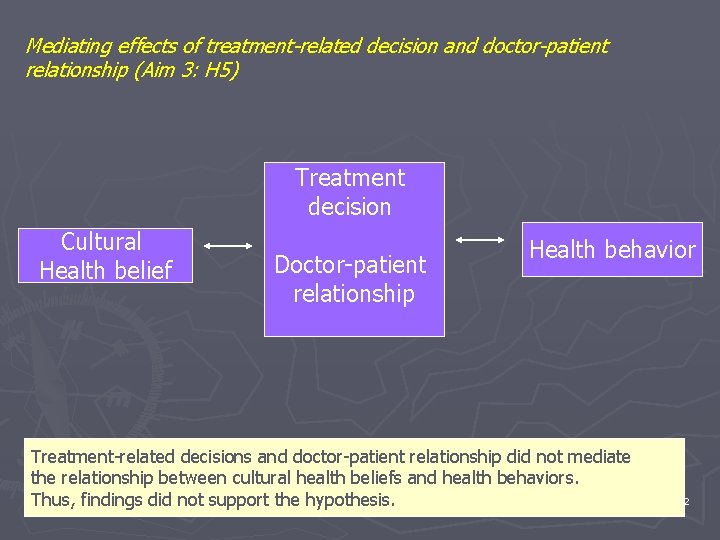
Mediating effects of treatment-related decision and doctor-patient relationship (Aim 3: H 5) Treatment decision Cultural Health belief Doctor-patient relationship Health behavior Treatment-related decisions and doctor-patient relationship did not mediate the relationship between cultural health beliefs and health behaviors. Thus, findings did not support the hypothesis. 12
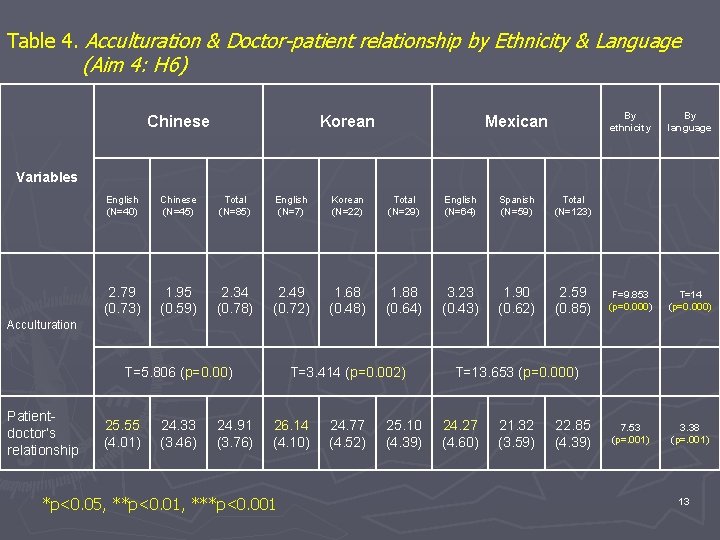
Table 4. Acculturation & Doctor-patient relationship by Ethnicity & Language (Aim 4: H 6) Chinese Korean Mexican By ethnicity By language F=9. 853 (p=0. 000) T=14 (p=0. 000) 7. 53 (p=. 001) 3. 38 (p=. 001) Variables English (N=40) Chinese (N=45) Total (N=85) English (N=7) Korean (N=22) Total (N=29) English (N=64) Spanish (N=59) Total (N=123) 2. 79 (0. 73) 1. 95 (0. 59) 2. 34 (0. 78) 2. 49 (0. 72) 1. 68 (0. 48) 1. 88 (0. 64) 3. 23 (0. 43) 1. 90 (0. 62) 2. 59 (0. 85) Acculturation T=5. 806 (p=0. 00) Patientdoctor’s relationship 25. 55 (4. 01) 24. 33 (3. 46) 24. 91 (3. 76) T=3. 414 (p=0. 002) 26. 14 (4. 10) *p<0. 05, **p<0. 01, ***p<0. 001 24. 77 (4. 52) 25. 10 (4. 39) T=13. 653 (p=0. 000) 24. 27 (4. 60) 21. 32 (3. 59) 22. 85 (4. 39) 13
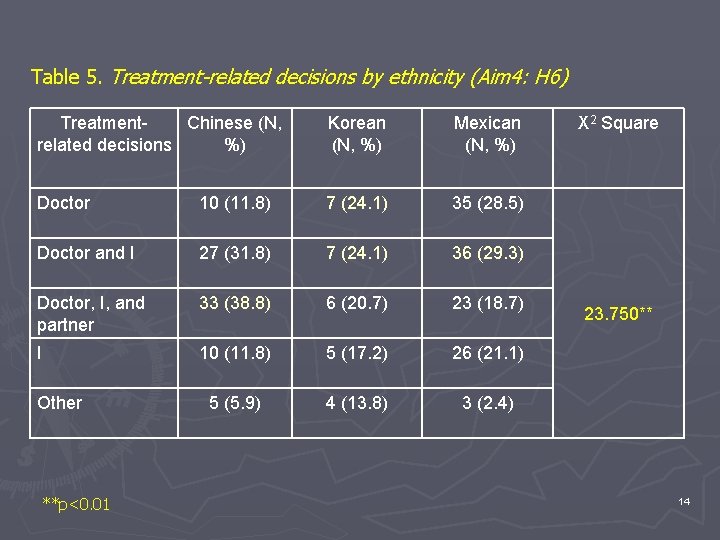
Table 5. Treatment-related decisions by ethnicity (Aim 4: H 6) Treatment. Chinese (N, related decisions %) Korean (N, %) Mexican (N, %) Doctor 10 (11. 8) 7 (24. 1) 35 (28. 5) Doctor and I 27 (31. 8) 7 (24. 1) 36 (29. 3) Doctor, I, and partner 33 (38. 8) 6 (20. 7) 23 (18. 7) I 10 (11. 8) 5 (17. 2) 26 (21. 1) 5 (5. 9) 4 (13. 8) 3 (2. 4) Other **p<0. 01 X 2 Square 23. 750** 14
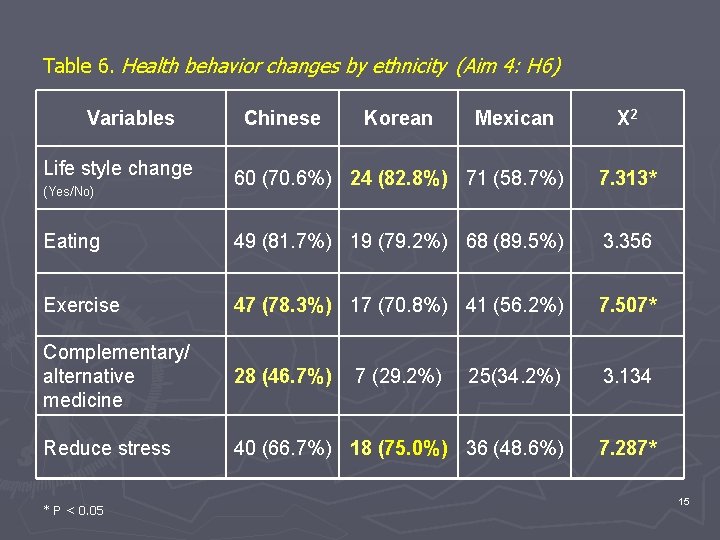
Table 6. Health behavior changes by ethnicity (Aim 4: H 6) Variables Life style change Chinese Korean Mexican X 2 60 (70. 6%) 24 (82. 8%) 71 (58. 7%) 7. 313* Eating 49 (81. 7%) 19 (79. 2%) 68 (89. 5%) 3. 356 Exercise 47 (78. 3%) 17 (70. 8%) 41 (56. 2%) 7. 507* Complementary/ alternative medicine 28 (46. 7%) 25(34. 2%) 3. 134 Reduce stress 40 (66. 7%) 18 (75. 0%) 36 (48. 6%) 7. 287* (Yes/No) * P < 0. 05 7 (29. 2%) 15
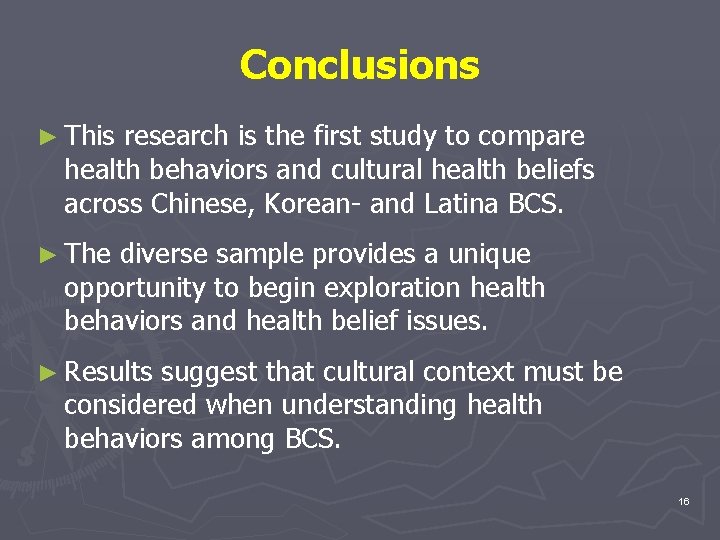
Conclusions ► This research is the first study to compare health behaviors and cultural health beliefs across Chinese, Korean- and Latina BCS. ► The diverse sample provides a unique opportunity to begin exploration health behaviors and health belief issues. ► Results suggest that cultural context must be considered when understanding health behaviors among BCS. 16
Limitations ► Participants may have provided socially acceptable responses ► Self report data are subject to recall bias ► Certain health behavior information was not included ► Korean-American sample size was small 17
Activities to Date ► Phase I § Identified variables based on research hypotheses § Secondary data analyses and interpretation § Findings reported / Manuscript Development ► Phase II § Focus Group Protocol and procedure preparation § Questionnaire § Contacted community agencies for recruitment § Two Chinese focus groups conducted § One Korean focus group conducted 18
Activities to Date (cont. ) ► Abstracts § § and Manuscripts Two Poster presentations One Oral presentation One manuscript in press (Supportive Care in Cancer) Two in preparation ► Student research assistants recruited ► Training and learning 19
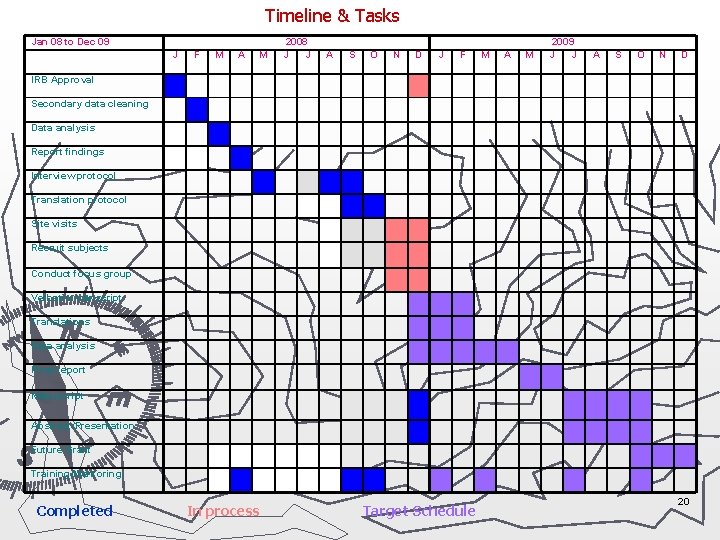
Timeline & Tasks Jan 08 to Dec 09 J F M A M 2008 J J A S O N D J F M A M 2009 J J A S O N D IRB Approval Secondary data cleaning Data analysis Report findings Interview protocol Translation protocol Site visits Recruit subjects Conduct focus group Verbatim transcript Translations Data analysis Final report Manuscript Abstract/Presentation Future Grant Training/Mentoring Completed In process Target Schedule 20
Acknowledgements Research Assistants: Ann Lee Suirong Li Mee Yon Yum Ariel Bianca Moreno Dr. Ashing-Giwa: Mentor Dr. Susan Kane & Dr. Jamil Momand Funding Source: NIH: 1 P 20 CA 118783 -01 A 1 & 1 P 20 CA 118775 -01 A 21
- Slides: 21