
The Role of Assessment in Improving Teacher Quality







- Slides: 20
The Role of Assessment in Improving Teacher Quality In this presentation we try to offer a rich menu of quality tools and resources that can help schools and teachers improve teaching, learning and the documentation of classroom processes
Teaching, Learning & Documentation of Classroom Processes DEPEND ON: n. Leadership management of schools & personnel- the faculty members, and the processes of learning & threefold interactions n teacher – students n teacher –teacher nstudent – student/s. n. Teamwork n Learning
TEACHER QUALITY FACTORS n n HUMANS RESOURCES PREPARED BY THEM a quality of school curriculum and syllabus - all facets of teaching and learning materials - supplementary aids - physical, social and economic conditions of both levels - macro and micro. -
TEACHER QUALITY ATTEMPS FOR CHANGES n n After the fall of USSR, for nearly 15 years, Azerbaijan’s schools have been at the center of a major reform effort to improve student learning. These reforms focused attention on what students were actually learning, but assumed educators could promote that learning by doing what they had always done; but now only redoubling their efforts.
TEACHER QUALITY Next step: n. These reforms were directed to structural aspects of the teaching profession and the schools, including teachers’ salary and schools’ autonomy rise. It enhanced more decision -making authority in schools. n. However, despite the gained obvious achievements the student achievement still did not improve conspicuously.
TEACHER QUALITY What was the problem that the schools couldn’t gain a desirable result?
TEACHER QUALITY SOLUTIONS: An overall lack of evaluation and assessment tools and accountability not only contribute to a lack of information about the usefulness or effectiveness of professional development, but they also give teachers no incentive to take professional development seriously.
TEACHER QUALITY The following issues were brought forward related to these interrelated processes: n What is an Assessment? The role of Assessment n Ways and methods of Quality Assessment n Why do we need to improve teachers? n
Recent changes Due to development of society inevitable some professions become less required; and on the other hand there emerge the new fields of educational development. n Here we should underline some positive practices which have been developed by the Azerbaijan Ministry of Education. It refers to the opportunities given to our teachers’ to change or extend their specialty to the new fields of education through skills upgrade and refreshment courses. n Test of Teaching Knowledge (TTK) has become the key to improving student learning and teacher quality. n
RULES & SHORTAGES n. Teachers do not have a career ladder whereby promotions are earned upon mastery of new techniques or successful demonstration of new skills. Teacher performance evaluations seldom measure whether teachers are translating professional development into effective classroom practice and student achievement. n n. Teachers tend to be rewarded solely for length of service n. Although obtaining a master’s degree is an exception to this rule but, because most districts do not specify that the degree must be in relevant subject areas, the incentive for obtaining the degree exists whether or not the degree improves classroom instruction or student learning.
Instrumental theses and priorities to quality learning and teaching I. Method applied on Zero level - Admission n n improvement of admissions criteria (incentives, etc) by the states – enrollment application of psychological science to clinical preparation of teachers
Instrumental theses and priorities to quality learning and teaching Method applied on Zero level - Admission n SSAC Azerbaijan has made some conspicuous positive changes in the students’ admission in 2007. n Some new subjects were included into the block of subjects relevant to the appropriate specialties. n The new methods applied for the improvement of admission criteria are underway. Methods needed on Zero level - Admission n n In future the group members plan presentations on psychology's contributions to education, academic and teacher training assessment, statewide accountability, classroom management and evidence-based interventions for students and families. We need to consolidate the psychological efforts to work for the benefit of quality improvements
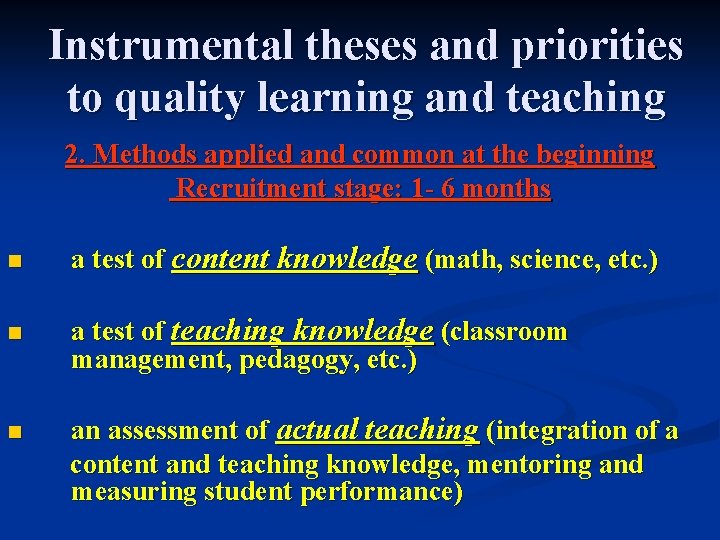
Instrumental theses and priorities to quality learning and teaching 2. Methods applied and common at the beginning Recruitment stage: 1 - 6 months n a test of content knowledge (math, science, etc. ) n a test of teaching knowledge (classroom management, pedagogy, etc. ) n an assessment of actual teaching (integration of a content and teaching knowledge, mentoring and measuring student performance)
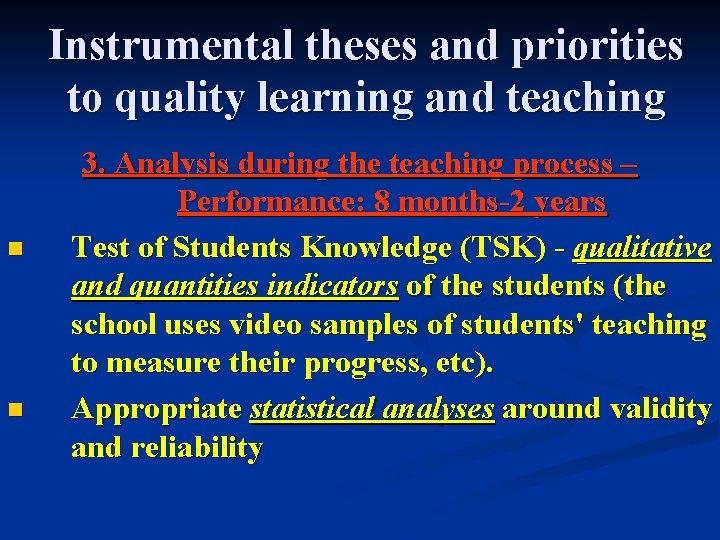
Instrumental theses and priorities to quality learning and teaching n n 3. Analysis during the teaching process – Performance: 8 months-2 years Test of Students Knowledge (TSK) - qualitative and quantities indicators of the students (the school uses video samples of students' teaching to measure their progress, etc). Appropriate statistical analyses around validity and reliability
Instrumental theses and priorities to quality learning and teaching 2. Methods applied and common at the beginning Recruitment stage: 1 - 6 months n a test of content knowledge (math, science, etc. ) n a test of teaching knowledge (classroom management, pedagogy, etc. ) n an assessment of actual teaching (integration of a content and teaching knowledge, mentoring and measuring student performance)
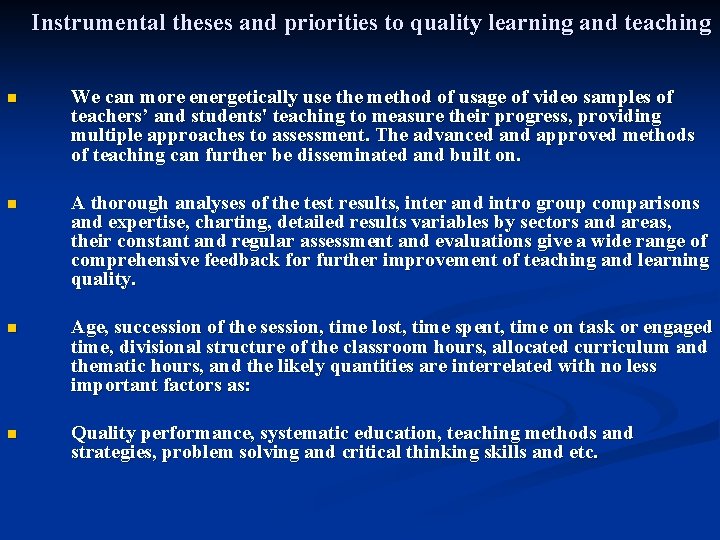
Instrumental theses and priorities to quality learning and teaching n We can more energetically use the method of usage of video samples of teachers’ and students' teaching to measure their progress, providing multiple approaches to assessment. The advanced and approved methods of teaching can further be disseminated and built on. n A thorough analyses of the test results, inter and intro group comparisons and expertise, charting, detailed results variables by sectors and areas, their constant and regular assessment and evaluations give a wide range of comprehensive feedback for further improvement of teaching and learning quality. n Age, succession of the session, time lost, time spent, time on task or engaged time, divisional structure of the classroom hours, allocated curriculum and thematic hours, and the likely quantities are interrelated with no less important factors as: n Quality performance, systematic education, teaching methods and strategies, problem solving and critical thinking skills and etc.
Instrumental theses and priorities to quality learning and teaching 4. During reassignments and carrier promotions: more than > two years n n Suitability of the criteria to the related areas and to the unrestricted areas (contributions to education, academic and teacher training assessment, statewide accountability, classroom management and evidence-based interventions, etc)
CONCLUSION n n n Studies provide strong clues but no definitive answer to the question of what makes a teacher effective. Available evidence (sometimes disputed) suggests that student achievement may be related to these measurable teacher qualifications: Certification Licensure Experience Subject-matter knowledge Pedagogical preparation
The purpose of this presentation is not to create yet another standard document, but to consider best thinking of education practitioners and researchers, and to articulate the collective voice of the states regarding sound teacher licensing policy
QUESTİONS & ANSWERS SUGGESTIONS: