
The Role of AI in the Paradigm Shift
- Slides: 23
The Role of AI in the Paradigm Shift towards Enaction Life and Mind seminar #2 Tom Froese Life and Mind seminar #2
Overview • Cognitivism • Embodied-Embedded Cognitive Science • Enactivism • Beyond? Life and Mind seminar #2 2
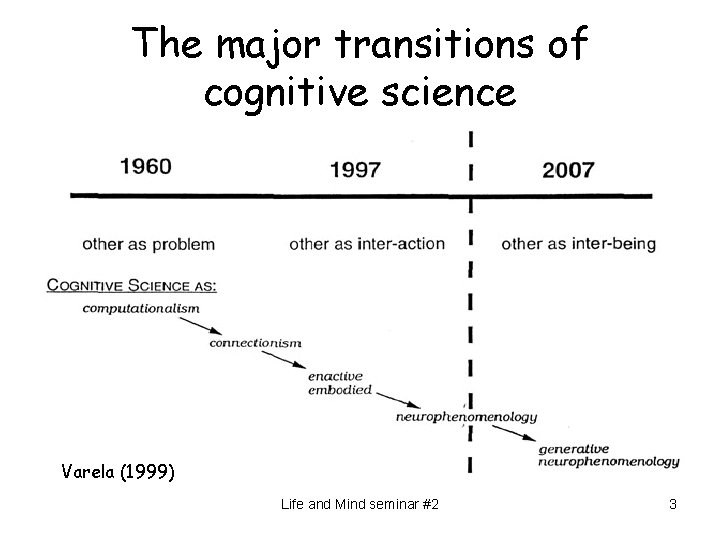
The major transitions of cognitive science Varela (1999) Life and Mind seminar #2 3
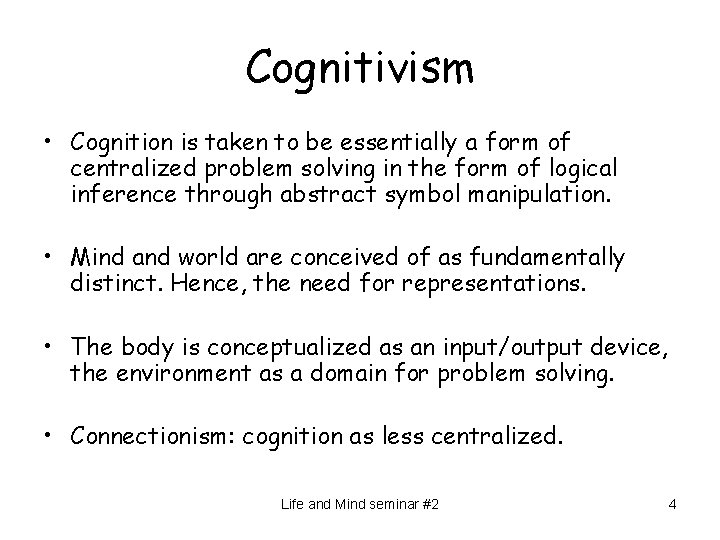
Cognitivism • Cognition is taken to be essentially a form of centralized problem solving in the form of logical inference through abstract symbol manipulation. • Mind and world are conceived of as fundamentally distinct. Hence, the need for representations. • The body is conceptualized as an input/output device, the environment as a domain for problem solving. • Connectionism: cognition as less centralized. Life and Mind seminar #2 4
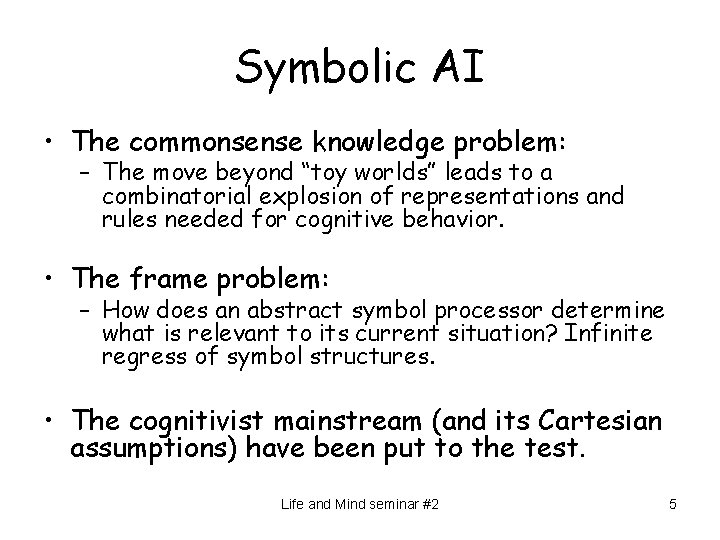
Symbolic AI • The commonsense knowledge problem: – The move beyond “toy worlds” leads to a combinatorial explosion of representations and rules needed for cognitive behavior. • The frame problem: – How does an abstract symbol processor determine what is relevant to its current situation? Infinite regress of symbol structures. • The cognitivist mainstream (and its Cartesian assumptions) have been put to the test. Life and Mind seminar #2 5
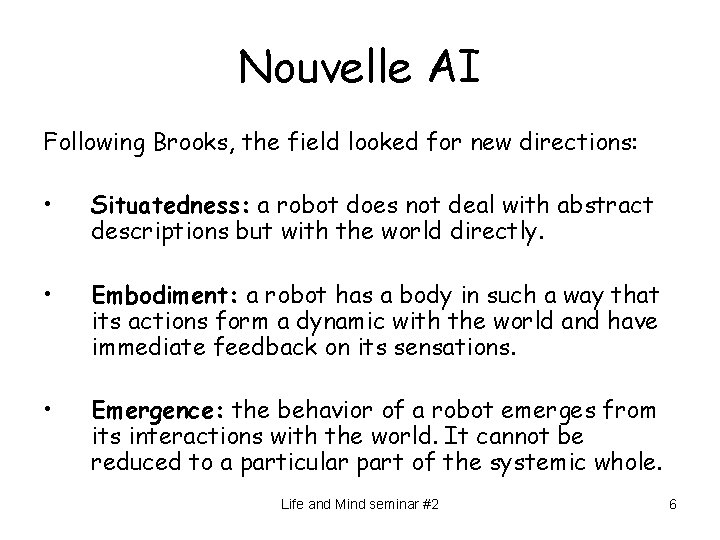
Nouvelle AI Following Brooks, the field looked for new directions: • Situatedness: a robot does not deal with abstract descriptions but with the world directly. • Embodiment: a robot has a body in such a way that its actions form a dynamic with the world and have immediate feedback on its sensations. • Emergence: the behavior of a robot emerges from its interactions with the world. It cannot be reduced to a particular part of the systemic whole. Life and Mind seminar #2 6
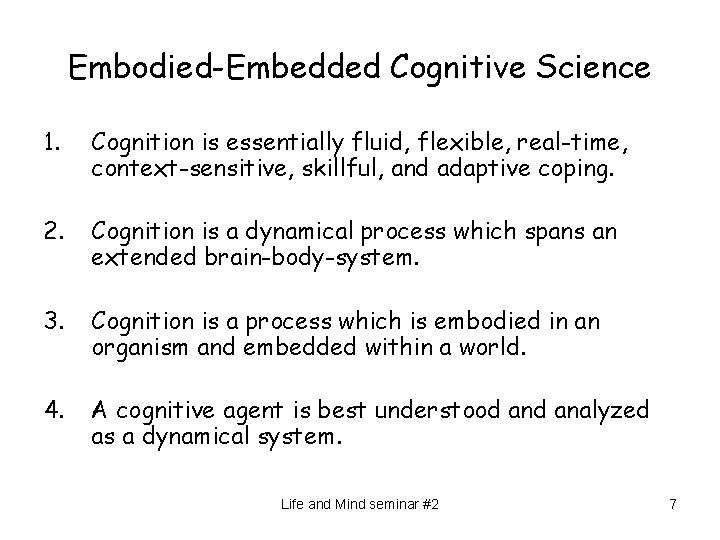
Embodied-Embedded Cognitive Science 1. Cognition is essentially fluid, flexible, real-time, context-sensitive, skillful, and adaptive coping. 2. Cognition is a dynamical process which spans an extended brain-body-system. 3. Cognition is a process which is embodied in an organism and embedded within a world. 4. A cognitive agent is best understood analyzed as a dynamical system. Life and Mind seminar #2 7
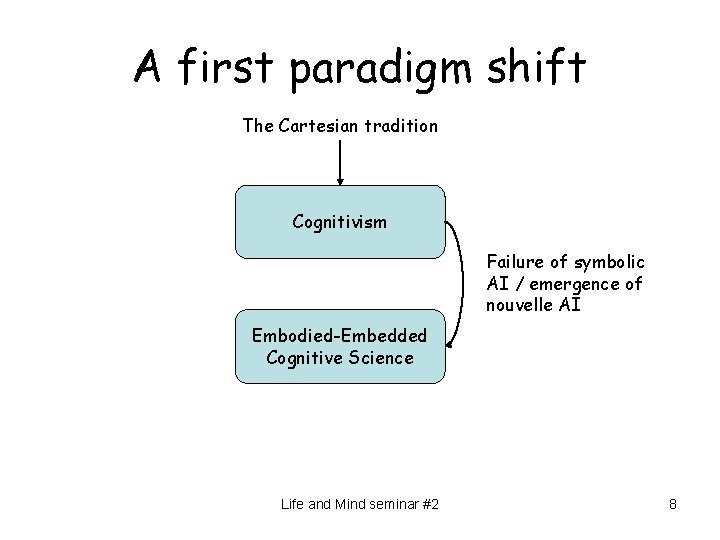
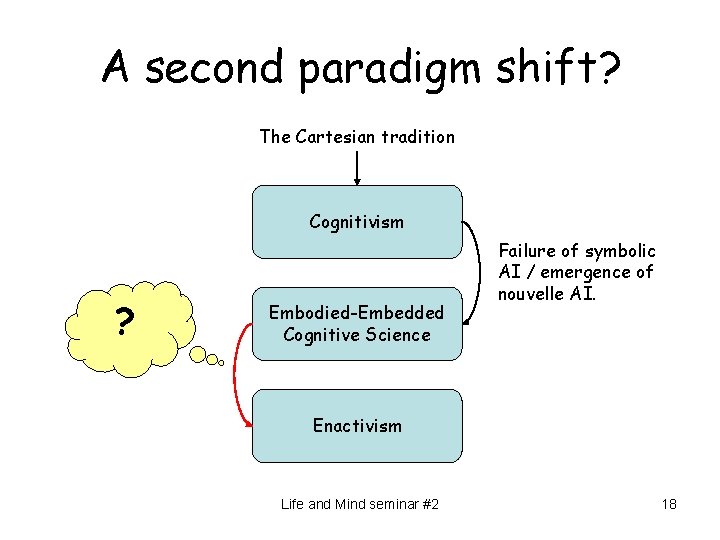
A first paradigm shift The Cartesian tradition Cognitivism Failure of symbolic AI / emergence of nouvelle AI Embodied-Embedded Cognitive Science Life and Mind seminar #2 8
The role of AI and robotics • It has provided the foundation for a lot of the conceptual developments. • In its role as a subversive science it was able to question and undermine the constitutive assumptions underlying cognitivism. • Philosophical stalemates could be resolved in the “empirical” domain of the cognitive sciences. Life and Mind seminar #2 9
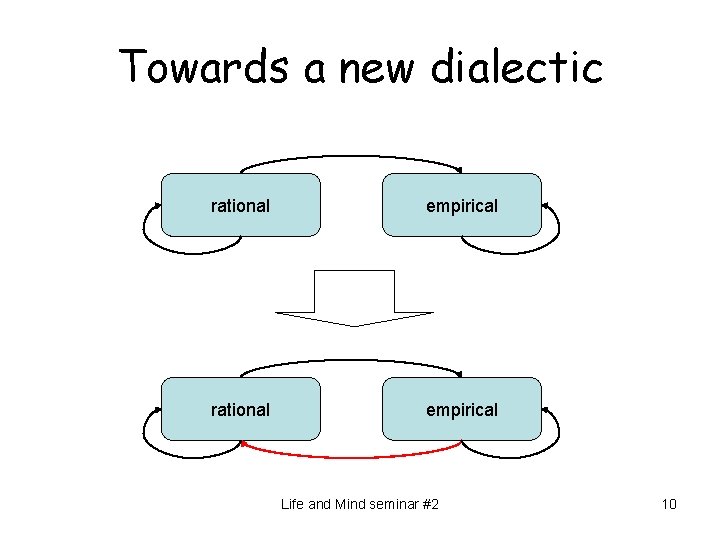
Towards a new dialectic rational empirical Life and Mind seminar #2 10
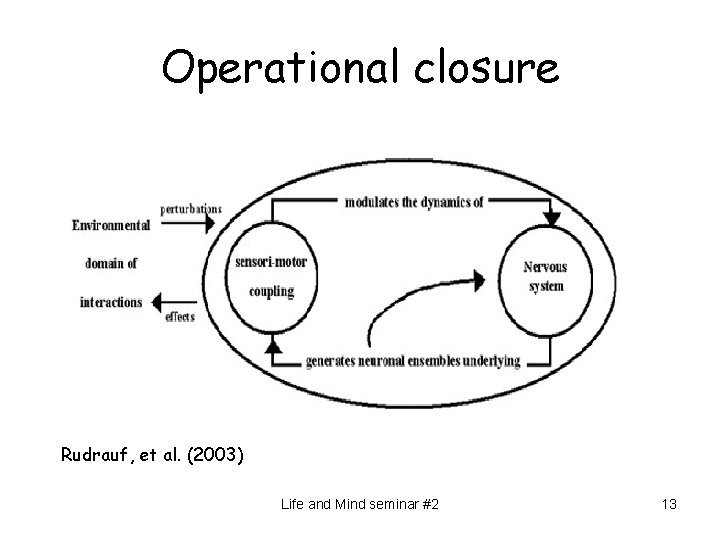
The Enactive Approach More recently the paradigm shift has been moving towards an enactive perspective: 1. Organisms are autonomous agents that actively generate and maintain their identities, and thereby enact or bring forth their own cognitive domains. 2. The nervous system is autonomous: it actively generates and maintains its own coherent and meaningful patterns of activity according to its operation as an operationally closed system. Life and Mind seminar #2 11
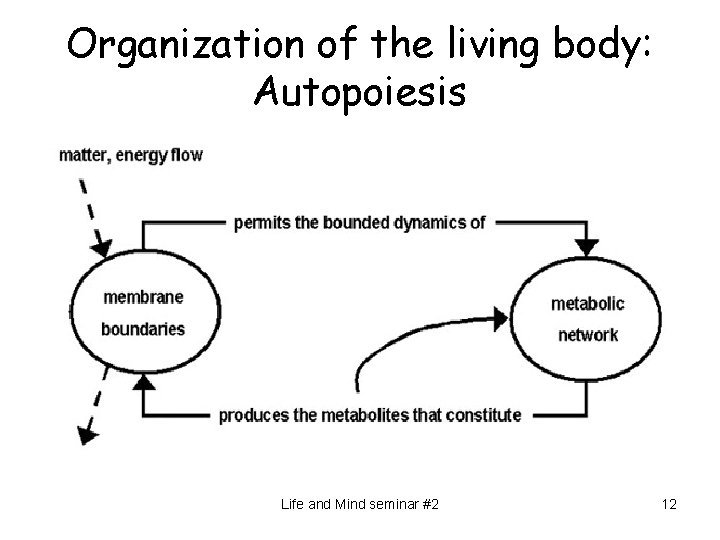
Organization of the living body: Autopoiesis Life and Mind seminar #2 12
Operational closure Rudrauf, et al. (2003) Life and Mind seminar #2 13
The Enactive Approach 3. Cognition, conceived fundamentally as meaninggeneration, arises from the sensorimotor coupling between organism and environment. Cognition is a form of embodied action. 4. The organism’s world is not a pre-specified, external realm somehow represented internally, but a relational domain enacted or brought forth by its autonomous agency and mode of coupling with the environment. 5. The organism’s experiential awareness is a central feature of its lived embodiment in the world. Life and Mind seminar #2 14
The problem of subjectivity • A central concern of enactivism is an improved understanding of subjectivity. It does this from 2 complementary perspectives: – Biological agency: an autonomous system that produces and maintains its own identity. – Phenomenal agency: non-intentional and pre-reflective, lived bodily self-awareness. • The ‘explanatory gap’ is no longer absolute as both aspects of subjectivity make common reference to living being: – The living body as object – The living body as subject Life and Mind seminar #2 15
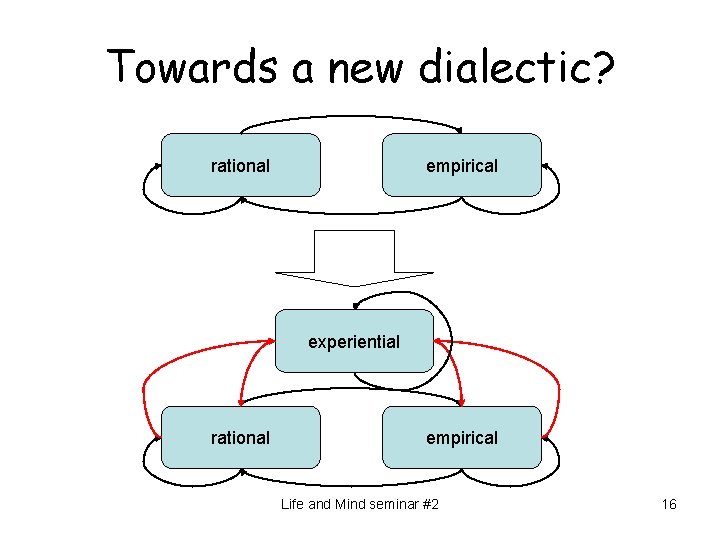
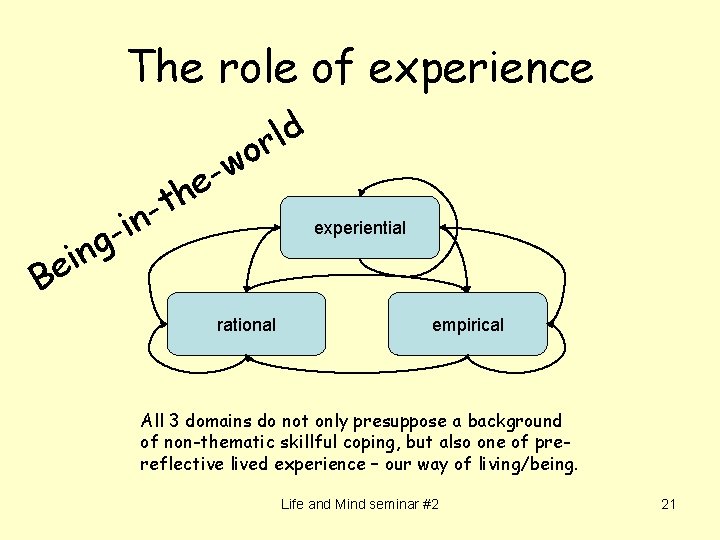
Towards a new dialectic? rational empirical experiential rational empirical Life and Mind seminar #2 16
The role of AI and robotics • Can we still say that this shift towards enactivism is driven by developments in AI and robotics? • How can its experimental results inform the experiential (phenomenological) component? • How can insights gained from the principled use of 1 st person methodologies inform AI research? • Momentarily at least it appears that AI and robotics is trailing behind the shift towards enactivism. Life and Mind seminar #2 17
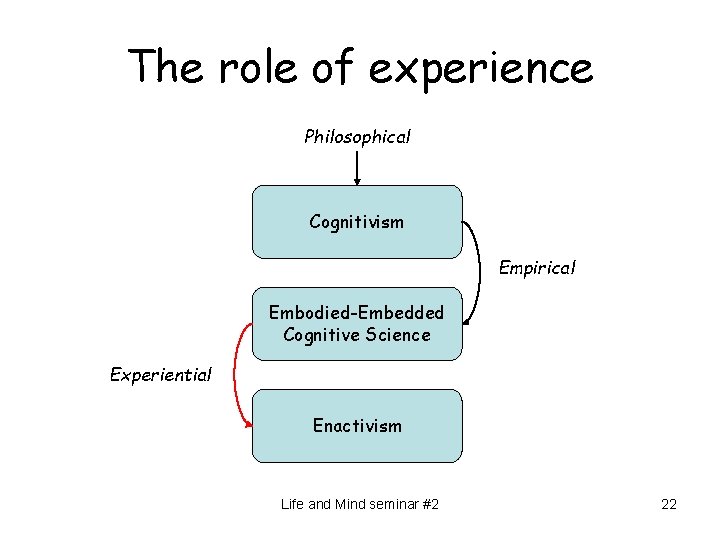
A second paradigm shift? The Cartesian tradition Cognitivism ? Embodied-Embedded Cognitive Science Failure of symbolic AI / emergence of nouvelle AI. Enactivism Life and Mind seminar #2 18
The nature of the second shift • Just like the cognitivism, the enactivist paradigm necessarily has its own set of metaphors (e. g. dynamics) and constitutive assumptions (e. g. embodiment). • Both paradigms are based on distinct premises which therefore entail non-overlapping rational domains. Because of this there is a fundamental stalemate in the philosophical domain. • Since the stalemate cannot be resolved rationally, a paradigm shift cannot be induced by means of argument alone. In the end the stalemate has to be resolved in the empirical domain of the cognitive sciences. • But even empirical data has to be interpreted from a point of view. What determines which one we adopt for ourselves? Life and Mind seminar #2 19
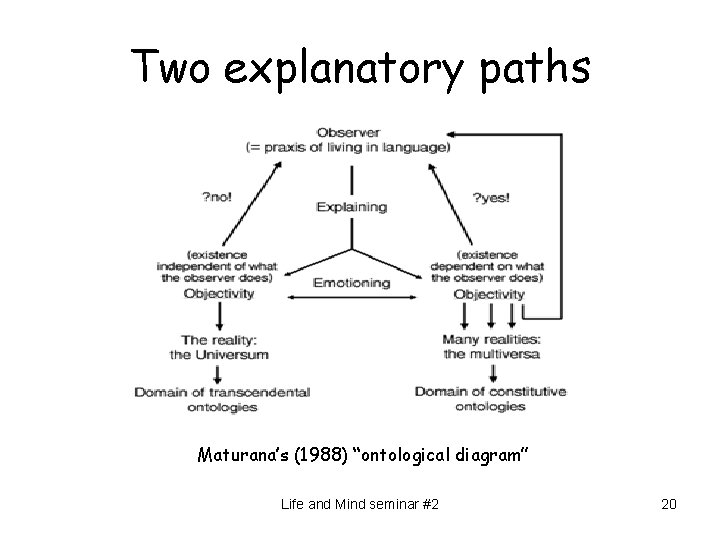
Two explanatory paths Maturana’s (1988) “ontological diagram” Life and Mind seminar #2 20
The role of experience n i Be w e h t n- i g ld r o experiential rational empirical All 3 domains do not only presuppose a background of non-thematic skillful coping, but also one of prereflective lived experience – our way of living/being. Life and Mind seminar #2 21
The role of experience Philosophical Cognitivism Empirical Embodied-Embedded Cognitive Science Experiential Enactivism Life and Mind seminar #2 22
Concluding remarks • It is clear that AI and robotics has contributed immensely to the shift towards embodied-embedded cognitive science. • It has done so by shifting the disputes from the philosophical domain to the empirical domain. • The next challenge for this field is to improve our understanding of agency. Is it possible to synthesize autonomous agents? • Nevertheless, a shift towards an enactive cognitive science appears to require shifting the dispute from the philosophical and empirical domains to the experiential domain. • Open question: What are the consequences? Life and Mind seminar #2 23