
The Role and Influence of Mentorship and Role


- Slides: 24
The Role and Influence of Mentorship and Role Models in Women’s Career Paths to the University Presidency Celeste A. Wheat, Ph. D. Associate Professor of Student Affairs in Higher Education, University of West Alabama & Lilian H. Hill, Ph. D. Professor of Adult Education,
Research Topic & Importance Ø Women still represent only 30% of college and university presidents Ø Women continue to be the least likely to serve as presidents of doctorate-granting universities. Ø The percentage of women holding key-line administrative positions (e. g. , dean, VP, Provost/CAO) is lower at doctorate-granting universities. Ø There is a critical need to prepare women to form leadership identities with over 50% of presidents retiring over the next 5 years.
Research Topic & Importance v A dearth of empirical data concerning the career paths and leadership experiences of university women administrators and presidents, especially concerning the role of mentorship and role models (Arini et al. , 2011; Brown, 2005; Bornstein, 2009; Dunbar& Kinnersley, 2011; Madsen, 2012) v This study presented the opportunity to provide a more in-depth understanding of the role of mentors and role models in shaping women’s leadership development and advancement.
Background & Literature Review Mentoring is important for women in providing them with: ü Sponsorship and greater visibility ü Career role models ü Career development and advice ü Advice for successfully balancing work-family responsibilities ü Career guidance and support ü Strategies for overcoming gendered barriers
Purpose Ø The purpose of this study was to qualitatively explore and describe how women in key-line administrative positions to the presidency and university women presidents understood the influence of mentoring relationships and role models in their career paths to leadership. Ø Understanding the unique and individualized ways women experience and view the influence of mentors and role models on their leadership aspirations and advancement to leadership is a factor of critical importance to increasing the representation of women presidents in higher education.
Conceptual/Theoretical Framework Ø This study draws upon a postmodernist feminist framework. Ø Women’s subjectivity is viewed in terms of “plurality, multiplicity, and difference” (Tong, 1989, p. 217). Ø Intersectionality—the intersection of the various dimensions (e. g. , race, gender, etc. ) of women’s personhood (Di. Palma & Ferguson, 2006, p. 134).
Research Questions (1) What career path did you take to your current leadership position? , (2) What role have mentors and role models played in helping you to advance to your current leadership position? , (3) Have you had more male or female mentors and role models? , and (4) How has your gender or other life roles (such as family roles) shaped your leadership experiences?
Research Methods v Basic interpretive qualitative design v Positionality: We are White, middle-class women who hold faculty positions in schools of education in research university settings. We were motivated to seek information that may be instructive to women in navigating their own path to leadership.
Data Collection a. b. c. 16 In-depth, semi-structured interviews Document review of personal (e. g. , curriculum vitae or résumé) documents Peer review *Prior to beginning this study, this project was reviewed and approved by the University of Southern Mississippi’s Institutional Review Board.
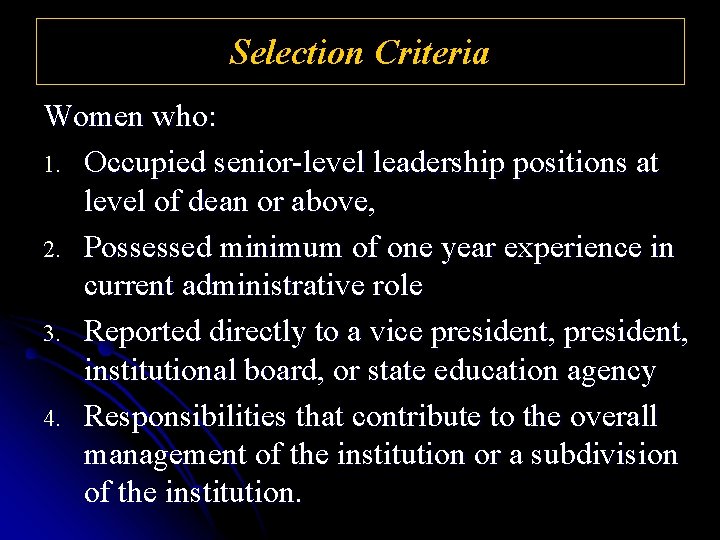
Selection Criteria Women who: 1. Occupied senior-level leadership positions at level of dean or above, 2. Possessed minimum of one year experience in current administrative role 3. Reported directly to a vice president, institutional board, or state education agency 4. Responsibilities that contribute to the overall management of the institution or a subdivision of the institution.
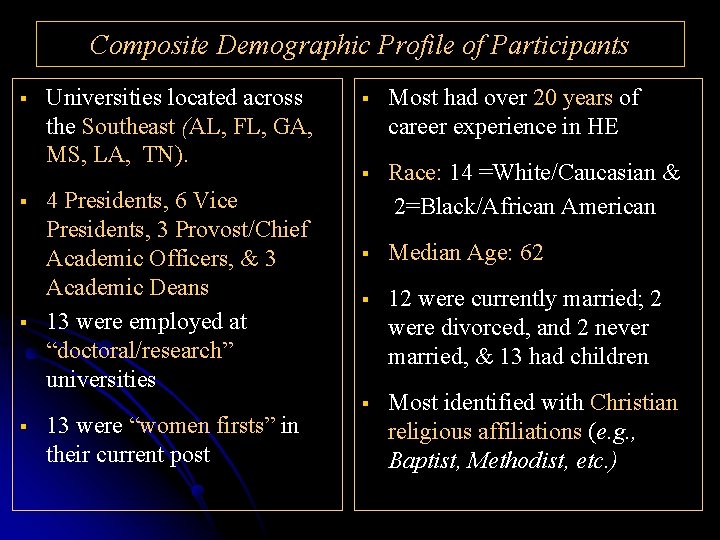
Composite Demographic Profile of Participants § § Universities located across the Southeast (AL, FL, GA, MS, LA, TN). 4 Presidents, 6 Vice Presidents, 3 Provost/Chief Academic Officers, & 3 Academic Deans 13 were employed at “doctoral/research” universities 13 were “women firsts” in their current post § Most had over 20 years of career experience in HE § Race: 14 =White/Caucasian & 2=Black/African American § Median Age: 62 § 12 were currently married; 2 were divorced, and 2 never married, & 13 had children § Most identified with Christian religious affiliations (e. g. , Baptist, Methodist, etc. )
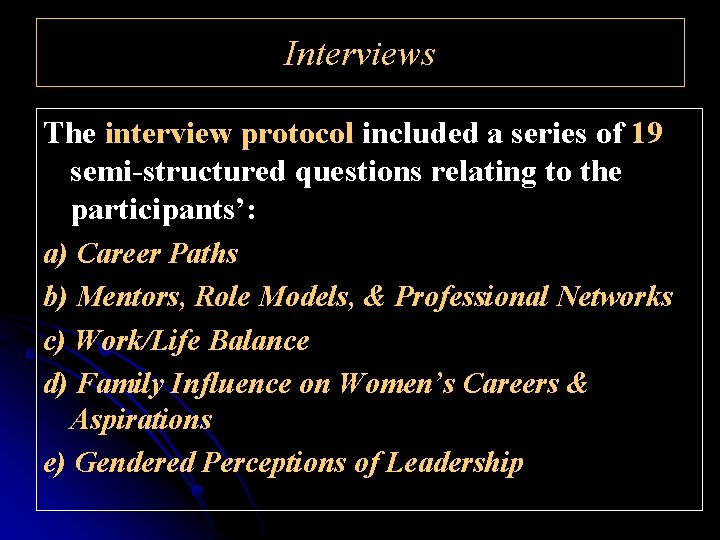
Interviews The interview protocol included a series of 19 semi-structured questions relating to the participants’: a) Career Paths b) Mentors, Role Models, & Professional Networks c) Work/Life Balance d) Family Influence on Women’s Careers & Aspirations e) Gendered Perceptions of Leadership
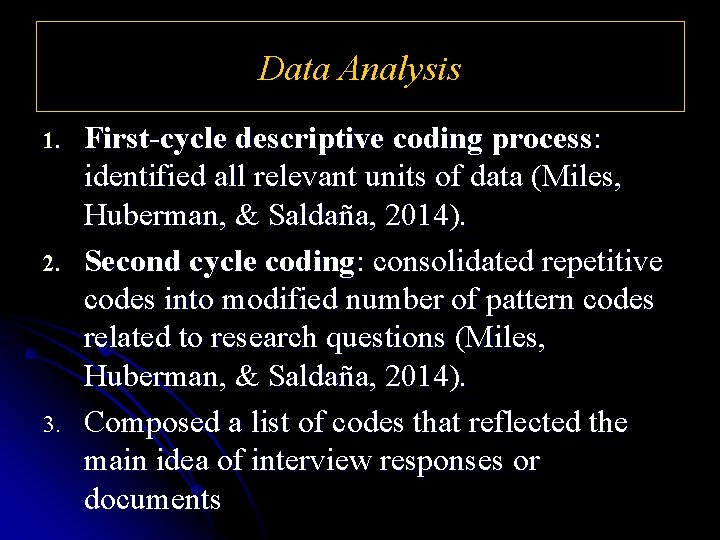
Data Analysis 1. 2. 3. First-cycle descriptive coding process: identified all relevant units of data (Miles, Huberman, & Saldaña, 2014). Second cycle coding: consolidated repetitive codes into modified number of pattern codes related to research questions (Miles, Huberman, & Saldaña, 2014). Composed a list of codes that reflected the main idea of interview responses or documents
Data Analysis (cont. ) 4. 5. 6. 7. Consolidated all redundant codes into a modified list of codes to address RQ Organized and modified the codes into a preliminary category list. Determined most important categories and modified some to eliminate redundancies. Transitioned from categories to concepts through selecting four key themes that reflect the meaning we derived from the data.
Trustworthiness l Triangulation employing peer review, audit trail, researcher reflexivity 1. 2. 3. Invited peers with expertise in content area and methodology to review/assess findings’ credibility Audit trail: research journal detailed processes involved with data collection, clarify researcher experiences, assumptions, biases, and worldview Reflexivity on the researchers’ positionality vis-àvis the research participants.
Findings 1. The minimal role of mentors and role models 2. Gender dynamics characterizing participants’ role models and mentoring relationships; 3. Mentoring moments with multiple and nontraditional mentors and role models; 4. Benefits of mentors and/or role models.
Minimal Role of Mentors and Role Models Lack of Primary Mentoring Relationships Only 2 out of 16 women had a ‘primary’ mentor in a more senior-level position of university leadership. Most women indicated that mentors and role model played a secondary role in their career advancement to administrative positions.
Gender Dynamics • • • For 14 out of 16 women, President Perkins notes, most or all mentors and “There weren’t any women role models were male ahead of me [as]. . . in all of. . . [my leadership roles. ] I Only 9 had a female role was [the] first woman dean, model in their career. . . the first woman provost, path. . . I was the first woman [president]. . . So, I didn’t ‘Women Firsts’ have a lot of women to experienced a lack of watch. ” female leaders to serve as mentors
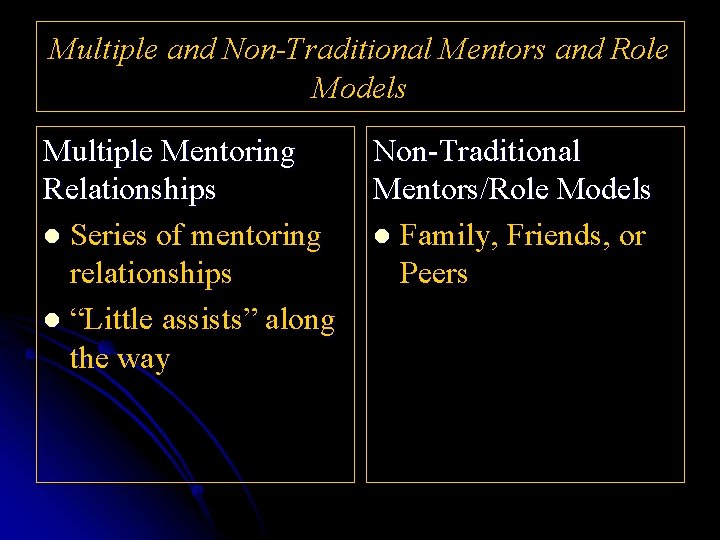
Multiple and Non-Traditional Mentors and Role Models Multiple Mentoring Relationships l Series of mentoring relationships l “Little assists” along the way Non-Traditional Mentors/Role Models l Family, Friends, or Peers
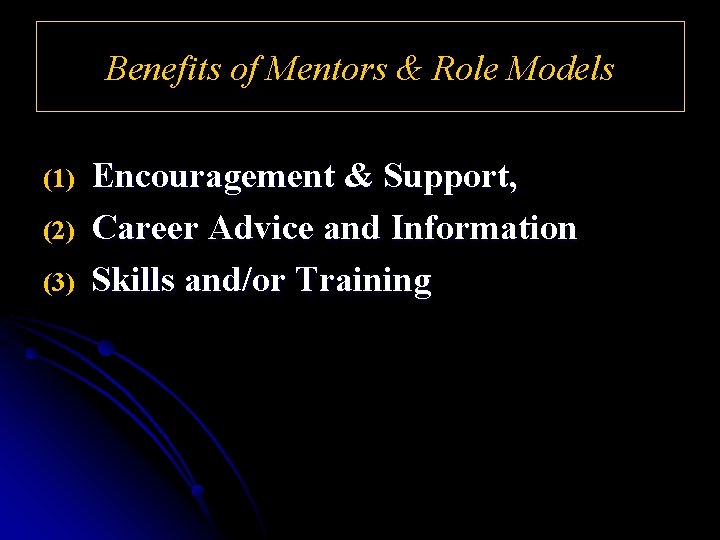
Benefits of Mentors & Role Models (1) (2) (3) Encouragement & Support, Career Advice and Information Skills and/or Training
Discussion l Usefulness of a postmodern feminist framework to illuminate the complexity of multiple identities of female working professionals rather than examine them as one-dimensional persons. l In keeping with the aims of feminist research and practice, one of the goals of this study was to provide women with information that would be instructive for navigating their career paths to university leadership
Research Implications There is a need for research that provides a more detailed and comprehensive understanding of why women continue to be underrepresented in top leadership positions in university settings. Researchers could seek to delve deeper into the personal and professional factors which influence women's career paths and leadership aspirations and tell the stories of minority women in leadership positions.
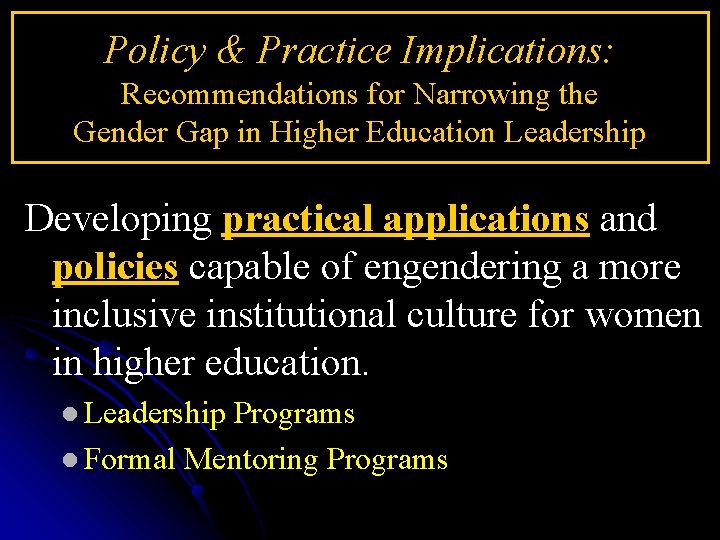
Policy & Practice Implications: Recommendations for Narrowing the Gender Gap in Higher Education Leadership Developing practical applications and policies capable of engendering a more inclusive institutional culture for women in higher education. l Leadership Programs l Formal Mentoring Programs
Questions? Discussion *Acknowledgements: § Research Grant Support for this study was provided by the University of Southern Mississippi’s Committee on Resources & Services for Women § This study has been published in The Qualitative Report 2017 Volume 22, Number 8, Article 2 https: //nsuworks. nova. edu/tqr/