
THE ROCHESTER INSTITUTE OF TECHNOLOGY MICROGRAVITY DROP TOWER
- Slides: 1
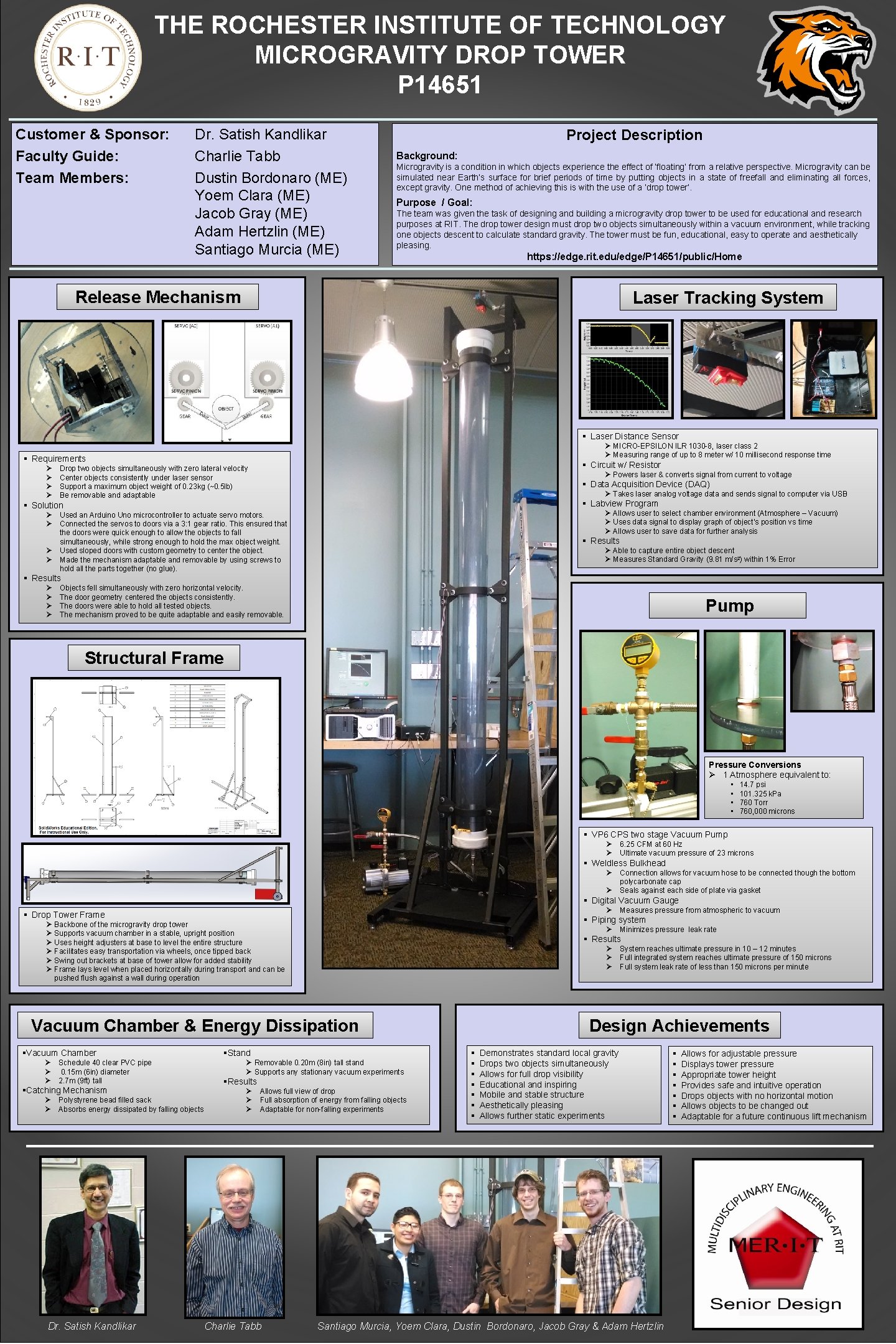
THE ROCHESTER INSTITUTE OF TECHNOLOGY MICROGRAVITY DROP TOWER P 14651 Customer & Sponsor: Faculty Guide: Team Members: Dr. Satish Kandlikar Charlie Tabb Dustin Bordonaro (ME) Yoem Clara (ME) Jacob Gray (ME) Adam Hertzlin (ME) Santiago Murcia (ME) Project Description Background: Microgravity is a condition in which objects experience the effect of ‘floating’ from a relative perspective. Microgravity can be simulated near Earth’s surface for brief periods of time by putting objects in a state of freefall and eliminating all forces, except gravity. One method of achieving this is with the use of a ‘drop tower’. Purpose / Goal: The team was given the task of designing and building a microgravity drop tower to be used for educational and research purposes at RIT. The drop tower design must drop two objects simultaneously within a vacuum environment, while tracking one objects descent to calculate standard gravity. The tower must be fun, educational, easy to operate and aesthetically pleasing. https: //edge. rit. edu/edge/P 14651/public/Home Release Mechanism Laser Tracking System § Laser Distance Sensor Ø MICRO-EPSILON ILR 1030 -8, laser class 2 Ø Measuring range of up to 8 meter w/ 10 millisecond response time § Requirements Ø Ø § Circuit w/ Resistor Drop two objects simultaneously with zero lateral velocity Center objects consistently under laser sensor Support a maximum object weight of 0. 23 kg (~0. 5 lb) Be removable and adaptable Ø Powers laser & converts signal from current to voltage § Data Acquisition Device (DAQ) Ø Takes laser analog voltage data and sends signal to computer via USB § Labview Program § Solution Ø Ø Ø Allows user to select chamber environment (Atmosphere – Vacuum) Ø Uses data signal to display graph of object’s position vs time Ø Allows user to save data for further analysis Used an Arduino Uno microcontroller to actuate servo motors. Connected the servos to doors via a 3: 1 gear ratio. This ensured that the doors were quick enough to allow the objects to fall simultaneously, while strong enough to hold the max object weight. Used sloped doors with custom geometry to center the object. Made the mechanism adaptable and removable by using screws to hold all the parts together (no glue). § Results Ø Able to capture entire object descent Ø Measures Standard Gravity (9. 81 m/s 2) within 1% Error § Results Ø Ø Objects fell simultaneously with zero horizontal velocity. The door geometry centered the objects consistently. The doors were able to hold all tested objects. The mechanism proved to be quite adaptable and easily removable. Pump Structural Frame Pressure Conversions Ø 1 Atmosphere equivalent to: • • 14. 7 psi 101. 325 k. Pa 760 Torr 760, 000 microns § VP 6 CPS two stage Vacuum Pump Ø Ø 6. 25 CFM at 60 Hz Ultimate vacuum pressure of 23 microns § Weldless Bulkhead Ø Ø Connection allows for vacuum hose to be connected though the bottom polycarbonate cap Seals against each side of plate via gasket § Digital Vacuum Gauge Ø § Drop Tower Frame § Piping system Ø Backbone of the microgravity drop tower Ø Supports vacuum chamber in a stable, upright position Ø Uses height adjusters at base to level the entire structure Ø Facilitates easy transportation via wheels, once tipped back Ø Swing out brackets at base of tower allow for added stability Ø Frame lays level when placed horizontally during transport and can be pushed flush against a wall during operation Ø Ø Schedule 40 clear PVC pipe 0. 15 m (6 in) diameter 2. 7 m (9 ft) tall §Catching Mechanism Ø Ø Ø Polystyrene bead filled sack Absorbs energy dissipated by falling objects Dr. Satish Kandlikar §Stand Ø Removable 0. 20 m (8 in) tall stand Ø Supports any stationary vacuum experiments §Results Ø Ø Ø Allows full view of drop Full absorption of energy from falling objects Adaptable for non-falling experiments Charlie Tabb Minimizes pressure leak rate § Results Vacuum Chamber & Energy Dissipation §Vacuum Chamber Measures pressure from atmospheric to vacuum System reaches ultimate pressure in 10 – 12 minutes Full integrated system reaches ultimate pressure of 150 microns Full system leak rate of less than 150 microns per minute Design Achievements § § § § Demonstrates standard local gravity Drops two objects simultaneously Allows for full drop visibility Educational and inspiring Mobile and stable structure Aesthetically pleasing Allows further static experiments Santiago Murcia, Yoem Clara, Dustin Bordonaro, Jacob Gray & Adam Hertzlin § § § § Allows for adjustable pressure Displays tower pressure Appropriate tower height Provides safe and intuitive operation Drops objects with no horizontal motion Allows objects to be changed out Adaptable for a future continuous lift mechanism