
THE ROAD AHEAD FOR A COGNITIVE COMPUTING PLATFORM
- Slides: 28
“THE ROAD AHEAD FOR A COGNITIVE COMPUTING PLATFORM SUPPORTING A UNIFIED APPROACH TOWARDS PRIVACY, SECURITY AND SAFETY (PSS) OF IOT SYSTEMS” Io. T Modelling Framework and Papyrus Shuai Li, CEA CHARIOT-VESSEDIA Workshop 9 May 2019, Dublin, Ireland CHARIOT – VESSEDIA Workshop, 9 May 2019, Dublin, Ireland 1
Presentation outline 01 From specifications to proof goals 02 System models to symbolically executable models 03 Symbolic execution and relational property inference 04 6 Lo. WPAN case-study CHARIOT – VESSEDIA Workshop, 9 May 2019, Dublin, Ireland 2
From specifications to proof goals
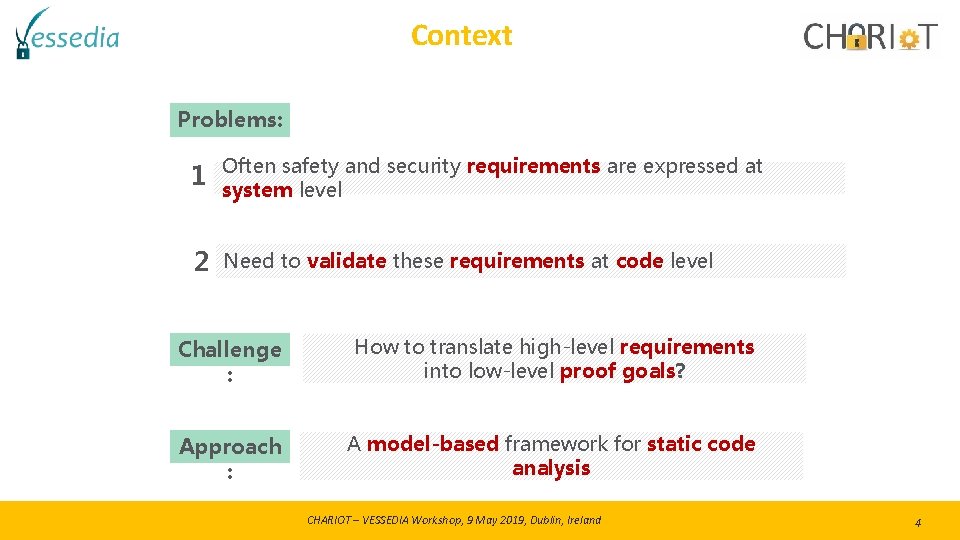
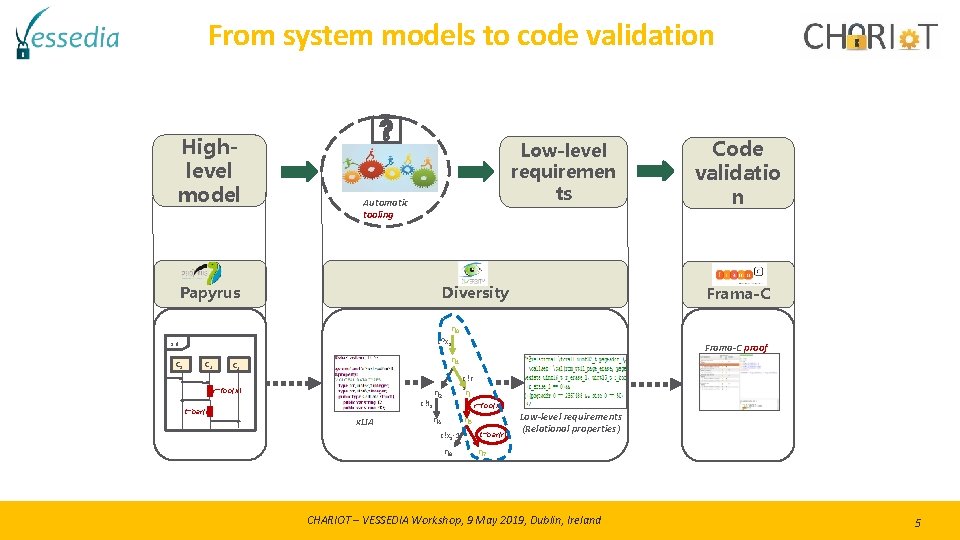
Context Problems: 1 Often safety and security requirements are expressed at system level 2 Need to validate these requirements at code level Challenge : How to translate high-level requirements into low-level proof goals? Approach : A model-based framework for static code analysis CHARIOT – VESSEDIA Workshop, 9 May 2019, Dublin, Ireland 4
From system models to code validation Highlevel model Low-level requiremen ts Automatic tooling Diversity Papyrus Code validatio n Frama-C η 0 c? x 1 sd C 1 C 2 Frama-C proof η 1 C 3 c!r r=foo(x) t=bar(r) c!t 1 x. LIA 1 η η 2 3 η 4 r=foo(x) η 5 c!x 1 -1 η 8 t=bar(r) Low-level requirements (Relational properties) η 7 CHARIOT – VESSEDIA Workshop, 9 May 2019, Dublin, Ireland 5
System models to symbolically executable models
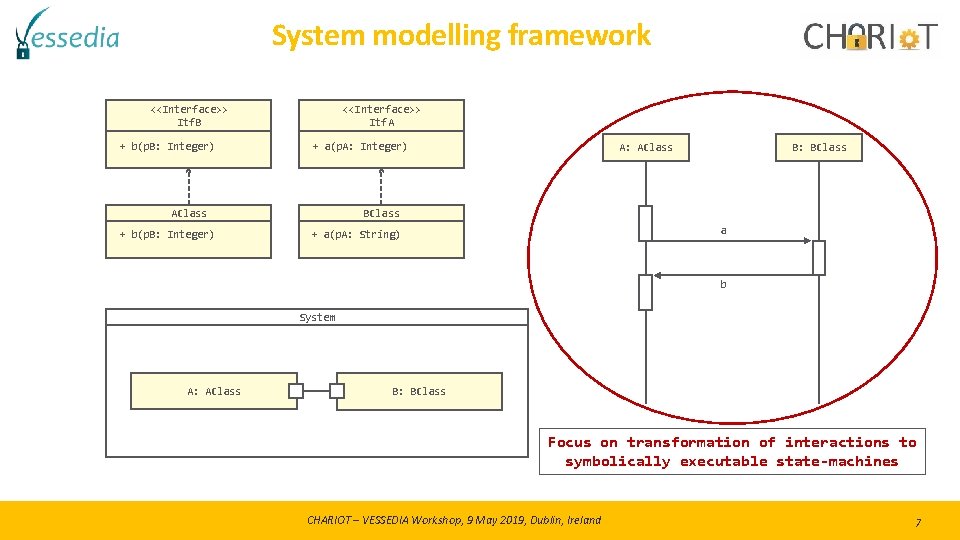
System modelling framework <<Interface>> Itf. B + b(p. B: Integer) <<Interface>> Itf. A + a(p. A: Integer) AClass + b(p. B: Integer) A: AClass B: BClass a + a(p. A: String) b System A: AClass B: BClass Focus on transformation of interactions to symbolically executable state-machines CHARIOT – VESSEDIA Workshop, 9 May 2019, Dublin, Ireland 7
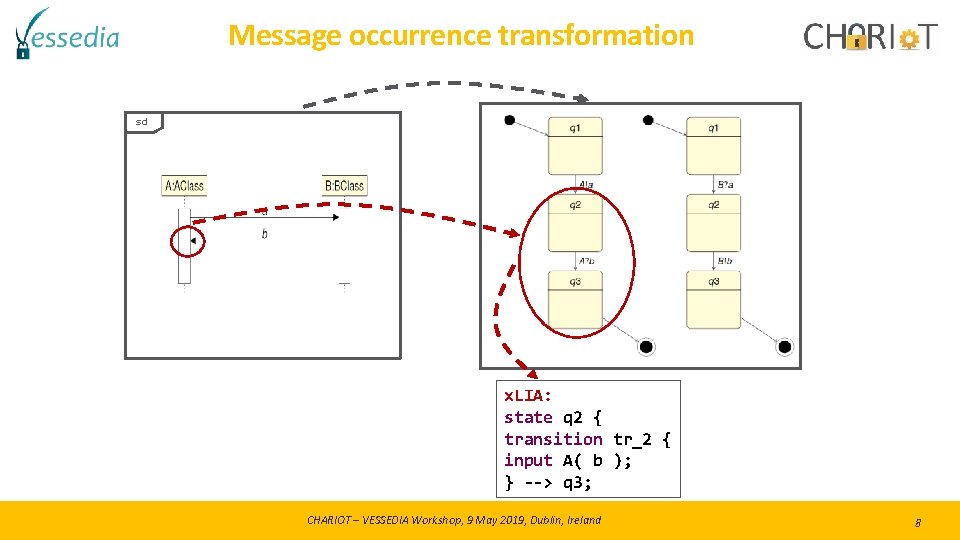
Message occurrence transformation sd x. LIA: state q 2 { transition tr_2 { input A( b ); } --> q 3; CHARIOT – VESSEDIA Workshop, 9 May 2019, Dublin, Ireland 8
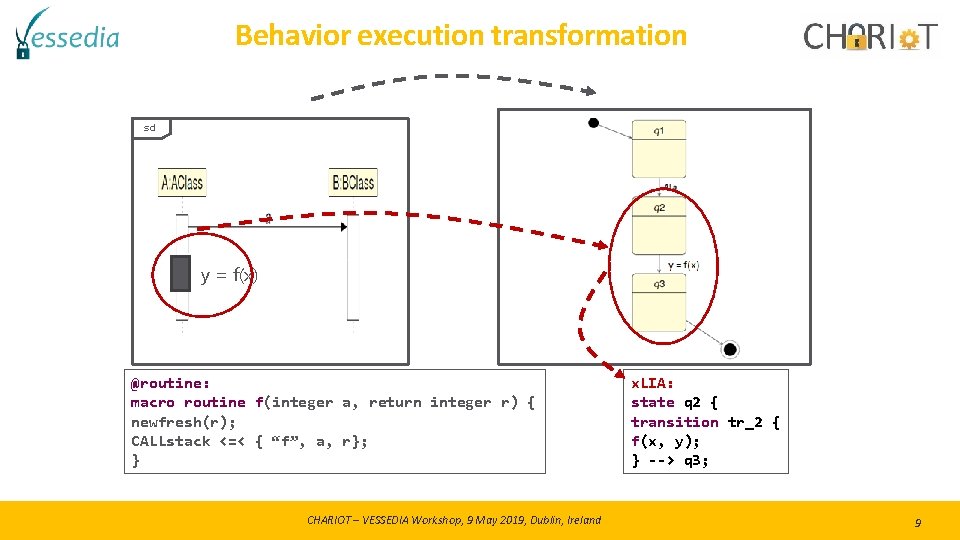
Behavior execution transformation sd y = f(x) @routine: macro routine f(integer a, return integer r) { newfresh(r); CALLstack <=< { “f”, a, r}; } CHARIOT – VESSEDIA Workshop, 9 May 2019, Dublin, Ireland x. LIA: state q 2 { transition tr_2 { f(x, y); } --> q 3; 9
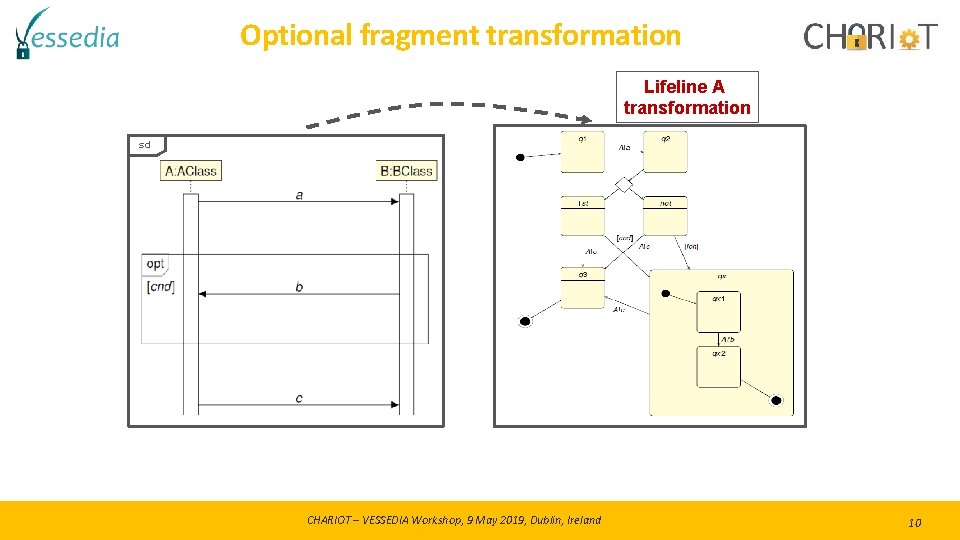
Optional fragment transformation Lifeline A transformation sd CHARIOT – VESSEDIA Workshop, 9 May 2019, Dublin, Ireland 10
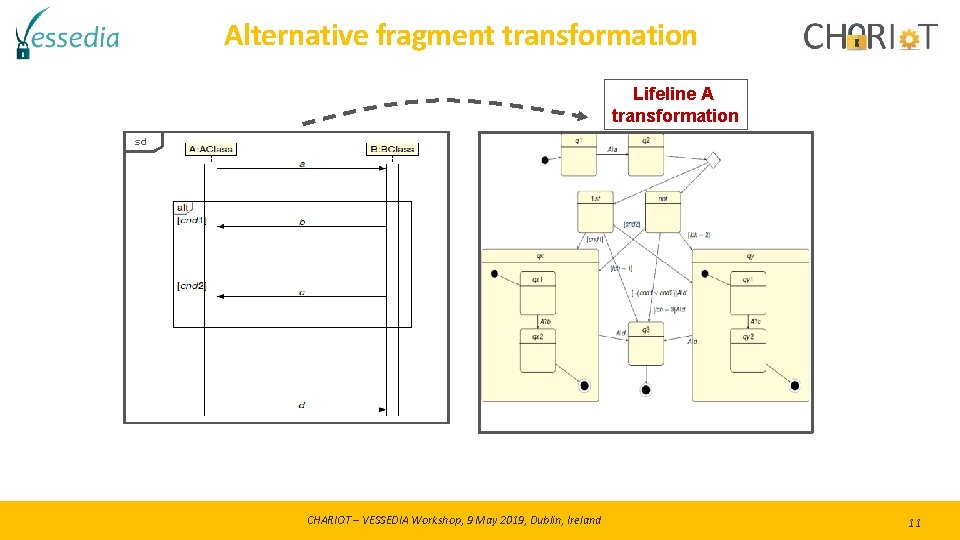
Alternative fragment transformation Lifeline A transformation sd CHARIOT – VESSEDIA Workshop, 9 May 2019, Dublin, Ireland 11
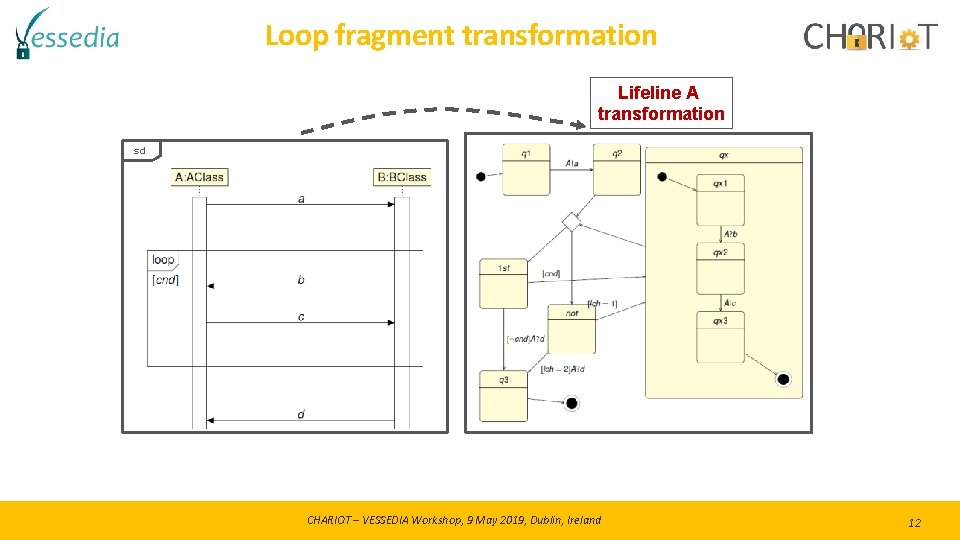
Loop fragment transformation Lifeline A transformation sd CHARIOT – VESSEDIA Workshop, 9 May 2019, Dublin, Ireland 12
Symbolic execution and relational property inference
Symbolic execution CHARIOT – VESSEDIA Workshop, 9 May 2019, Dublin, Ireland 14
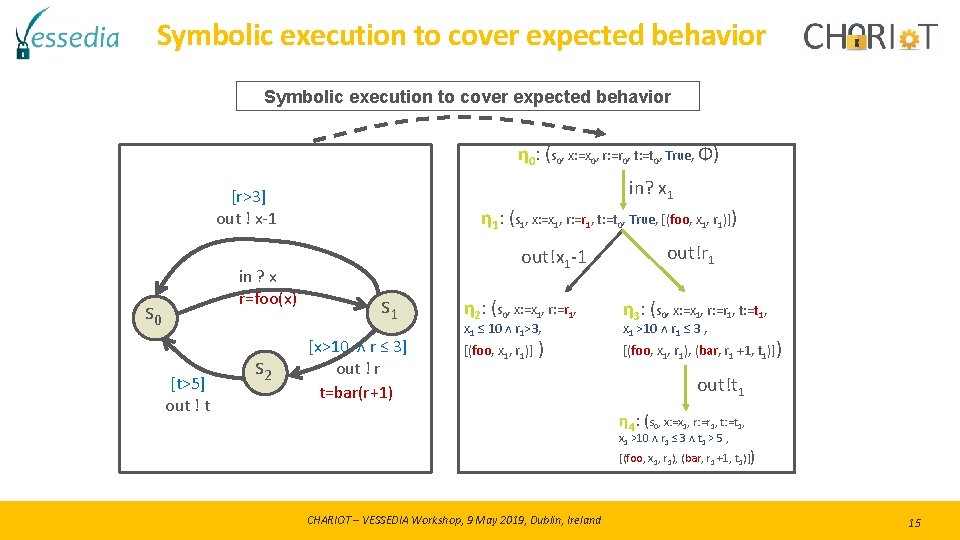
Symbolic execution to cover expected behavior η 0: (s 0, x: =x 0, r: =r 0, t: =t 0, True, Φ) in? x 1 [r>3] out ! x-1 in ? x r=foo(x) s 0 [t>5] out ! t s 2 η 1: (s 1, x: =x 1, r: =r 1, t: =t 0, True, [(foo, x 1, r 1)]) out!x 1 -1 s 1 [x>10 ᴧ r ≤ 3] out ! r t=bar(r+1) η 2: (s 0, x: =x 1, r: =r 1, x 1 ≤ 10 ᴧ r 1>3, [(foo, x 1, r 1)] ) out!r 1 η 3: (s 0, x: =x 1, r: =r 1, t: =t 1, x 1 >10 ᴧ r 1 ≤ 3 , [(foo, x 1, r 1), (bar, r 1 +1, t 1)]) out!t 1 η 4: (s 0, x: =x 1, r: =r 1, t: =t 1, x 1 >10 ᴧ r 1 ≤ 3 ᴧ t 1 > 5 , [(foo, x 1, r 1), (bar, r 1 +1, t 1)]) CHARIOT – VESSEDIA Workshop, 9 May 2019, Dublin, Ireland 15
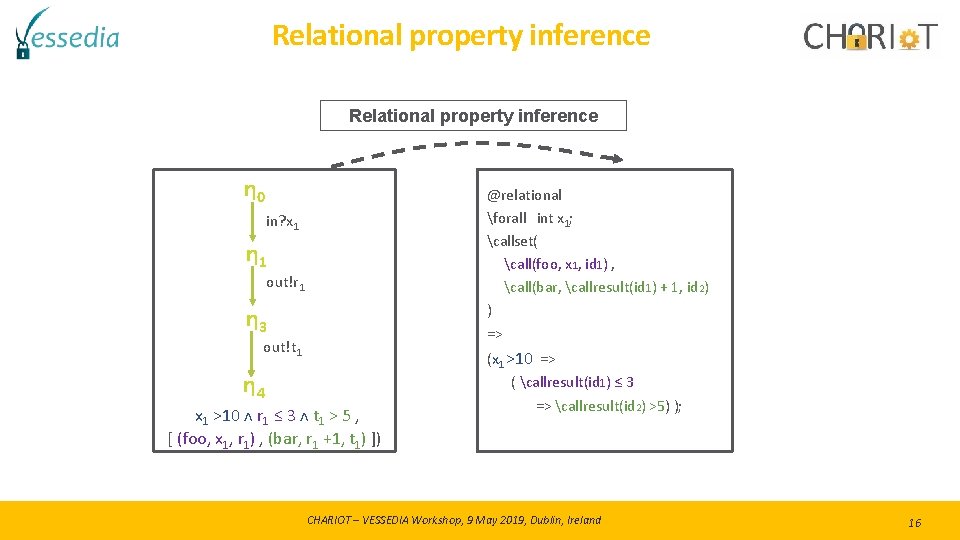
Relational property inference η 0 @relational forall int x 1; callset( call(foo, x 1, id 1) , call(bar, callresult(id 1) + 1, id 2) ) => in? x 1 η 1 out!r 1 η 3 out!t 1 η 4 yyyyy x 1 >10 ᴧ r 1 ≤ 3 ᴧ t 1 > 5 , [ (foo, x 1, r 1) , (bar, r 1 +1, t 1) ]) (x 1 >10 => ( callresult(id 1) ≤ 3 => callresult(id 2) >5) ); CHARIOT – VESSEDIA Workshop, 9 May 2019, Dublin, Ireland 16
6 Lo. WPAN case-study
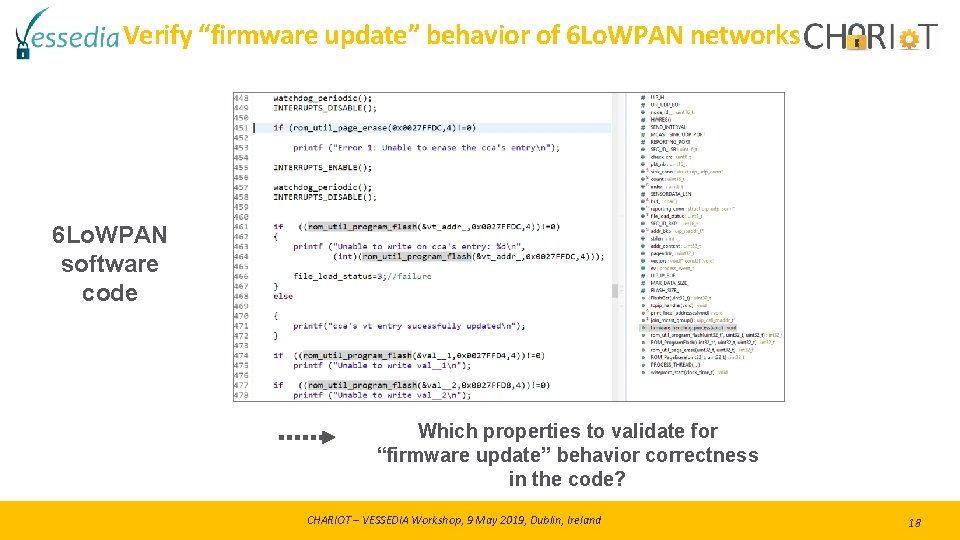
Verify “firmware update” behavior of 6 Lo. WPAN networks 6 Lo. WPAN software code Which properties to validate for “firmware update” behavior correctness in the code? CHARIOT – VESSEDIA Workshop, 9 May 2019, Dublin, Ireland 18
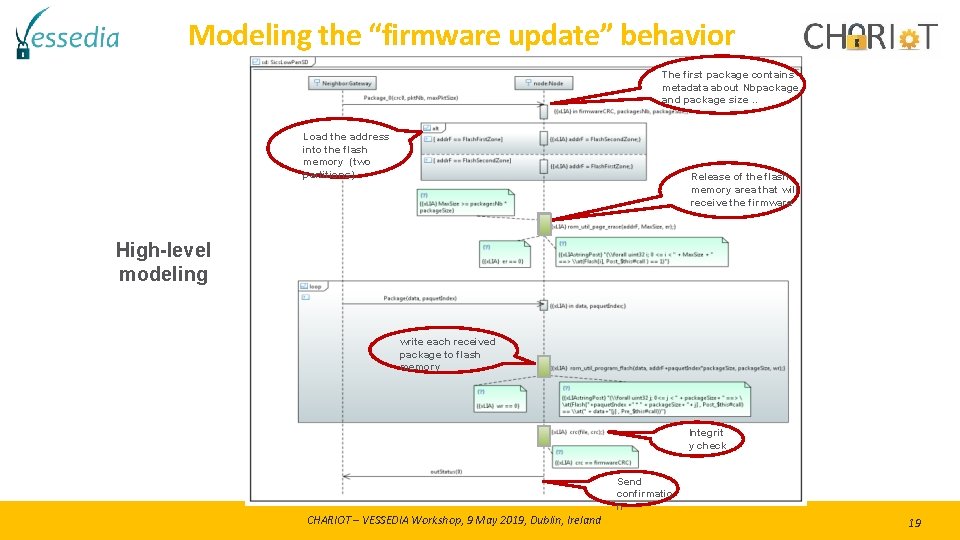
Modeling the “firmware update” behavior The first package contains metadata about Nbpackage, and package size. . Load the address into the flash memory (two partitions). Release of the flash memory area that will receive the firmware High-level modeling write each received package to flash memory Integrit y check Send confirmatio n CHARIOT – VESSEDIA Workshop, 9 May 2019, Dublin, Ireland 19
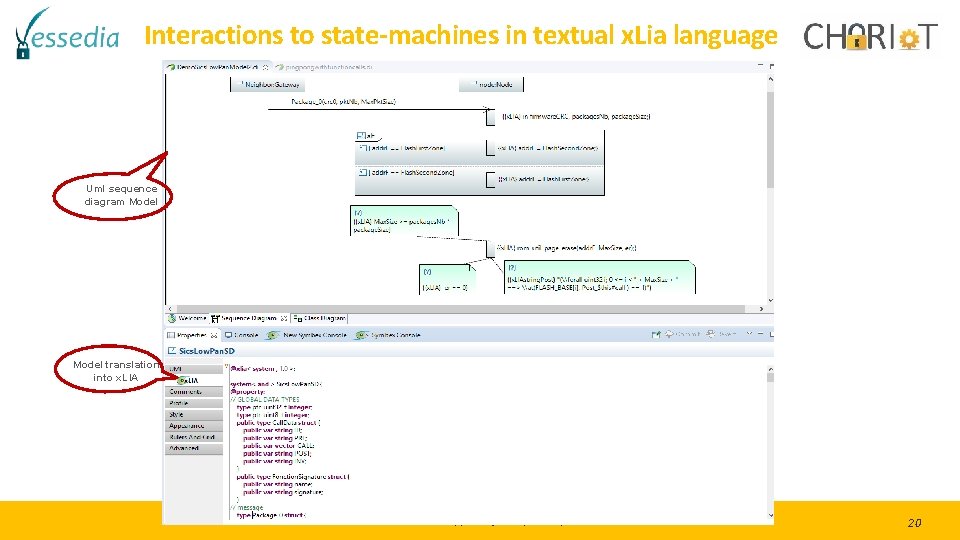
Interactions to state-machines in textual x. Lia language Uml sequence diagram Model translation into x. LIA CHARIOT – VESSEDIA Workshop, 9 May 2019, Dublin, Ireland 20
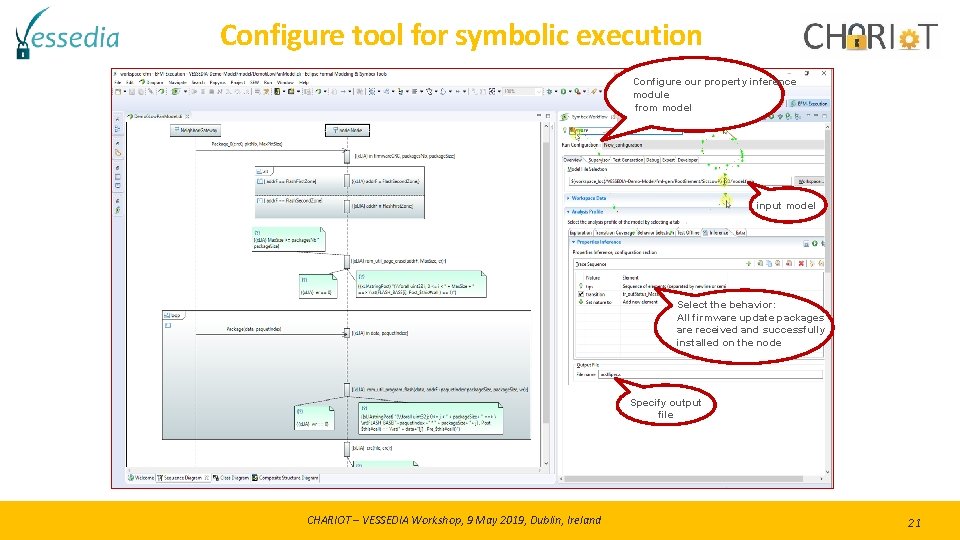
Configure tool for symbolic execution Configure our property inference module from model input model Select the behavior: All firmware update packages are received and successfully installed on the node Specify output file CHARIOT – VESSEDIA Workshop, 9 May 2019, Dublin, Ireland 21
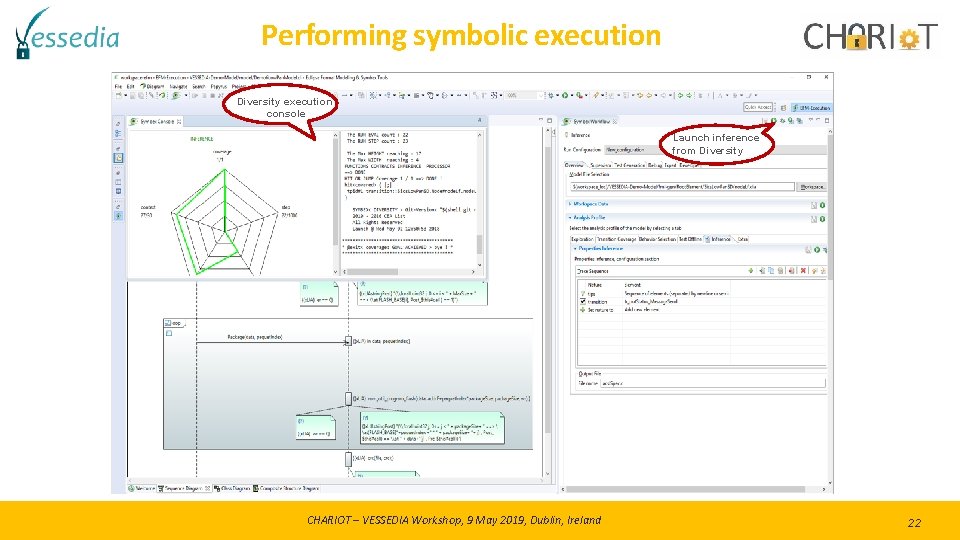
Performing symbolic execution Diversity execution console Launch inference from Diversity CHARIOT – VESSEDIA Workshop, 9 May 2019, Dublin, Ireland 22
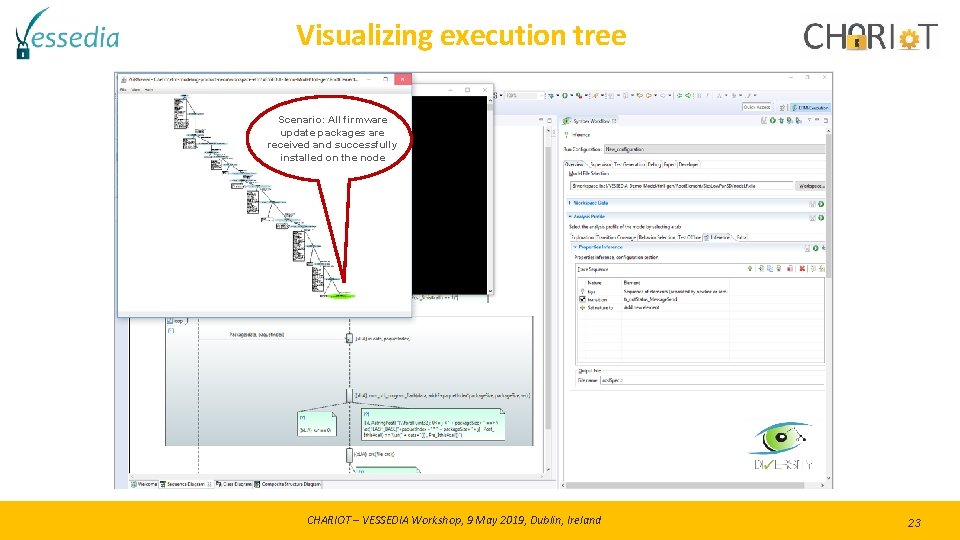
Visualizing execution tree Scenario: All firmware update packages are received and successfully installed on the node CHARIOT – VESSEDIA Workshop, 9 May 2019, Dublin, Ireland 23
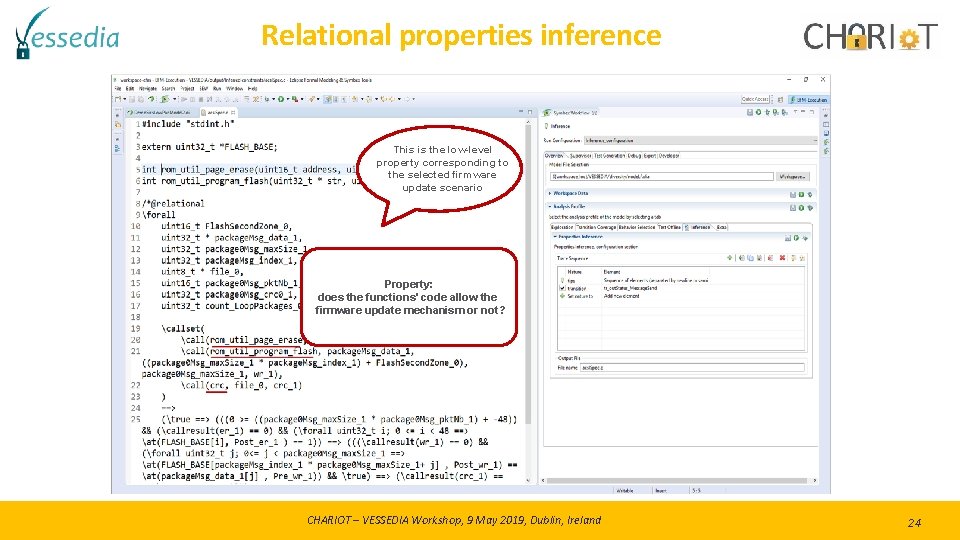
Relational properties inference This is the low-level property corresponding to the selected firmware update scenario The property annotates functions called within the Property: firmware update does the functions' code scenario allow the firmware update mechanism or not? CHARIOT – VESSEDIA Workshop, 9 May 2019, Dublin, Ireland 24
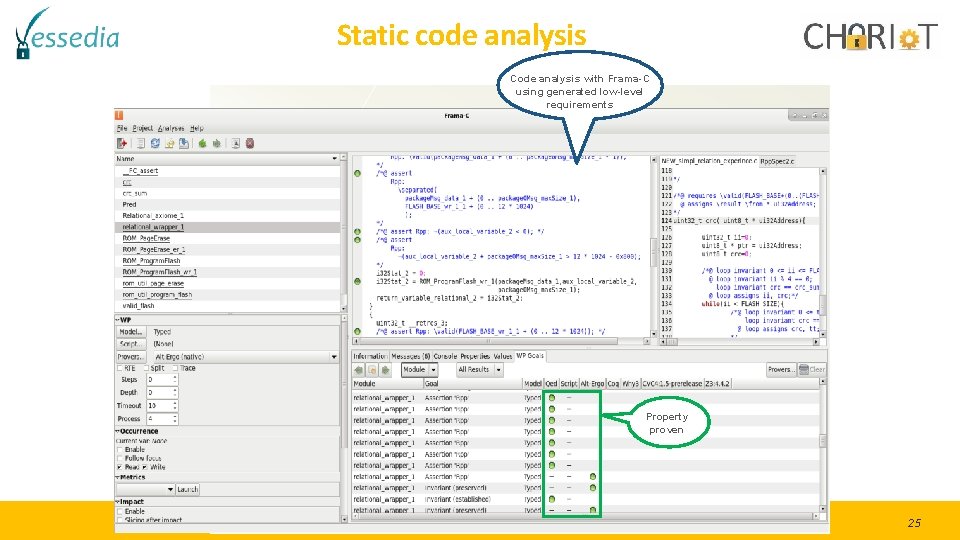
Static code analysis Code analysis with Frama-C using generated low-level requirements Property proven CHARIOT – VESSEDIA Workshop, 9 May 2019, Dublin, Ireland 25
Conclusion
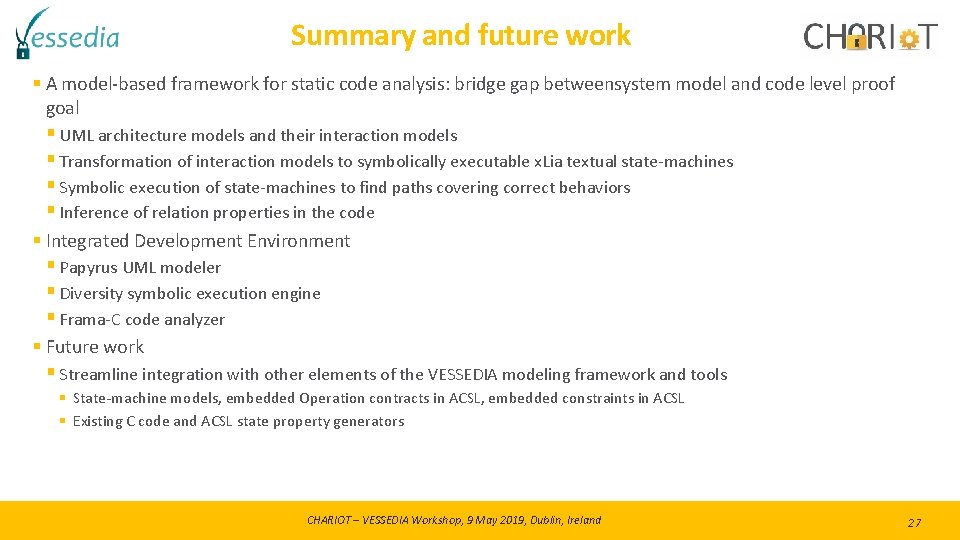
Summary and future work § A model-based framework for static code analysis: bridge gap betweensystem model and code level proof goal § UML architecture models and their interaction models § Transformation of interaction models to symbolically executable x. Lia textual state-machines § Symbolic execution of state-machines to find paths covering correct behaviors § Inference of relation properties in the code § Integrated Development Environment § Papyrus UML modeler § Diversity symbolic execution engine § Frama-C code analyzer § Future work § Streamline integration with other elements of the VESSEDIA modeling framework and tools § State-machine models, embedded Operation contracts in ACSL, embedded constraints in ACSL § Existing C code and ACSL state property generators CHARIOT – VESSEDIA Workshop, 9 May 2019, Dublin, Ireland 27
Contact Details CEA Shuai Li shuai. li@cea. fr The projects CHARIOT & VESSEDIA have received funding from the European Union’s Horizon 2020 research and innovation programme under grant agreement No 780075 & No 731453. CHARIOT – VESSEDIA Workshop, 9 May 2019, Dublin, Ireland 28