
The risks of a new global debt crises

The risks of a new global debt crises Bodo Ellmers, Eurodad 20 September 2018 Budapest
What has caused the last financial crisis? • Rising inequality: The poor have to borrow to meet their needs, the rich have to invest – the banks facilitate sub-prime lending. • Financialization: Privatization of public goods such as health, housing, or education creates more needs to borrow, new asset classes – and much more debt. • Deregulation: USA and EU lifted restrictions on the financial sector financial institutions respond by shifting their business model to speculative activities.
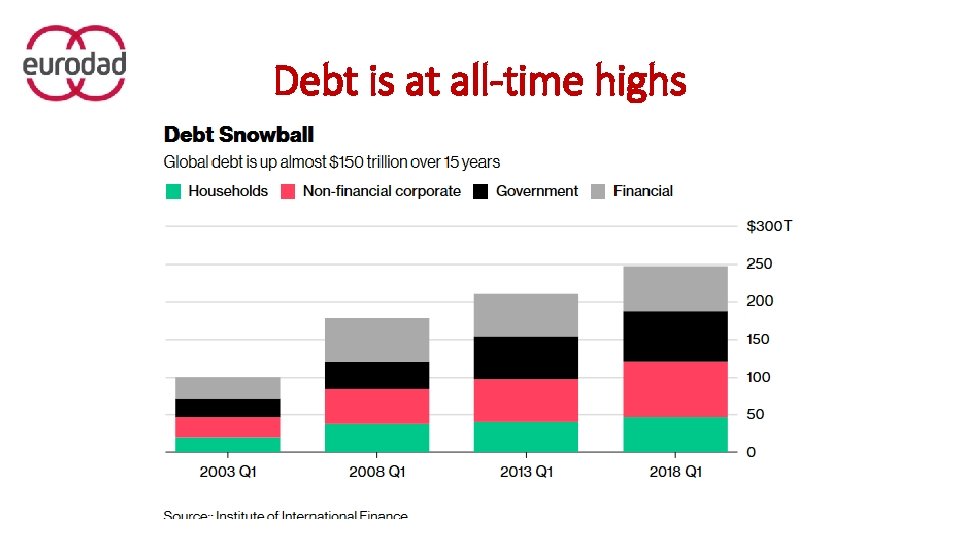
Debt is at all-time highs
Total & Public debt Total debt: - Worldwide debt (excluding financial debt) has reached US$164 trillion, equal to 225% of global GDP and up from a previous record of 213% in 2009. Public debt: - Advanced economies’ public debt has risen to 106. 9% of GDP in 2017 - Greece expected to breach 190% this year, three times the debt level considered “sustainable” under the EU’s Maastricht rules (Italy 129. 7%; USA now way beyond 100% of GDP and rising) - Emerging economies crisis: Argentina already turned to the IMF, massive debt problems also in Brasil, Pakistan, Turkey etc. - Just 1 of 5 Low Income Countries is considered to be in “low risk of debt distress” Effects of debt 1990/2000 s debt relief has been undone
Private debt • Corporate debt globally has reached 66 trillion USD • Boom of bond issuance everywhere: public and private, North and South, large share denominated in foreign currency. • Especially in Asia bond issuance tripled from 62 bn in 2017 to 191 bn USD in 2018 • Even in Low Income Countries the bond boom continues: high yields of up to 10% annually attract greedy investors and drain poor countries’ resources. • This is driven by hot money from the USA, EU and Japan (quantitative easing) • … and by the banks who cashed in 23. 3 bn in commissions in 2017 for their services related to issuing bonds. The whole world economy is overleveraged: financial bubbles that are likely to burst in an new crisis
2. The response to the last (and still ongoing) financial crisis has paved the way for the next crises
Solving debt crises: Policy options • Growth (of GDP, wages, tax income) • Austerity (reduce expenses for consumption) • Inflation (inflation > interest rate = debt disappears over time) • Bailout (delays defaults through provision of new liquidity) • Debt relief or restructuring (reduces debt stock)
… and which policy options have been chosen? • Mix of austerity and bailout has been chosen, the first depresses GDP growth, the second increases debt levels No surprise that debt/GDP ratios have been rising! • QE was supposed to boost inflation and growth but this failed, also due to lack of capital controls. It rather triggered a “tsunami of capital flows” to the global south. • Growth and debt restructuring have not been chosen there was no deleveraging, no reduction of overall debt/GDP-ratios
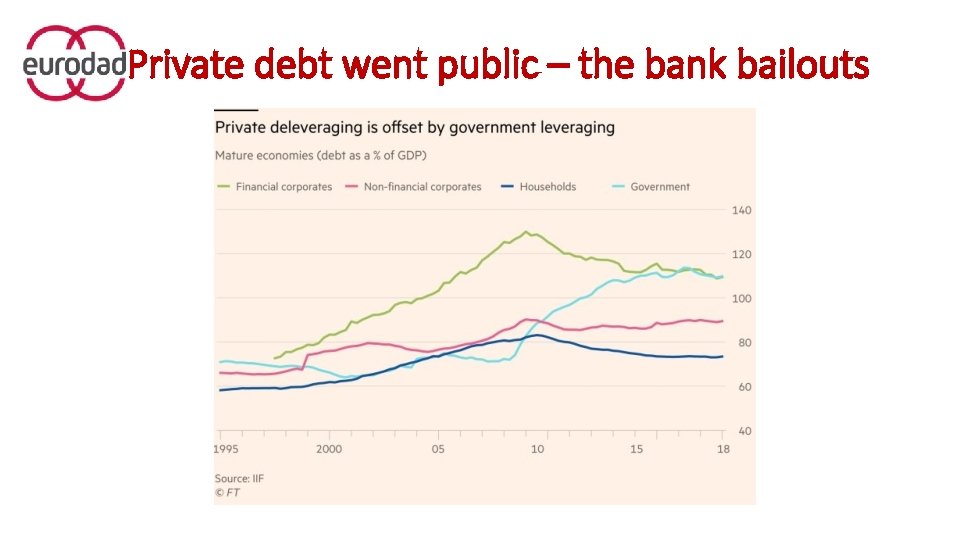
Private debt went public – the bank bailouts

3. History repeats itself? The current cycle is similar to the one that triggered the 1980 s debt crises
The debt cycle • Excessive savings and sluggish growth in some countries lending boom to deficit countries rising debt levels debt crises • Debt services costs are rising they increasingly absorb scarce official development assistance and tax income • Developing country debt payments increased by 60% between 2014 and 2017. • Public spending is being reduced, is crowded out by debt payments • IMF and other IFIs have not learned lessons from the past: They prioritize bailout lending, with austerity conditions attached, over debt restructuring The next lost decade might be at the doorstep … these are not so good prospects for the Sustainable Development Goals!
4. Where will the next crisis start? • Corporate debt? Extremely high leverage, including in China and Latin America • Financial sector debt? Too-big-too-fail has not been resolved since last crises, concentration process has continued, QE keeps “zombie banks” alive • China? extremely high private debt levels and contingent liabilities, spillover to the global south would be dramatic • Italy? high sovereign debt to GDP, gross financing needs of 40. 7% of GDP, lots of non-performing loans the return of the Euro crisis? • USA? Will the Fed’s interest rate decisions in combination with Trump’s tax reform take the whole world economy down (rising USD interest is highly problematic for all USD borrowers, especially developing countries). US fiscal deficit is expected to rise to 6% of GDP by 2019, due to the tax cuts vacuum cleaner • Emerging economies? Argentina is already in crises • What about the poorest countries? First cases of default already. Chad, Mozambique etc. LICs crises are more “collateral damage” of the debt system, a victim of policy decisions taken elsewhere in the debt system.
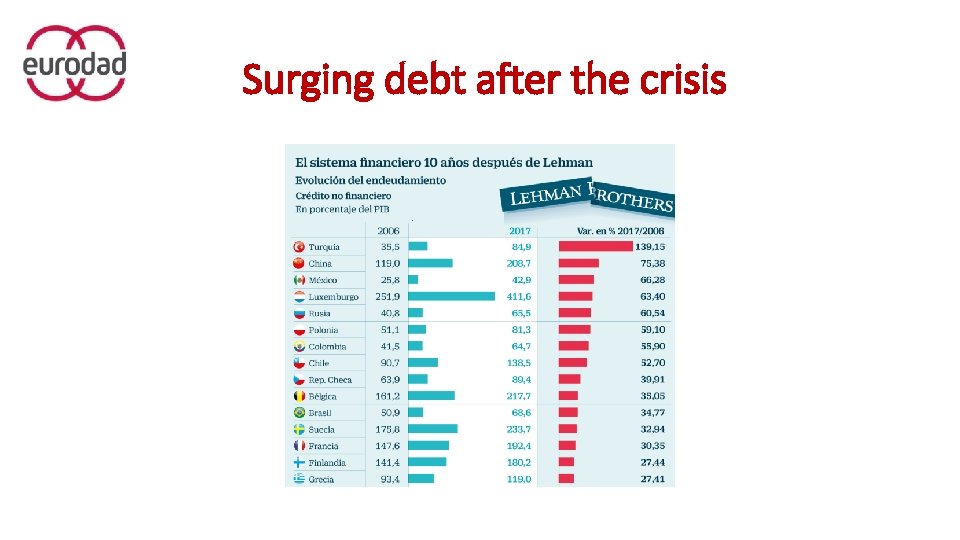
Surging debt after the crisis
5. Which way to go – the need for reforms: Prevention of crises: - More reliance on financing instruments that do not create new debts (tax, development assistance, equity etc) - Responsible Lending: Financing instruments that reduce default risks (GDP-linked bonds; state-contingent lending) Resolution of crises: - Debt relief/restructuring (deleveraging) must become the first or at least a more prominent policy option - Better institutions to make this possible are needs (debt workout mechanism)
- Slides: 14