
The Rise Peak Fall of Conflict The Civil


- Slides: 25
The Rise, Peak, & Fall of Conflict The Civil War
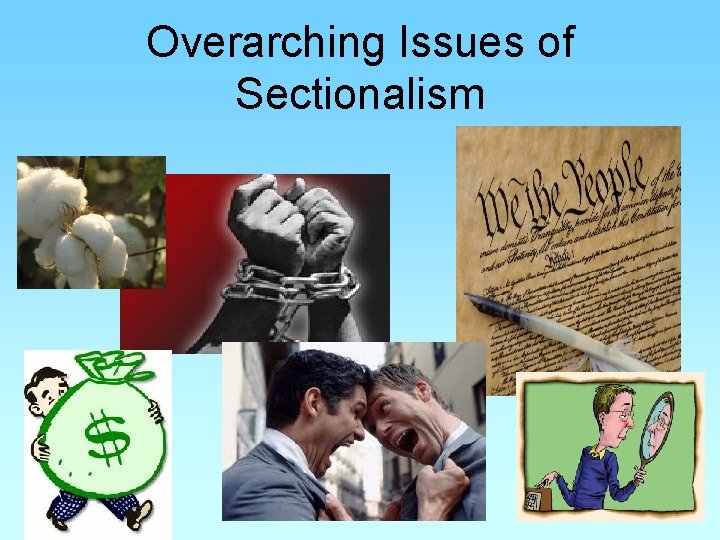
Overarching Issues of Sectionalism
Manifestation of Sectionalism
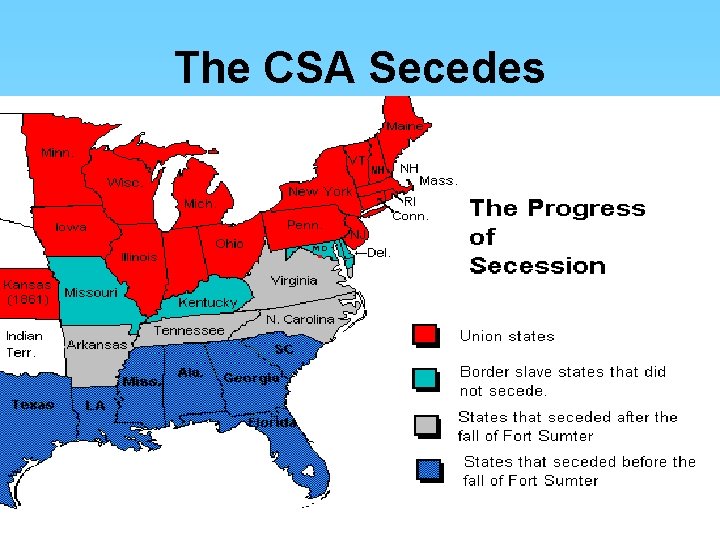
The CSA Secedes
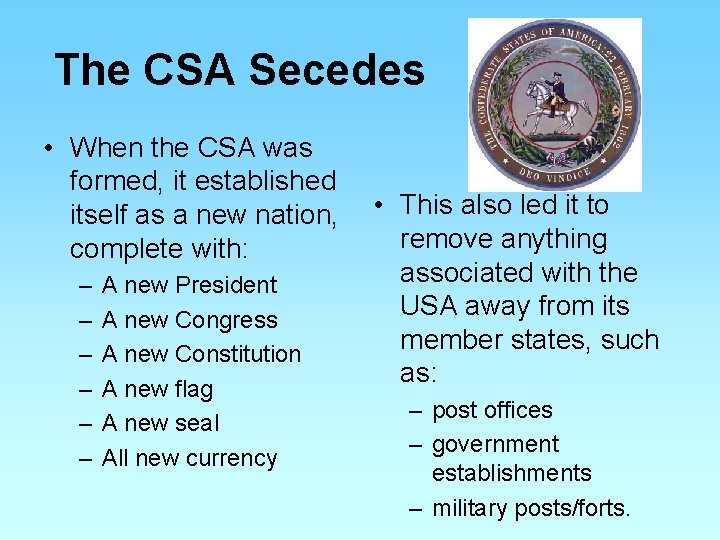
The CSA Secedes • When the CSA was formed, it established itself as a new nation, complete with: – – – A new President A new Congress A new Constitution A new flag A new seal All new currency • This also led it to remove anything associated with the USA away from its member states, such as: – post offices – government establishments – military posts/forts.
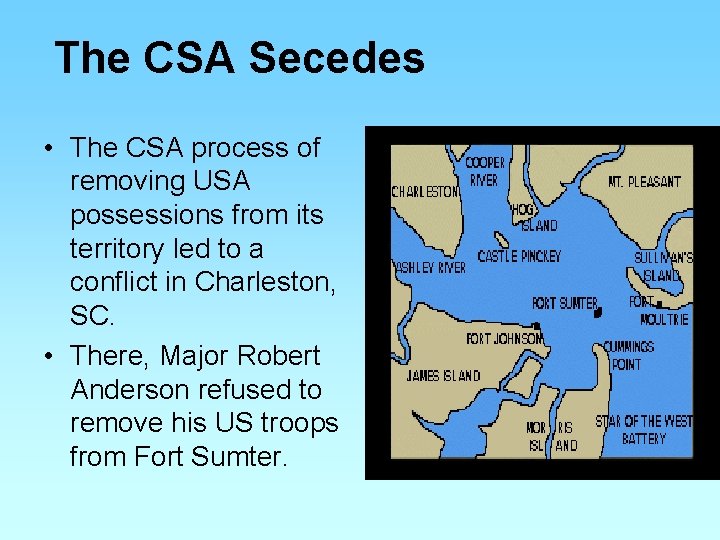
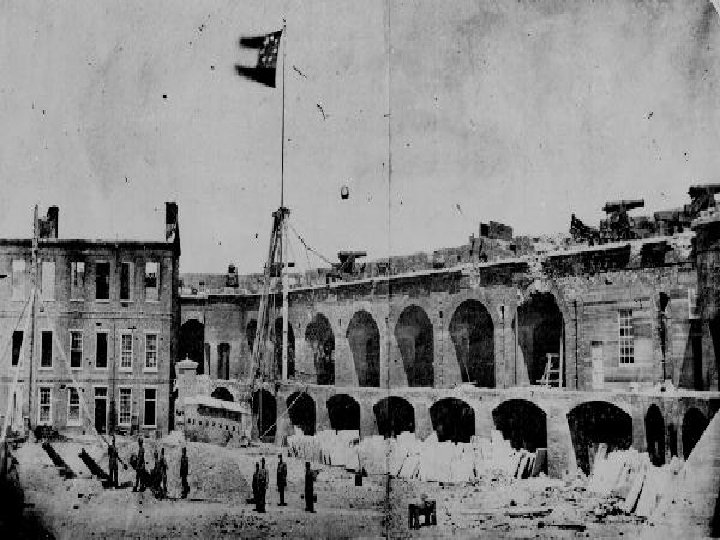
The CSA Secedes • The CSA process of removing USA possessions from its territory led to a conflict in Charleston, SC. • There, Major Robert Anderson refused to remove his US troops from Fort Sumter.
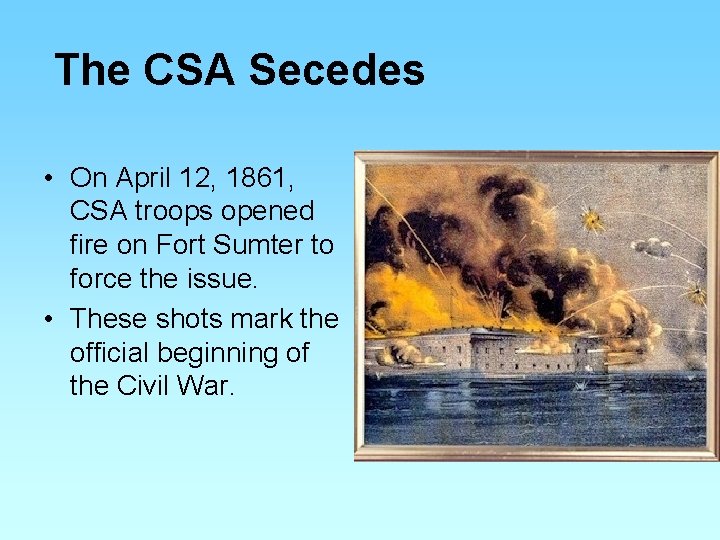
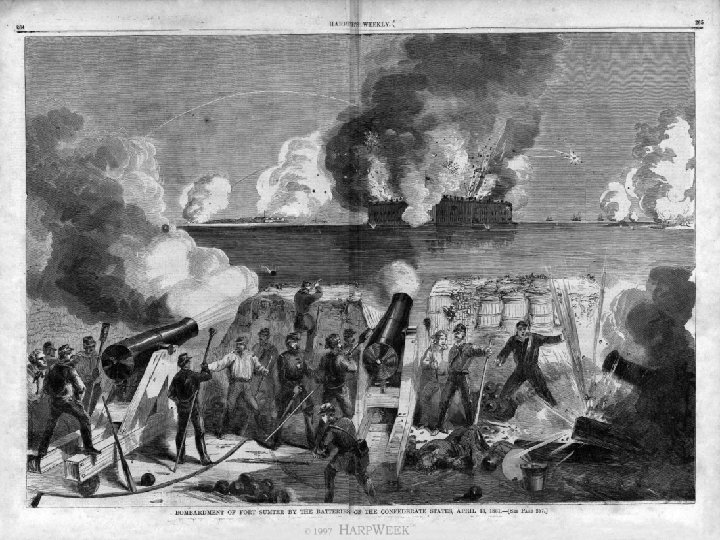
The CSA Secedes • On April 12, 1861, CSA troops opened fire on Fort Sumter to force the issue. • These shots mark the official beginning of the Civil War.
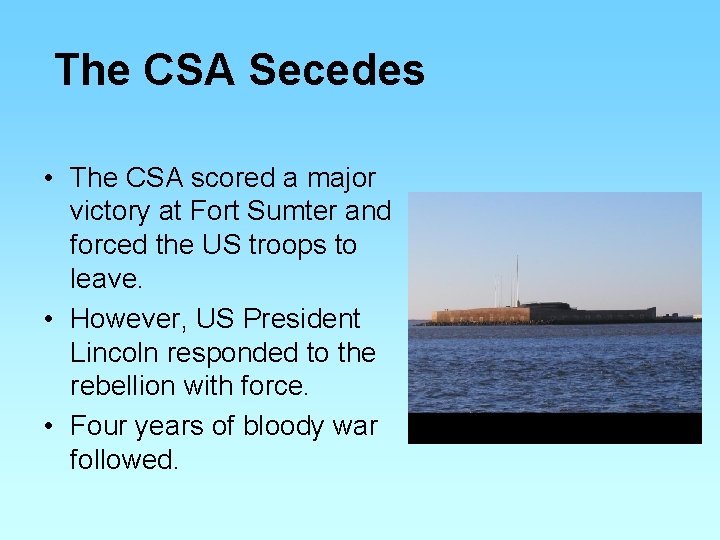
The CSA Secedes • The CSA scored a major victory at Fort Sumter and forced the US troops to leave. • However, US President Lincoln responded to the rebellion with force. • Four years of bloody war followed.
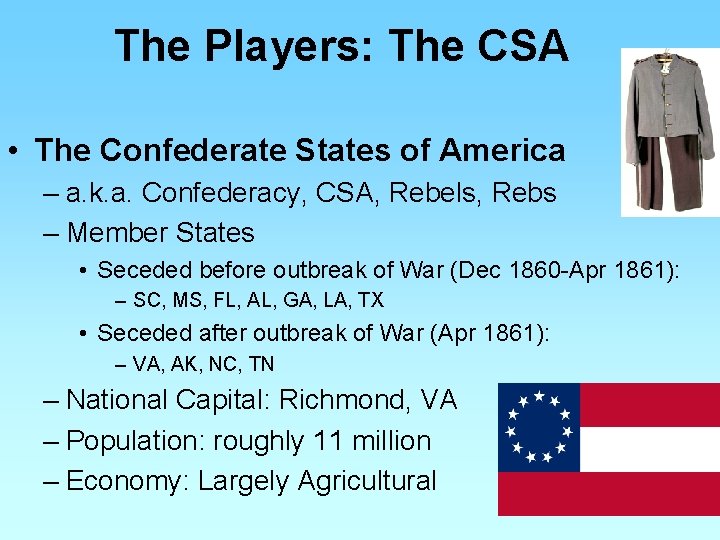
The Players: The CSA • The Confederate States of America – a. k. a. Confederacy, CSA, Rebels, Rebs – Member States • Seceded before outbreak of War (Dec 1860 -Apr 1861): – SC, MS, FL, AL, GA, LA, TX • Seceded after outbreak of War (Apr 1861): – VA, AK, NC, TN – National Capital: Richmond, VA – Population: roughly 11 million – Economy: Largely Agricultural
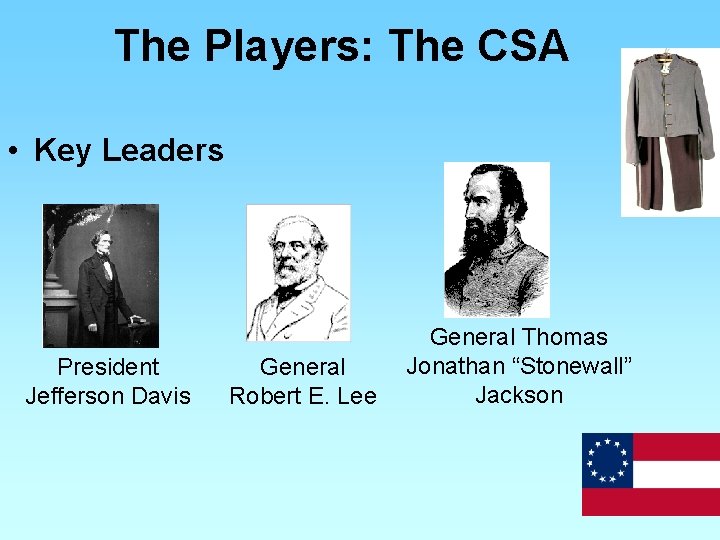
The Players: The CSA • Key Leaders President Jefferson Davis General Robert E. Lee General Thomas Jonathan “Stonewall” Jackson
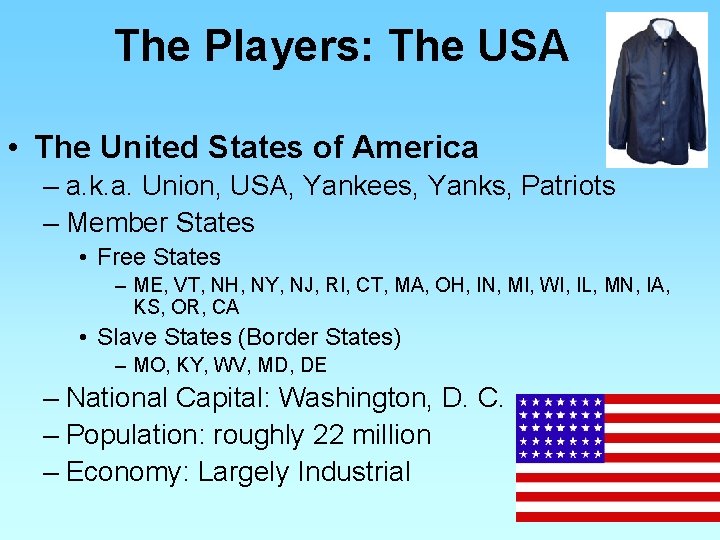
The Players: The USA • The United States of America – a. k. a. Union, USA, Yankees, Yanks, Patriots – Member States • Free States – ME, VT, NH, NY, NJ, RI, CT, MA, OH, IN, MI, WI, IL, MN, IA, KS, OR, CA • Slave States (Border States) – MO, KY, WV, MD, DE – National Capital: Washington, D. C. – Population: roughly 22 million – Economy: Largely Industrial
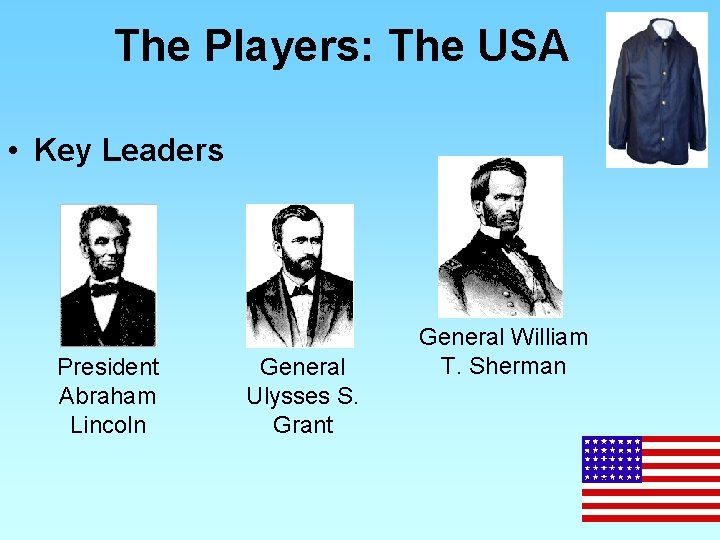
The Players: The USA • Key Leaders President Abraham Lincoln General Ulysses S. Grant General William T. Sherman
Let’s get ready to rumble!!!
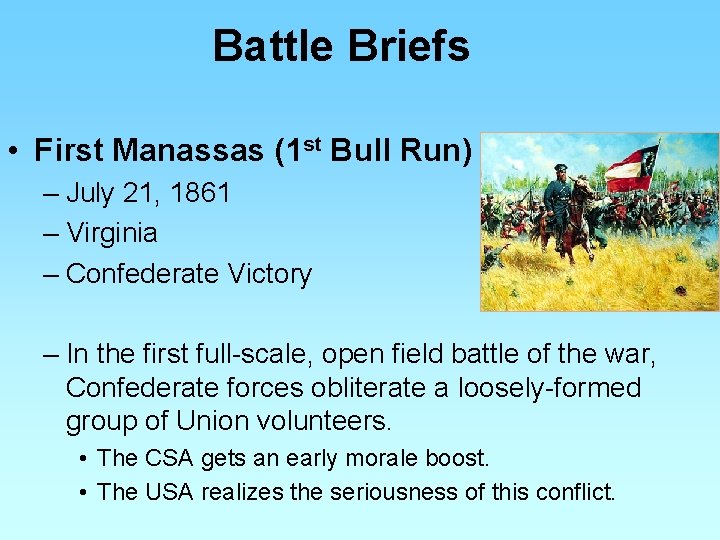
Battle Briefs • First Manassas (1 st Bull Run) – July 21, 1861 – Virginia – Confederate Victory – In the first full-scale, open field battle of the war, Confederate forces obliterate a loosely-formed group of Union volunteers. • The CSA gets an early morale boost. • The USA realizes the seriousness of this conflict.
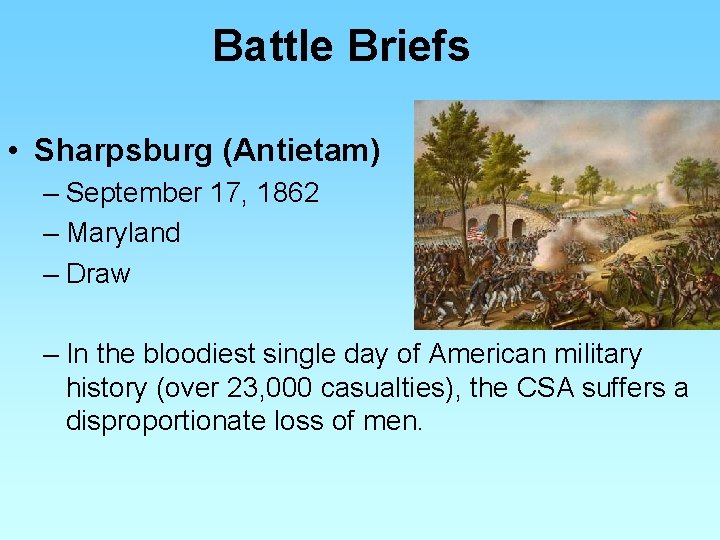
Battle Briefs • Sharpsburg (Antietam) – September 17, 1862 – Maryland – Draw – In the bloodiest single day of American military history (over 23, 000 casualties), the CSA suffers a disproportionate loss of men.
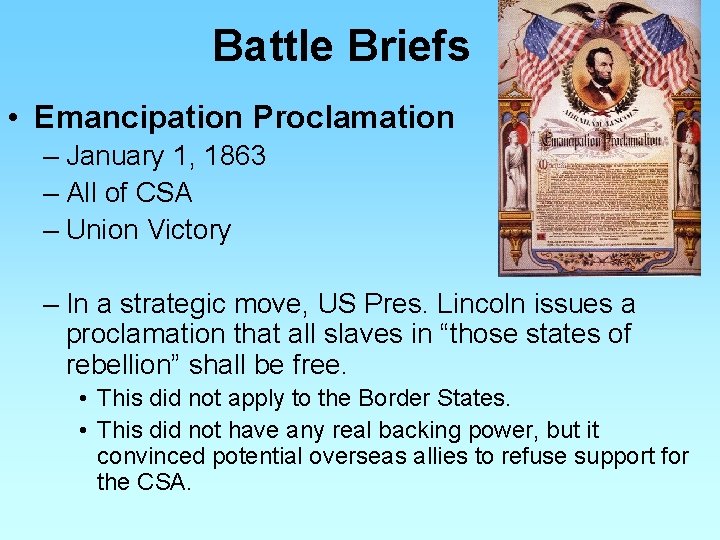
Battle Briefs • Emancipation Proclamation – January 1, 1863 – All of CSA – Union Victory – In a strategic move, US Pres. Lincoln issues a proclamation that all slaves in “those states of rebellion” shall be free. • This did not apply to the Border States. • This did not have any real backing power, but it convinced potential overseas allies to refuse support for the CSA.
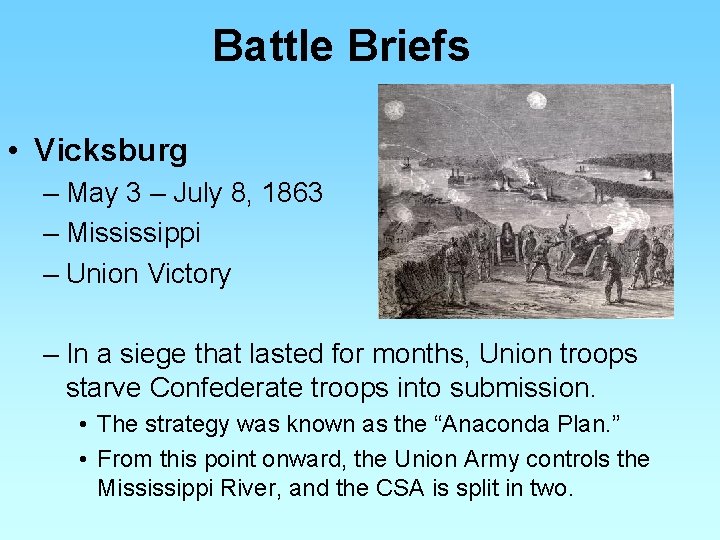
Battle Briefs • Vicksburg – May 3 – July 8, 1863 – Mississippi – Union Victory – In a siege that lasted for months, Union troops starve Confederate troops into submission. • The strategy was known as the “Anaconda Plan. ” • From this point onward, the Union Army controls the Mississippi River, and the CSA is split in two.
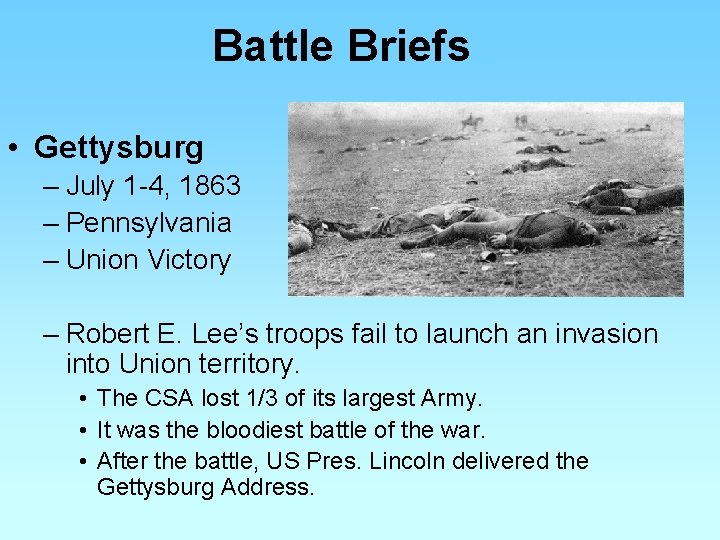
Battle Briefs • Gettysburg – July 1 -4, 1863 – Pennsylvania – Union Victory – Robert E. Lee’s troops fail to launch an invasion into Union territory. • The CSA lost 1/3 of its largest Army. • It was the bloodiest battle of the war. • After the battle, US Pres. Lincoln delivered the Gettysburg Address.
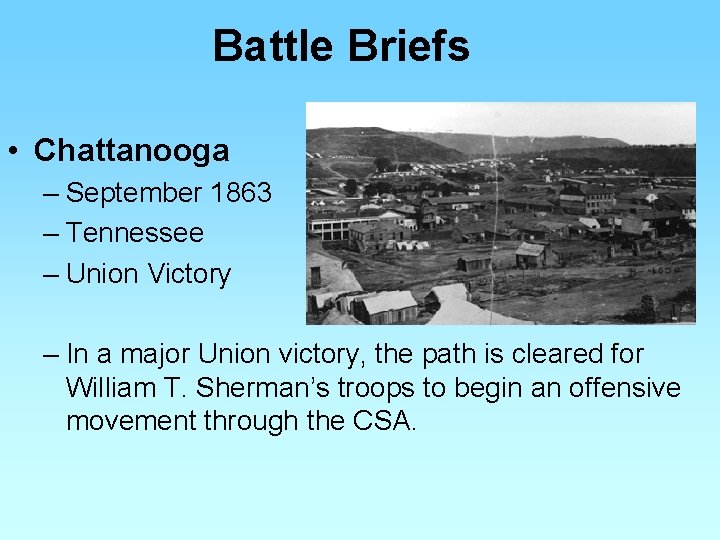
Battle Briefs • Chattanooga – September 1863 – Tennessee – Union Victory – In a major Union victory, the path is cleared for William T. Sherman’s troops to begin an offensive movement through the CSA.
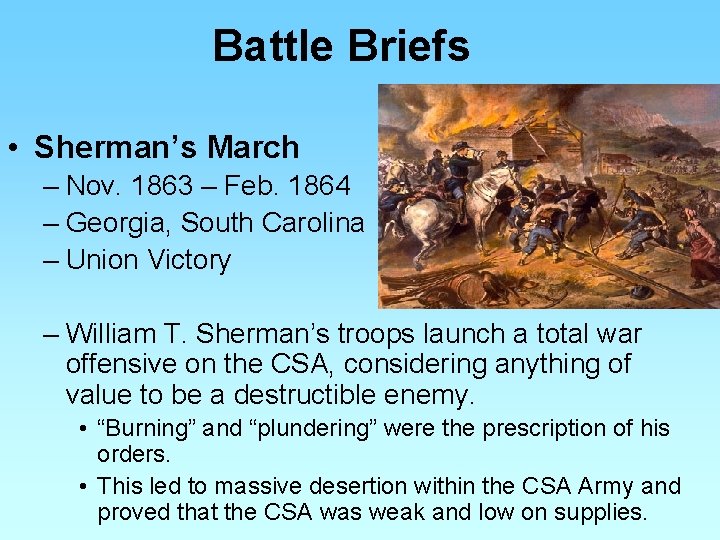
Battle Briefs • Sherman’s March – Nov. 1863 – Feb. 1864 – Georgia, South Carolina – Union Victory – William T. Sherman’s troops launch a total war offensive on the CSA, considering anything of value to be a destructible enemy. • “Burning” and “plundering” were the prescription of his orders. • This led to massive desertion within the CSA Army and proved that the CSA was weak and low on supplies.
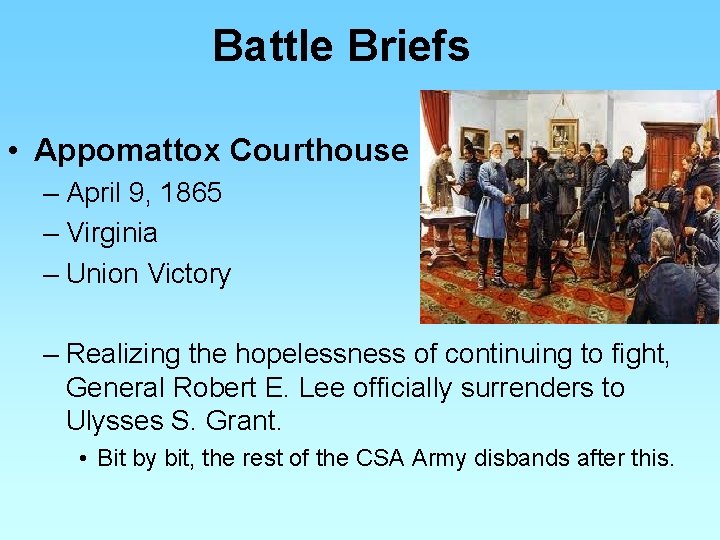
Battle Briefs • Appomattox Courthouse – April 9, 1865 – Virginia – Union Victory – Realizing the hopelessness of continuing to fight, General Robert E. Lee officially surrenders to Ulysses S. Grant. • Bit by bit, the rest of the CSA Army disbands after this.
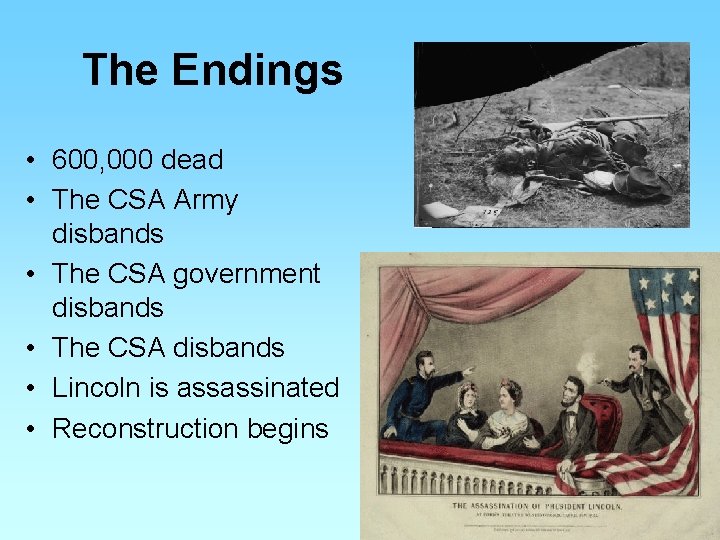
The Endings • 600, 000 dead • The CSA Army disbands • The CSA government disbands • The CSA disbands • Lincoln is assassinated • Reconstruction begins