
The Rise of the Novel Defoe and Swift
- Slides: 18
The Rise of the Novel Defoe and Swift
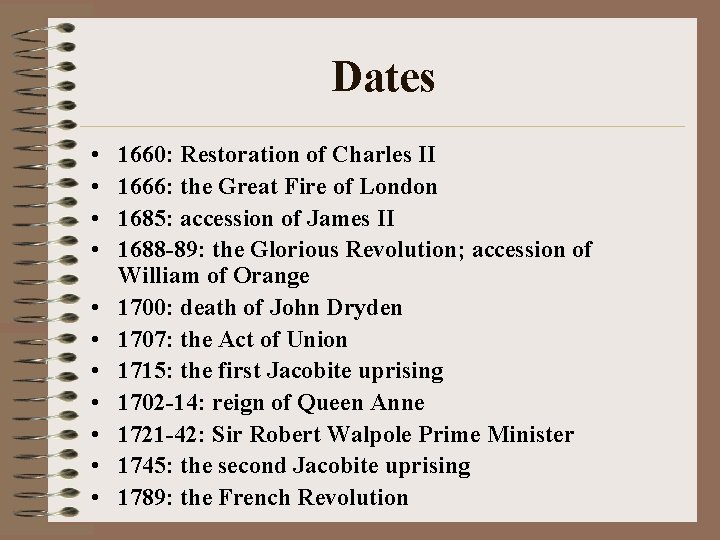
Dates • • • 1660: Restoration of Charles II 1666: the Great Fire of London 1685: accession of James II 1688 -89: the Glorious Revolution; accession of William of Orange 1700: death of John Dryden 1707: the Act of Union 1715: the first Jacobite uprising 1702 -14: reign of Queen Anne 1721 -42: Sir Robert Walpole Prime Minister 1745: the second Jacobite uprising 1789: the French Revolution
Literary Periods • 1660 -1700:
Literary Periods • 1660 -1700: the Restoration Period (the Age of Dryden) • 1700 -1745:
Literary Periods • 1660 -1700: the Restoration Period (the Age of Dryden) • 1700 -1745: the Augustan Period (the Age of Pope and Swift) • 1745 -1798:
Literary Periods • 1660 -1700: the Restoration Period (the Age of Dryden) • 1700 -1745: the Augustan Period (the Age of Pope and Swift) • 1745 -1798: the Age of Sensibility (the Age of Dr Johnson) • Restoration Period+Augustan Period: the Age of Reason
Cultural Background • The Age of Enlightenment: value of reason, fear of unreason, hatred of pedantry • Neoclassicism: Augustan Period • Restoration Period: forerunners of Neoclassicism (Dryden)
New Genres • Drama: – Heroic plays (Dryden, All for Love, 1677) – Comedies of manners (Congreve, The Way of the World, 1700) • Poetry: – Heroic couplet (Dryden, Absalom and Achitophel, 1681)
Neoclassicist Poetics • Imitation of nature: – ‘landscape’ (Dryden) – ‘Human nature’ (Pope) – ‘universal truths’ (Dr Johnson) • Imitation of Classical literature: – Perfect imitations of nature – Craftmanship – Codification of rules in literature
The Augustan Period • The Age of Swift, Pope, Addison, Walpole • Expansion of reading public – New journalism – Professional writers and booksellers
New genres • Sentimental comedy: Gay, The Beggar’s Opera (1728) • Mock heroic: Swift, Battle of the Books (1697, 1704); Pope, The Rape of the Lock (1712, 1714) • Landscape poems: Thomson, Winter (1726) • Novel: Defoe, Robinson Crusoe (1719)
The Antecedents of the Novel • Newspapers: Grub Street, ‘scribblers’, gossips, reports • Journals: best writers, didacticism, model for taste, education of middle classes; Steele and Addison, Tatler and Spectator (1709 -11, 171112) • Pamphlets and satires: political, occasional, ridicule • Other: essays, travelogues, biographies, letters
Swift’s pamphlets and satires • ‘A Modest Proposal’ (1729): political, against Walpole, mask of indifference, savage indignation, ‘reductio ad absurdum’; misanthropy • Battle of the Books (1697, 1704): occasional, Sir William Temple, mock heroic in prose; ancients (new ancients) V moderns; the bee and the spider
Defoe’s innovations • Reportage: keen eye for the detail • Narrative realism • Fictitious events against a realistic background • ‘the father of the English novel’
Robinson Crusoe (1719) • The first full-length prose fiction, the first English popular novel • Application of journalism • World view of middle classes
Swift’s innovations • A master of irony, satire, a moralist • Belief in reason but misanthropy: ‘I hate and detest that animal called man, although I heartily love John, Peter, Thomas, and so forth. ’ • Man is not a reational being but is capable of reason
Gulliver’s Travels (1726) • Genre: fictitious travelogue, in matter of fact style • Other: dystopia, utopia, satire, mock heroic, romance, allegory • Paradox: most comprehensive satire and children’s classic • Development of Gulliver’s character: from irony to bitter satire
Further reading • Róna Éva, A XVIII. század angol irodalma (Bp. : Tankönyvkiadó, 1992). . .