
The Rise of the British Parliamentary System Netherlands
The Rise of the British Parliamentary System
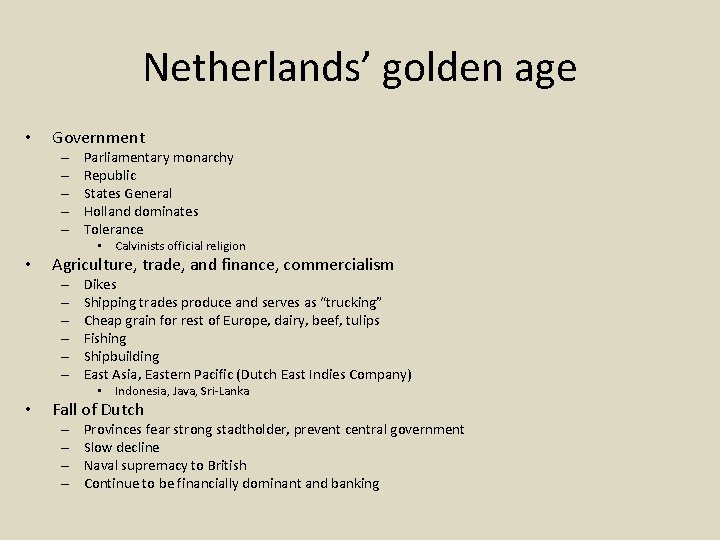
Netherlands’ golden age • Government – – – Parliamentary monarchy Republic States General Holland dominates Tolerance • Calvinists official religion • Agriculture, trade, and finance, commercialism – – – Dikes Shipping trades produce and serves as “trucking” Cheap grain for rest of Europe, dairy, beef, tulips Fishing Shipbuilding East Asia, Eastern Pacific (Dutch East Indies Company) • Indonesia, Java, Sri-Lanka • Fall of Dutch – – Provinces fear strong stadtholder, prevent central government Slow decline Naval supremacy to British Continue to be financially dominant and banking
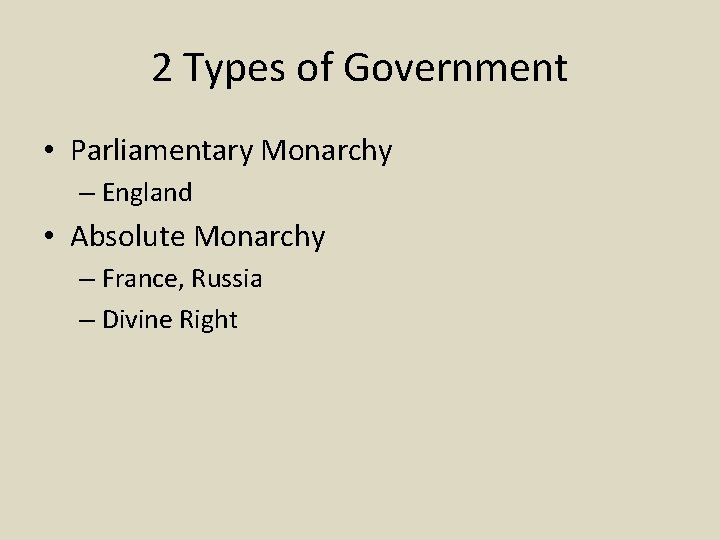
2 Types of Government • Parliamentary Monarchy – England • Absolute Monarchy – France, Russia – Divine Right

ENGLAND
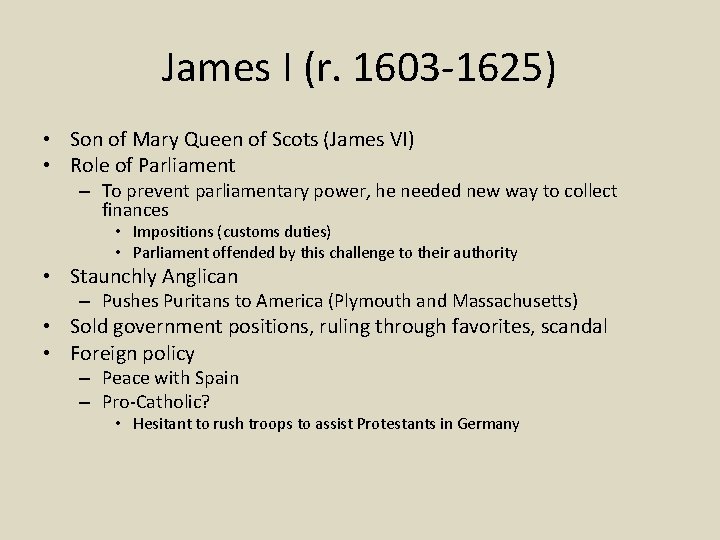
James I (r. 1603 -1625) • Son of Mary Queen of Scots (James VI) • Role of Parliament – To prevent parliamentary power, he needed new way to collect finances • Impositions (customs duties) • Parliament offended by this challenge to their authority • Staunchly Anglican – Pushes Puritans to America (Plymouth and Massachusetts) • Sold government positions, ruling through favorites, scandal • Foreign policy – Peace with Spain – Pro-Catholic? • Hesitant to rush troops to assist Protestants in Germany
Charles I (r. 1625 -1649) • Parliament favored war with Spain, but distrusted monarchy – Would not fund British war – Charles levies taxes, forced loans, imprisonment and quartering of troops – Parliament allows for finances to Charles if he recognized Petition of Right • No forced loans or taxation without Parliament’s consent, no imprisonment or quartering without due cause • Dissolving of Parliament • Parliament frustrated with monarchy – Arrests and executes king’s advisors – Abolishes courts enforcing royal policy, forbids ability to levy new tax without Parliamentary approval – Refuses to give Charles finances to declare war against Scotland
English Civil War (1642 -1660) • Frustrated Charles I invades Parliament to arrest opponents, flees England to amass army • Parliamentary army organized by Oliver Cromwell – Captures and executes Charles I – Abolition of monarchy, House of Lords, Anglican Church • Cromwell becomes Lord Protector of England – Religion converts to Puritan England – Brutally conquers Scotland Ireland (Catholic) – Establishment of military dictatorship • Prohibition of drunkenness, dancing, theater
Charles II (r. 1660 -1685) • Parliament reestablishes monarchy, House of Lords, Anglican Church – Invites Charles II (son of Charles I) to return to England • Politique, but favors Catholicism • Clarendon Code – Excludes Catholics and Presbyterians from power in England • Charles wants to ally with France (Catholic) against Dutch (Protestant) – Creates Declaration of Indulgence, suspending laws against Catholics • Parliament refuses to fund war until Declaration rescinded – Issues Test Act, forcing all political and military leaders to deny transubstantiation
James II (r. 1685 -1688) • Issues new Declaration of Indulgence – Suspends religious tests, permits free worship • English invite William III of Orange and his wife Mary to take English throne (Netherlands)
William and Mary (r. 1689 -1702) • William arrives with army – James flees without bloodshed, “Glorious Revolution” • W&M issue Bill of Rights – Limit monarchical power, guarantees civil liberties of upper classes – Monarchy subject to power of the Parliament, called every three years – Prohibited Roman Catholics from ruling throne • Toleration Act – Permitted worship by all Protestants – Outlawed Catholicism • Act of Settlement – Makes Queen Anne (daughter of James II) monarch (r. 1702 -1714) – After Queen Anne, if no heir, monarchy passes to House of Hanover in Germany (George I) • COME IN TO FIX ENGLAND PASS MONARCHY BACK TO ENGLISH
George and Walpole (1714 -1727) • Anne dies w/o heir • Monarchy passes to House of Hanover, George I • Sir Robert Walpole dominates politics of England beginning in 1721 -1742 – Makes England what it is • • Nation of prosperity through trade New overseas colonies Political liberties and true free speech Significant religious tolerance
- Slides: 11