
The Rise of New Atheism aka militant atheism

- Slides: 8
The Rise of New Atheism aka - militant atheism, anti-theism, fundamentalist atheism Polarising the debate…?
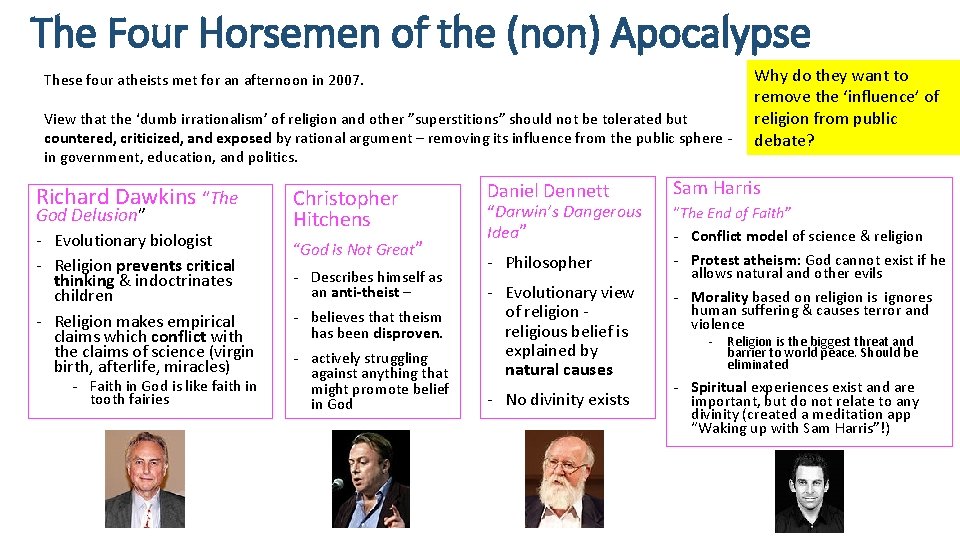
The Four Horsemen of the (non) Apocalypse These four atheists met for an afternoon in 2007. View that the ‘dumb irrationalism’ of religion and other ”superstitions” should not be tolerated but countered, criticized, and exposed by rational argument – removing its influence from the public sphere in government, education, and politics. Richard Dawkins “The God Delusion” - Evolutionary biologist - Religion prevents critical thinking & indoctrinates children - Religion makes empirical claims which conflict with the claims of science (virgin birth, afterlife, miracles) - Faith in God is like faith in tooth fairies Christopher Hitchens “God is Not Great” - Describes himself as an anti-theist – - believes that theism has been disproven. - actively struggling against anything that might promote belief in God Why do they want to remove the ‘influence’ of religion from public debate? Daniel Dennett Sam Harris - Philosopher “The End of Faith” - Conflict model of science & religion - Protest atheism: God cannot exist if he allows natural and other evils - Morality based on religion is ignores human suffering & causes terror and violence “Darwin’s Dangerous Idea” - Evolutionary view of religion religious belief is explained by natural causes - No divinity exists - Religion is the biggest threat and barrier to world peace. Should be eliminated - Spiritual experiences exist and are important, but do not relate to any divinity (created a meditation app “Waking up with Sam Harris”!)
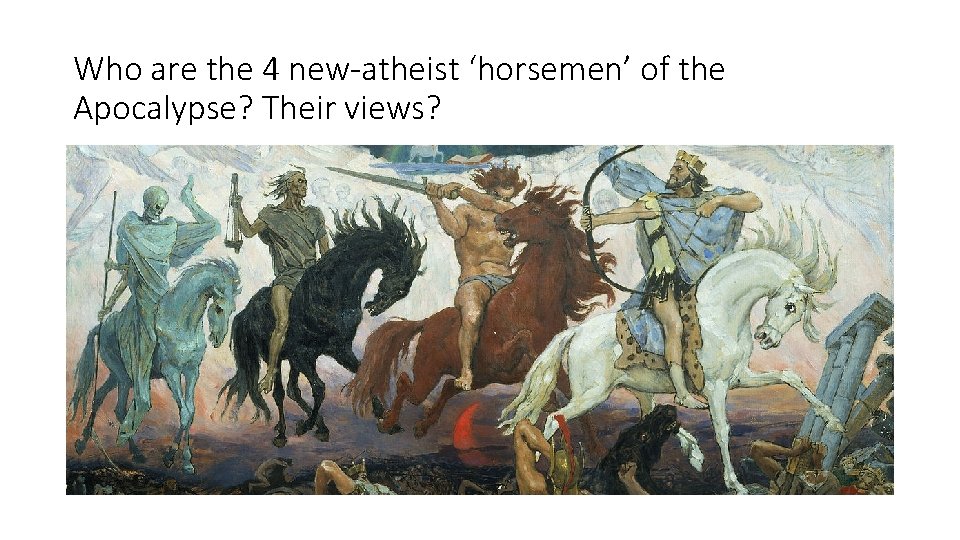
Who are the 4 new-atheist ‘horsemen’ of the Apocalypse? Their views?
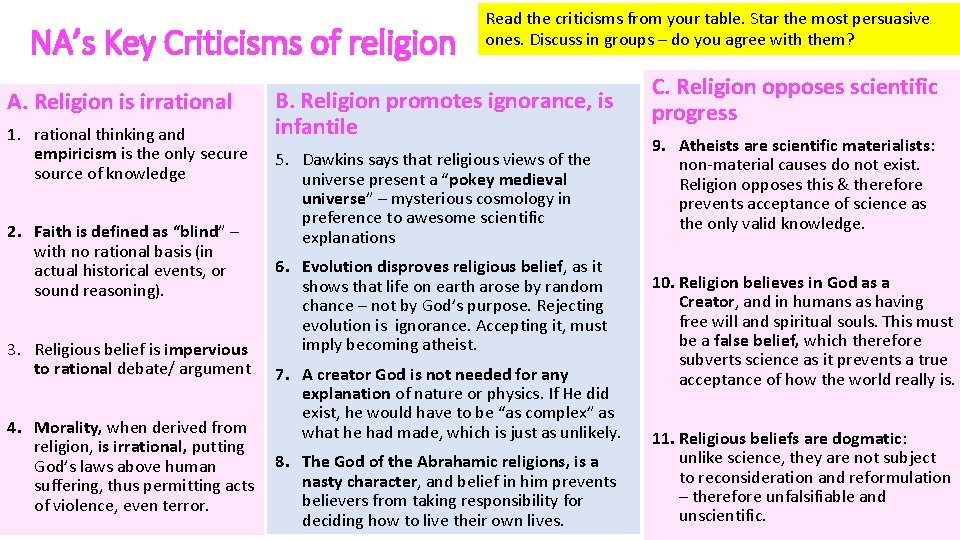
NA’s Key Criticisms of religion A. Religion is irrational 1. rational thinking and empiricism is the only secure source of knowledge 2. Faith is defined as “blind” – with no rational basis (in actual historical events, or sound reasoning). 3. Religious belief is impervious to rational debate/ argument 4. Morality, when derived from religion, is irrational, putting God’s laws above human suffering, thus permitting acts of violence, even terror. Read the criticisms from your table. Star the most persuasive ones. Discuss in groups – do you agree with them? B. Religion promotes ignorance, is infantile 5. Dawkins says that religious views of the universe present a “pokey medieval universe” – mysterious cosmology in preference to awesome scientific explanations 6. Evolution disproves religious belief, as it shows that life on earth arose by random chance – not by God’s purpose. Rejecting evolution is ignorance. Accepting it, must imply becoming atheist. 7. A creator God is not needed for any explanation of nature or physics. If He did exist, he would have to be “as complex” as what he had made, which is just as unlikely. 8. The God of the Abrahamic religions, is a nasty character, and belief in him prevents believers from taking responsibility for deciding how to live their own lives. C. Religion opposes scientific progress 9. Atheists are scientific materialists: non-material causes do not exist. Religion opposes this & therefore prevents acceptance of science as the only valid knowledge. 10. Religion believes in God as a Creator, and in humans as having free will and spiritual souls. This must be a false belief, which therefore subverts science as it prevents a true acceptance of how the world really is. 11. Religious beliefs are dogmatic: unlike science, they are not subject to reconsideration and reformulation – therefore unfalsifiable and unscientific.
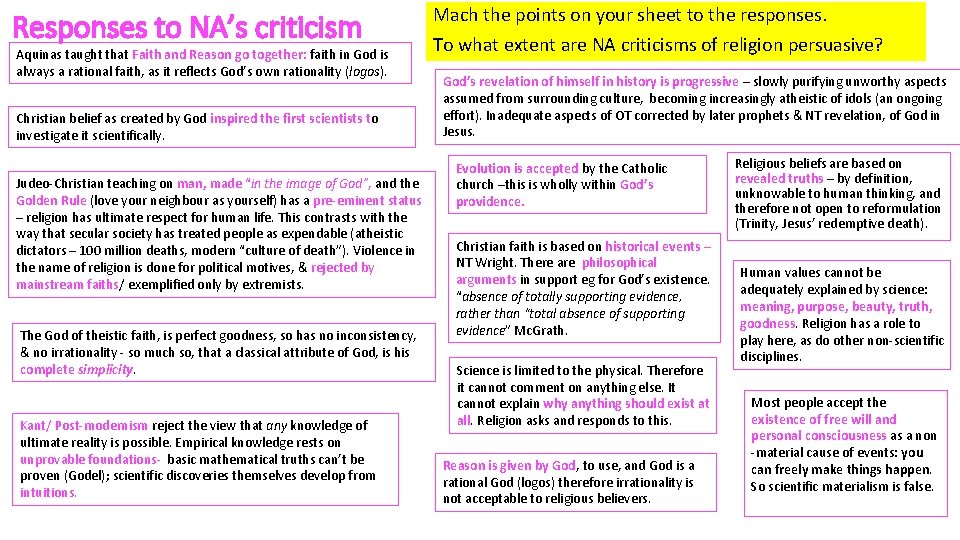
Responses to NA’s criticism Aquinas taught that Faith and Reason go together: faith in God is always a rational faith, as it reflects God’s own rationality (logos). Christian belief as created by God inspired the first scientists to investigate it scientifically. Judeo-Christian teaching on man, made “in the image of God”, and the Golden Rule (love your neighbour as yourself) has a pre-eminent status – religion has ultimate respect for human life. This contrasts with the way that secular society has treated people as expendable (atheistic dictators – 100 million deaths, modern “culture of death”). Violence in the name of religion is done for political motives, & rejected by mainstream faiths/ exemplified only by extremists. The God of theistic faith, is perfect goodness, so has no inconsistency, & no irrationality - so much so, that a classical attribute of God, is his complete simplicity. Kant/ Post-modernism reject the view that any knowledge of ultimate reality is possible. Empirical knowledge rests on unprovable foundations- basic mathematical truths can’t be proven (Godel); scientific discoveries themselves develop from intuitions. Mach the points on your sheet to the responses. To what extent are NA criticisms of religion persuasive? God’s revelation of himself in history is progressive – slowly purifying unworthy aspects assumed from surrounding culture, becoming increasingly atheistic of idols (an ongoing effort). Inadequate aspects of OT corrected by later prophets & NT revelation, of God in Jesus. Evolution is accepted by the Catholic church –this is wholly within God’s providence. Christian faith is based on historical events – NT Wright. There are philosophical arguments in support eg for God’s existence. “absence of totally supporting evidence, rather than “total absence of supporting evidence” Mc. Grath. Science is limited to the physical. Therefore it cannot comment on anything else. It cannot explain why anything should exist at all. Religion asks and responds to this. Reason is given by God, to use, and God is a rational God (logos) therefore irrationality is not acceptable to religious believers. Religious beliefs are based on revealed truths – by definition, unknowable to human thinking, and therefore not open to reformulation (Trinity, Jesus’ redemptive death). Human values cannot be adequately explained by science: meaning, purpose, beauty, truth, goodness. Religion has a role to play here, as do other non-scientific disciplines. Most people accept the existence of free will and personal consciousness as a non -material cause of events: you can freely make things happen. So scientific materialism is false.
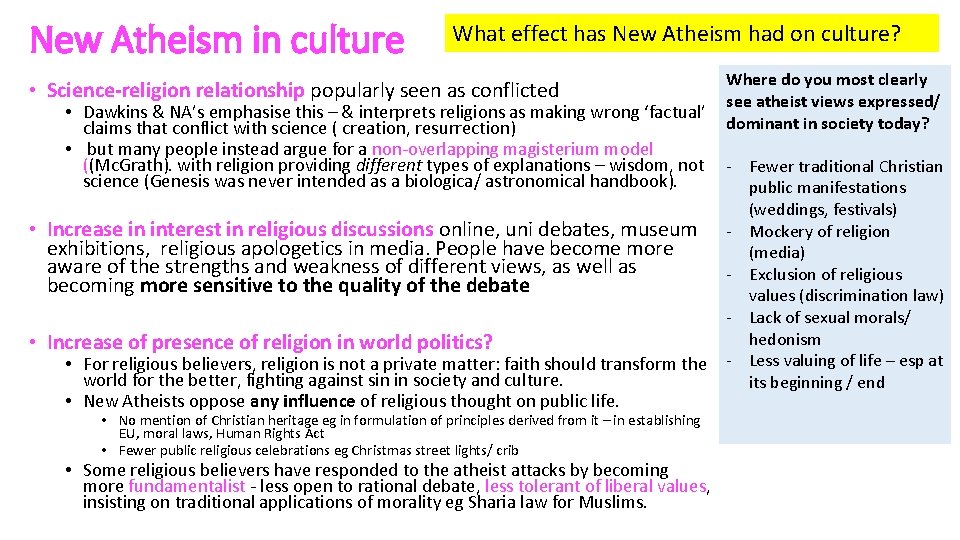
New Atheism in culture What effect has New Atheism had on culture? • Science-religion relationship popularly seen as conflicted • Dawkins & NA’s emphasise this – & interprets religions as making wrong ‘factual’ claims that conflict with science ( creation, resurrection) • but many people instead argue for a non-overlapping magisterium model ((Mc. Grath). with religion providing different types of explanations – wisdom, not science (Genesis was never intended as a biologica/ astronomical handbook). • Increase in interest in religious discussions online, uni debates, museum exhibitions, religious apologetics in media. People have become more aware of the strengths and weakness of different views, as well as becoming more sensitive to the quality of the debate • Increase of presence of religion in world politics? • For religious believers, religion is not a private matter: faith should transform the world for the better, fighting against sin in society and culture. • New Atheists oppose any influence of religious thought on public life. • No mention of Christian heritage eg in formulation of principles derived from it – in establishing EU, moral laws, Human Rights Act • Fewer public religious celebrations eg Christmas street lights/ crib • Some religious believers have responded to the atheist attacks by becoming more fundamentalist - less open to rational debate, less tolerant of liberal values, insisting on traditional applications of morality eg Sharia law for Muslims. Where do you most clearly see atheist views expressed/ dominant in society today? - Fewer traditional Christian public manifestations (weddings, festivals) - Mockery of religion (media) - Exclusion of religious values (discrimination law) - Lack of sexual morals/ hedonism - Less valuing of life – esp at its beginning / end
Should a modern person be an atheist?
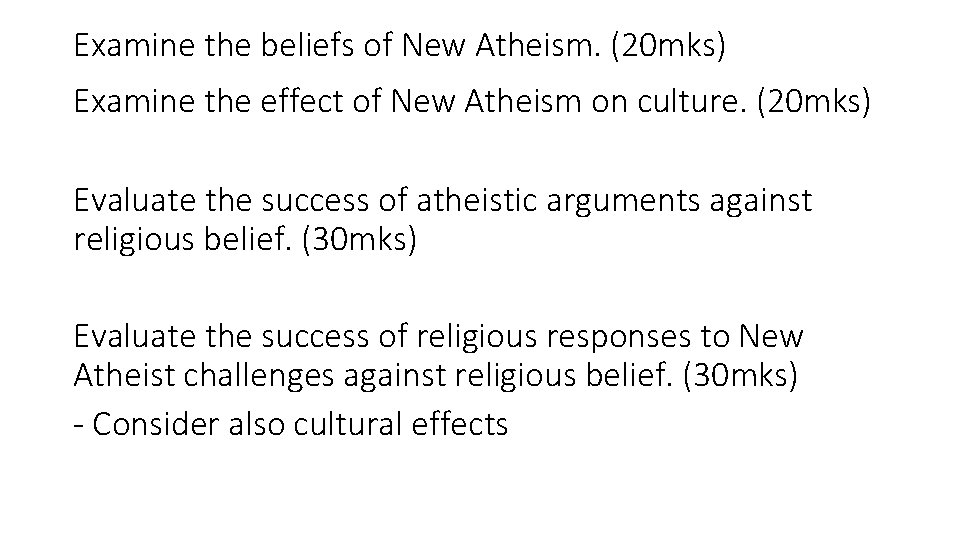
Examine the beliefs of New Atheism. (20 mks) Examine the effect of New Atheism on culture. (20 mks) Evaluate the success of atheistic arguments against religious belief. (30 mks) Evaluate the success of religious responses to New Atheist challenges against religious belief. (30 mks) - Consider also cultural effects