
The Rise of Napoleon and the Napoleonic Wars
- Slides: 7
The Rise of Napoleon and the Napoleonic Wars ESSENTIAL QUESTIONS What causes revolution? How does revolution change society?
The Rise of Napoleon Guiding Question: How did instability in the French government create an opportunity for Napoleon to take power? • • Napoleon Bonaparte's role in the French Revolution is complex. In one sense, he brought it to an end when he came to power in 1799. Yet he was a child of the revolution as well. Without it, he would never have risen to power, and he himself never failed to remind the French that he had preserved the best parts of the revolution during his reign as emperor.
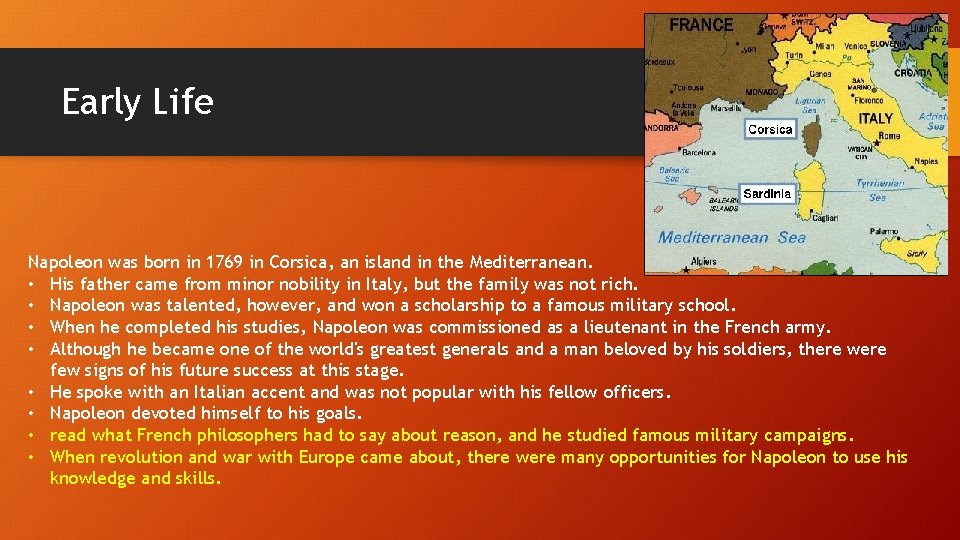
Early Life Napoleon was born in 1769 in Corsica, an island in the Mediterranean. • His father came from minor nobility in Italy, but the family was not rich. • Napoleon was talented, however, and won a scholarship to a famous military school. • When he completed his studies, Napoleon was commissioned as a lieutenant in the French army. • Although he became one of the world's greatest generals and a man beloved by his soldiers, there were few signs of his future success at this stage. • He spoke with an Italian accent and was not popular with his fellow officers. • Napoleon devoted himself to his goals. • read what French philosophers had to say about reason, and he studied famous military campaigns. • When revolution and war with Europe came about, there were many opportunities for Napoleon to use his knowledge and skills.
Military Success Napoleon rose quickly through the ranks. • In 1792 he became a captain. • Two years later, at age 24, the Committee of Public Safety made him a brigadier general. • In 1796 he became commander of the French armies in Italy. • won a series of battles • defeated the armies of the Papal States and their Austrian allies. • His personal qualities allowed him to win the support of those around him. • 1797 he returned to France as a hero. • given command of an army in training to invade Britain, but he knew the French could not carry out that invasion. Instead, Napoleon suggested striking indirectly at Britain by taking Egypt. • (Egypt lay on the route to India, one of Britain's most important colonies and a major source of its wealth. )
Consul and Emperor In Paris, Napoleon took part in the military coup 1799 that overthrew the Directory and set up a new government, the consulate. • In theory, it was a republic, but, in fact, Napoleon held absolute power. • He appointed officials, controlled the army, conducted foreign affairs, and influenced the legislature. • In 1802 Napoleon was made consul for life. • Two years later, he crowned himself Emperor Napoleon I.
Peace with the Church One of Napoleon’s first moves at home was to establish peace with the Catholic Church • He believed in reason and felt that religion was at most a social convenience. • However, since most of France was Catholic, it was a good idea to mend relations with the Church. In 1801 Napoleon came to an agreement with the pope, which recognized Catholicism as the religion of a majority of the French people. • With this agreement, the Catholic Church was no longer an enemy of the French government.
Codification of Laws Napoleon's most famous domestic achievement was to codify the laws. • Seven law codes were created, but the most important was the Civil Code, or Napoleonic Code, introduced in 1804. • It preserved many of the principles that the revolutionaries had fought for: equality of all citizens before the law; the right of the individual to choose a profession; religious toleration; and the abolition of serfdom and all feudal obligations. For women and children, the Civil Code was a step back • Women were now "less equal than men. "