
The Rise of Labor Unions Objective 5 03
The Rise of Labor Unions Objective 5. 03
Objective 5. 03 o Assess the impact of labor unions on industry and the lives of workers
What were working conditions like in the late 19 th Century? o NOT GOOD!!!! (for many workers) o Many employers demanded a 7 day work week o Some factory workers worked 12 or more hours a day o Employees not entitled to vacation, sick leave, unemployment comp, workman’s comp. o Injuries were common
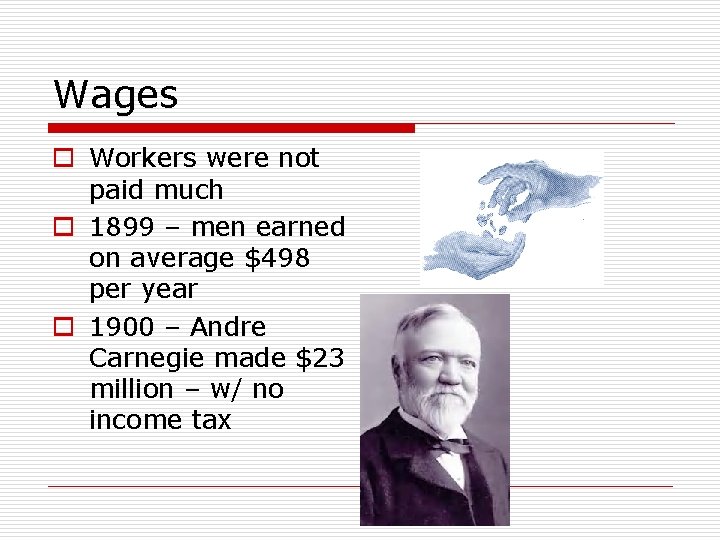
Wages o Workers were not paid much o 1899 – men earned on average $498 per year o 1900 – Andre Carnegie made $23 million – w/ no income tax
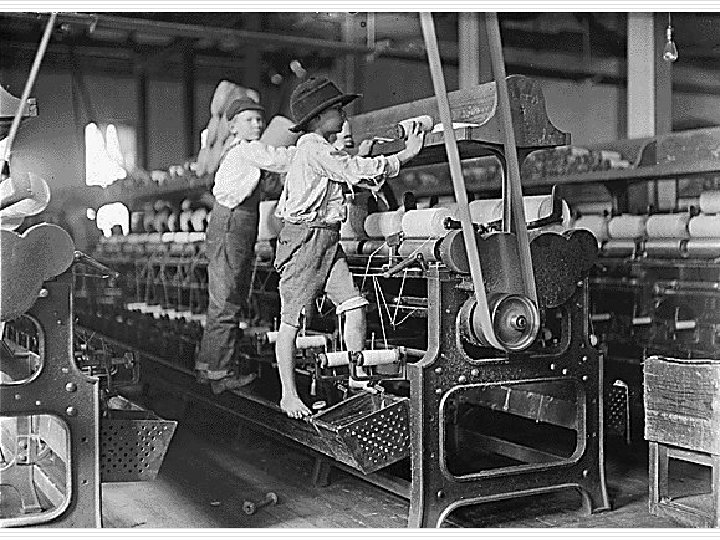
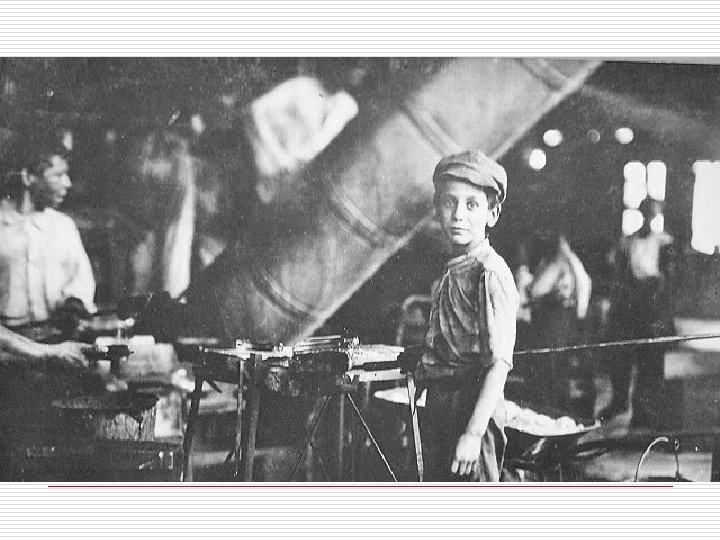
Child Labor o Conditions so stressful that children had poor health n Misshapen bones, died due to industrial accidents o Between 1890 and 1910, 20% of boys and 10% of girls under age 15 held full-time jobs n Some as young as 5
Workers Organize o Americans had been organizing to fight what they saw as opppression for years n American Revolution n Anti-Renter movement – 1840 s n Civil War
Unions o Organization of workers. Craft union (skilled labor) or industrial union (unskilled labor) to fight for higher pay and safer worker conditions. o Minimal gains in this time period. o Opposed by gov’t and business
Craft Unions of skilled workers organized by trade. o Forerunner to the “umbrella” unions of the AFL and CIO n Cigar makers n Hatters n etc
Industrial Unions o unskilled
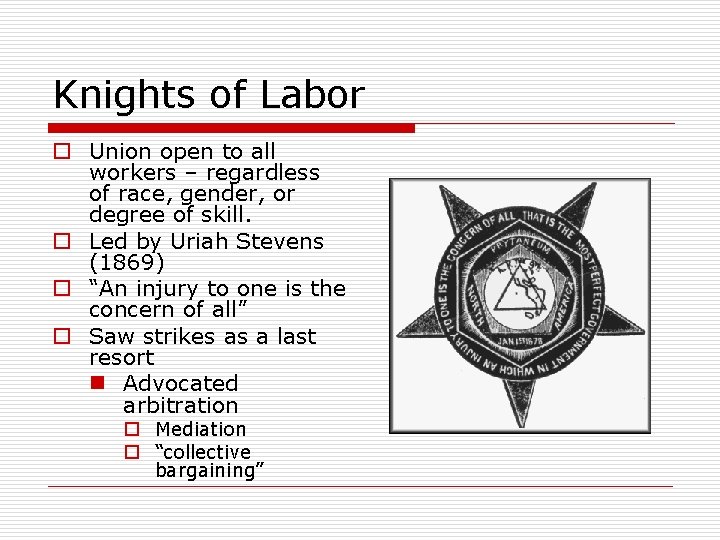
Knights of Labor o Union open to all workers – regardless of race, gender, or degree of skill. o Led by Uriah Stevens (1869) o “An injury to one is the concern of all” o Saw strikes as a last resort n Advocated arbitration o Mediation o “collective bargaining”
Collective Bargaining o The right of labor unions to negotiate as a group w/ management, rather than individually. o Right later guaranteed by the Wagner Act (passed during the New Deal)
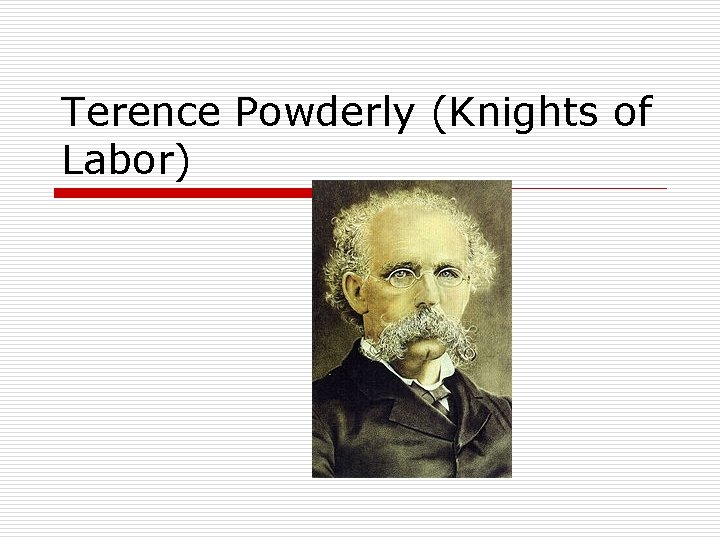
Terence Powderly (Knights of Labor)
Knights of Labor wanted… o o o o o Eight-hour workday. Workers’ cooperatives. Worker-owned factories. Abolition of child and prison labor. Increased circulation of greenbacks. Equal pay for men and women. Safety codes in the workplace. Prohibition of contract foreign labor. Abolition of the National Bank.
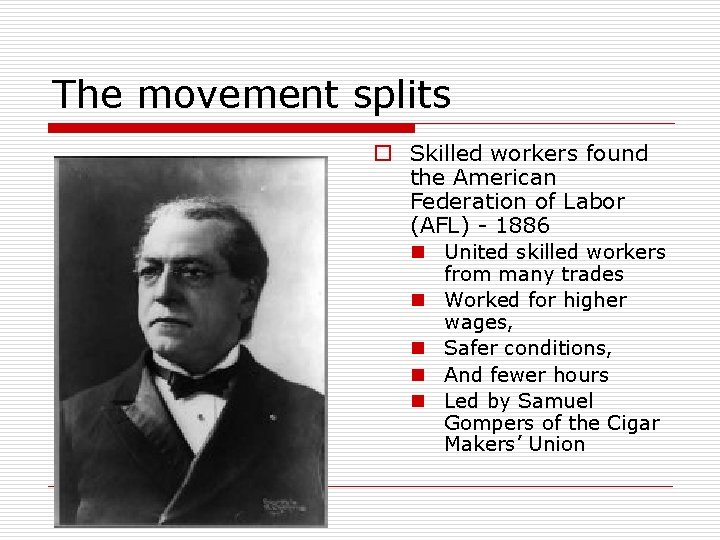
The movement splits o Skilled workers found the American Federation of Labor (AFL) - 1886 n United skilled workers from many trades n Worked for higher wages, n Safer conditions, n And fewer hours n Led by Samuel Gompers of the Cigar Makers’ Union
AFL o Used strikes as a major tactic o Helped them when higher wages and shorter workweeks
Wobblies o Industrial Workers of the World n Founded 1905 n International, radical labor union o Favored direct tactics over political action
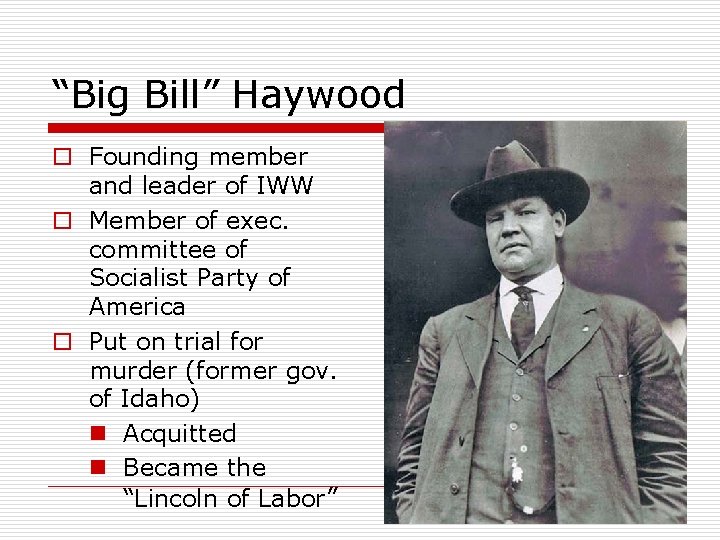
“Big Bill” Haywood o Founding member and leader of IWW o Member of exec. committee of Socialist Party of America o Put on trial for murder (former gov. of Idaho) n Acquitted n Became the “Lincoln of Labor”
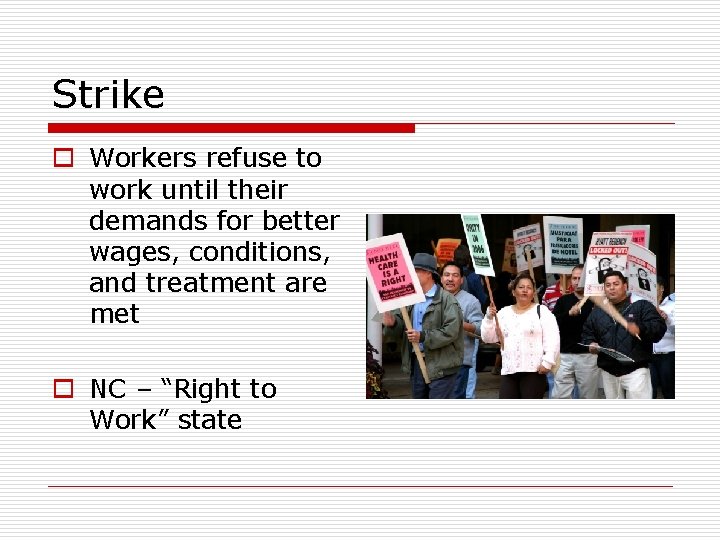
Strike o Workers refuse to work until their demands for better wages, conditions, and treatment are met o NC – “Right to Work” state
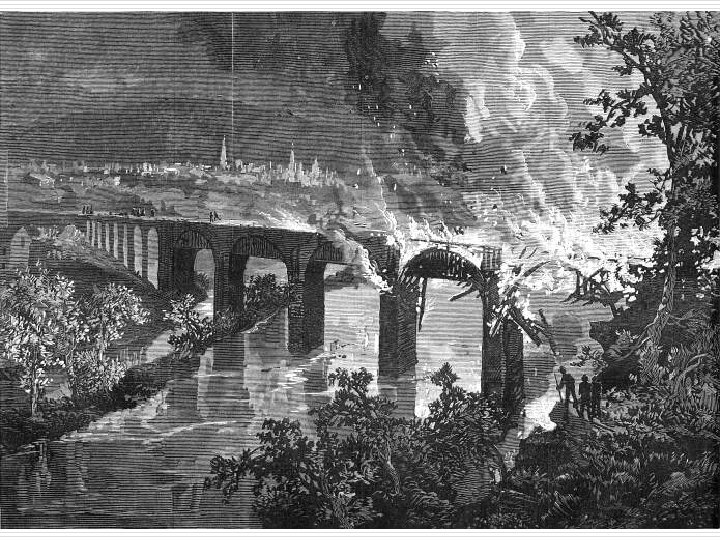
Railroad Strike – 1877 (Great Strike) o Workers for Baltimore and Ohio Railroad (B & O) struck to protest 2 nd wage cut in 2 months. (WVa) o Many freight and some passenger trains stopped for over a week o More than half of freight on nation’s 75, 000 miles of track stalled
Great Strike – 1877 (continued) o National Guard called in o Rutherford B. Hayes had to send in Federal troops to break strike as it spread to other cities.
Great Strike of 1877 (continued) o Many people sympathetic to the men on strike. o When the RR strikes of 1877 were over, >100 people dead n 100, 000 had gone on strike
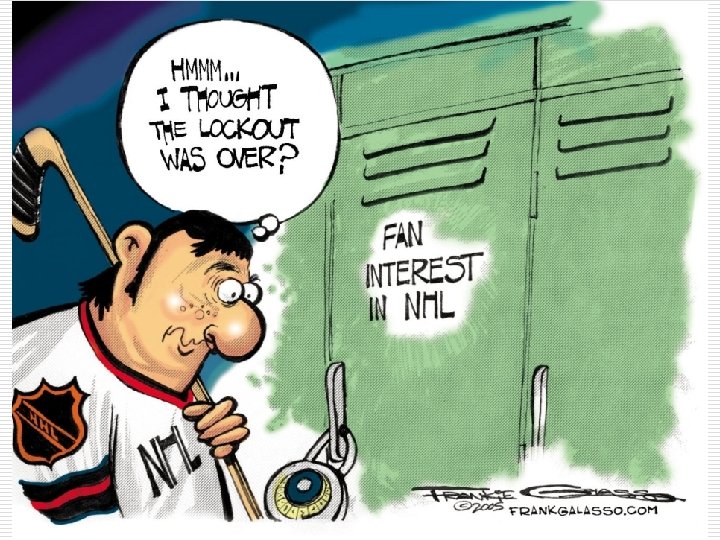
How were strikes broken? o o o Scabs Lockouts Workers blacklisted Court injunction U. S. military (by order of Commander in Chief)
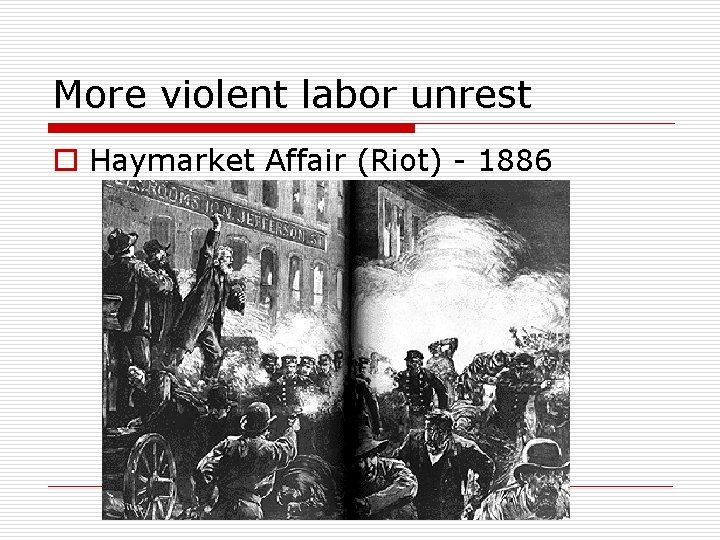
More violent labor unrest o Haymarket Affair (Riot) - 1886
Haymarket Riot o Crowd of 3, 000 gathered in Chicago on May 4 to protest police brutality at the Mc. Cormick Harvester Works o Storm clouds came and crowd dwindled o 180 policemen showed up and ordered the crowd to disperse n Speaker said meeting was almost over
Haymarket Riot (continued) o Bomb exploded in midst of policemen (66 wounded – 7 later died) o Police fired on crowd, killing several, wounding 200
Haymarket (continued) o No evidence of who threw bomb o Police arrested 8 anarchist leaders in Chicago
Haymarket (continued) 7 leaders sentenced to death 1 to 15 years in prison 4 executed in 1887 1 commits suicide on eve of execution 2 remaining death sentences commuted by Gov Oglesby o 3 later pardoned by Gov Altgeld in 1894 o o o
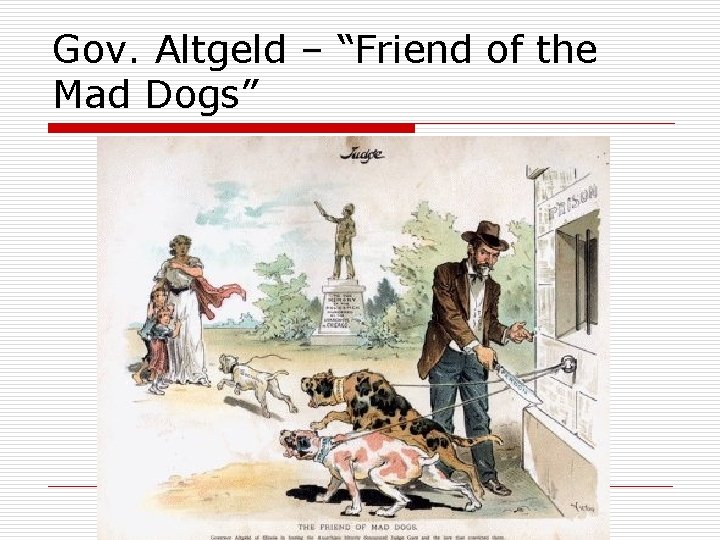
Gov. Altgeld – “Friend of the Mad Dogs”
Haymarket Riot (continued) o Public outcry o Also discredited labor movement in the U. S. o Led to xenophobia (many of the leaders were German)
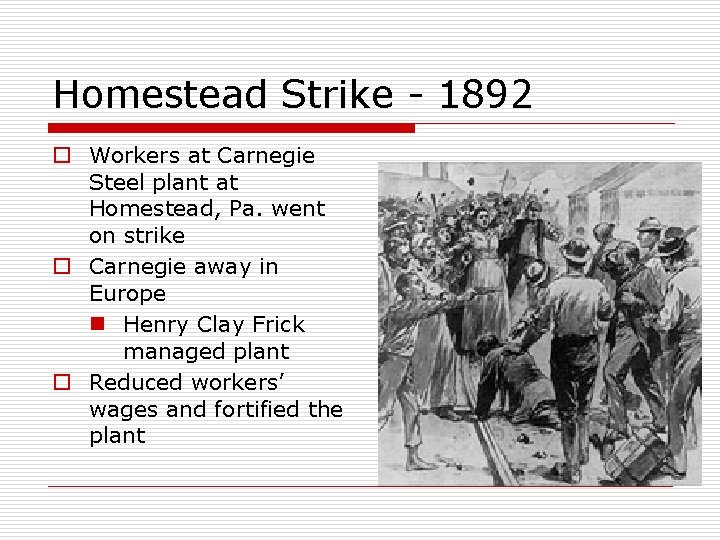
Homestead Strike - 1892 o Workers at Carnegie Steel plant at Homestead, Pa. went on strike o Carnegie away in Europe n Henry Clay Frick managed plant o Reduced workers’ wages and fortified the plant
Homestead Strike (continued) o Workers went on strike o Pinkerton detectives brought in to protect strikebreakers o Violence between detectives and strikers
Homestead Strike (continued) o Lasted 4 months o Strikebreakers worked o Workers ended strike o Leaders of strike charged w/ murder
Effects of Homestead Strike? o Support for labor unions declined o Many Carnegie workers did not unionize until well into 20 th Century
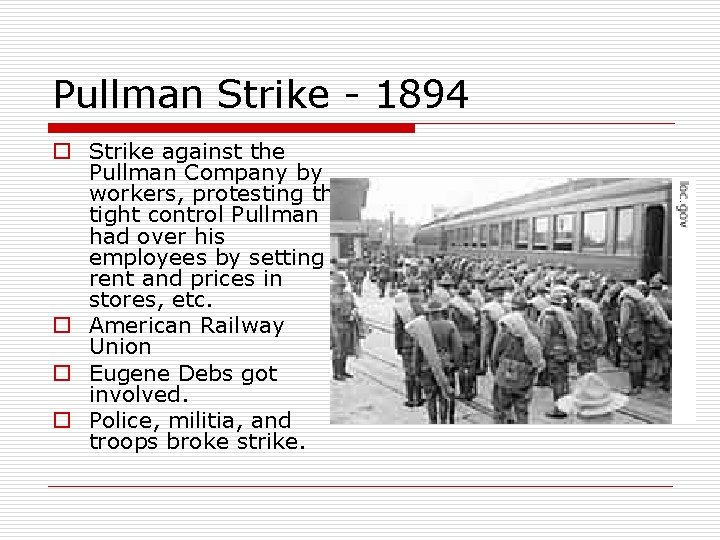
Pullman Strike - 1894 o Strike against the Pullman Company by workers, protesting the tight control Pullman had over his employees by setting rent and prices in stores, etc. o American Railway Union o Eugene Debs got involved. o Police, militia, and troops broke strike.
Employers start to worry o Some employers force employees to sign “Yellow-dog contracts” n An employeremployee contract in which the employee agrees not to join a union while employed
The opposite also took place… o Closed shop n An agreement between labor and management in which no non-union member would be allowed to work in a business. n Eventually abolished by the Taft-Hartley Act
- Slides: 41