
The Rise of Islam 600 CE 1450 CE
- Slides: 14
The Rise of Islam 600 CE – 1450 CE
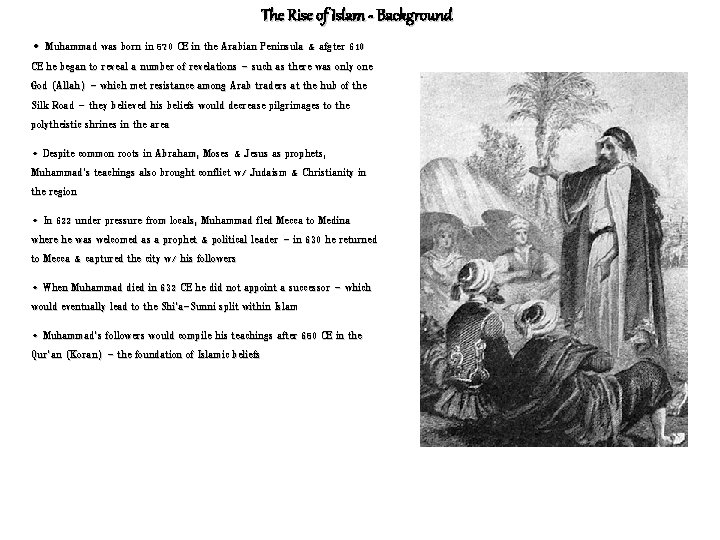
The Rise of Islam - Background • Muhammad was born in 570 CE in the Arabian Peninsula & afgter 610 CE he began to reveal a number of revelations – such as there was only one God (Allah) – which met resistance among Arab traders at the hub of the Silk Road – they believed his beliefs would decrease pilgrimages to the polytheistic shrines in the area • Despite common roots in Abraham, Moses & Jesus as prophets, Muhammad’s teachings also brought conflict w/ Judaism & Christianity in the region • In 622 under pressure from locals, Muhammad fled Mecca to Medina where he was welcomed as a prophet & political leader – in 630 he returned to Mecca & captured the city w/ his followers • When Muhammad died in 632 CE he did not appoint a successor – which would eventually lead to the Shi’a-Sunni split within Islam • Muhammad’s followers would compile his teachings after 650 CE in the Qur’an (Koran) – the foundation of Islamic beliefs
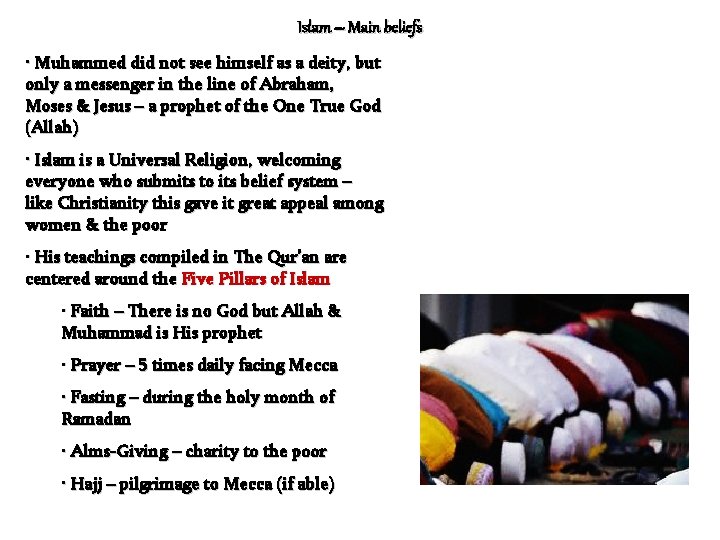
Islam – Main beliefs • Muhammed did not see himself as a deity, but only a messenger in the line of Abraham, Moses & Jesus – a prophet of the One True God (Allah) • Islam is a Universal Religion, welcoming everyone who submits to its belief system – like Christianity this gave it great appeal among women & the poor • His teachings compiled in The Qur’an are centered around the Five Pillars of Islam • Faith – There is no God but Allah & Muhammad is His prophet • Prayer – 5 times daily facing Mecca • Fasting – during the holy month of Ramadan • Alms-Giving – charity to the poor • Hajj – pilgrimage to Mecca (if able)
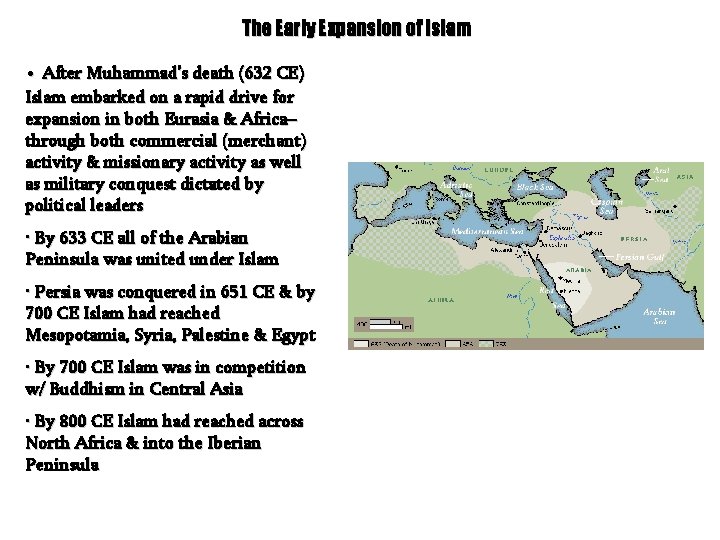
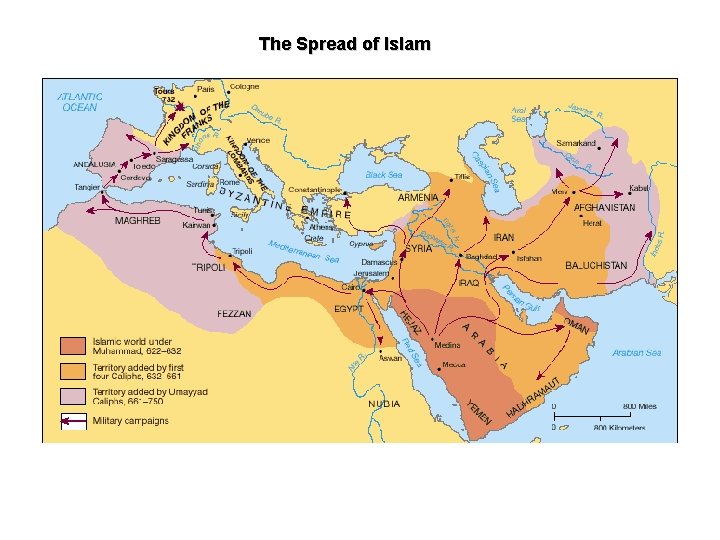
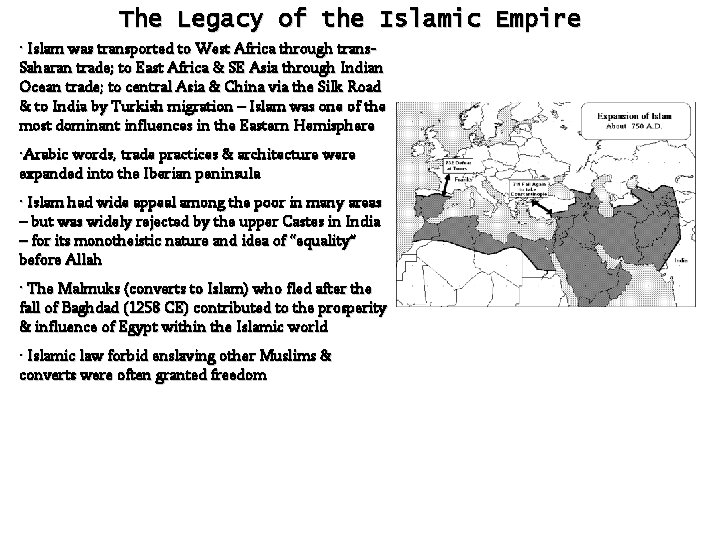
The Early Expansion of Islam • After Muhammad’s death (632 CE) Islam embarked on a rapid drive for expansion in both Eurasia & Africa– through both commercial (merchant) activity & missionary activity as well as military conquest dictated by political leaders • By 633 CE all of the Arabian Peninsula was united under Islam • Persia was conquered in 651 CE & by 700 CE Islam had reached Mesopotamia, Syria, Palestine & Egypt • By 700 CE Islam was in competition w/ Buddhism in Central Asia • By 800 CE Islam had reached across North Africa & into the Iberian Peninsula
The Spread of Islam
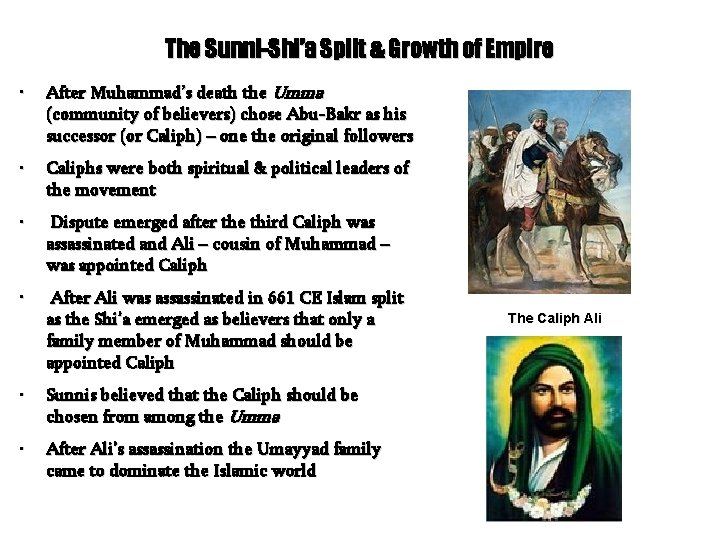
The Sunni-Shi’a Split & Growth of Empire • After Muhammad’s death the Umma (community of believers) chose Abu-Bakr as his successor (or Caliph) – one the original followers • Caliphs were both spiritual & political leaders of the movement • Dispute emerged after the third Caliph was assassinated and Ali – cousin of Muhammad – was appointed Caliph • After Ali was assassinated in 661 CE Islam split as the Shi’a emerged as believers that only a family member of Muhammad should be appointed Caliph • Sunnis believed that the Caliph should be chosen from among the Umma • After Ali’s assassination the Umayyad family came to dominate the Islamic world The Caliph Ali
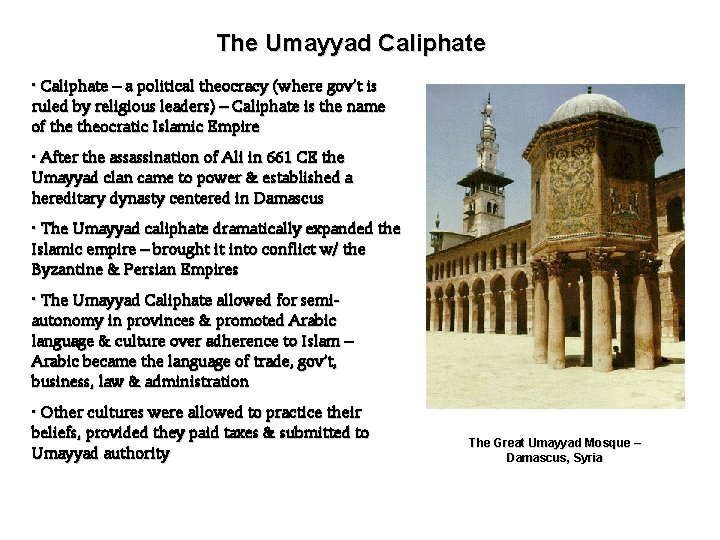
The Umayyad Caliphate • Caliphate – a political theocracy (where gov’t is ruled by religious leaders) – Caliphate is the name of theocratic Islamic Empire • After the assassination of Ali in 661 CE the Umayyad clan came to power & established a hereditary dynasty centered in Damascus • The Umayyad caliphate dramatically expanded the Islamic empire – brought it into conflict w/ the Byzantine & Persian Empires • The Umayyad Caliphate allowed for semiautonomy in provinces & promoted Arabic language & culture over adherence to Islam – Arabic became the language of trade, gov’t, business, law & administration • Other cultures were allowed to practice their beliefs, provided they paid taxes & submitted to Umayyad authority The Great Umayyad Mosque – Damascus, Syria
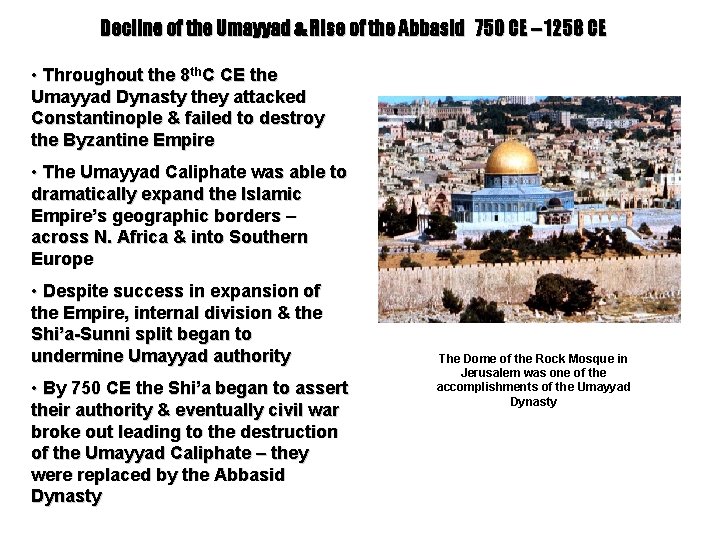
Decline of the Umayyad & Rise of the Abbasid 750 CE – 1258 CE • Throughout the 8 th. C CE the Umayyad Dynasty they attacked Constantinople & failed to destroy the Byzantine Empire • The Umayyad Caliphate was able to dramatically expand the Islamic Empire’s geographic borders – across N. Africa & into Southern Europe • Despite success in expansion of the Empire, internal division & the Shi’a-Sunni split began to undermine Umayyad authority • By 750 CE the Shi’a began to assert their authority & eventually civil war broke out leading to the destruction of the Umayyad Caliphate – they were replaced by the Abbasid Dynasty The Dome of the Rock Mosque in Jerusalem was one of the accomplishments of the Umayyad Dynasty
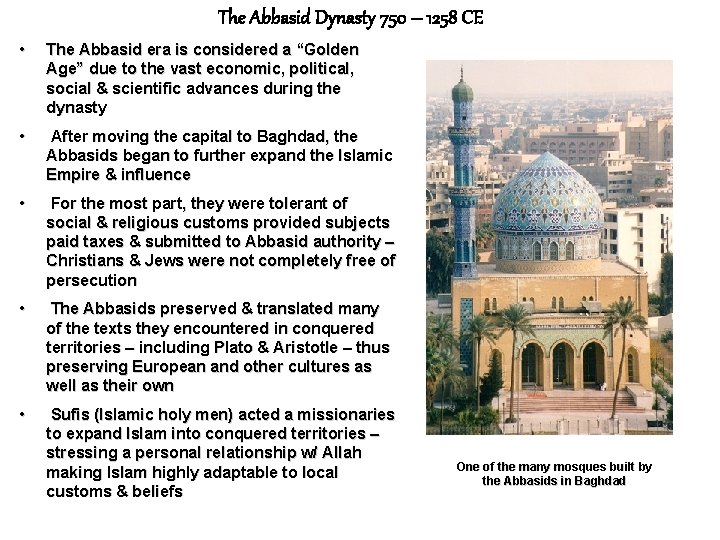
The Abbasid Dynasty 750 – 1258 CE • The Abbasid era is considered a “Golden Age” due to the vast economic, political, social & scientific advances during the dynasty • After moving the capital to Baghdad, the Abbasids began to further expand the Islamic Empire & influence • For the most part, they were tolerant of social & religious customs provided subjects paid taxes & submitted to Abbasid authority – Christians & Jews were not completely free of persecution • The Abbasids preserved & translated many of the texts they encountered in conquered territories – including Plato & Aristotle – thus preserving European and other cultures as well as their own • Sufis (Islamic holy men) acted a missionaries to expand Islam into conquered territories – stressing a personal relationship w/ Allah making Islam highly adaptable to local customs & beliefs One of the many mosques built by the Abbasids in Baghdad
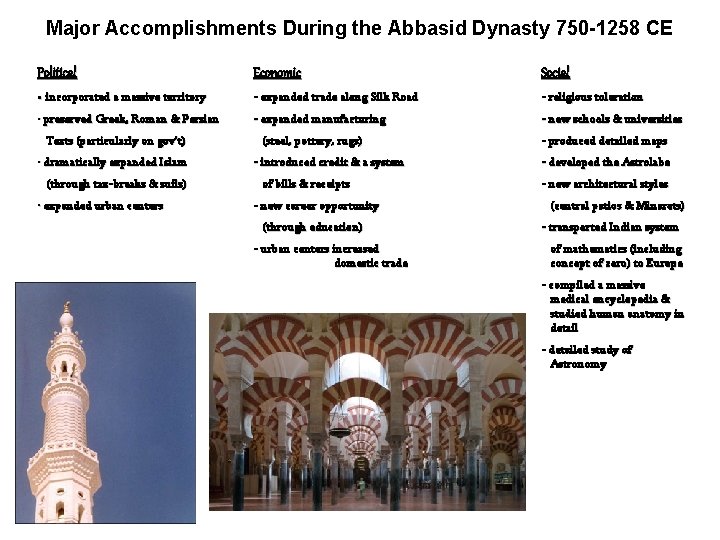
Major Accomplishments During the Abbasid Dynasty 750 -1258 CE Political Economic Social • incorporated a massive territory - expanded trade along Silk Road - religious toleration • preserved Greek, Roman & Persian - expanded manufacturing - new schools & universities Texts (particularly on gov’t) • dramatically expanded Islam (through tax-breaks & sufis) • expanded urban centers (steel, pottery, rugs) - introduced credit & a system of bills & receipts - new career opportunity (through education) - urban centers increased domestic trade - produced detailed maps - developed the Astrolabe - new architectural styles (central patios & Minarets) - transported Indian system of mathematics (including concept of zero) to Europe - compiled a massive medical encyclopedia & studied human anatomy in detail - detailed study of Astronomy
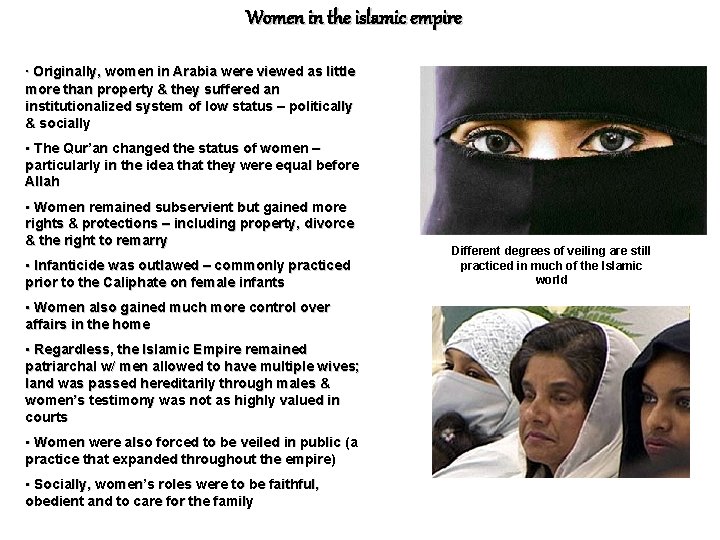
Women in the islamic empire • Originally, women in Arabia were viewed as little more than property & they suffered an institutionalized system of low status – politically & socially • The Qur’an changed the status of women – particularly in the idea that they were equal before Allah • Women remained subservient but gained more rights & protections – including property, divorce & the right to remarry • Infanticide was outlawed – commonly practiced prior to the Caliphate on female infants • Women also gained much more control over affairs in the home • Regardless, the Islamic Empire remained patriarchal w/ men allowed to have multiple wives; land was passed hereditarily through males & women’s testimony was not as highly valued in courts • Women were also forced to be veiled in public (a practice that expanded throughout the empire) • Socially, women’s roles were to be faithful, obedient and to care for the family Different degrees of veiling are still practiced in much of the Islamic world
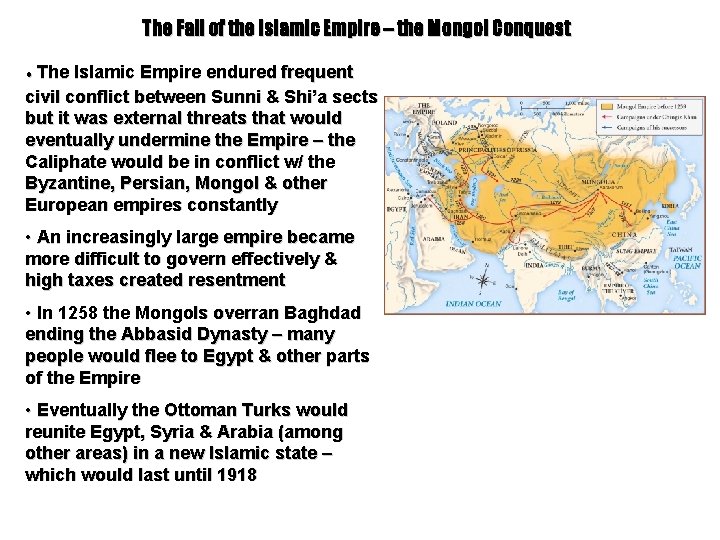
The Fall of the Islamic Empire – the Mongol Conquest • The Islamic Empire endured frequent civil conflict between Sunni & Shi’a sects but it was external threats that would eventually undermine the Empire – the Caliphate would be in conflict w/ the Byzantine, Persian, Mongol & other European empires constantly • An increasingly large empire became more difficult to govern effectively & high taxes created resentment • In 1258 the Mongols overran Baghdad ending the Abbasid Dynasty – many people would flee to Egypt & other parts of the Empire • Eventually the Ottoman Turks would reunite Egypt, Syria & Arabia (among other areas) in a new Islamic state – which would last until 1918
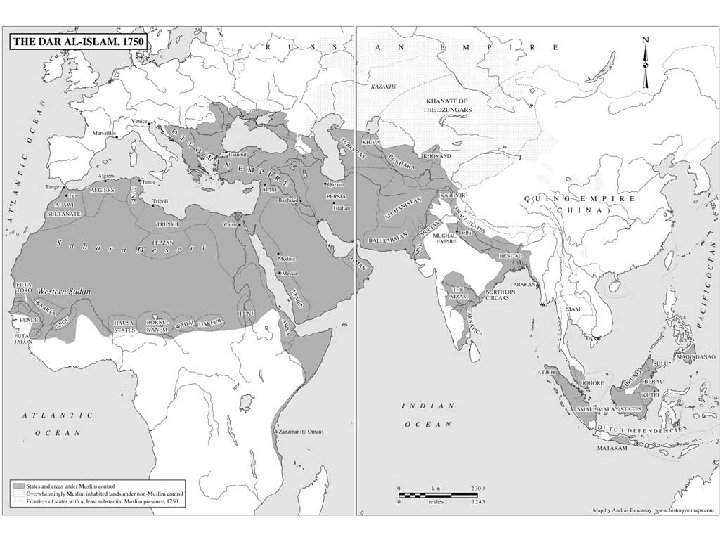
The Legacy of the Islamic Empire • Islam was transported to West Africa through trans. Saharan trade; to East Africa & SE Asia through Indian Ocean trade; to central Asia & China via the Silk Road & to India by Turkish migration – Islam was one of the most dominant influences in the Eastern Hemisphere • Arabic words, trade practices & architecture were expanded into the Iberian peninsula • Islam had wide appeal among the poor in many areas – but was widely rejected by the upper Castes in India – for its monotheistic nature and idea of “equality” before Allah • The Malmuks (converts to Islam) who fled after the fall of Baghdad (1258 CE) contributed to the prosperity & influence of Egypt within the Islamic world • Islamic law forbid enslaving other Muslims & converts were often granted freedom