
THE RISE OF INDUSTRIAL AMERICA Economic Expansion from
- Slides: 21
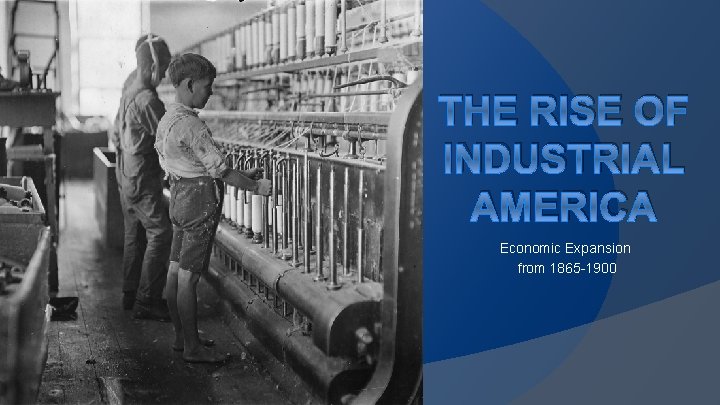
THE RISE OF INDUSTRIAL AMERICA Economic Expansion from 1865 -1900
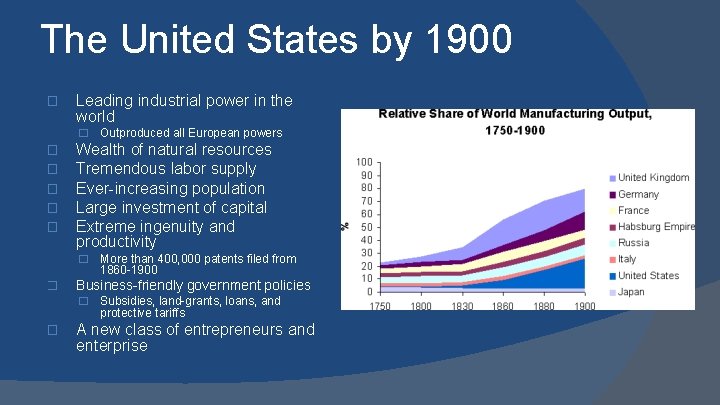
The United States by 1900 � Leading industrial power in the world � Outproduced all European powers � � � Wealth of natural resources Tremendous labor supply Ever-increasing population Large investment of capital Extreme ingenuity and productivity � More than 400, 000 patents filed from 1860 -1900 � Business-friendly government policies � Subsidies, land-grants, loans, and protective tariffs � A new class of entrepreneurs and enterprise
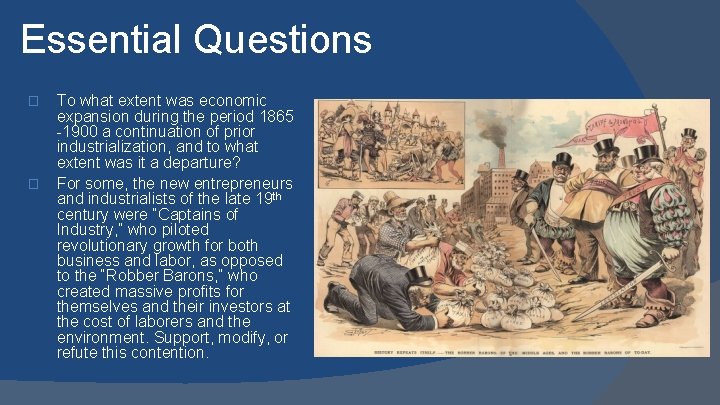
Essential Questions � � To what extent was economic expansion during the period 1865 -1900 a continuation of prior industrialization, and to what extent was it a departure? For some, the new entrepreneurs and industrialists of the late 19 th century were “Captains of Industry, ” who piloted revolutionary growth for both business and labor, as opposed to the “Robber Barons, ” who created massive profits for themselves and their investors at the cost of laborers and the environment. Support, modify, or refute this contention.
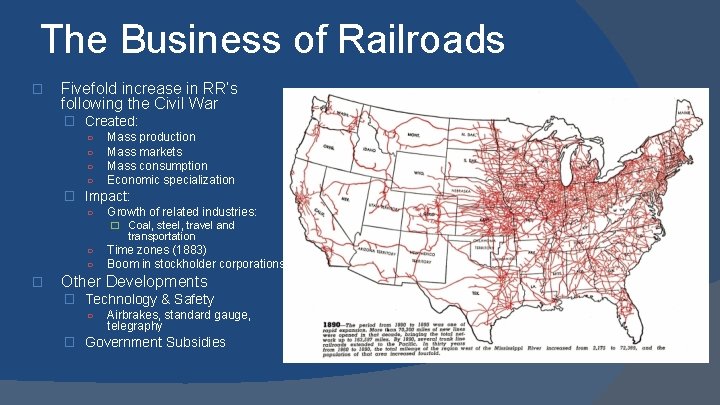
The Business of Railroads � Fivefold increase in RR’s following the Civil War � Created: ○ ○ Mass production Mass markets Mass consumption Economic specialization � Impact: ○ Growth of related industries: � Coal, steel, travel and transportation ○ ○ � Time zones (1883) Boom in stockholder corporations Other Developments � Technology & Safety ○ Airbrakes, standard gauge, telegraphy � Government Subsidies
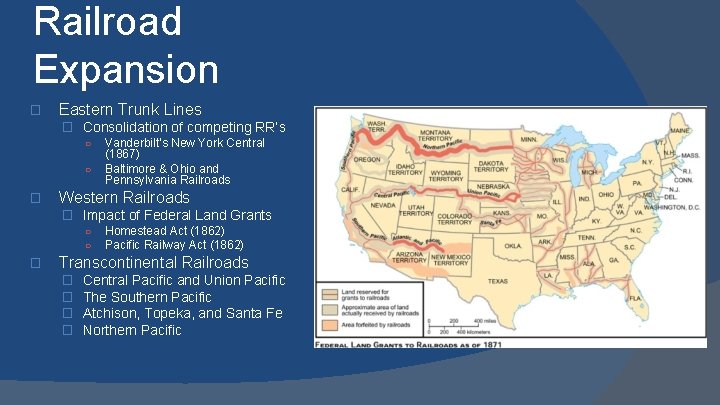
Railroad Expansion � Eastern Trunk Lines � Consolidation of competing RR’s ○ ○ � Vanderbilt’s New York Central (1867) Baltimore & Ohio and Pennsylvania Railroads Western Railroads � Impact of Federal Land Grants ○ ○ � Homestead Act (1862) Pacific Railway Act (1862) Transcontinental Railroads � � Central Pacific and Union Pacific The Southern Pacific Atchison, Topeka, and Santa Fe Northern Pacific
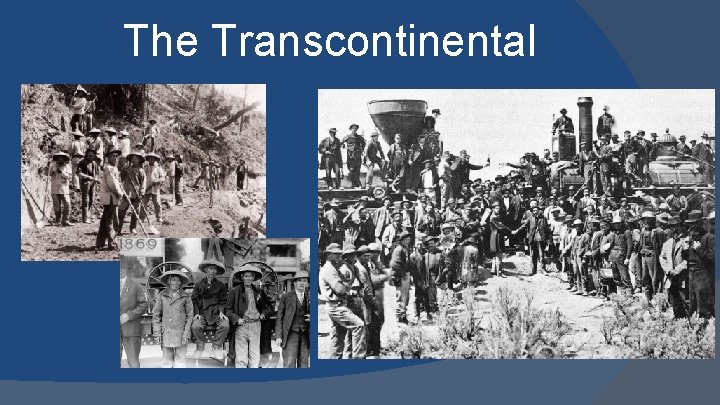
The Transcontinental
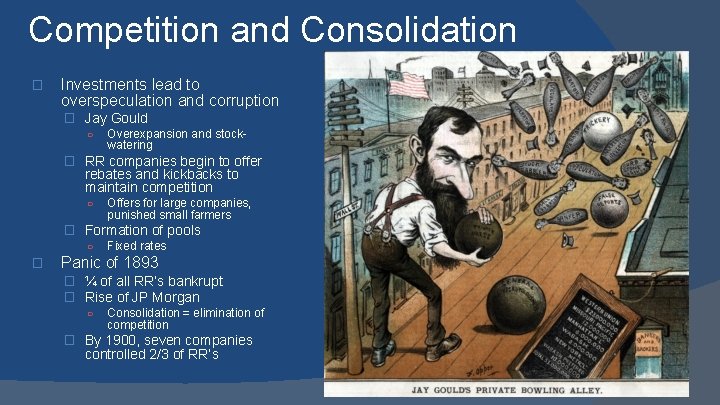
Competition and Consolidation � Investments lead to overspeculation and corruption � Jay Gould ○ Overexpansion and stockwatering � RR companies begin to offer rebates and kickbacks to maintain competition ○ Offers for large companies, punished small farmers � Formation of pools ○ � Fixed rates Panic of 1893 � ¼ of all RR’s bankrupt � Rise of JP Morgan ○ Consolidation = elimination of competition � By 1900, seven companies controlled 2/3 of RR’s
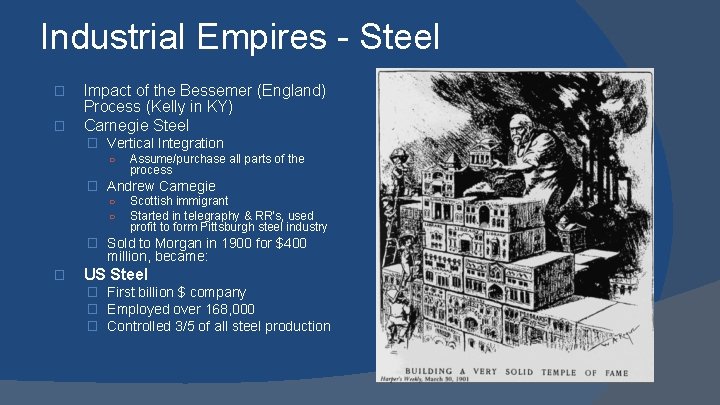
Industrial Empires - Steel � � Impact of the Bessemer (England) Process (Kelly in KY) Carnegie Steel � Vertical Integration ○ Assume/purchase all parts of the process � Andrew Carnegie ○ ○ Scottish immigrant Started in telegraphy & RR’s, used profit to form Pittsburgh steel industry � Sold to Morgan in 1900 for $400 million, became: � US Steel � First billion $ company � Employed over 168, 000 � Controlled 3/5 of all steel production
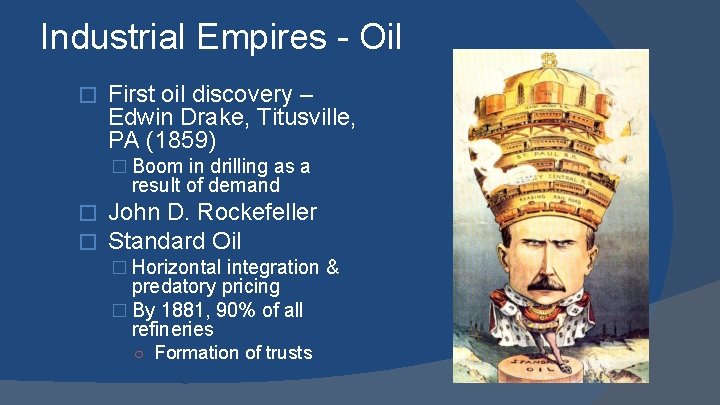
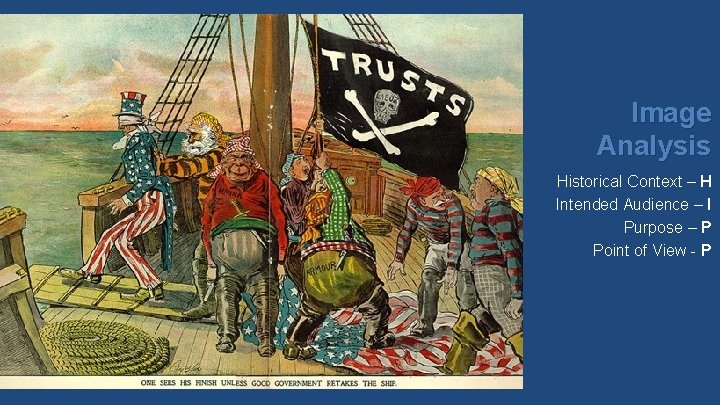
Industrial Empires - Oil � First oil discovery – Edwin Drake, Titusville, PA (1859) � Boom in drilling as a result of demand � � John D. Rockefeller Standard Oil � Horizontal integration & predatory pricing � By 1881, 90% of all refineries ○ Formation of trusts
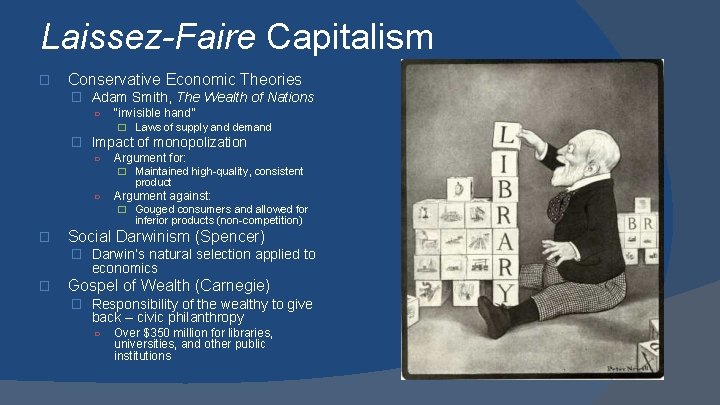
Laissez-Faire Capitalism � Conservative Economic Theories � Adam Smith, The Wealth of Nations ○ “invisible hand” � Laws of supply and demand � Impact of monopolization ○ Argument for: � Maintained high-quality, consistent product ○ Argument against: � Gouged consumers and allowed for inferior products (non-competition) � Social Darwinism (Spencer) � Darwin’s natural selection applied to economics � Gospel of Wealth (Carnegie) � Responsibility of the wealthy to give back – civic philanthropy ○ Over $350 million for libraries, universities, and other public institutions
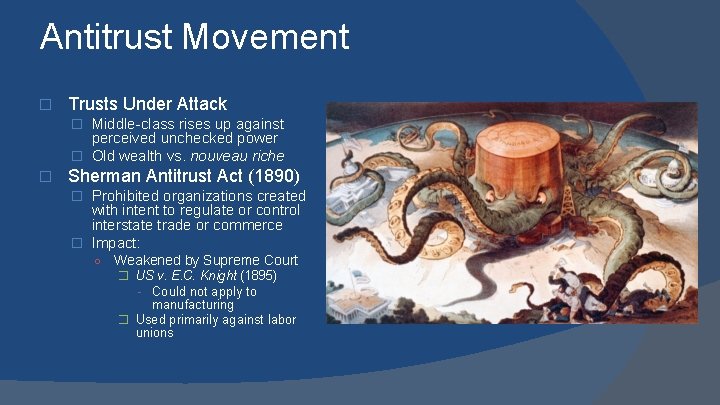
Antitrust Movement � Trusts Under Attack � Middle-class rises up against perceived unchecked power � Old wealth vs. nouveau riche � Sherman Antitrust Act (1890) � Prohibited organizations created with intent to regulate or control interstate trade or commerce � Impact: ○ Weakened by Supreme Court � US v. E. C. Knight (1895) - Could not apply to manufacturing � Used primarily against labor unions
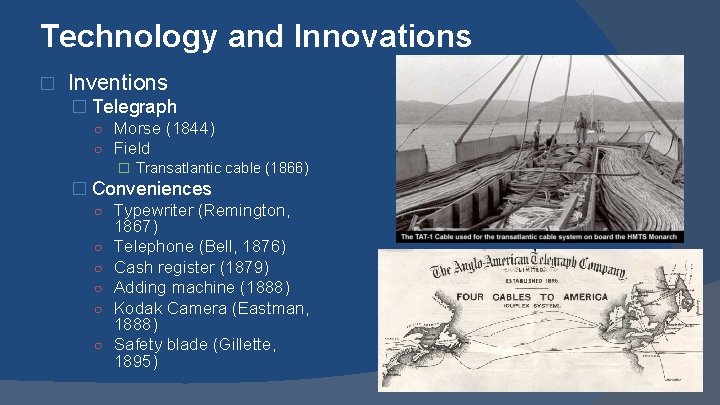
Technology and Innovations � Inventions � Telegraph ○ Morse (1844) ○ Field � Transatlantic cable (1866) � Conveniences ○ Typewriter (Remington, 1867) ○ Telephone (Bell, 1876) ○ Cash register (1879) ○ Adding machine (1888) ○ Kodak Camera (Eastman, 1888) ○ Safety blade (Gillette, 1895)
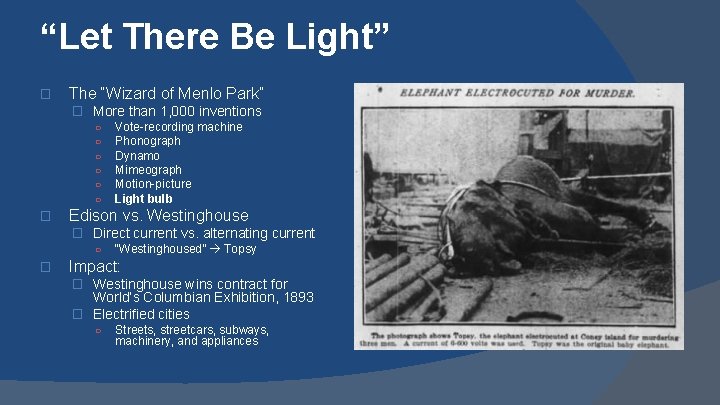
“Let There Be Light” � The “Wizard of Menlo Park” � More than 1, 000 inventions ○ ○ ○ � Vote-recording machine Phonograph Dynamo Mimeograph Motion-picture Light bulb Edison vs. Westinghouse � Direct current vs. alternating current ○ � “Westinghoused” Topsy Impact: � Westinghouse wins contract for World’s Columbian Exhibition, 1893 � Electrified cities ○ Streets, streetcars, subways, machinery, and appliances
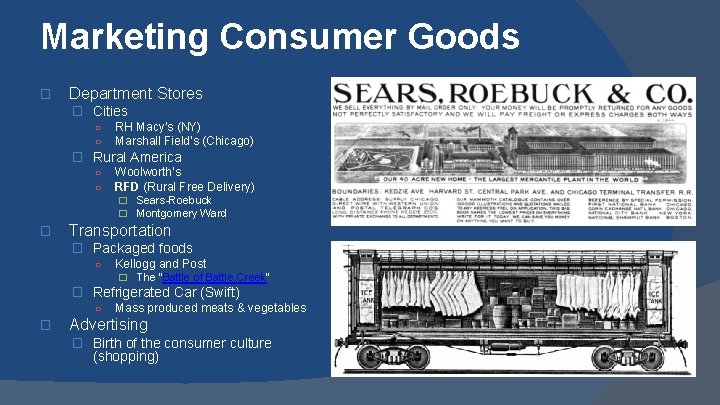
Marketing Consumer Goods � Department Stores � Cities ○ ○ RH Macy’s (NY) Marshall Field’s (Chicago) � Rural America ○ ○ Woolworth’s RFD (Rural Free Delivery) � Sears-Roebuck � Montgomery Ward � Transportation � Packaged foods ○ Kellogg and Post � The “Battle of Battle Creek” � Refrigerated Car (Swift) ○ � Mass produced meats & vegetables Advertising � Birth of the consumer culture (shopping)
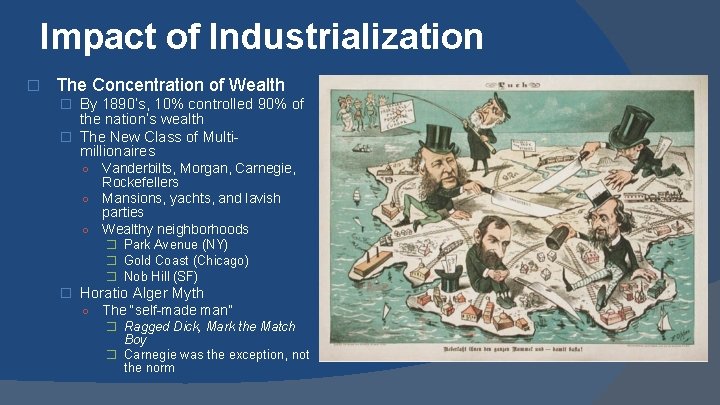
Impact of Industrialization � The Concentration of Wealth � By 1890’s, 10% controlled 90% of the nation’s wealth � The New Class of Multimillionaires Vanderbilts, Morgan, Carnegie, Rockefellers ○ Mansions, yachts, and lavish parties ○ Wealthy neighborhoods ○ � Park Avenue (NY) � Gold Coast (Chicago) � Nob Hill (SF) � Horatio Alger Myth ○ The “self-made man” � Ragged Dick, Mark the Match Boy � Carnegie was the exception, not the norm
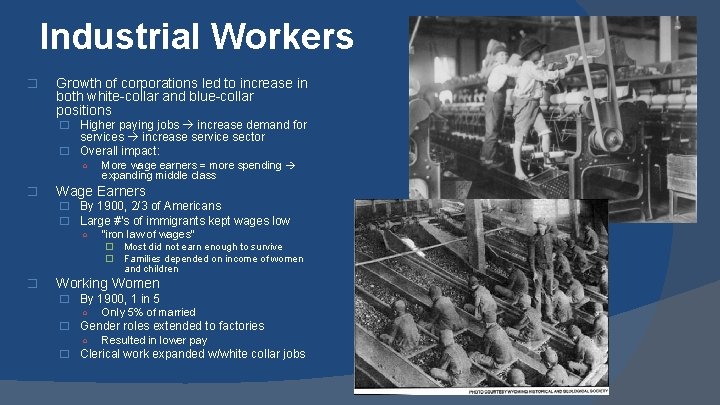
Industrial Workers � Growth of corporations led to increase in both white-collar and blue-collar positions � Higher paying jobs increase demand for services increase service sector � Overall impact: ○ More wage earners = more spending expanding middle class � Wage Earners � By 1900, 2/3 of Americans � Large #’s of immigrants kept wages low ○ “iron law of wages” � Most did not earn enough to survive � Families depended on income of women and children � Working Women � By 1900, 1 in 5 ○ Only 5% of married � Gender roles extended to factories ○ Resulted in lower pay � Clerical work expanded w/white collar jobs
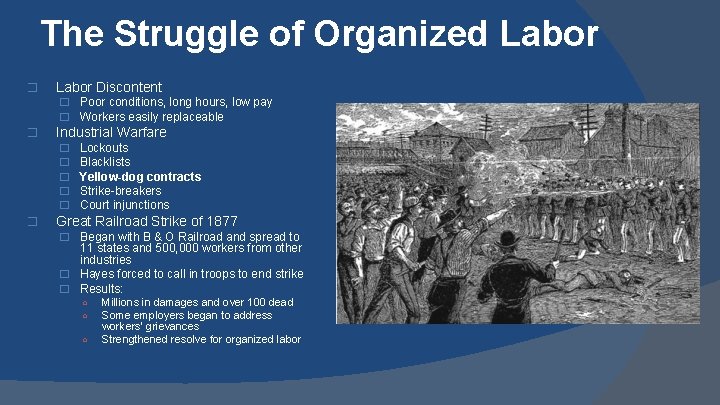
The Struggle of Organized Labor � Labor Discontent � Poor conditions, long hours, low pay � Workers easily replaceable � Industrial Warfare � � � Lockouts Blacklists Yellow-dog contracts Strike-breakers Court injunctions Great Railroad Strike of 1877 � Began with B & O Railroad and spread to 11 states and 500, 000 workers from other industries � Hayes forced to call in troops to end strike � Results: ○ ○ ○ Millions in damages and over 100 dead Some employers began to address workers’ grievances Strengthened resolve for organized labor
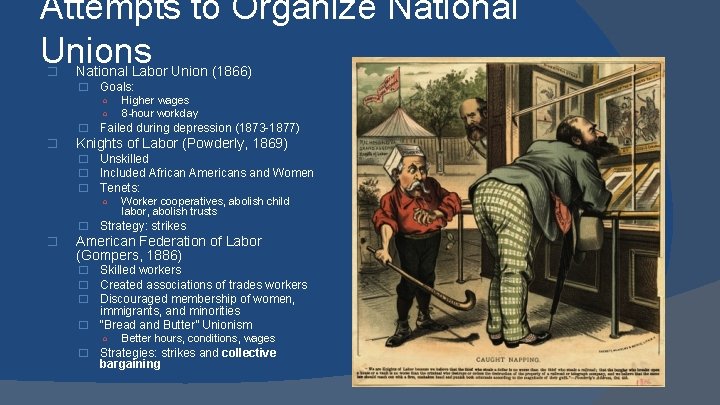
Attempts to Organize National Unions � National Labor Union (1866) � Goals: ○ Higher wages ○ 8 -hour workday � Failed during depression (1873 -1877) � Knights of Labor (Powderly, 1869) � Unskilled � Included African Americans and Women � Tenets: ○ Worker cooperatives, abolish child labor, abolish trusts � Strategy: strikes � American Federation of Labor (Gompers, 1886) � Skilled workers � Created associations of trades workers � Discouraged membership of women, immigrants, and minorities � “Bread and Butter” Unionism ○ Better hours, conditions, wages � Strategies: strikes and collective bargaining
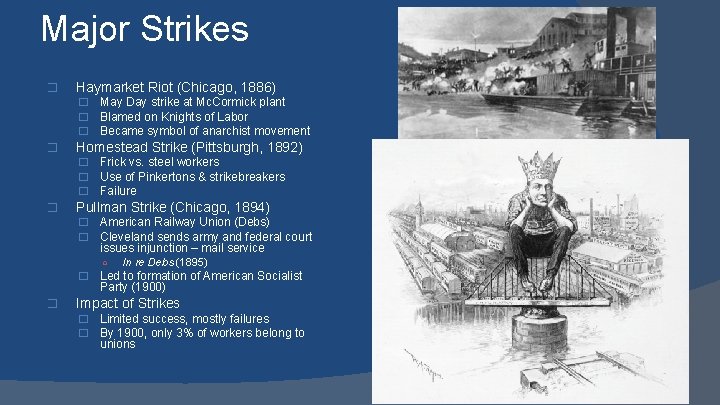
Major Strikes � Haymarket Riot (Chicago, 1886) � May Day strike at Mc. Cormick plant � Blamed on Knights of Labor � Became symbol of anarchist movement � Homestead Strike (Pittsburgh, 1892) � Frick vs. steel workers � Use of Pinkertons & strikebreakers � Failure � Pullman Strike (Chicago, 1894) � American Railway Union (Debs) � Cleveland sends army and federal court issues injunction – mail service ○ In re Debs (1895) � Led to formation of American Socialist Party (1900) � Impact of Strikes � Limited success, mostly failures � By 1900, only 3% of workers belong to unions
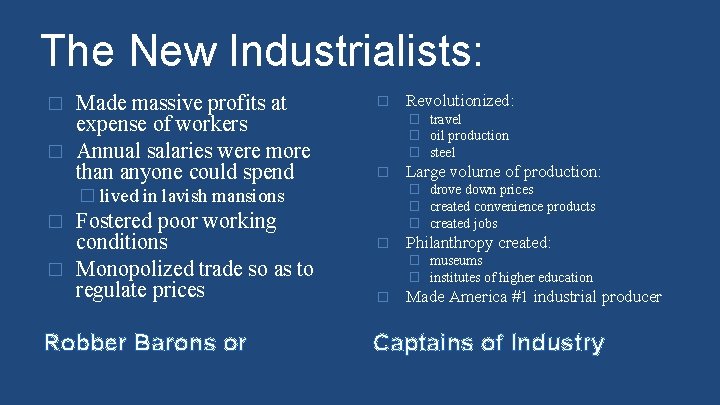
The New Industrialists: Made massive profits at expense of workers � Annual salaries were more than anyone could spend � � � travel � oil production � steel � � Robber Barons or Large volume of production: � drove down prices � created convenience products � created jobs � lived in lavish mansions Fostered poor working conditions � Monopolized trade so as to regulate prices Revolutionized: � Philanthropy created: � museums � institutes of higher education � Made America #1 industrial producer Captains of Industry
Image Analysis Historical Context – H Intended Audience – I Purpose – P Point of View - P