
The Rise of Industrial America 1865 1900 The




- Slides: 19
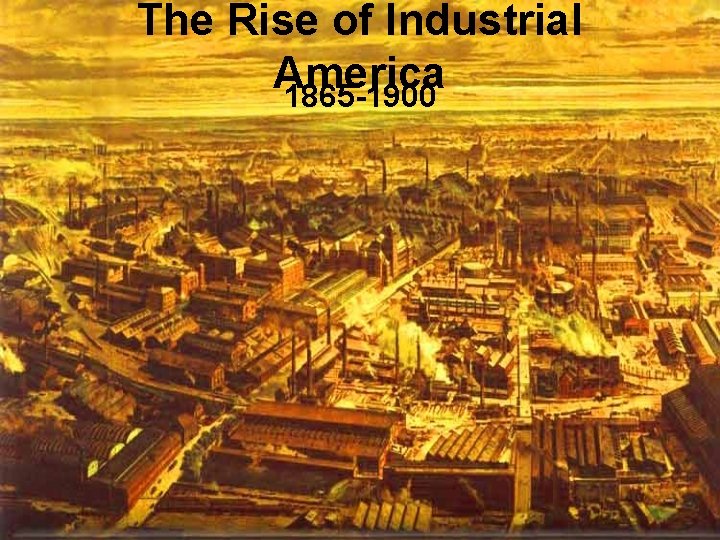
The Rise of Industrial America 1865 -1900
The Industrial Boom • The Civil War and the growth of railroads in the 1860 s contributed to the start of America’s Second Industrial Revolution (c. 1865 -1900) • Whereas America’s First Industrial Revolution of the early 1800 s had been characterized by steam powered textile factories in New England, the Second Industrial Revolution spread nationwide and was characterized by: 1. Exploitation of vast coal reserves (especially in Appalachia) 2. Technological innovations (transportation, communication) 3. Huge demand for labor (both skilled and unskilled) 4. Intense competition that led to the rise of monopolies 5. Rapid decline of prices (both agricultural and industrial) 6. Failure of the money supply to keep pace with expansion
Corporations: • A company or group of people authorized to act as a single entity and recognized as such in law. Early incorporated entities were established by charter. • What were the first examples of corporations in American history? • How does this impact this era of industrialization?
The Railroad Industry • Expansion from 10, 000 miles of track in 1850 to nearly 200, 000 miles by 1900 – opened up a huge internal market that promoted farming, commerce, and closure of the frontier • Railroad companies were the first “modern” corporations – sought capital through stock issuances, separated ownership from management, created national distribution and marketing systems, established complex accounting methods, and formed new organizational structures • Railroads often went deeply into debt, relied on government subsidies (often in the form of real estate) and used questionable business practices to compete for business and profits; owners (such as Jay Gould of the Union Pacific) were depicted as “robber barons” who violated the public trust • Congress created the Interstate Commerce Commission in 1887 in an attempt to regulate railroad business practices that hurt small farmers and business owners in remote areas
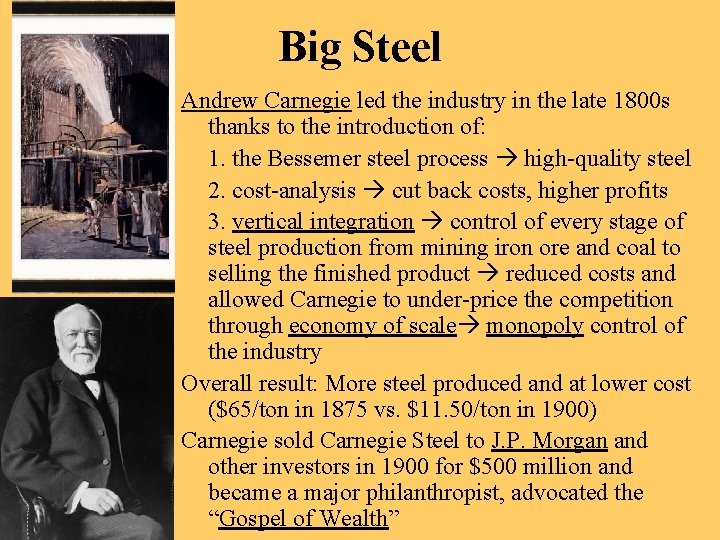
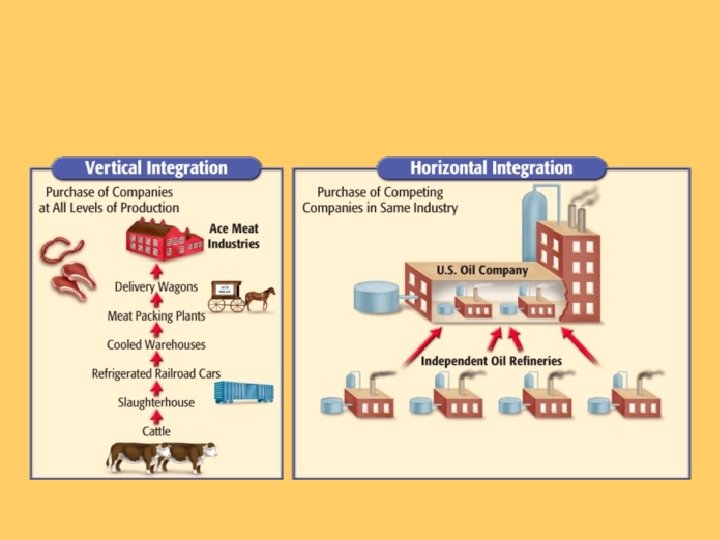
Big Steel Andrew Carnegie led the industry in the late 1800 s thanks to the introduction of: 1. the Bessemer steel process high-quality steel 2. cost-analysis cut back costs, higher profits 3. vertical integration control of every stage of steel production from mining iron ore and coal to selling the finished product reduced costs and allowed Carnegie to under-price the competition through economy of scale monopoly control of the industry Overall result: More steel produced and at lower cost ($65/ton in 1875 vs. $11. 50/ton in 1900) Carnegie sold Carnegie Steel to J. P. Morgan and other investors in 1900 for $500 million and became a major philanthropist, advocated the “Gospel of Wealth”
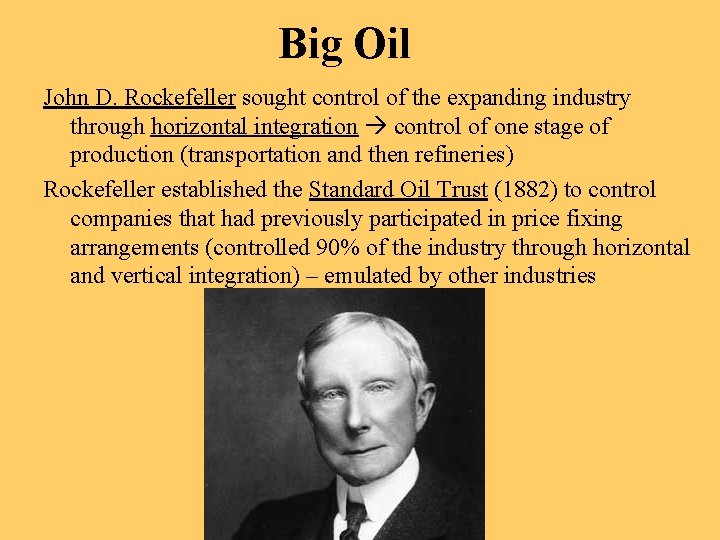
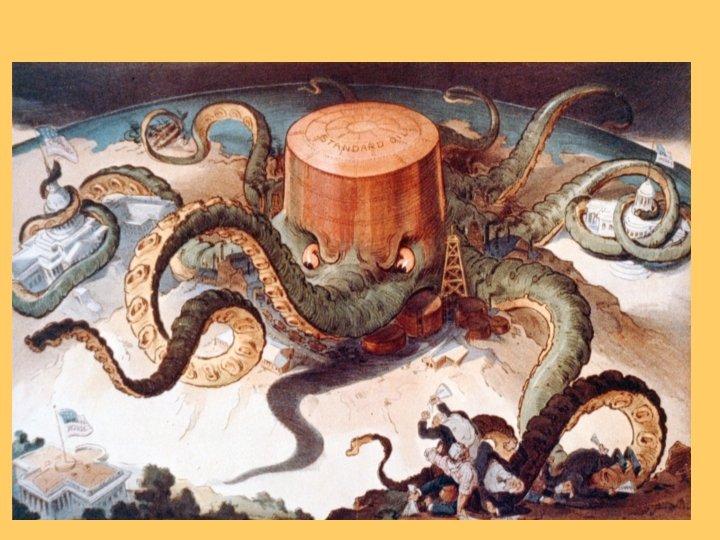
Big Oil John D. Rockefeller sought control of the expanding industry through horizontal integration control of one stage of production (transportation and then refineries) Rockefeller established the Standard Oil Trust (1882) to control companies that had previously participated in price fixing arrangements (controlled 90% of the industry through horizontal and vertical integration) – emulated by other industries
• Vertical Integration: Controlling all aspects of a company, from raw material to production to distribution, in order to maximize profits. • Horizontal Integration: Controlling all aspects of a business or good by buying out competing interests to control the market.
Regulating Monopolies and Trusts • 1890 – Congress passed the Sherman Anti-Trust Act in an attempt to break up trusts and monopolies that were found to be operating “in restraint of trade” • To avoid being targeted by this legislation, Standard Oil reorganized into a holding company, whereby control was no longer exercised through direct ownership of companies but instead through majority share ownership • 1895 - the Supreme Court ruled in U. S. vs. E. C. Knight Company (a sugar trust) that manufacturing did not constitute interstate commerce and therefore could not be regulated encouraged further consolidation of industry into larger trusts
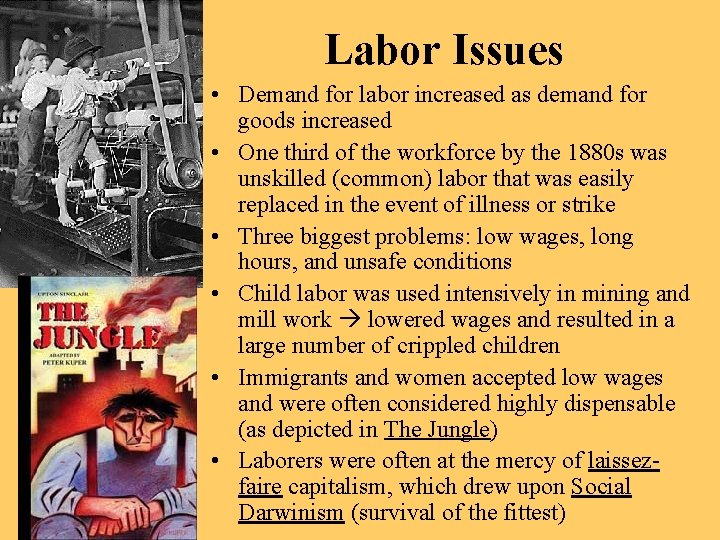
Labor Issues • Demand for labor increased as demand for goods increased • One third of the workforce by the 1880 s was unskilled (common) labor that was easily replaced in the event of illness or strike • Three biggest problems: low wages, long hours, and unsafe conditions • Child labor was used intensively in mining and mill work lowered wages and resulted in a large number of crippled children • Immigrants and women accepted low wages and were often considered highly dispensable (as depicted in The Jungle) • Laborers were often at the mercy of laissezfaire capitalism, which drew upon Social Darwinism (survival of the fittest)
Factors of Industrialization Continued • The following 5 concepts and ideas helped America emerge as an industrial power and you need to know/understand them!
Laissez-Faire Capitalism • “to leave alone” or “to let do/be” • The idea is to let businesses monitor their own regulation through competition. • Laissez-faire capitalism reached its apex in the 1870 s during the age of industrialization, as American factories operated with a free hand. • A contradiction developed however, as competing businesses began to merge, resulting in the removal of competition.
Social Darwinism • Led by English social philosopher Herbert Spencer, some people argued that Darwin’s ideas of natural selection and survival of the fittest should be applied to the marketplace. • Spencer believed that concentrating wealth in the hands of the most ‘fit’ benefited everyone.
Social Darwinism • An American Social Darwinist, Professor William Graham Sumner of Yale, argued that helping the poor was misguided because it interfered with the laws of nature and would only weaken the evolution of the species by preserving the unfit. • Social Darwinism gave some during this period a ‘scientific’ justification for their racial intolerance.
Gospel of Wealth • Many Americans also used religion to justify the wealth of succesful industrialists and bankers. • Rockefeller applied the Protestant work ethic (hard work and material success are signs of God’s favor) to his personal and business life, concluding that ‘God gave me my riches. ’
Gospel of Wealth • Andrew Carnegie’s article ‘Wealth’ argued that the wealthy had a God-given responsibility to carry out projects of civic philanthropy for the benefit of society. • Carnegie practiced what he preached, distributing more than $350 million of his fortune to support the building of libraries, universities, and various public institutions.
Corporation Charters • 1819 (Dartmouth College v. Woodward): This decision declared private corporation charters to be contracts and immune from state legislation impairing its progress. • This allowed companies to grow exponentially without regulation by the states they resided in.
High Tariffs • Throughout American history, especially Jacksonian America in the early 1800’s and then during the rise of industrial America (1865 -1900), high taxes on imported goods protected American businesses. The government was motivated to protect American interests to help the economy grow, both in strength and stability.