
The Rise of Civilization in China The Rivers




- Slides: 52
The Rise of Civilization in China
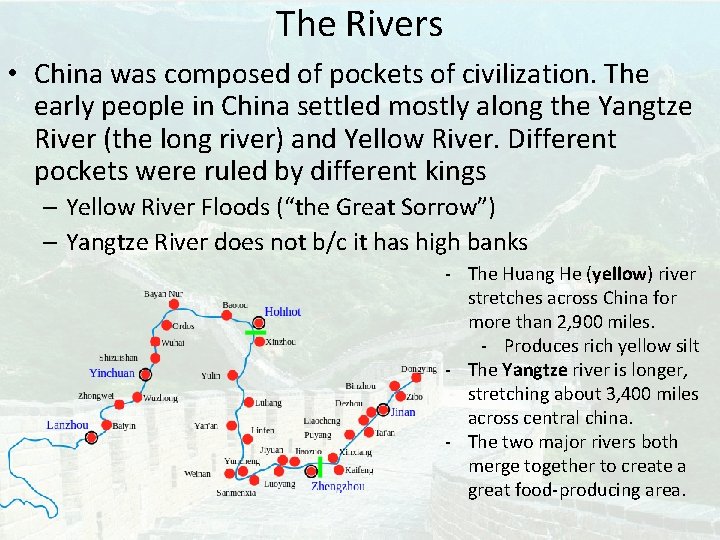
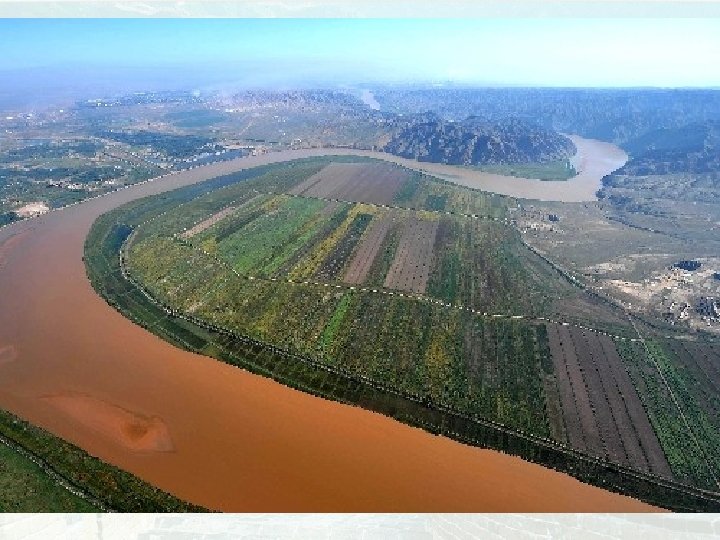
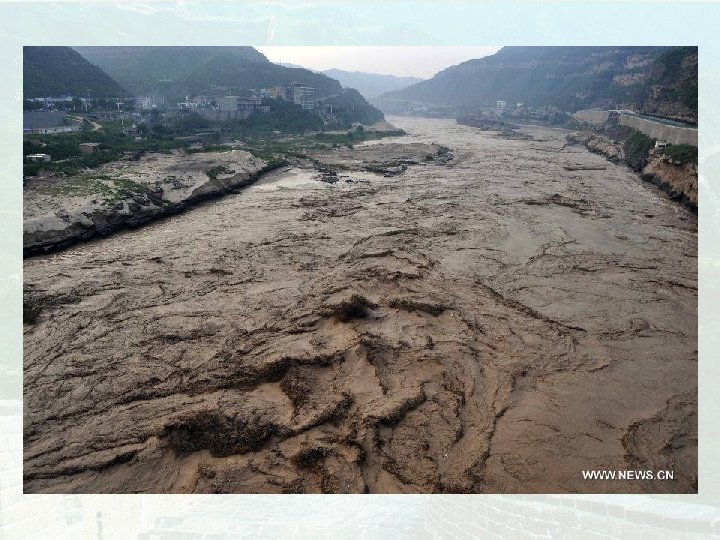
The Rivers • China was composed of pockets of civilization. The early people in China settled mostly along the Yangtze River (the long river) and Yellow River. Different pockets were ruled by different kings – Yellow River Floods (“the Great Sorrow”) – Yangtze River does not b/c it has high banks - The Huang He (yellow) river stretches across China for more than 2, 900 miles. - Produces rich yellow silt - The Yangtze river is longer, stretching about 3, 400 miles across central china. - The two major rivers both merge together to create a great food-producing area.
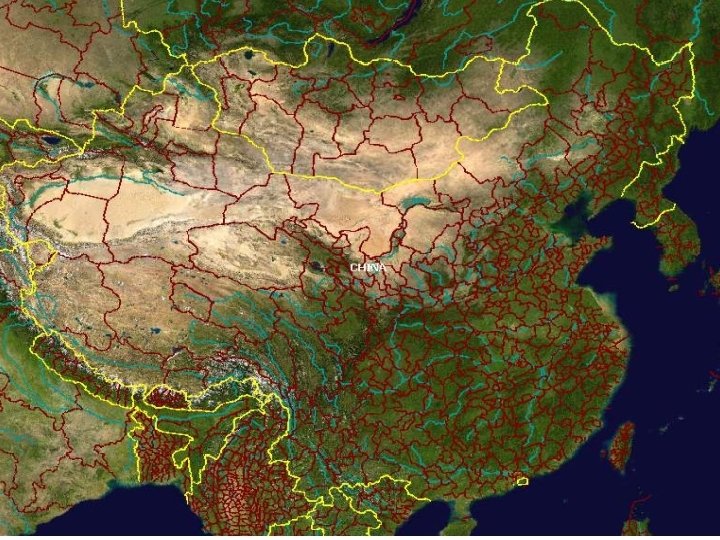
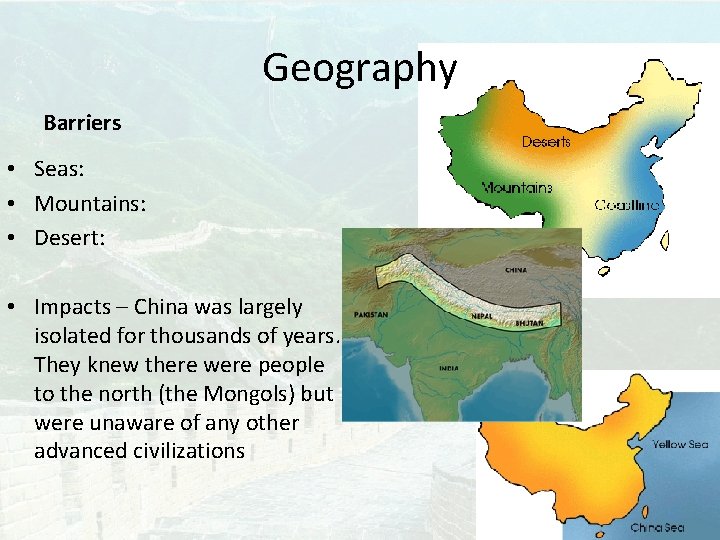
Geography Barriers • Seas: • Mountains: • Desert: • Impacts – China was largely isolated for thousands of years. They knew there were people to the north (the Mongols) but were unaware of any other advanced civilizations
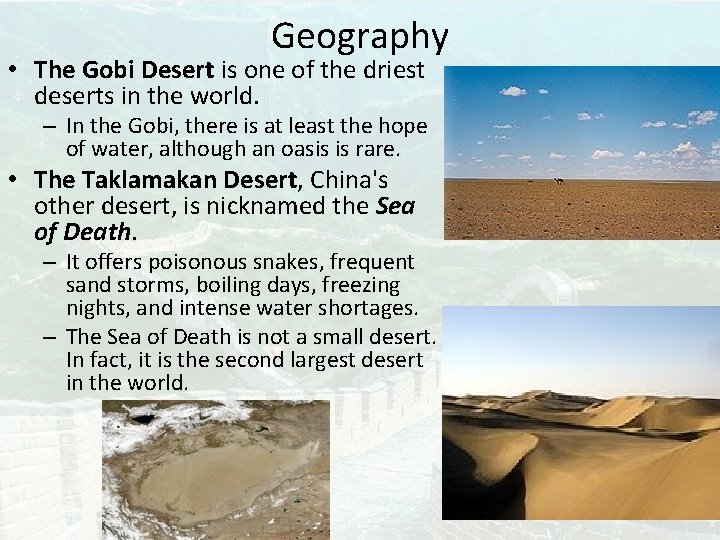
Geography • The Gobi Desert is one of the driest deserts in the world. – In the Gobi, there is at least the hope of water, although an oasis is rare. • The Taklamakan Desert, China's other desert, is nicknamed the Sea of Death. – It offers poisonous snakes, frequent sand storms, boiling days, freezing nights, and intense water shortages. – The Sea of Death is not a small desert. In fact, it is the second largest desert in the world.
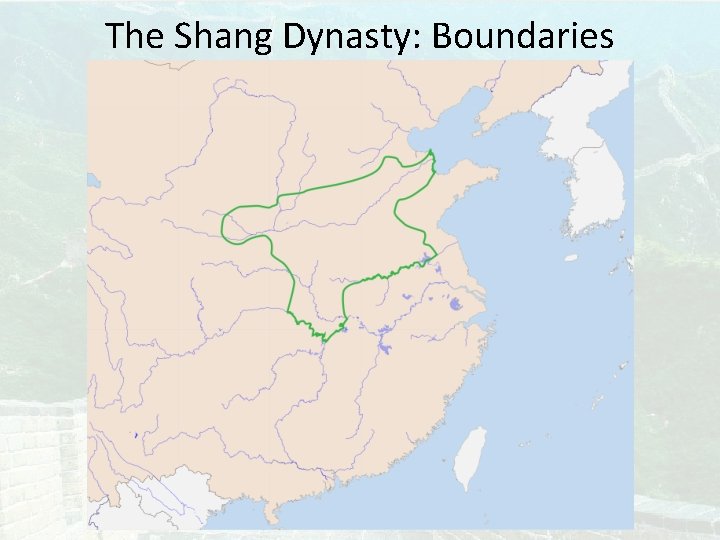
The Shang: 1766 BCE— 1122 BCE • First dynasty in China. • Built capital at present-day Anyang and controlled the surrounding lands. Nobles helped rule the rest of the empire. • Mostly peasants • Royal family→ Warriors→ Merchants→ Peasants • Set the foundation for later Chinese society. Idea of family was at the center of society. – Lead by wealthy, land owning, warrior nobles. • Valued bronze more than gold.
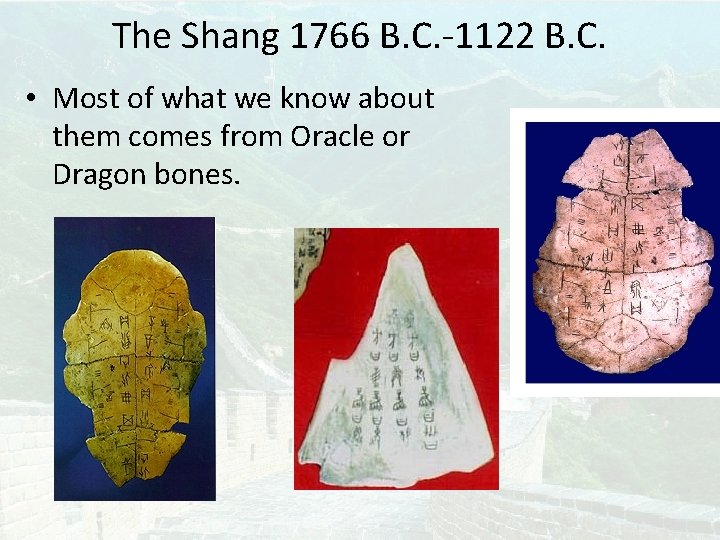
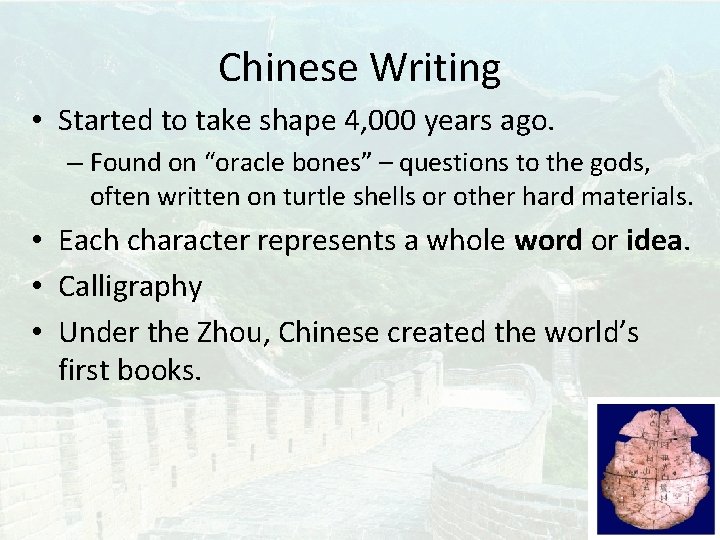
The Shang 1766 B. C. -1122 B. C. • Most of what we know about them comes from Oracle or Dragon bones.
Religion • Worshipped major gods who they believed created the earth (polytheism). – Main god is Shang Di; the king was seen as the link to Shang Di. • Practiced human sacrifice to please their gods, and to receive the wisdom to rule. • Also worshipped on a more personal level, the spirits of their ancestors. Changes in Religious Belief over time • At first, it was thought that only the prayers of the nobles would be listened to. • Also worshipped on a more personal level, to the spirits of their ancestors.
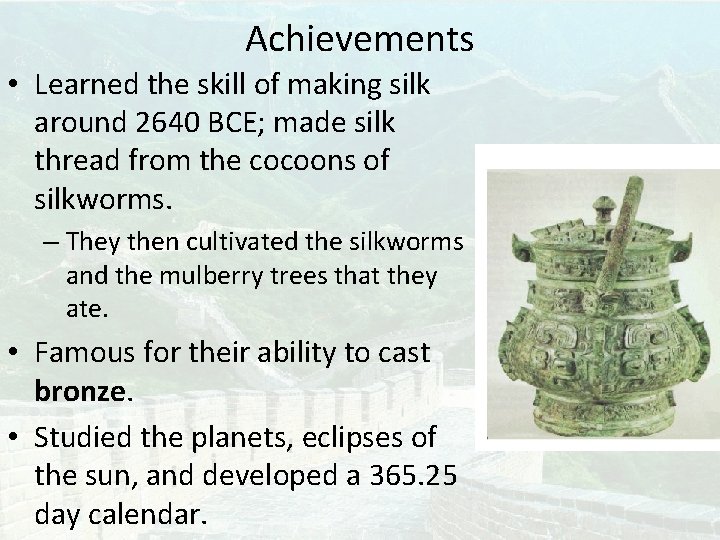
Achievements • Learned the skill of making silk around 2640 BCE; made silk thread from the cocoons of silkworms. – They then cultivated the silkworms and the mulberry trees that they ate. • Famous for their ability to cast bronze. • Studied the planets, eclipses of the sun, and developed a 365. 25 day calendar.
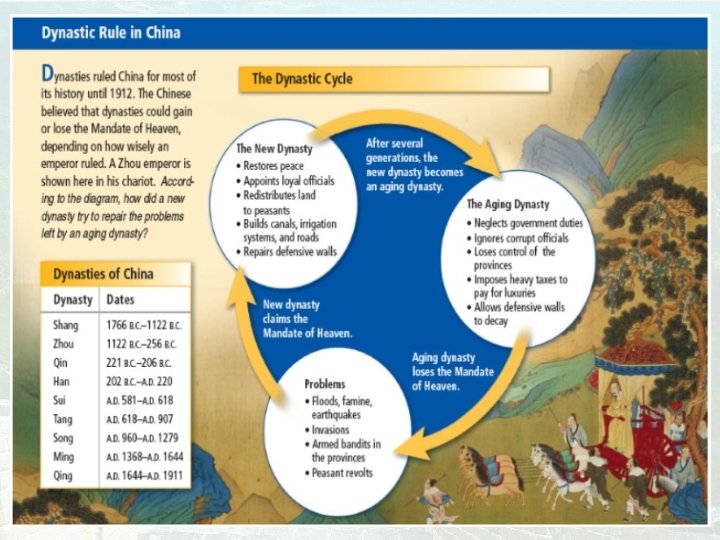
Fall of the Shang • Toward the end of the dynasty, the Shang kings neglected their duty. • A new dynasty, the Zhou, rose to challenge the Shang. • The Zhou introduced the idea of the Mandate of Heaven to justify their actions.
The Mandate of Heaven • The right or wisdom to rule comes from the gods. As long as the leader takes care of the people and the government, he will maintain the goodwill of the gods. However, if he neglects the people and the government, he will lose this mandate. The gods will then send signs of their displeasure: famine, drought, war, corruption, floods. The loss of the Mandate will lead to rebellion.
The Shang Dynasty: Boundaries
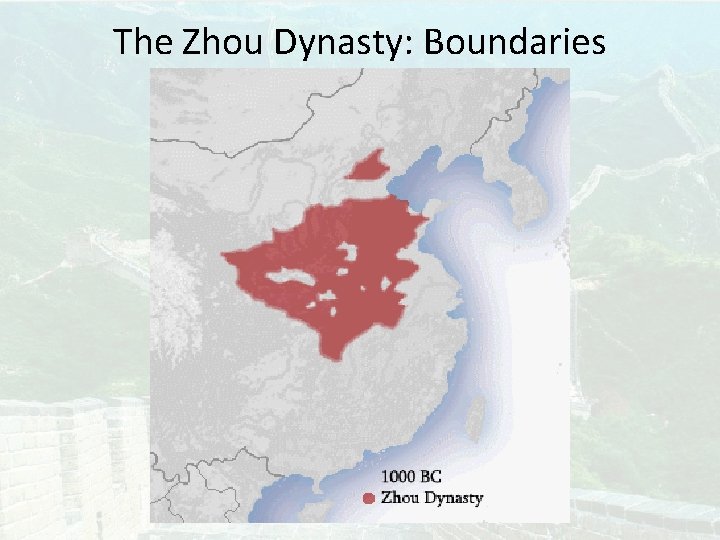
Zhou Dynasty: 1122 BCE— 256 BCE or Chou Dynasty (same thing) • 2 nd dynasty of China • Explained their rebellion against the Shang through the Mandate of Heaven.
The Zhou Dynasty: Boundaries
Feudalism • The Zhou allowed land-owning nobles of the Shang dynasty to keep their land in the new empire. – In return, the nobles owed the king military service, taxes, and loyalty. This type of government is called Feudalism.
Zhou Dynasty: Achievements • Ruled effectively for 250 years … • New iron farm tools and better irrigation allowed for more productive use of the land. Food production increased as did population. • First written law code is developed. • Bronze coins came into use and slowly replaced the barter economy. • Crossbow was invented and used in warfare. • In the end, would Feudalism be an effective way to manage an empire?
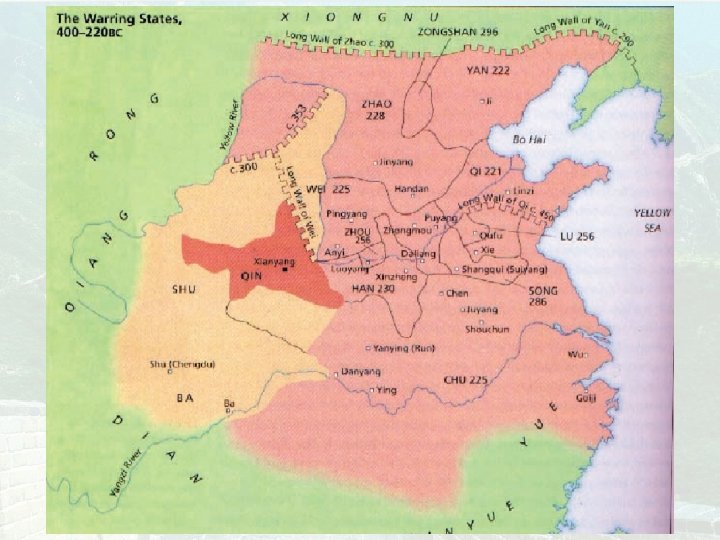
Zhou Dynasty: Fall • Feudalism ruled effectively for 250 years, but over time, leaders lost control to powerhungry nobles (competition). • For the next 600 years China would be plagued by civil war and chaos. • Leads into the “Warring States Period”
Was Feudalism Effective? • So where did the Zhou go wrong? What mistake did they make?
Chinese Writing • Started to take shape 4, 000 years ago. – Found on “oracle bones” – questions to the gods, often written on turtle shells or other hard materials. • Each character represents a whole word or idea. • Calligraphy • Under the Zhou, Chinese created the world’s first books.
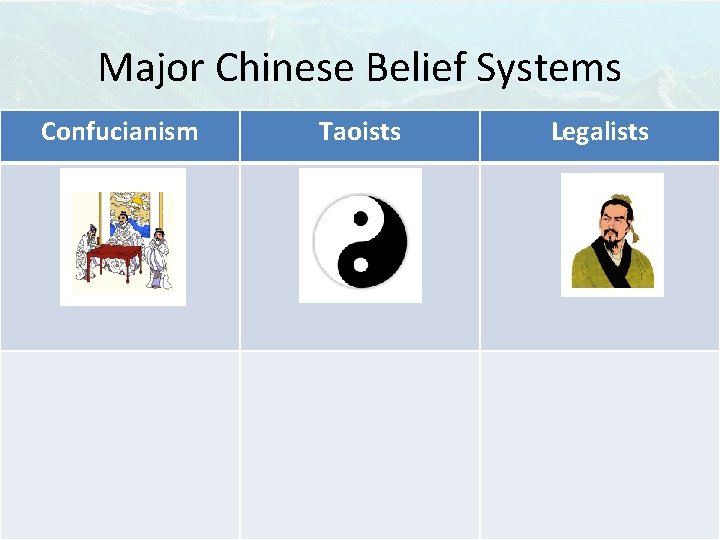
Major Chinese Belief Systems Confucianism Taoists Legalists
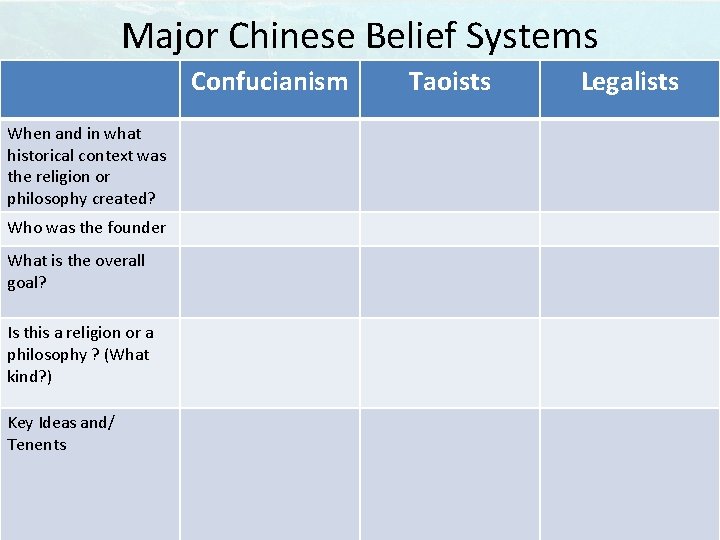
Major Chinese Belief Systems Confucianism When and in what historical context was the religion or philosophy created? Who was the founder What is the overall goal? Is this a religion or a philosophy ? (What kind? ) Key Ideas and/ Tenents Taoists Legalists
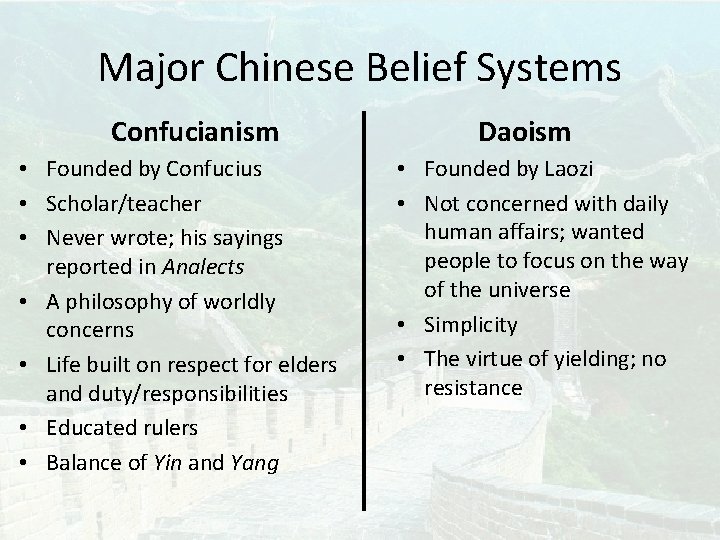
Major Chinese Belief Systems Confucianism • Founded by Confucius • Scholar/teacher • Never wrote; his sayings reported in Analects • A philosophy of worldly concerns • Life built on respect for elders and duty/responsibilities • Educated rulers • Balance of Yin and Yang Daoism • Founded by Laozi • Not concerned with daily human affairs; wanted people to focus on the way of the universe • Simplicity • The virtue of yielding; no resistance
Qin Dynasty • 221 BCE: Zheng of the state of Qin overthrew feudal lords and called himself Qin Shi Huang di, or “First Emperor. ” (Huang-di = emperor) – Full title: Emperor, Son of Heaven, Lord of all things under the sun • He centralized power, imposed punishments for failure. • The thinker Hanfeizi: “The only way to achieve order is to pass strict laws and impose harsh punishments for crimes. ” (Legalism)
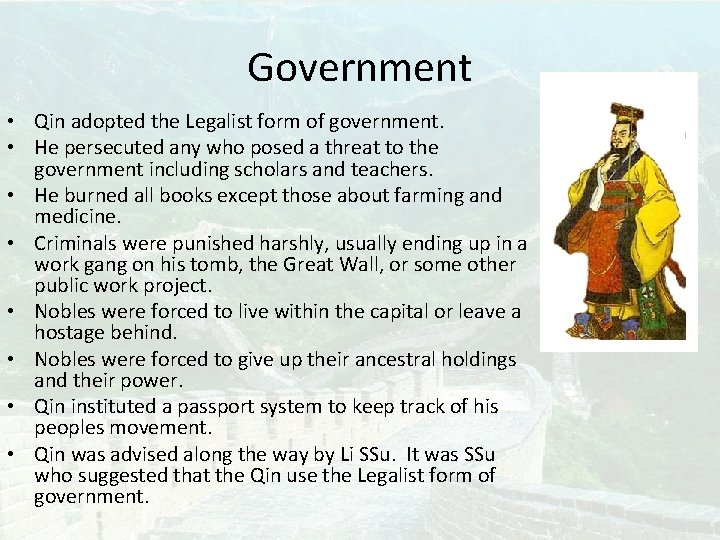
Government • Qin adopted the Legalist form of government. • He persecuted any who posed a threat to the government including scholars and teachers. • He burned all books except those about farming and medicine. • Criminals were punished harshly, usually ending up in a work gang on his tomb, the Great Wall, or some other public work project. • Nobles were forced to live within the capital or leave a hostage behind. • Nobles were forced to give up their ancestral holdings and their power. • Qin instituted a passport system to keep track of his peoples movement. • Qin was advised along the way by Li SSu. It was SSu who suggested that the Qin use the Legalist form of government.
Unity and Compliance • Shi Huangdi removed feudalism; replaced feudal states with 36 military districts. • Standardized weights & measurements. • Made a national coin (replaced local currency).
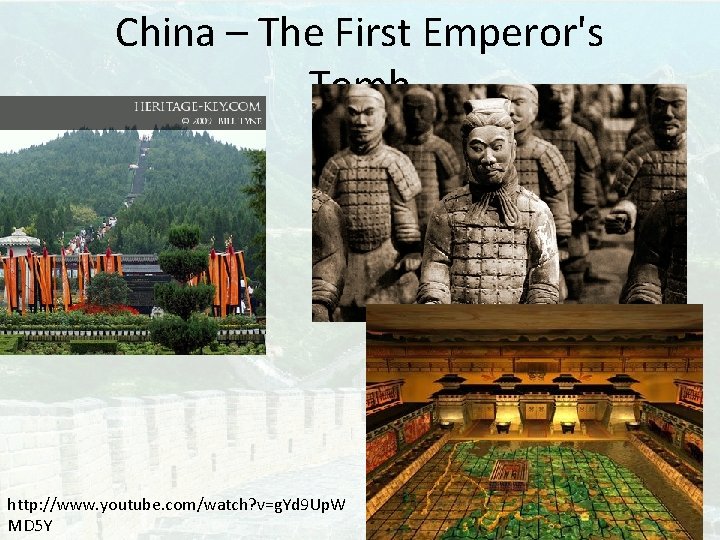
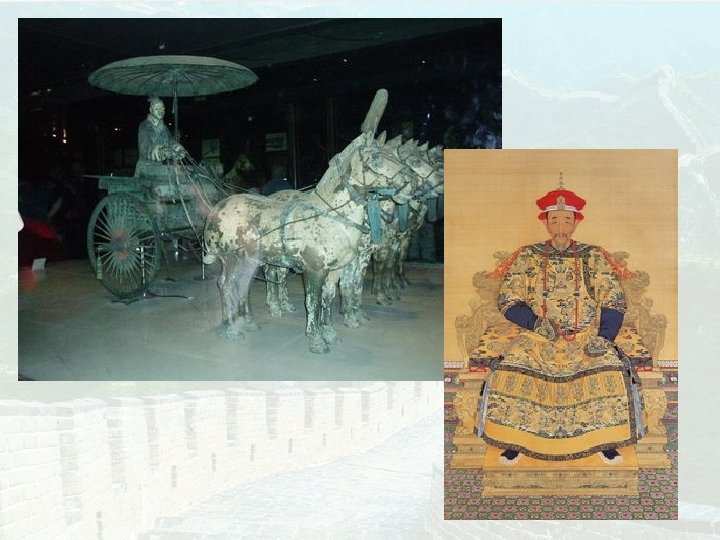
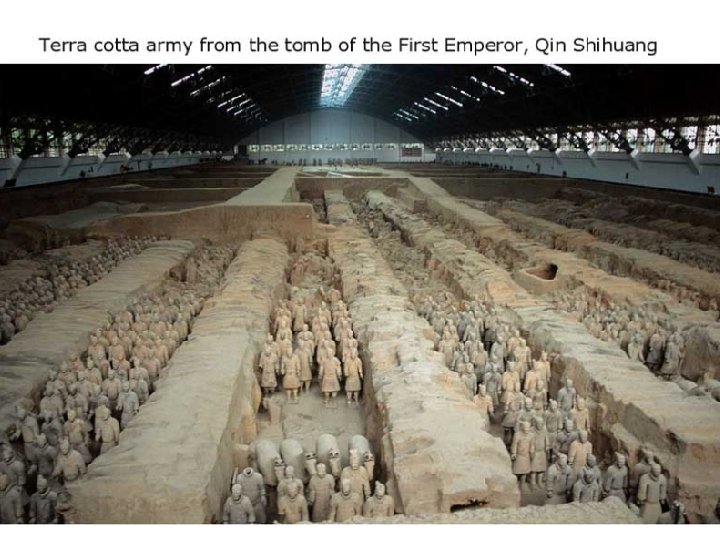
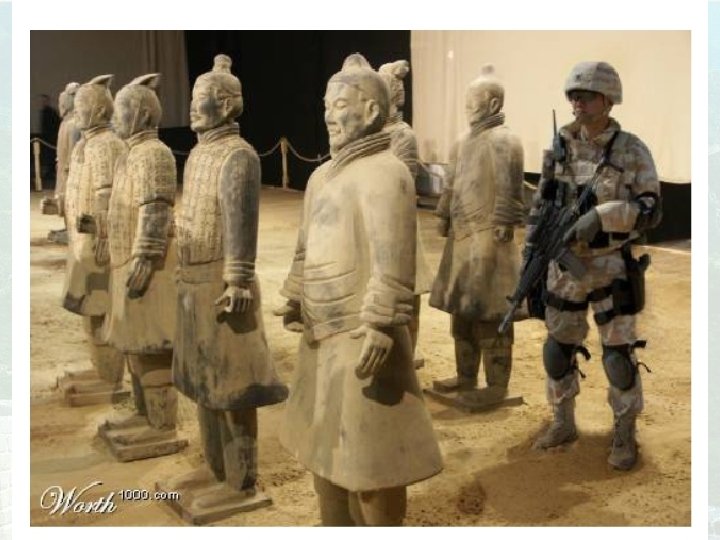
Accomplishments · · · · Unified China under one ruler. Built roads and canals to carry goods. Established a common currency to make trade easier. Connected the smaller sections of previous walls to create The Great Wall. Unified the length of axles on wagons. Created the Terra cotta Army and a massive tomb. Drained marshland added a vast amount of new farm land, size of CT. Simplified the writing system.
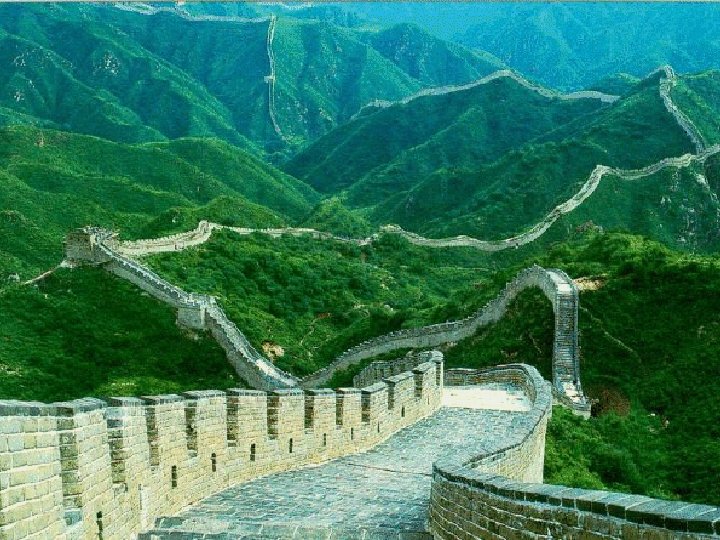
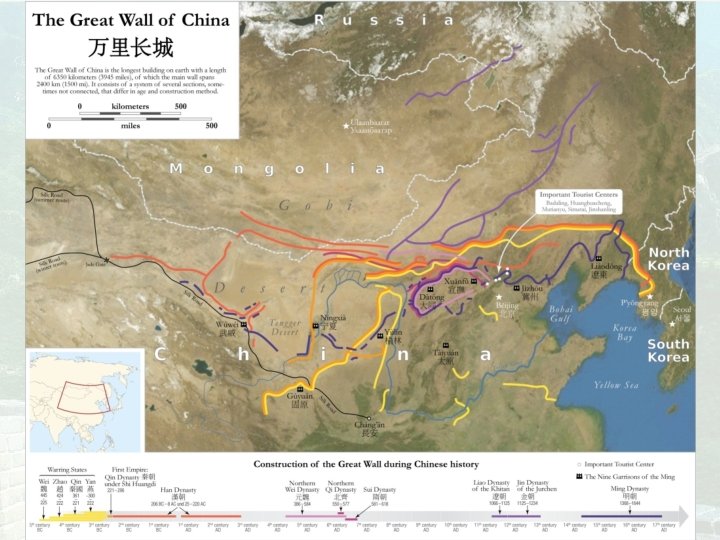
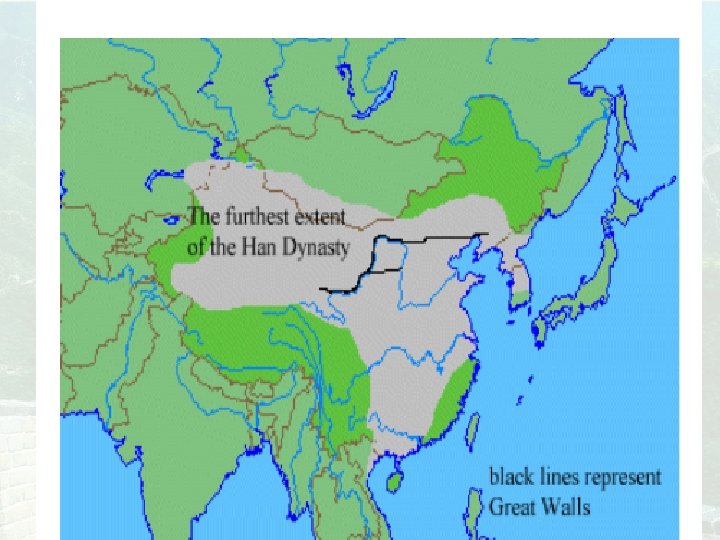
The Great Wall • The walls had already existed at various points; Shi Huangdi ordered them to be joined. • At this point, it was pounded earth; it did not have the brick sides that you see today (not until the Ming Dynasty). • An important symbol of China’s ability to mobilize at a national level; demonstrates isolation.
China – The First Emperor's Tomb http: //www. youtube. com/watch? v=g. Yd 9 Up. W MD 5 Y
Secrets of the dead – China’s Terracotta warriors • http: //video. pbs. org/video/1907176069/ • 0 – 13: 00
The End of Qin • Because Shi Huangdi was such a brutal leader his people strongly disliked him. After several assassination attempts, he became obsessed with his own death. He spent much of his time looking for a potion of everlasting life. In the end he drank a potion containing deadly mercury. His dynasty ended shortly after his death in 210 B. C.
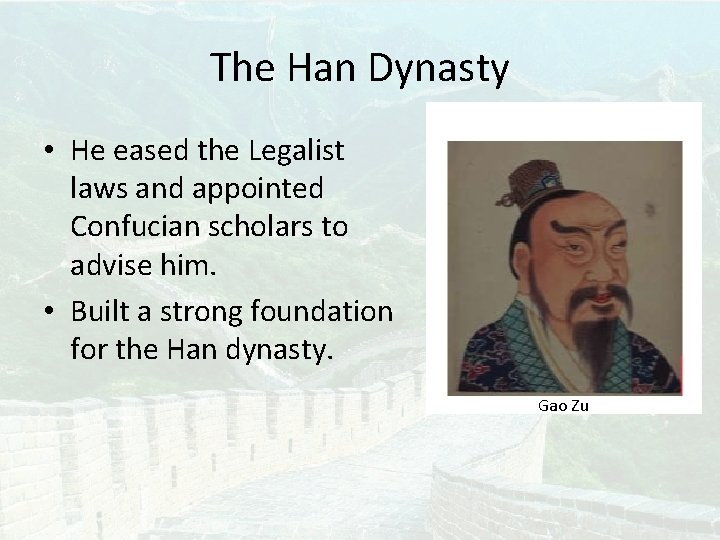
Qin Dynasty Collapses • After Shi Huangdi’s death: chaos. • There was anger over: – Taxes – Forced labor – Cruel policies • Gao Zu, an illiterate peasant lead the revolt that over threw Shi Huangdi's son. defeated rival armies and founded the Han dynasty.
The Han Dynasty • He eased the Legalist laws and appointed Confucian scholars to advise him. • Built a strong foundation for the Han dynasty. Gao Zu
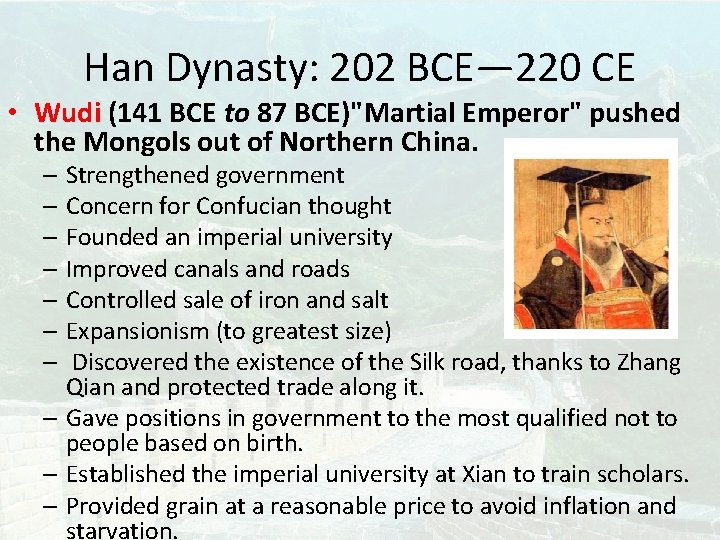
Han Dynasty: 202 BCE— 220 CE • Wudi (141 BCE to 87 BCE)"Martial Emperor" pushed the Mongols out of Northern China. – Strengthened government – Concern for Confucian thought – Founded an imperial university – Improved canals and roads – Controlled sale of iron and salt – Expansionism (to greatest size) – Discovered the existence of the Silk road, thanks to Zhang Qian and protected trade along it. – Gave positions in government to the most qualified not to people based on birth. – Established the imperial university at Xian to train scholars. – Provided grain at a reasonable price to avoid inflation and starvation.
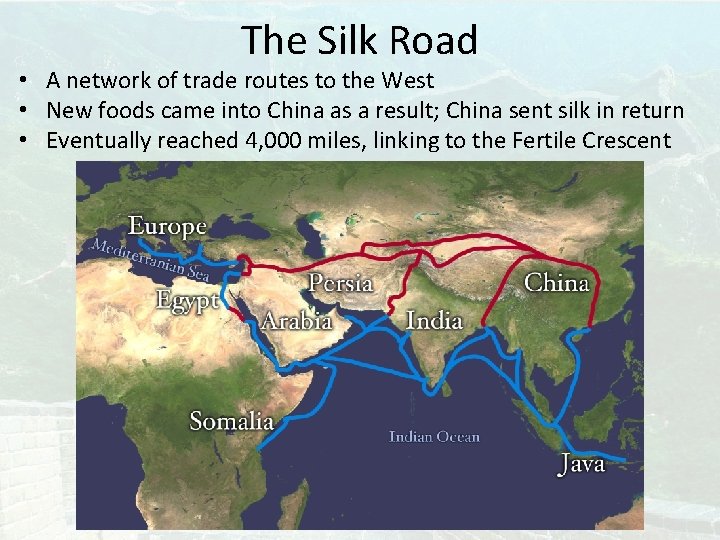
The Silk Road • A network of trade routes to the West • New foods came into China as a result; China sent silk in return • Eventually reached 4, 000 miles, linking to the Fertile Crescent
China’s Civil Service System • Civil servants—government officials—should win positions by merit (quality), not by family ties. • You would start on the bottom and move up as you showed your talents. • To move up, you might be tested on your knowledge of government policy.
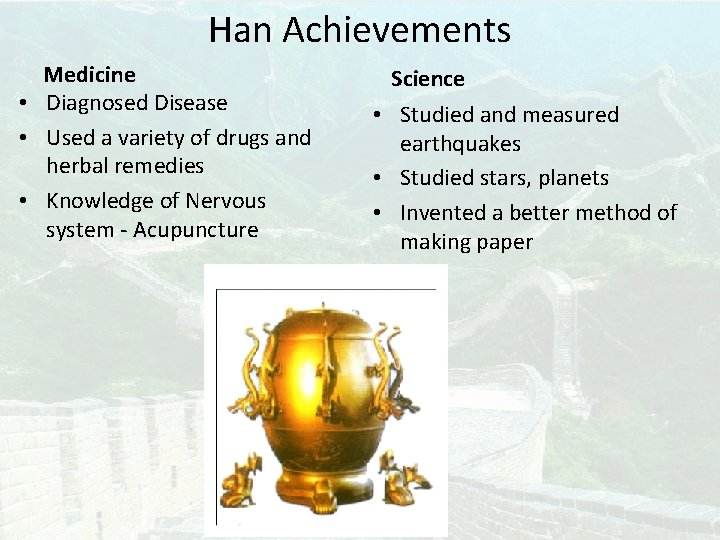
Han Dynasty: Achievements • Wang Chong argued that no scientific theories should be accepted unless they were supported by proof. – Showed that comets and eclipses were natural, not heavenly. • Acupuncture: needles to release pain. • At the time, the Han dynasty had the best technology in the world. – – Paper-making from wood pulp: still used today Invention of the boat rudder Bronze & iron stirrups for horses Suspension bridges
Han Achievements Medicine • Diagnosed Disease • Used a variety of drugs and herbal remedies • Knowledge of Nervous system - Acupuncture Science • Studied and measured earthquakes • Studied stars, planets • Invented a better method of making paper
Chinese Accept Buddhism • By 100 CE, Mahayana Buddhism (easier for ordinary people vs. Theravada) had spread from India to China. – At first, opposed China’s ideas of the family unit (Buddhist monks lived a solitary life) • Success due to its promise of an end to suffering. • Chinese Buddhists still honored filial piety (respect for elders) and Confucius.
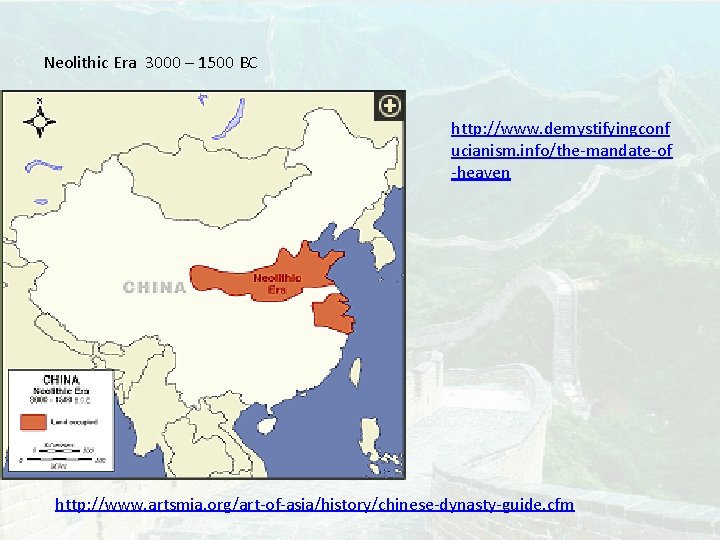
Neolithic Era 3000 – 1500 BC http: //www. demystifyingconf ucianism. info/the-mandate-of -heaven http: //www. artsmia. org/art-of-asia/history/chinese-dynasty-guide. cfm