
The Rise of Behaviorism Functionalism was eclectic in
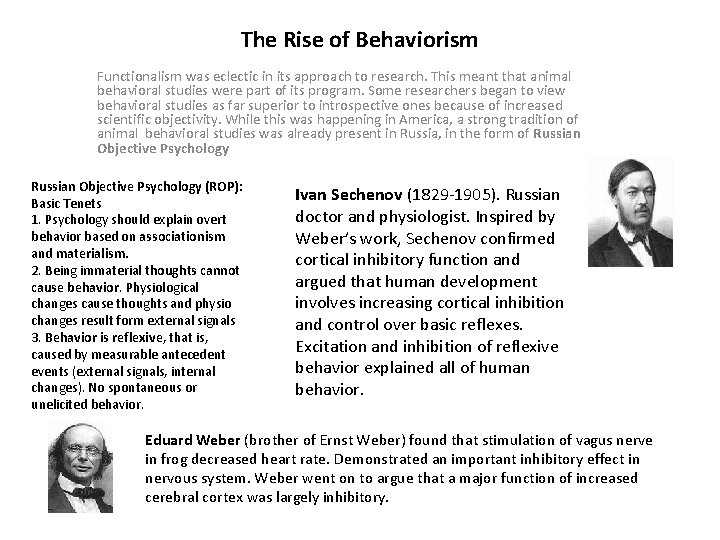
The Rise of Behaviorism Functionalism was eclectic in its approach to research. This meant that animal behavioral studies were part of its program. Some researchers began to view behavioral studies as far superior to introspective ones because of increased scientific objectivity. While this was happening in America, a strong tradition of animal behavioral studies was already present in Russia, in the form of Russian Objective Psychology (ROP): Basic Tenets 1. Psychology should explain overt behavior based on associationism and materialism. 2. Being immaterial thoughts cannot cause behavior. Physiological changes cause thoughts and physio changes result form external signals 3. Behavior is reflexive, that is, caused by measurable antecedent events (external signals, internal changes). No spontaneous or unelicited behavior. Ivan Sechenov (1829 -1905). Russian doctor and physiologist. Inspired by Weber’s work, Sechenov confirmed cortical inhibitory function and argued that human development involves increasing cortical inhibition and control over basic reflexes. Excitation and inhibition of reflexive behavior explained all of human behavior. Eduard Weber (brother of Ernst Weber) found that stimulation of vagus nerve in frog decreased heart rate. Demonstrated an important inhibitory effect in nervous system. Weber went on to argue that a major function of increased cerebral cortex was largely inhibitory.
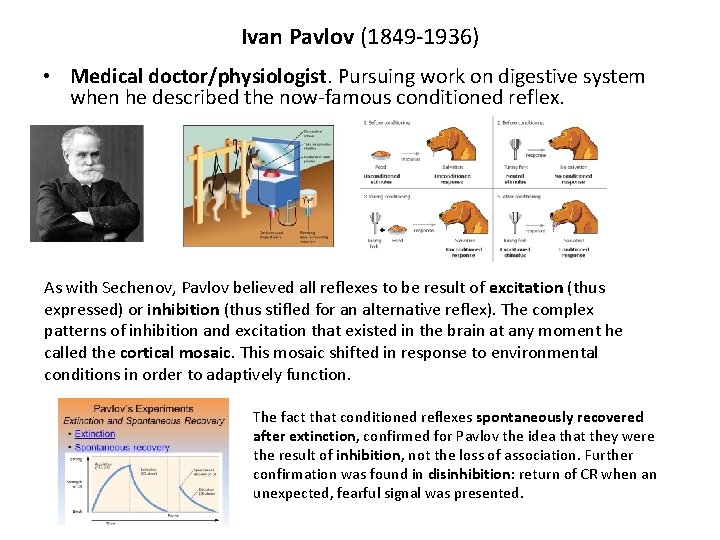
Ivan Pavlov (1849 -1936) • Medical doctor/physiologist. Pursuing work on digestive system when he described the now-famous conditioned reflex. As with Sechenov, Pavlov believed all reflexes to be result of excitation (thus expressed) or inhibition (thus stifled for an alternative reflex). The complex patterns of inhibition and excitation that existed in the brain at any moment he called the cortical mosaic. This mosaic shifted in response to environmental conditions in order to adaptively function. The fact that conditioned reflexes spontaneously recovered after extinction, confirmed for Pavlov the idea that they were the result of inhibition, not the loss of association. Further confirmation was found in disinhibition: return of CR when an unexpected, fearful signal was presented.
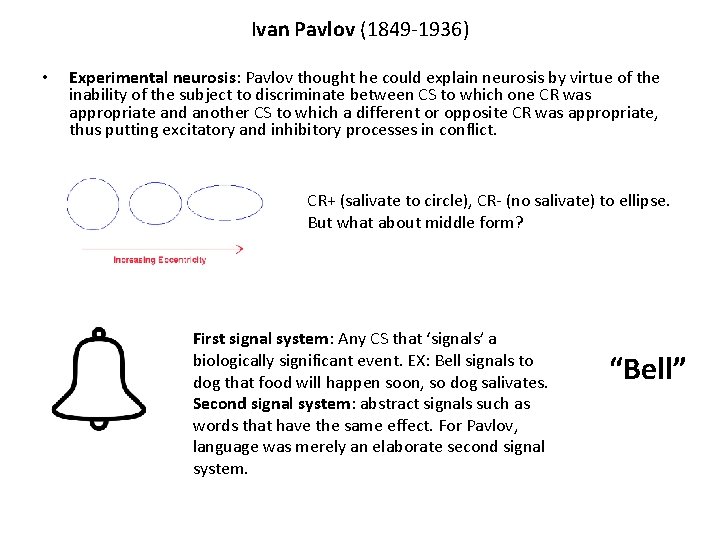
Ivan Pavlov (1849 -1936) • Experimental neurosis: Pavlov thought he could explain neurosis by virtue of the inability of the subject to discriminate between CS to which one CR was appropriate and another CS to which a different or opposite CR was appropriate, thus putting excitatory and inhibitory processes in conflict. CR+ (salivate to circle), CR- (no salivate) to ellipse. But what about middle form? First signal system: Any CS that ‘signals’ a biologically significant event. EX: Bell signals to dog that food will happen soon, so dog salivates. Second signal system: abstract signals such as words that have the same effect. For Pavlov, language was merely an elaborate second signal system. “Bell”
Vladimir Bechterev (1857 -1927) In his book General Principles of Human Reflexology (1917), he outlined a course of study very similar to what would become radical behaviorism in the US, even though it was Pavlov who was far more wellknown • Medical doctor/physiologist. Critical of Pavlov for using glandular responses. Argued that motor reflexes was the more appropriate focus of study. Why? • Glandular studies require operations that could not be done on humans (generalizability problem) • Glandular studies have satiation problem (dog not hungry) • Glandular studies less reliable, harder to measure. • Glandular responses not as adaptive as motor responses.
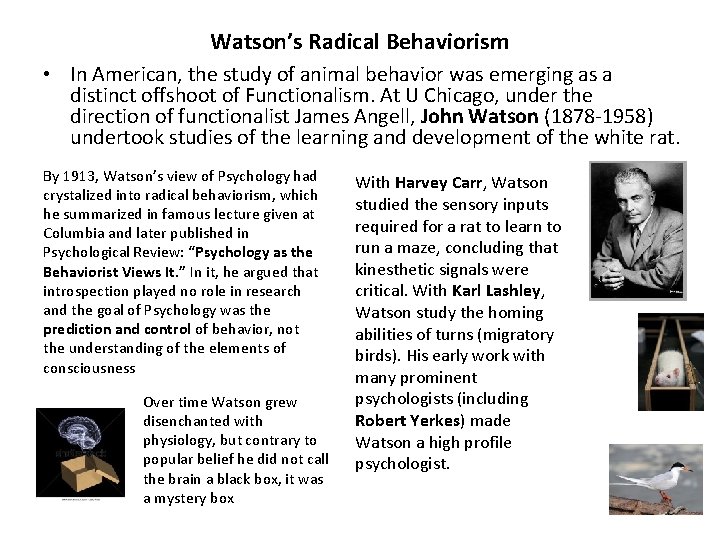
Watson’s Radical Behaviorism • In American, the study of animal behavior was emerging as a distinct offshoot of Functionalism. At U Chicago, under the direction of functionalist James Angell, John Watson (1878 -1958) undertook studies of the learning and development of the white rat. By 1913, Watson’s view of Psychology had crystalized into radical behaviorism, which he summarized in famous lecture given at Columbia and later published in Psychological Review: “Psychology as the Behaviorist Views It. ” In it, he argued that introspection played no role in research and the goal of Psychology was the prediction and control of behavior, not the understanding of the elements of consciousness Over time Watson grew disenchanted with physiology, but contrary to popular belief he did not call the brain a black box, it was a mystery box With Harvey Carr, Watson studied the sensory inputs required for a rat to learn to run a maze, concluding that kinesthetic signals were critical. With Karl Lashley, Watson study the homing abilities of turns (migratory birds). His early work with many prominent psychologists (including Robert Yerkes) made Watson a high profile psychologist.
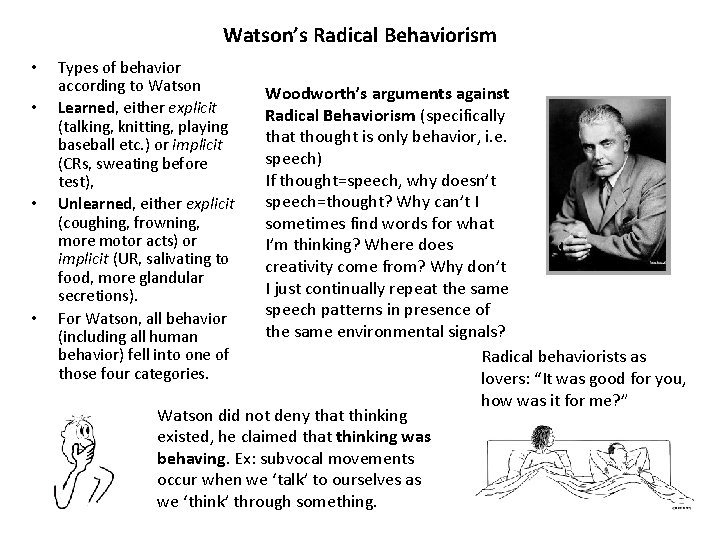
Watson’s Radical Behaviorism • • Types of behavior according to Watson Learned, either explicit (talking, knitting, playing baseball etc. ) or implicit (CRs, sweating before test), Unlearned, either explicit (coughing, frowning, more motor acts) or implicit (UR, salivating to food, more glandular secretions). For Watson, all behavior (including all human behavior) fell into one of those four categories. Woodworth’s arguments against Radical Behaviorism (specifically that thought is only behavior, i. e. speech) If thought=speech, why doesn’t speech=thought? Why can’t I sometimes find words for what I’m thinking? Where does creativity come from? Why don’t I just continually repeat the same speech patterns in presence of the same environmental signals? Radical behaviorists as lovers: “It was good for you, how was it for me? ” Watson did not deny that thinking existed, he claimed that thinking was behaving. Ex: subvocal movements occur when we ‘talk’ to ourselves as we ‘think’ through something.
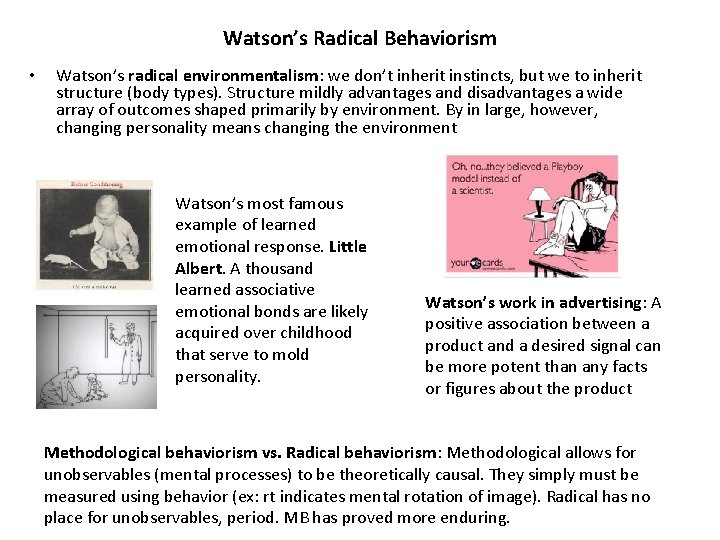
Watson’s Radical Behaviorism • Watson’s radical environmentalism: we don’t inherit instincts, but we to inherit structure (body types). Structure mildly advantages and disadvantages a wide array of outcomes shaped primarily by environment. By in large, however, changing personality means changing the environment Watson’s most famous example of learned emotional response. Little Albert. A thousand learned associative emotional bonds are likely acquired over childhood that serve to mold personality. Watson’s work in advertising: A positive association between a product and a desired signal can be more potent than any facts or figures about the product Methodological behaviorism vs. Radical behaviorism: Methodological allows for unobservables (mental processes) to be theoretically causal. They simply must be measured using behavior (ex: rt indicates mental rotation of image). Radical has no place for unobservables, period. MB has proved more enduring.
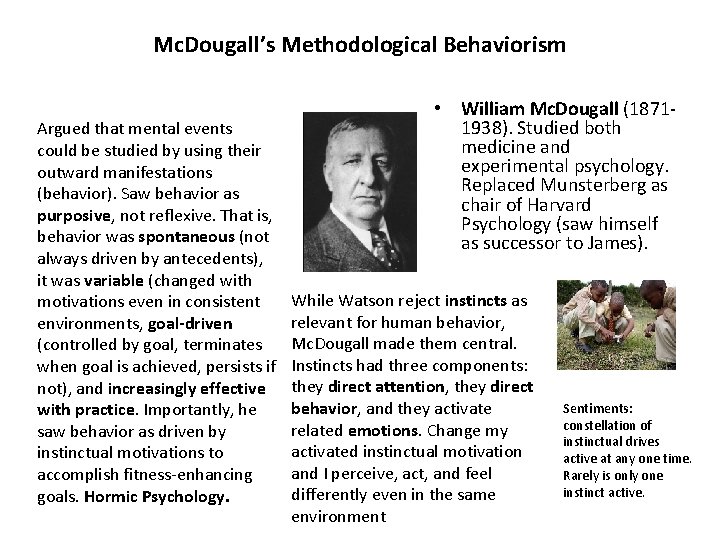
Mc. Dougall’s Methodological Behaviorism Argued that mental events could be studied by using their outward manifestations (behavior). Saw behavior as purposive, not reflexive. That is, behavior was spontaneous (not always driven by antecedents), it was variable (changed with motivations even in consistent environments, goal-driven (controlled by goal, terminates when goal is achieved, persists if not), and increasingly effective with practice. Importantly, he saw behavior as driven by instinctual motivations to accomplish fitness-enhancing goals. Hormic Psychology. • William Mc. Dougall (18711938). Studied both medicine and experimental psychology. Replaced Munsterberg as chair of Harvard Psychology (saw himself as successor to James). While Watson reject instincts as relevant for human behavior, Mc. Dougall made them central. Instincts had three components: they direct attention, they direct behavior, and they activate related emotions. Change my activated instinctual motivation and I perceive, act, and feel differently even in the same environment Sentiments: constellation of instinctual drives active at any one time. Rarely is only one instinct active.
- Slides: 8