
The Rise and Fall of the Gang of




- Slides: 10
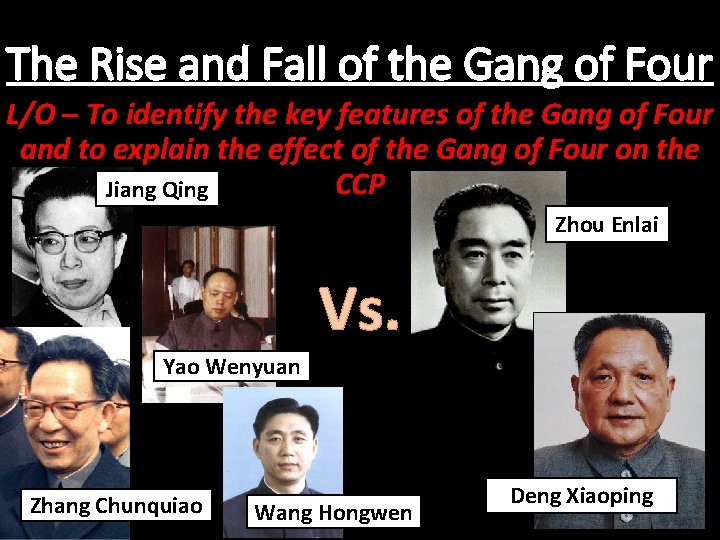
The Rise and Fall of the Gang of Four L/O – To identify the key features of the Gang of Four and to explain the effect of the Gang of Four on the CCP Jiang Qing Zhou Enlai Vs. Yao Wenyuan Zhang Chunquiao Wang Hongwen Deng Xiaoping
Power Groupings after the Cultural Revolution In the aftermath of the Cultural Revolution, there were three main power groupings within the Chinese political system: Lin Biao and the PLA Zhou Enlai and the bureaucracy Jiang Qing and the Shanghai Radicals
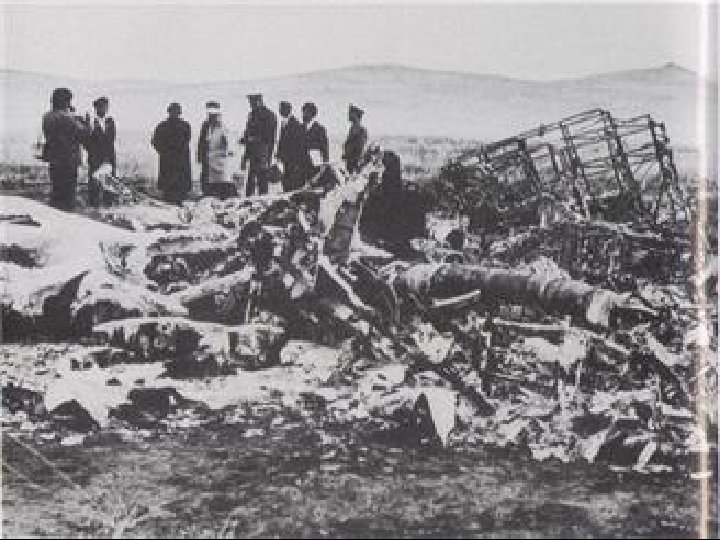
Mao 1969 -1976 • Mao announced the Cultural Revolution was over in 1969. He was now in a strong position. Most of the moderates had been expelled from the party and the government and Mao’s supporters controlled the top positions. • In 1969, Lin Biao was named as second-incommand. However, Lin Biao began to doubt Mao whilst Mao feared that Lin might try to oust him as leader. • In 1971, Lin drew up a plan to overthrow Mao which was code-named ‘Project 571’. The plot was discovered and Lin tried to escape but his plan ‘crashed’ in the Mongolian desert.
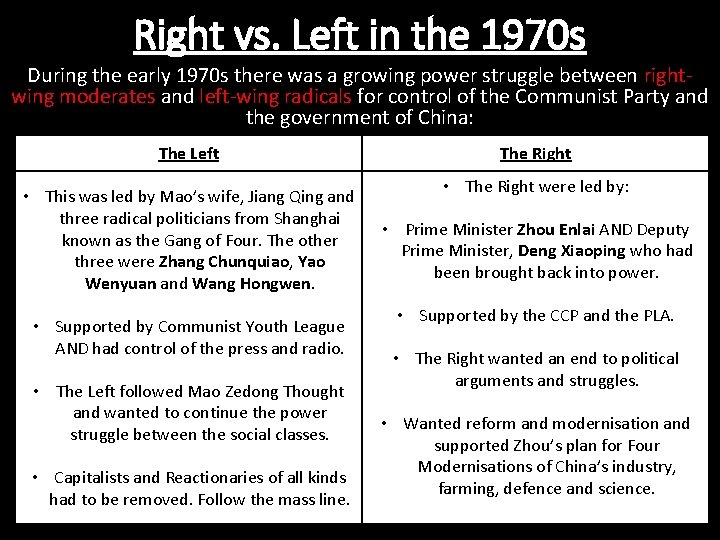
Right vs. Left in the 1970 s During the early 1970 s there was a growing power struggle between rightwing moderates and left-wing radicals for control of the Communist Party and the government of China: The Left • This was led by Mao’s wife, Jiang Qing and three radical politicians from Shanghai known as the Gang of Four. The other three were Zhang Chunquiao, Yao Wenyuan and Wang Hongwen. • Supported by Communist Youth League AND had control of the press and radio. • The Left followed Mao Zedong Thought and wanted to continue the power struggle between the social classes. • Capitalists and Reactionaries of all kinds had to be removed. Follow the mass line. The Right • The Right were led by: • Prime Minister Zhou Enlai AND Deputy Prime Minister, Deng Xiaoping who had been brought back into power. • Supported by the CCP and the PLA. • The Right wanted an end to political arguments and struggles. • Wanted reform and modernisation and supported Zhou’s plan for Four Modernisations of China’s industry, farming, defence and science.
The Gang of Four Yao Wenyuan Jiang Qing Wang Hongwen Zhang Chunquiao
Rise of Gang of Four • The Right suffered a real setback in 1976 when Zhou died and was succeeded by Deng Xiaoping. • Zhou Enlai had been a popular leader – thousands went to his funeral to lay wreaths and put up posters criticising Jiang Qing and Mao. • On 5 th April 1976 visitors to the square found that the wreaths had been removed. 10, 000 people rioted to show their support for Zhou and Deng, followed by 200 + arrests.
Rise of Gang of Four • Jiang Qing and the Left blamed the riots on Deng and removed him from the Party and Government. • He was replaced by Hua Guofeng – an unknown politican – he was even nicknamed ‘the helicopter’ due to his rapid rise to power. He became Mao’s choice of successor. • The Gang of Four now seemed in control of the CCP and the government. When Mao died in September 1976, the Gang of Four prepared to take full power.
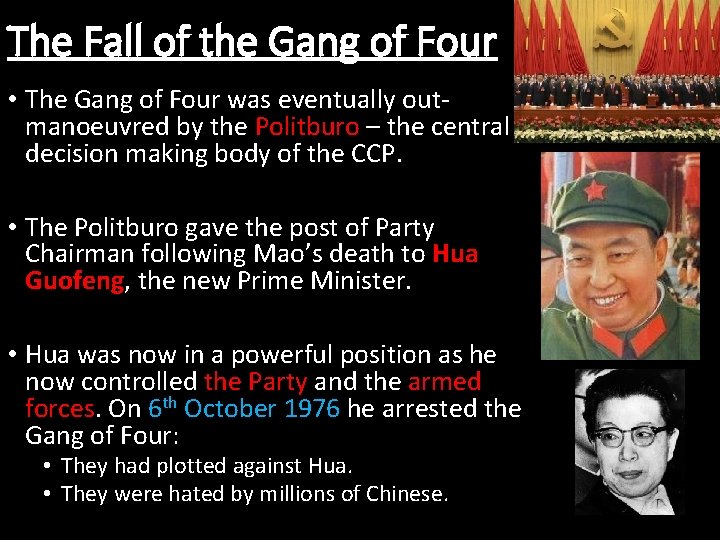
The Fall of the Gang of Four • The Gang of Four was eventually outmanoeuvred by the Politburo – the central decision making body of the CCP. • The Politburo gave the post of Party Chairman following Mao’s death to Hua Guofeng, the new Prime Minister. • Hua was now in a powerful position as he now controlled the Party and the armed forces. On 6 th October 1976 he arrested the Gang of Four: • They had plotted against Hua. • They were hated by millions of Chinese.
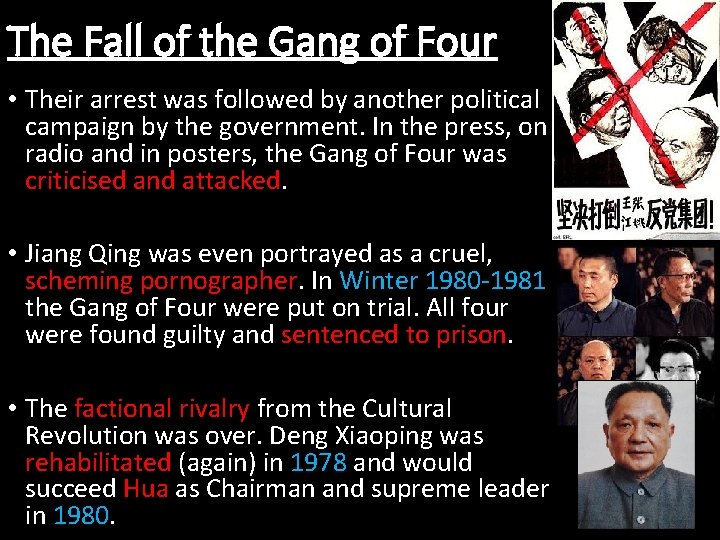
The Fall of the Gang of Four • Their arrest was followed by another political campaign by the government. In the press, on radio and in posters, the Gang of Four was criticised and attacked. • Jiang Qing was even portrayed as a cruel, scheming pornographer. In Winter 1980 -1981 the Gang of Four were put on trial. All four were found guilty and sentenced to prison. • The factional rivalry from the Cultural Revolution was over. Deng Xiaoping was rehabilitated (again) in 1978 and would succeed Hua as Chairman and supreme leader in 1980.