
The Rise and Fall of Napoleon Bonaparte Vive
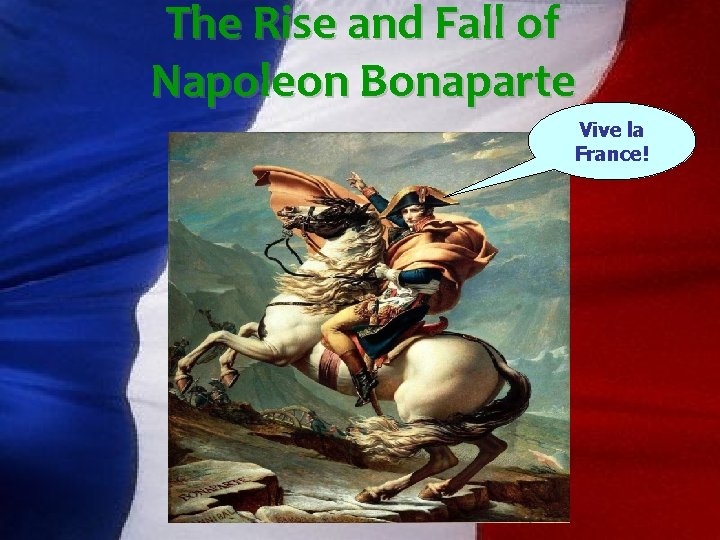
The Rise and Fall of Napoleon Bonaparte Vive la France!
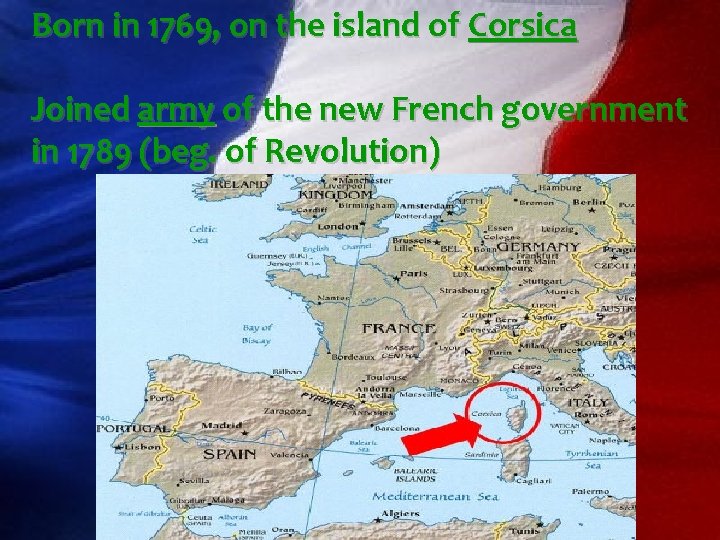
Born in 1769, on the island of Corsica Joined army of the new French government in 1789 (beg. of Revolution)
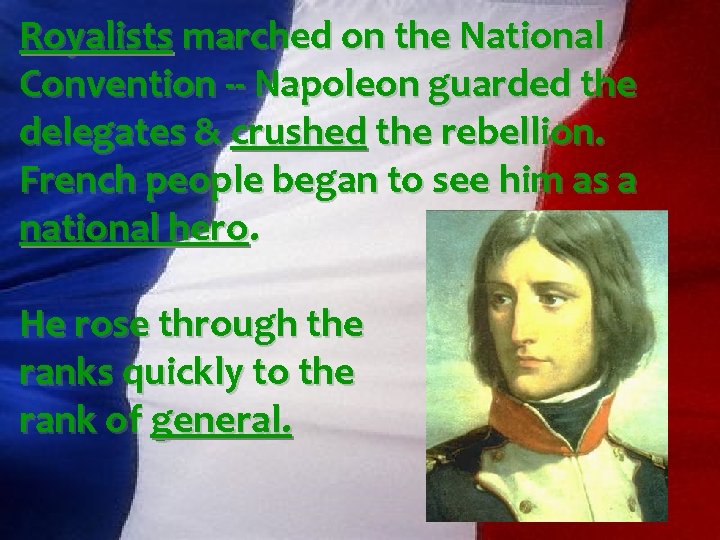
Royalists marched on the National Convention -- Napoleon guarded the delegates & crushed the rebellion. French people began to see him as a national hero. He rose through the ranks quickly to the rank of general.
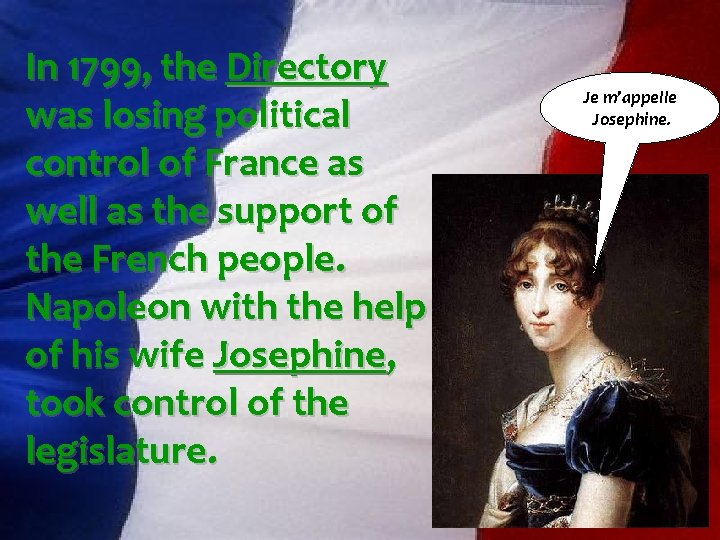
In 1799, the Directory was losing political control of France as well as the support of the French people. Napoleon with the help of his wife Josephine, took control of the legislature. Je m’appelle Josephine.
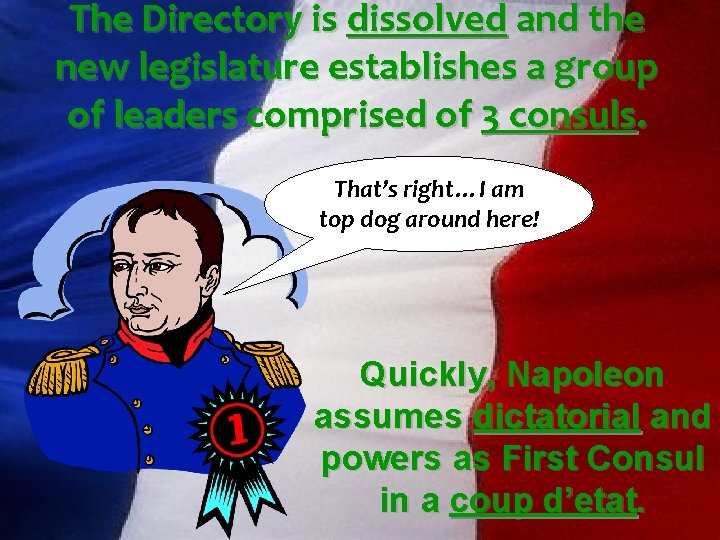
The Directory is dissolved and the new legislature establishes a group of leaders comprised of 3 consuls. That’s right…I am top dog around here! Quickly, Napoleon assumes dictatorial and powers as First Consul in a coup d’etat.
NAPOLEON RULES FRANCE He kept many of the changes from the Revolution and supported laws that would both strengthen the central govt. and achieve some goals of the Revolution: 1 st goal: Build a solid economy: - efficient tax system & establish a national bank
2 nd goal: Reduce Government Corruption: - dismissed corrupt officials, appointed now by merit - set up lycees (govt. run public schools) - created code of laws (Napoleonic Code) which actually took away some liberties gained from the Revolution like freedom of speech and press

3 rd goal: Religion Reform: *Results: religious tolerance, govt. control of Church lands, govt. recognition of Church's influence
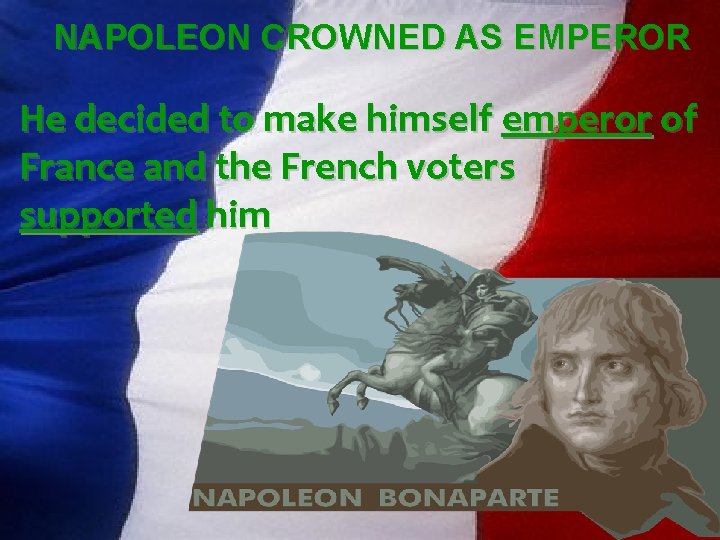
NAPOLEON CROWNED AS EMPEROR He decided to make himself emperor of France and the French voters supported him
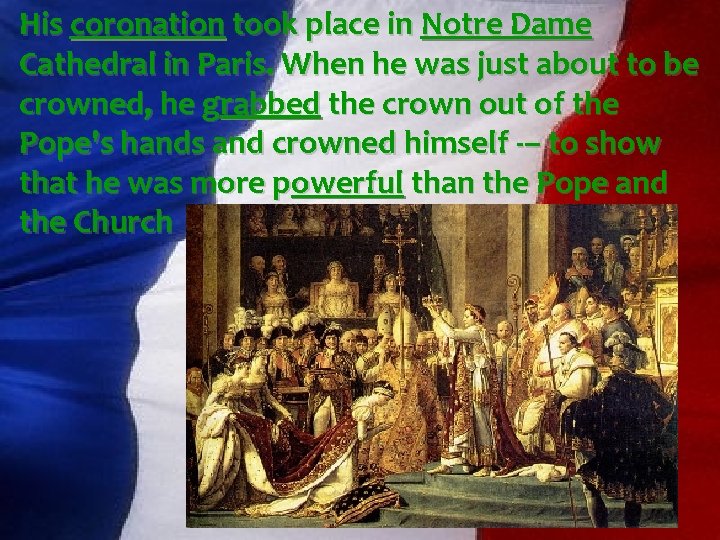
His coronation took place in Notre Dame Cathedral in Paris. When he was just about to be crowned, he grabbed the crown out of the Pope's hands and crowned himself -– to show that he was more powerful than the Pope and the Church
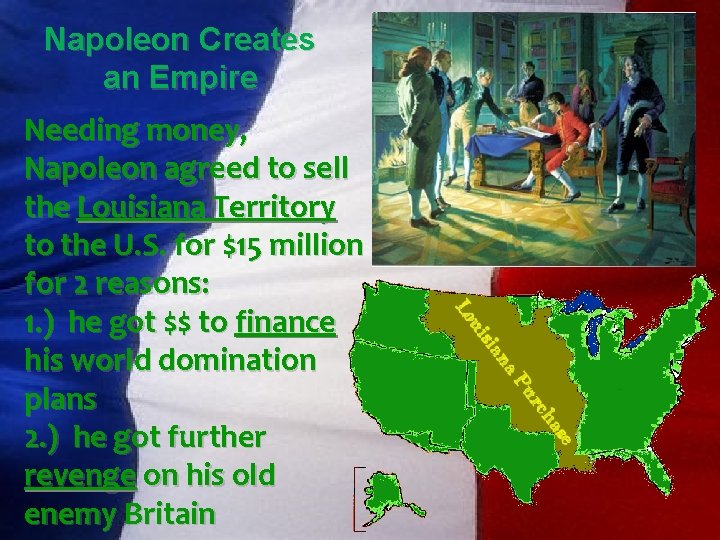
Napoleon Creates an Empire Needing money, Napoleon agreed to sell the Louisiana Territory to the U. S. for $15 million for 2 reasons: 1. ) he got $$ to finance his world domination plans 2. ) he got further revenge on his old enemy Britain
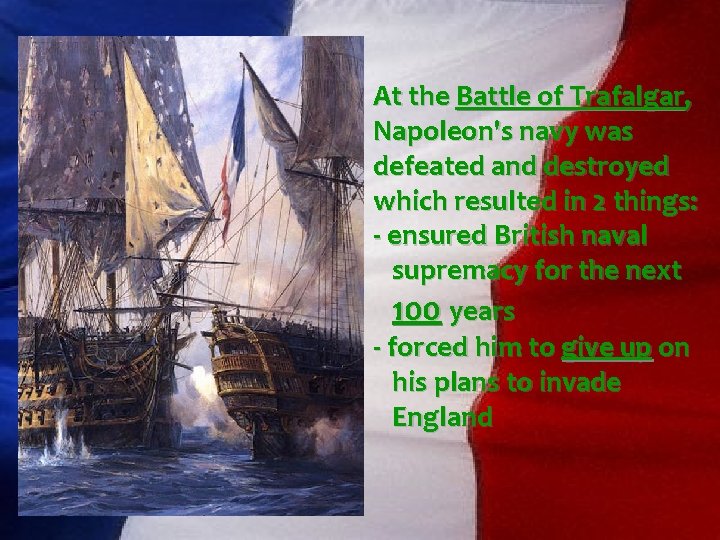
At the Battle of Trafalgar, Napoleon's navy was defeated and destroyed which resulted in 2 things: - ensured British naval supremacy for the next 100 years - forced him to give up on his plans to invade England
NAPOLEON'S EMPIRE COLLAPSES He made three costly mistakes: #1. ) the Continental System - Napoleon ordered a blockade to prevent all trade and communication b/w Great Britain and the rest of Europe; intended to destroy Britain's commercial and industrial economy - - Britain responded with its own blockade where they searched and then taxed ships going to the mainland Europe. Britain's more powerful navy made their blockade more successful Result? ? ? . . .
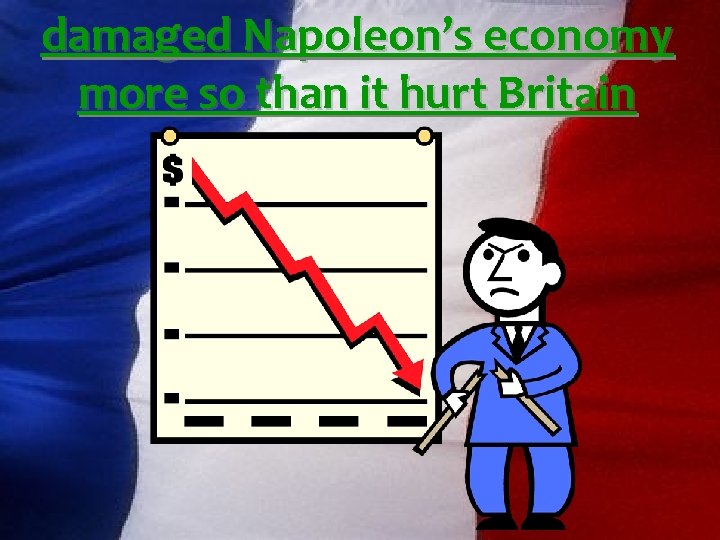
damaged Napoleon’s economy more so than it hurt Britain
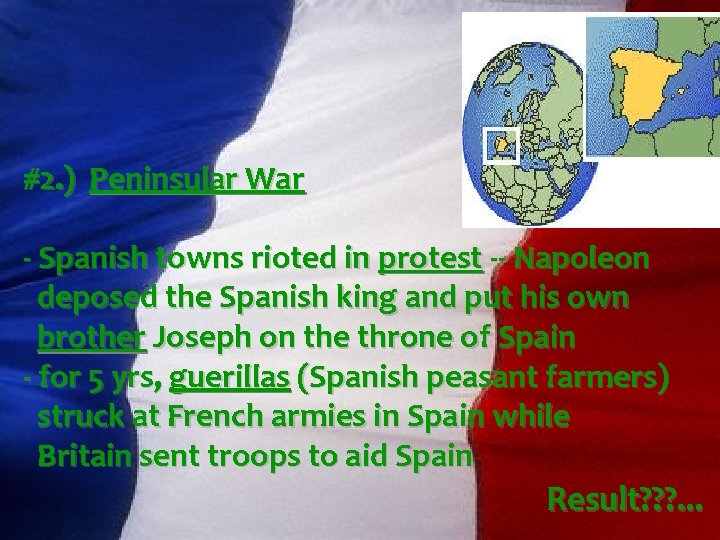
#2. ) Peninsular War - Spanish towns rioted in protest -- Napoleon deposed the Spanish king and put his own brother Joseph on the throne of Spain - for 5 yrs, guerillas (Spanish peasant farmers) struck at French armies in Spain while Britain sent troops to aid Spain Result? ? ? . . .
Napoleon lost 300, 000 men and nationalism was becoming a powerful weapon against him
#3. ) Invasion of Russia - Napoleon decides to invade Russia - Czar Alexander practiced a scorched-earth policy - Battle of Borodino: where the 2 sides finally meet; after several hours of indecisive fighting, the Russian army retreated and gave Napoleon a narrow victory.
By this time, winter has arrived and Napoleon orders his starving army to retreat; the Russians then attack Napoleon's cold, tired, hungry, and retreating army back to the Russian border… Brrrrr ---I’m outta here….
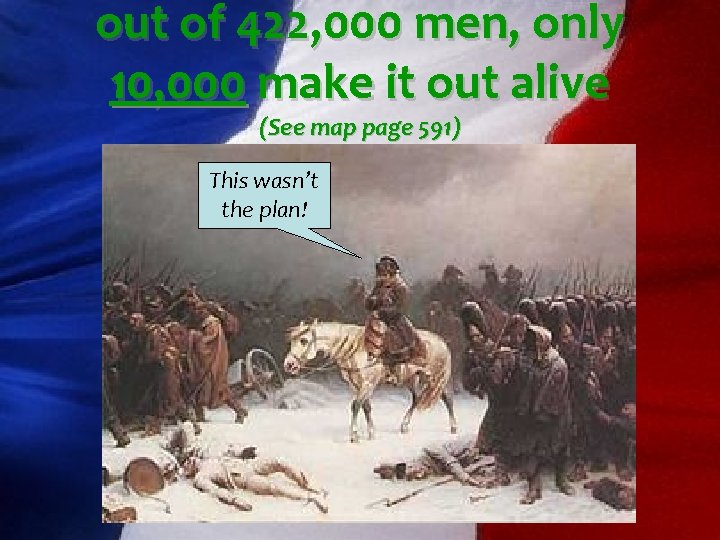
out of 422, 000 men, only 10, 000 make it out alive (See map page 591) This wasn’t the plan!
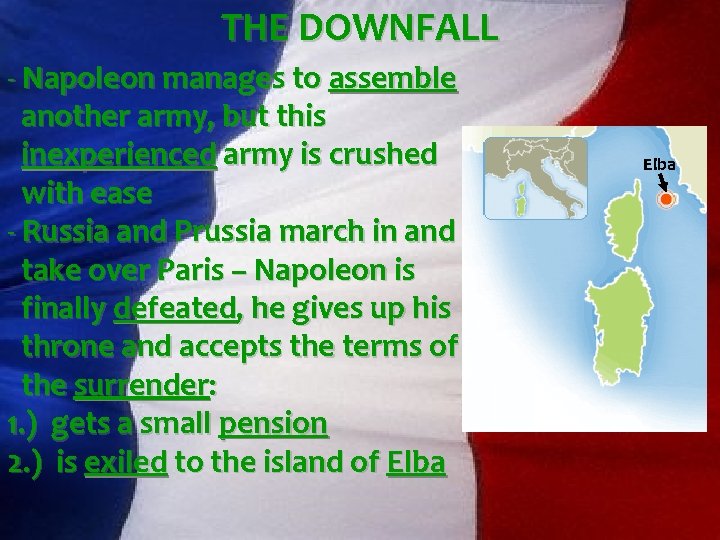
THE DOWNFALL - Napoleon manages to assemble another army, but this inexperienced army is crushed with ease - Russia and Prussia march in and take over Paris – Napoleon is finally defeated, he gives up his throne and accepts the terms of the surrender: 1. ) gets a small pension 2. ) is exiled to the island of Elba
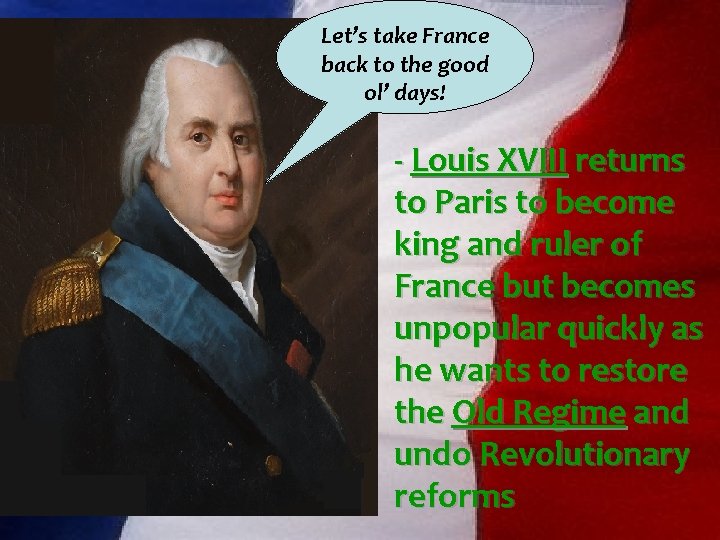
Let’s take France back to the good ol’ days! - Louis XVIII returns to Paris to become king and ruler of France but becomes unpopular quickly as he wants to restore the Old Regime and undo Revolutionary reforms
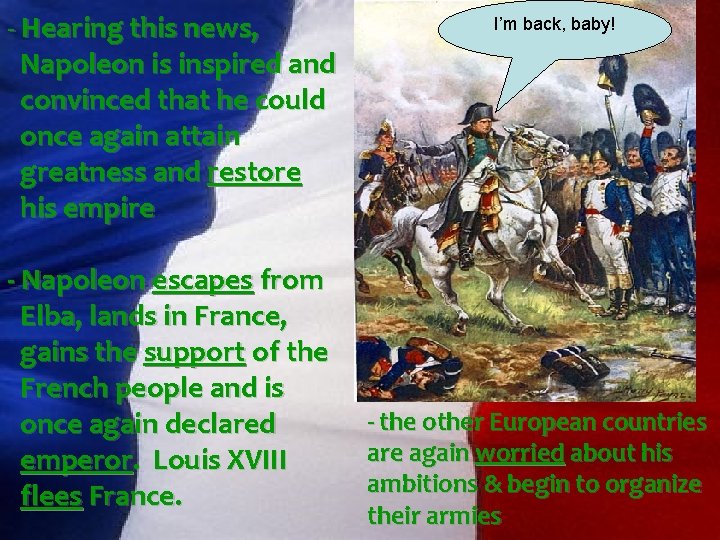
- Hearing this news, Napoleon is inspired and convinced that he could once again attain greatness and restore his empire - Napoleon escapes from Elba, lands in France, gains the support of the French people and is once again declared emperor. Louis XVIII flees France. I’m back, baby! - the other European countries are again worried about his ambitions & begin to organize their armies
-Napoleon meets the British army in Belgium at the Battle of Waterloo. The Prussians soon arrive with backup troops to aid the British and in 2 days, Napoleon was once again defeated. This brief 2 nd reign of Napoleon as emperor and his last attempt at power is known as the Hundred Days.
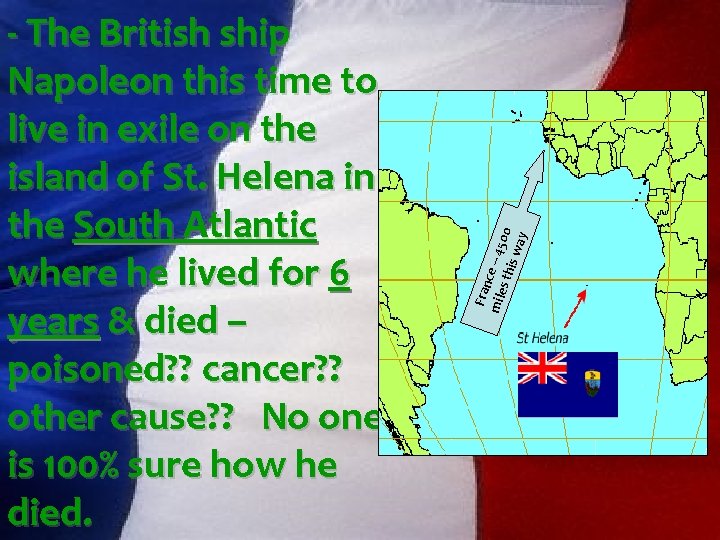
Fran mile ce – 45 0 s th is w 0 ay - The British ship Napoleon this time to live in exile on the island of St. Helena in the South Atlantic where he lived for 6 years & died – poisoned? ? cancer? ? other cause? ? No one is 100% sure how he died.
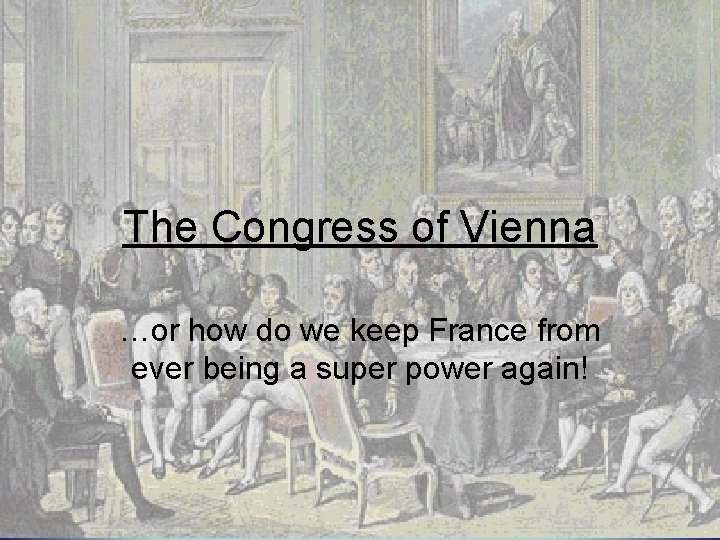
The Congress of Vienna …or how do we keep France from ever being a super power again!
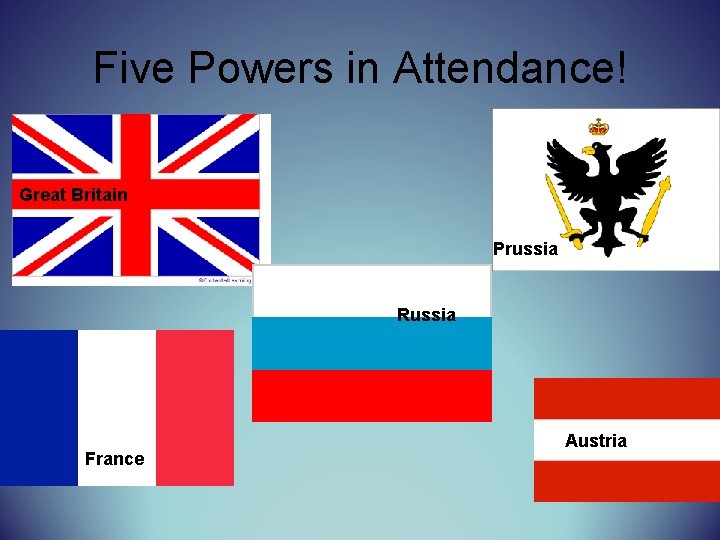
Five Powers in Attendance! Great Britain Prussia Russia France Austria
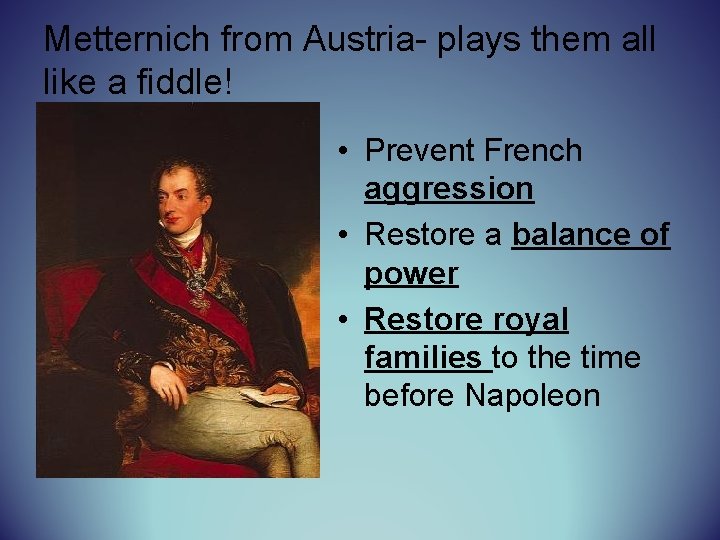
Metternich from Austria- plays them all like a fiddle! • Prevent French aggression • Restore a balance of power • Restore royal families to the time before Napoleon
Lasting Legacy • Peace between countries for almost 50 years • Great Britain and Prussia increase power • Nationalism leads to revolution • Democracy = a growing trend
Latin American Revolutions 1800 -1825
• Why did European colonies in Latin America rebel? In a word… – Napoleon • Countries like Spain and Portugal needed all military personnel in Europe to fight Napoleon. • Latin America was left “unguarded”. • After Napoleon was defeated, Latin Americans refused to turn over control to the Europeans. Result • Wars of independence in Latin America.
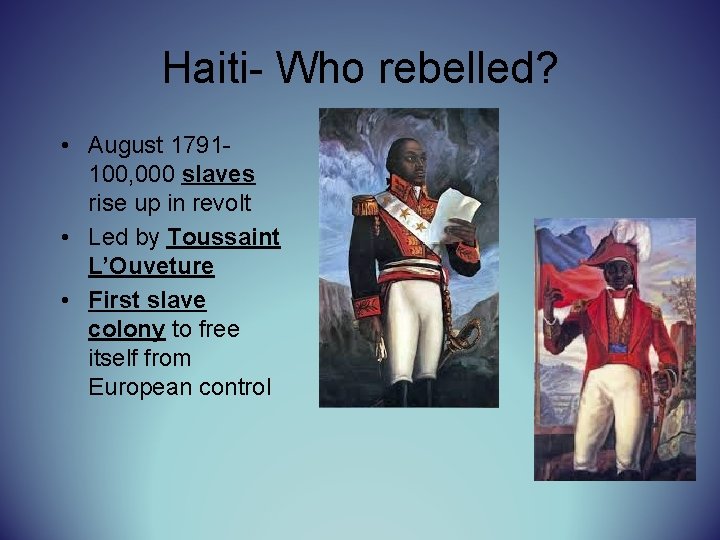
Haiti- Who rebelled? • August 1791100, 000 slaves rise up in revolt • Led by Toussaint L’Ouveture • First slave colony to free itself from European control
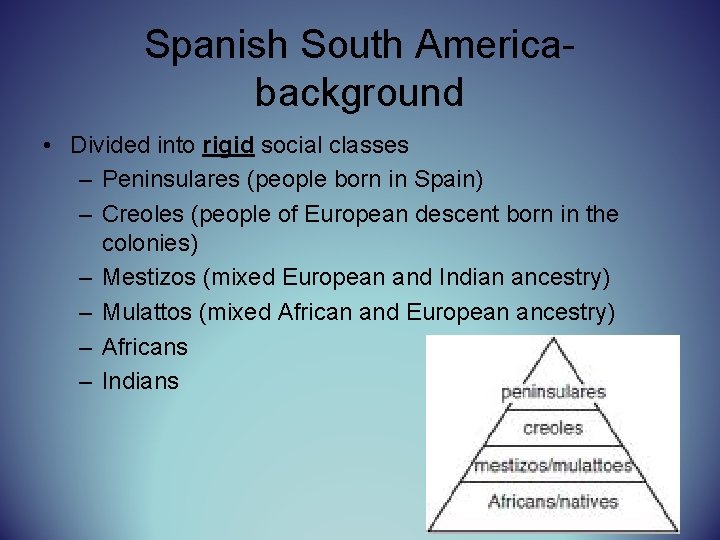
Spanish South Americabackground • Divided into rigid social classes – Peninsulares (people born in Spain) – Creoles (people of European descent born in the colonies) – Mestizos (mixed European and Indian ancestry) – Mulattos (mixed African and European ancestry) – Africans – Indians
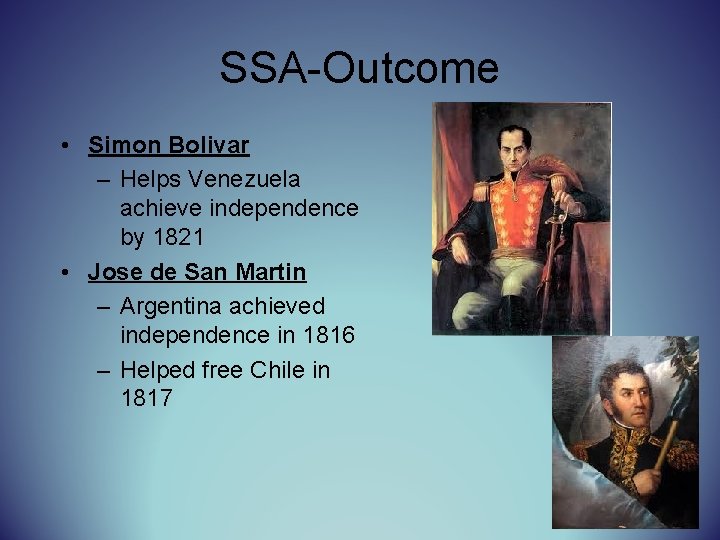
SSA-Outcome • Simon Bolivar – Helps Venezuela achieve independence by 1821 • Jose de San Martin – Argentina achieved independence in 1816 – Helped free Chile in 1817
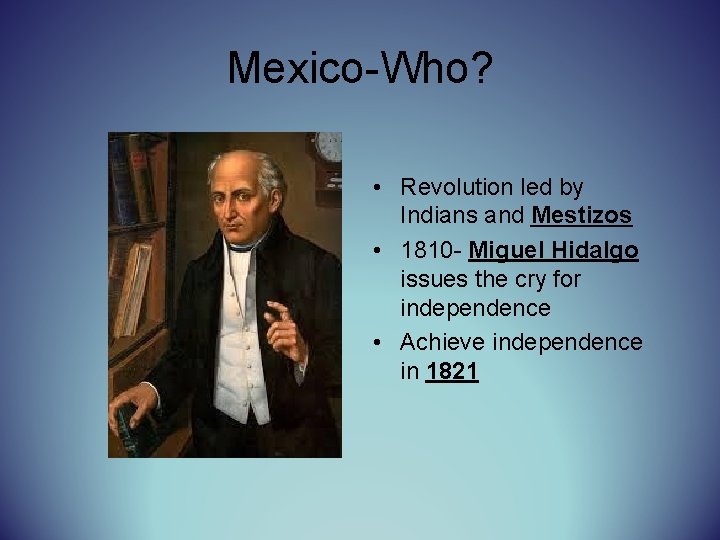
Mexico-Who? • Revolution led by Indians and Mestizos • 1810 - Miguel Hidalgo issues the cry for independence • Achieve independence in 1821
- Slides: 34