
THE RIGHT OF CHILDREN TO FREE COMPULSORY EDUCATION

- Slides: 76
THE RIGHT OF CHILDREN TO FREE COMPULSORY EDUCATION ACT, 2009 AND Introduction and Functions Dr. Sukhwinder Singh Cheema Assistant Professor Malwa Central College of Education For Women Ludhiana 9815676193
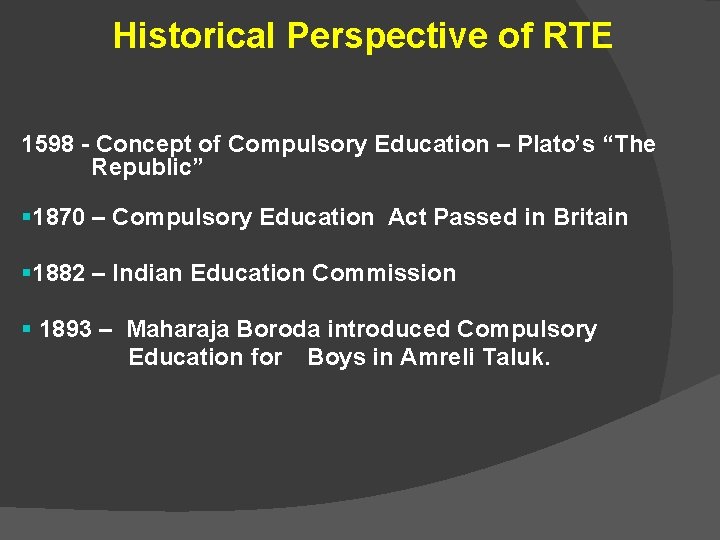
Historical Perspective of RTE 1598 - Concept of Compulsory Education – Plato’s “The Republic” § 1870 – Compulsory Education Act Passed in Britain § 1882 – Indian Education Commission § 1893 – Maharaja Boroda introduced Compulsory Education for Boys in Amreli Taluk.
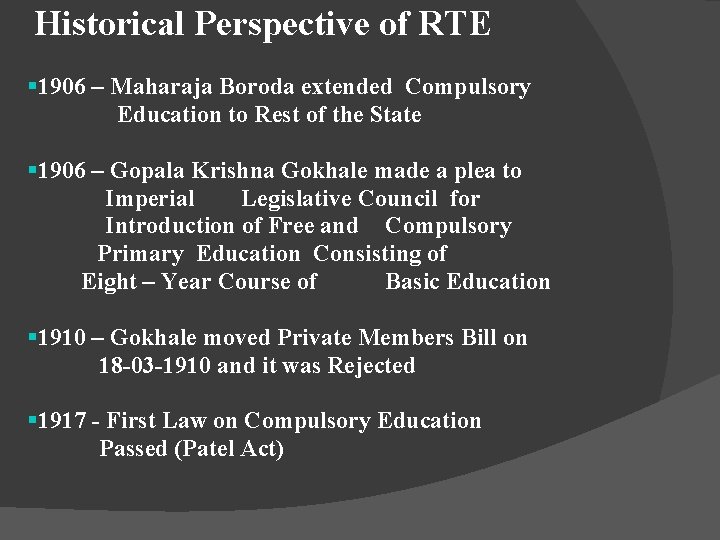
Historical Perspective of RTE § 1906 – Maharaja Boroda extended Compulsory Education to Rest of the State § 1906 – Gopala Krishna Gokhale made a plea to Imperial Legislative Council for Introduction of Free and Compulsory Primary Education Consisting of Eight – Year Course of Basic Education § 1910 – Gokhale moved Private Members Bill on 18 -03 -1910 and it was Rejected § 1917 - First Law on Compulsory Education Passed (Patel Act)
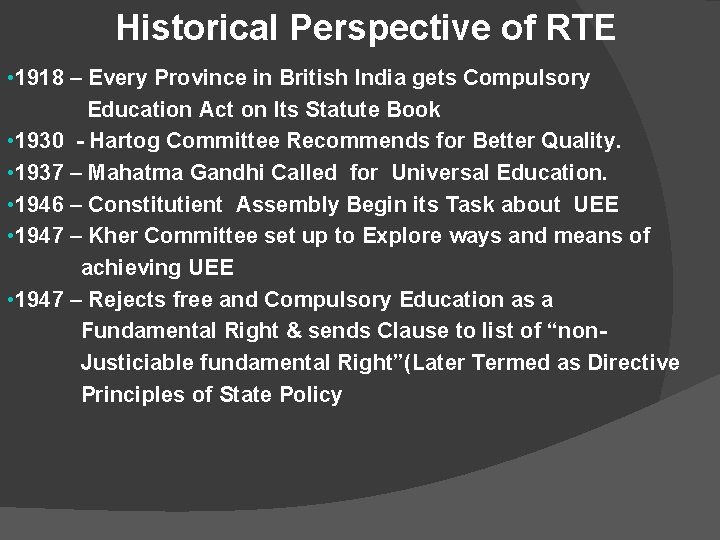
Historical Perspective of RTE • 1918 – Every Province in British India gets Compulsory Education Act on Its Statute Book • 1930 - Hartog Committee Recommends for Better Quality. • 1937 – Mahatma Gandhi Called for Universal Education. • 1946 – Constitutient Assembly Begin its Task about UEE • 1947 – Kher Committee set up to Explore ways and means of achieving UEE • 1947 – Rejects free and Compulsory Education as a Fundamental Right & sends Clause to list of “non. Justiciable fundamental Right”(Later Termed as Directive Principles of State Policy
1950 Article 45 of Directive Principles of State Policy: “The State shall endeavour to provide, within a period of ten years from the commencement of this Constitution, for free and compulsory education for all children until they complete the age of fourteen years”
Historical Perspective of RTE • 1993 – Supreme Court Held Free Education • Until the Child Completes the age of 14 to be a Fundamental Right (Article 21)
The 86 th Amendment Act, 2002 � made three specific provisions in the Constitution to facilitate the realization of free and compulsory education. These were (i) adding Article 21 A in Part III (fundamental rights), (ii) modifying Article 45, and (iii) adding a new clause (k) under Article 51 A (fundamental duties), making the parent or guardian responsible for providing opportunities for education to their children between 6 and 14 years.
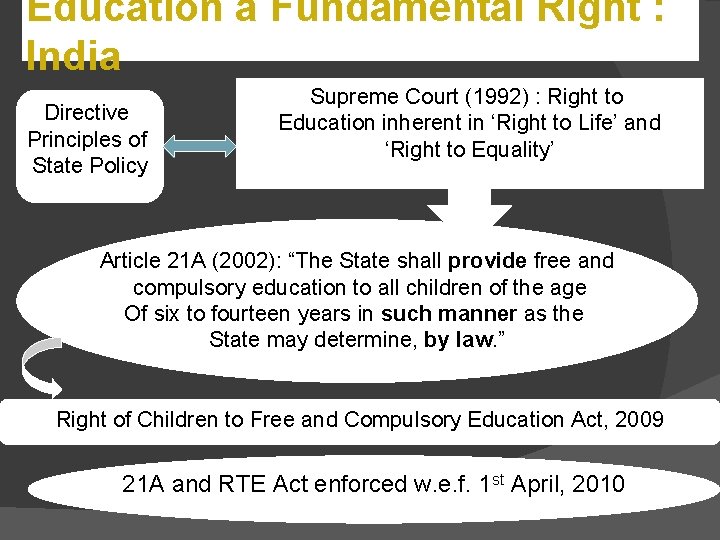
Article 21 A: The state shall provide free and compulsory education to all children of the age of six to fourteen years in such manner as the state may by law determine
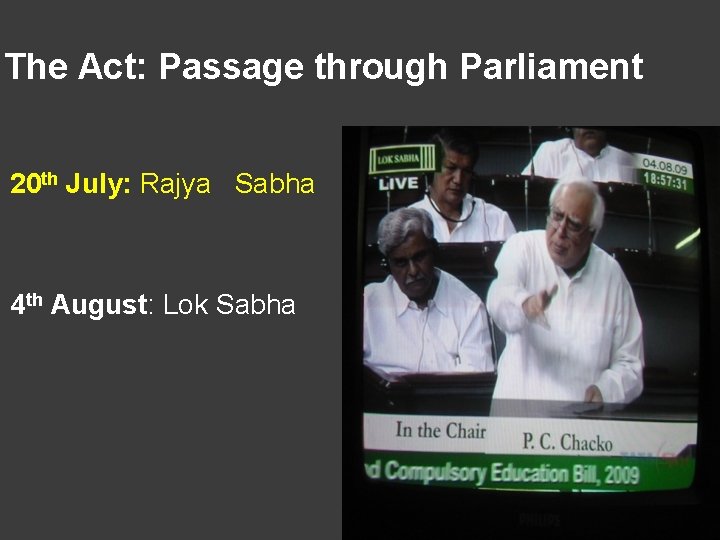
The Act: Passage through Parliament 20 th July: Rajya Sabha 4 th August: Lok Sabha
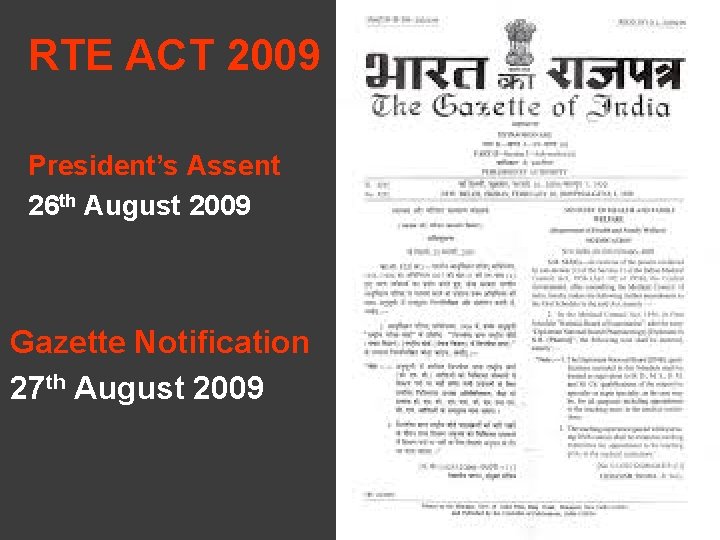
RTE ACT 2009 President’s Assent 26 th August 2009 Gazette Notification 27 th August 2009
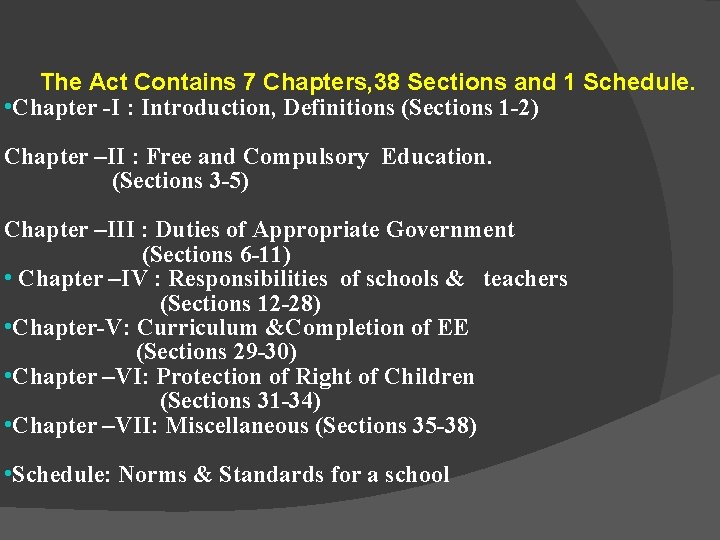
The Act Contains 7 Chapters, 38 Sections and 1 Schedule. • Chapter -I : Introduction, Definitions (Sections 1 -2) Chapter –II : Free and Compulsory Education. (Sections 3 -5) Chapter –III : Duties of Appropriate Government (Sections 6 -11) • Chapter –IV : Responsibilities of schools & teachers (Sections 12 -28) • Chapter-V: Curriculum &Completion of EE (Sections 29 -30) • Chapter –VI: Protection of Right of Children (Sections 31 -34) • Chapter –VII: Miscellaneous (Sections 35 -38) • Schedule: Norms & Standards for a school
Article 21 -A inserted in Fundamental Rights
Education a Fundamental Right : India Directive Principles of State Policy Supreme Court (1992) : Right to Education inherent in ‘Right to Life’ and ‘Right to Equality’ Article 21 A (2002): “The State shall provide free and compulsory education to all children of the age Of six to fourteen years in such manner as the State may determine, by law. ” Right of Children to Free and Compulsory Education Act, 2009 21 A and RTE Act enforced w. e. f. 1 st April, 2010
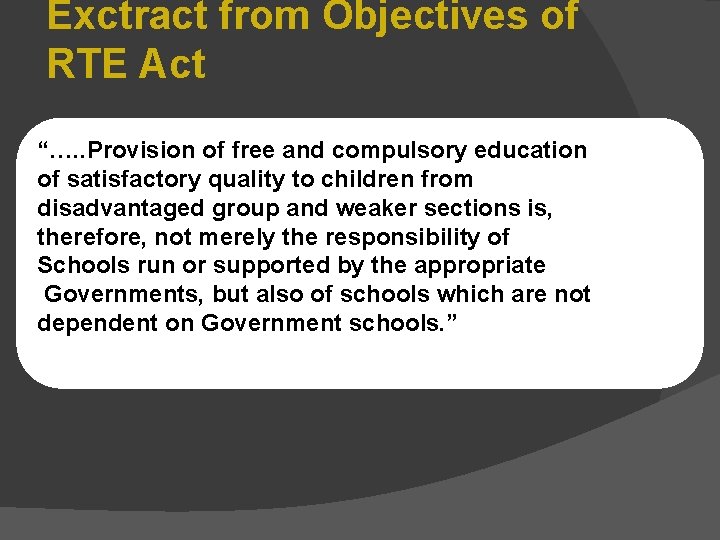
Exctract from Objectives of RTE Act “…. . Provision of free and compulsory education of satisfactory quality to children from disadvantaged group and weaker sections is, therefore, not merely the responsibility of Schools run or supported by the appropriate Governments, but also of schools which are not dependent on Government schools. ”
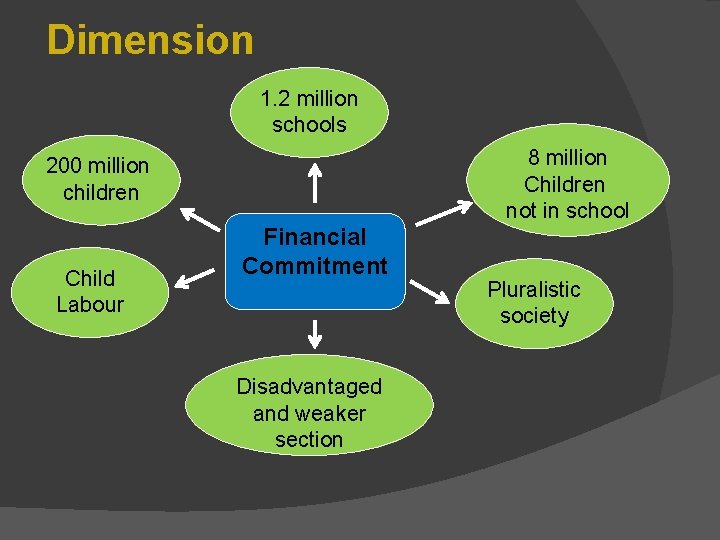
Dimension 1. 2 million schools 8 million Children not in school 200 million children Child Labour Financial Commitment Disadvantaged and weaker section Pluralistic society
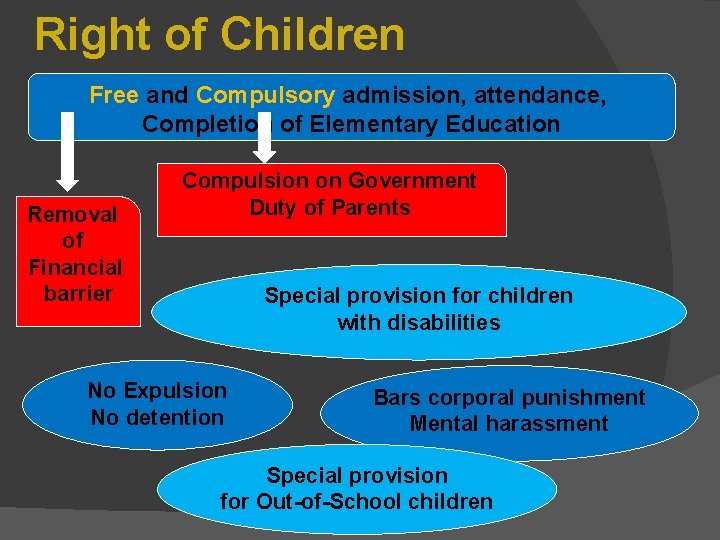
Right of Children Free and Compulsory admission, attendance, Completion of Elementary Education Removal of Financial barrier Compulsion on Government Duty of Parents Special provision for children with disabilities No Expulsion No detention Bars corporal punishment Mental harassment Special provision for Out-of-School children
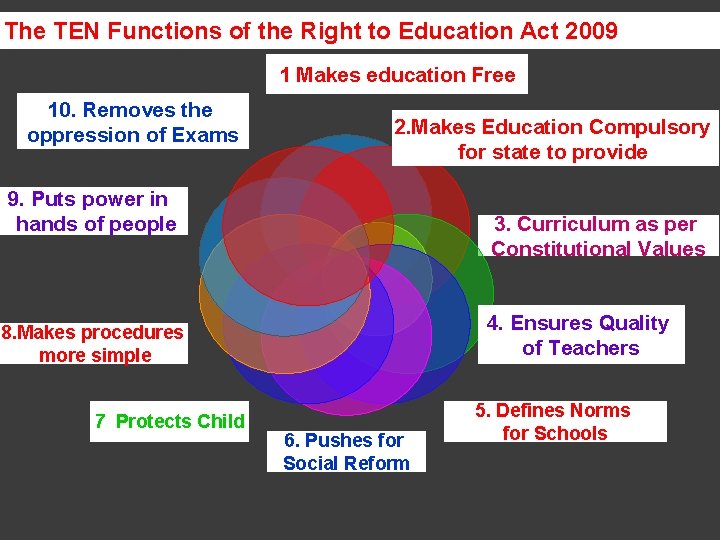
The TEN Functions of the Right to Education Act 2009 1 Makes education Free 10. Removes the oppression of Exams 2. Makes Education Compulsory for state to provide 9. Puts power in hands of people 3. Curriculum as per Constitutional Values 4. Ensures Quality of Teachers 8. Makes procedures more simple 7 Protects Child 6. Pushes for Social Reform 5. Defines Norms for Schools
Chapter – I – Preliminary Section 1 – Short Title , extent and commencement. • This Act may be called the Right of Children to free and compulsory Education Act, 2009 • It shall extend to the whole of India except the State of Jammu and Kashmir. • It shall come into force on such date as the Central Government may by notification in the Official Gazette, appoint.
Section 2 – Definitions • APPROPRIATE GOVERNMENT: 1. In relation to a School established, owned or controlled by the Central Government, or the administrator of the Union Territory, having no legislature, the Central Government. 2. In relation to a school, other than the school referred to in sub-clause (i), established within the territory of a State, the State Government. • CAPITATION FEE : Any kind of donation or contribution or payment other than the fee identified by the School. • CHILD : A male or female child of age 6 -14 years. • DISADVANTAGE GROUP: Means a child belonging to SC, ST, Orphans, HIV affected/infected and Specified by the appropriate Govt by notification.
SECTION 2 –DEFINITIONS • Weaker section : A child belonging to Such Parent or Guardian whose annual income is lower the minimum limit Specified by the appropriate Govt by notification • Elementary Education: The education from first class to eighth class • Guardian: A person having the care and custody of that child and includes a natural guardian or guardian appointed or declared by a court or a statute • Local authority: Such authority or body having administrative Control over the school • NCPCR: National Commission for Protection of Child Rights • Parent: Either the natural or step or adoptive father or mother of a child
SECTION 2 –DEFINITIONS • School: Any recognized school imparting elementary education and includes— (i) a school established, owned or controlled by the appropriate Government or a local authority (ii) an aided school receiving aid or grants to meet whole or part of its expenses from the appropriate Government or the local authority. (iii) a school belonging to specified category; and (iv) an unaided school (not receiving any kind of aid or grants to meet its expenses from appropriate Government or the local authority • Screening procedure: The method of selection for admission of a child, in preference over another, other than a random method • Specified category: Kendriya Vidyalaya, Navodaya Vidyalaya, Sainik School or any other school having a distinct character which may be specified by the appropriate Government • SPCPR: The State Commission for Protection of Child Rights
School: first time specified by law Earlier: No schools, over crowded; under staffed, lack of rooms, no playground, no equipment, Now: � primary school within neighbourhood; � One teacher per class; PTR: 30 in primary, 35 in upper primary; � all weather building, ramp, kitchen, toilets, � safe and adequate drinking water; � playground Grace period: Three years
Key concept: Full time Formal School Therefore: � No more ‘Non Formal Education’, � No ‘drop in’ centres for working children � No Govt. / NGO centres –only ‘schools’ All children in proper formal Schools
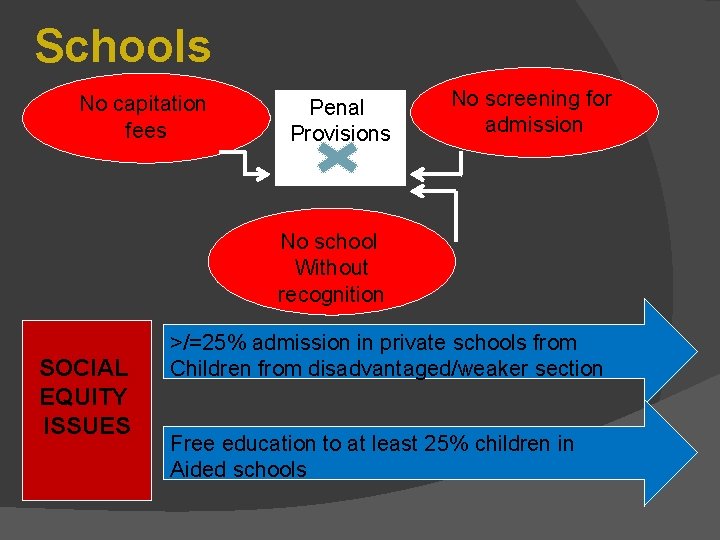
Schools No capitation fees Penal Provisions No screening for admission No school Without recognition SOCIAL EQUITY ISSUES >/=25% admission in private schools from Children from disadvantaged/weaker section Free education to at least 25% children in Aided schools
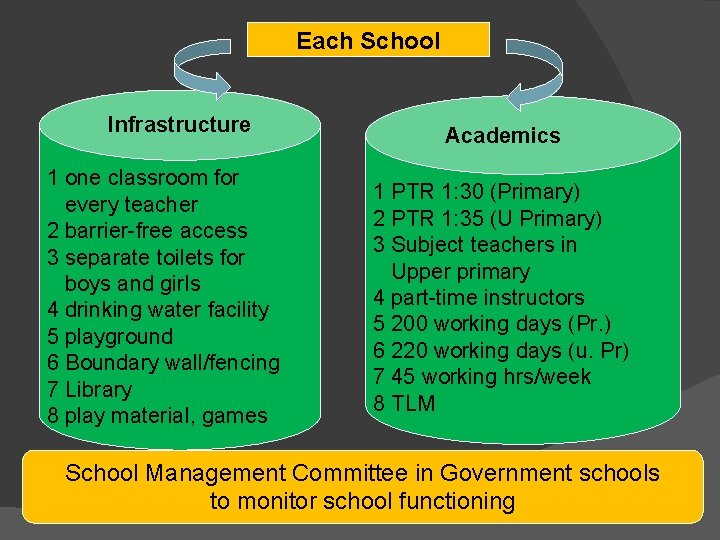
Each School Infrastructure 1 one classroom for every teacher 2 barrier-free access 3 separate toilets for boys and girls 4 drinking water facility 5 playground 6 Boundary wall/fencing 7 Library 8 play material, games Academics 1 PTR 1: 30 (Primary) 2 PTR 1: 35 (U Primary) 3 Subject teachers in Upper primary 4 part-time instructors 5 200 working days (Pr. ) 6 220 working days (u. Pr) 7 45 working hrs/week 8 TLM School Management Committee in Government schools to monitor school functioning
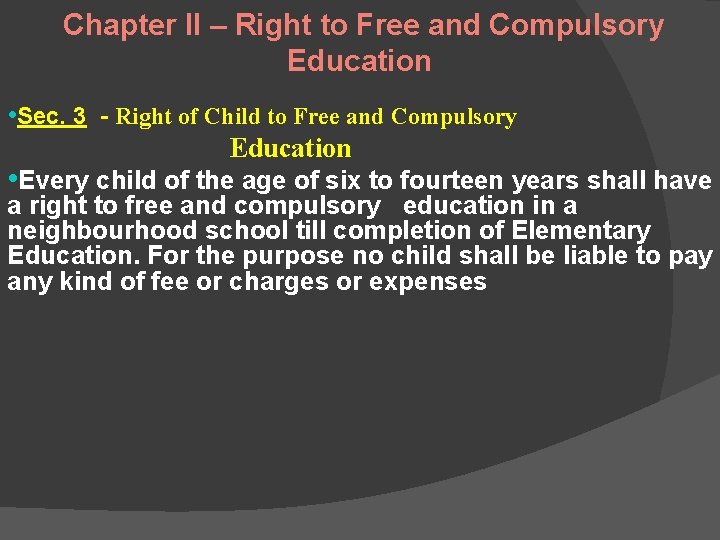
Chapter II – Right to Free and Compulsory Education • Sec. 3 - Right of Child to Free and Compulsory Education • Every child of the age of six to fourteen years shall have a right to free and compulsory education in a neighbourhood school till completion of Elementary Education. For the purpose no child shall be liable to pay any kind of fee or charges or expenses
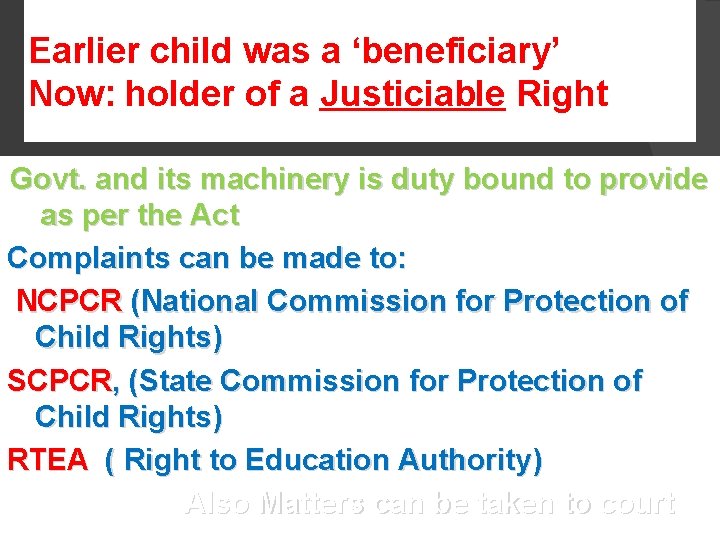
Earlier child was a ‘beneficiary’ Now: holder of a Justiciable Right Govt. and its machinery is duty bound to provide as per the Act Complaints can be made to: NCPCR (National Commission for Protection of Child Rights) SCPCR, (State Commission for Protection of Child Rights) RTEA ( Right to Education Authority) Also Matters can be taken to court
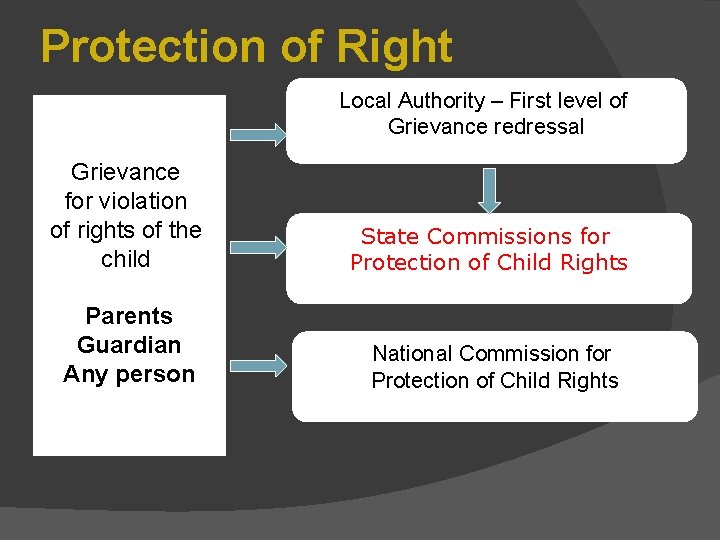
Protection of Right Local Authority – First level of Grievance redressal Grievance for violation of rights of the child State Commissions for Protection of Child Rights Parents Guardian Any person National Commission for Protection of Child Rights
RTE Act: Objects and Reasons (as stated when introducing Bill) The 2 nd December, 2008. 3. Seeks to provide, — v(a) full time elementary education of satisfactory and equitable quality in a formal school which satisfies certain essential norms 4. Responsibility also of schools which are not dependent on Government funds.
Right to Elementary Education • Right is to Classes 1 -8 States will have to ensure the completion of class 8, no fees, and in addition Free text books , uniforms, and mid day meals etc.
Admissions: � Year round admission, � No documents, � Easy ‘TC’ for migration to another school
Admissions: No screening; No capitation fees : Child had to be ‘fit’ to be admitted : Only by ‘random’ method (lottery) even for private schools : Age criteria only responsibility on school to prepare the child : admission tests illegal. Now all those applying up to class 8 -will get admission in govt. system
Earlier: � children turned away for lack of birth certificate; residence proof etc. � lack of TC (transfer certificate) meant end of schooling Now: no waiting for admission dates; not legal to turn child away for lack of certificate School HM given powers to issue TC; lack of TC not to affect admission
Social mixing in Private fee charging schools all private schools to admit children from weaker sections : Every year, 25% of enrolment of class 1 to be from weaker sections Schools to be reimbursed at rate of per capita cost of education in govt. schools.
Sec. 4 - Special Provision for Children not admitted to any school. � • An OSC shall be admitted in a class appropriate to his or her age • Special training to enable such children to be at par with others • Child so admitted entitled to completion of EE even after age 14
• Sec. 5 - Right of transfer to other school If there is no provision for completion of elementary education for completing his or her EE, or if he/she is required to move from one school to another, either within a State or outside, for any reason whatsoever, such child shall have a right to seek transfer to any other school • For seeking admission in such other school, the Head-teacher or in-charge of the school where such child was last admitted, shall immediately issue the transfer certificate. Provided that delay in producing transfer certificate shall not be a ground for either delaying or denying admission in such other school • Head-teacher or in-charge of the School delaying issuance of transfer certificate shall be liable for disciplinary action under the service rules applicable to him, or her.
Age appropriate Classes Taken togethersingle age- multi level classes; Individualized pace;
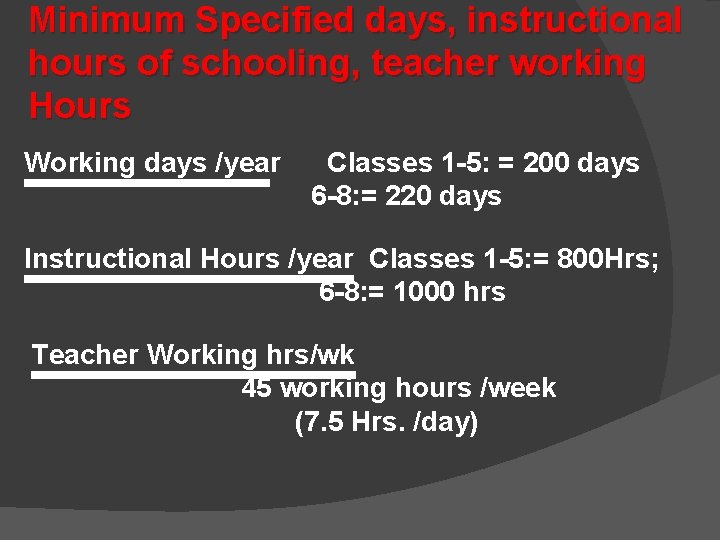
Minimum Specified days, instructional hours of schooling, teacher working Hours Working days /year Classes 1 -5: = 200 days 6 -8: = 220 days Instructional Hours /year Classes 1 -5: = 800 Hrs; 6 -8: = 1000 hrs Teacher Working hrs/wk 45 working hours /week (7. 5 Hrs. /day)
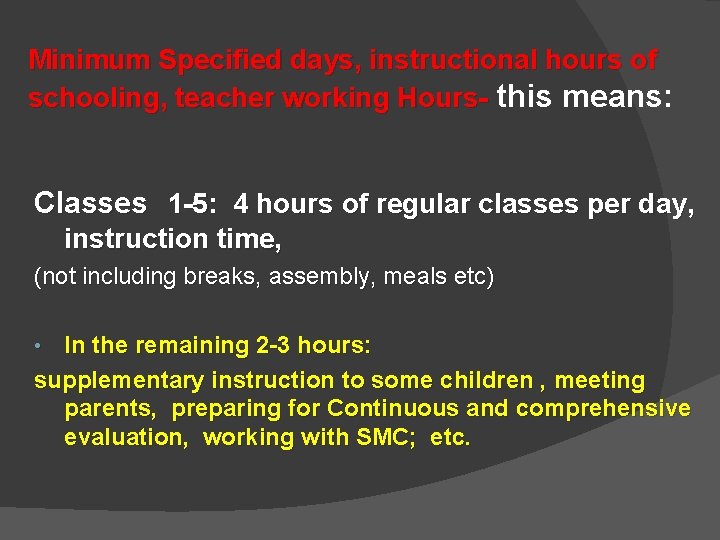
Minimum Specified days, instructional hours of schooling, teacher working Hours- this means: Classes 1 -5: 4 hours of regular classes per day, instruction time, (not including breaks, assembly, meals etc) In the remaining 2 -3 hours: supplementary instruction to some children , meeting parents, preparing for Continuous and comprehensive evaluation, working with SMC; etc. •
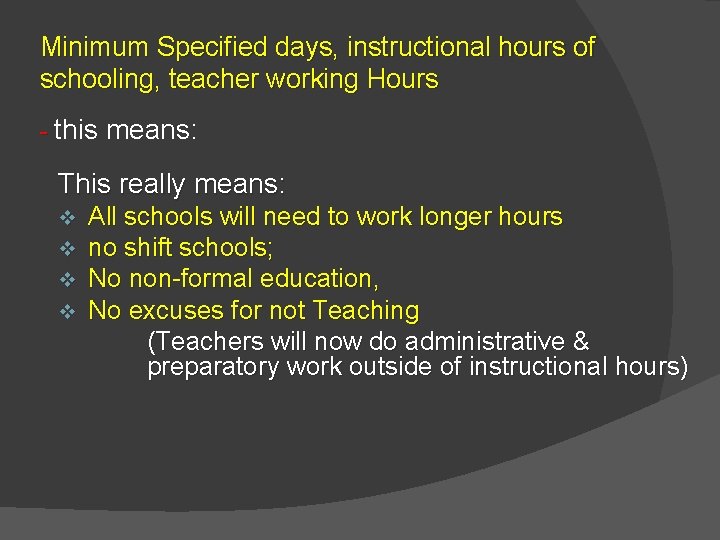
Minimum Specified days, instructional hours of schooling, teacher working Hours - this means: This really means: v v All schools will need to work longer hours no shift schools; No non-formal education, No excuses for not Teaching (Teachers will now do administrative & preparatory work outside of instructional hours)
No corporal punishment, no mental harassment of pupils Teaching learning had become synonymous with hitting and abusing pupils -Institutionalization of a culture of abuse of power - Absence of Democratic functioning Now: hitting of children is no longer a right– provided children (& parents) know their rights and learn how to exercise them. reform: a culture of mutual respect
Curriculum Content/Principles Ø Conform to constitutional values Ø Make child free from fear, trauma, anxiety Ø child-centred, child-friendly Ø learning through activities Ø instruction in child’s mother tongue as far as practicable Ø Continuous and comprehensive evaluation No Board Examination till completion of EE
Testing only for guiding instruction • • • No detention, no failure, No exclusion, No board exams, C&C Evaluation:
Teachers: Teachers to be qualified Earlier: Both government and private schools employed unqualified teachers Now: Minimum qualification fixed by NCTE CTET Qualified No Para teachers Grace period: Five years
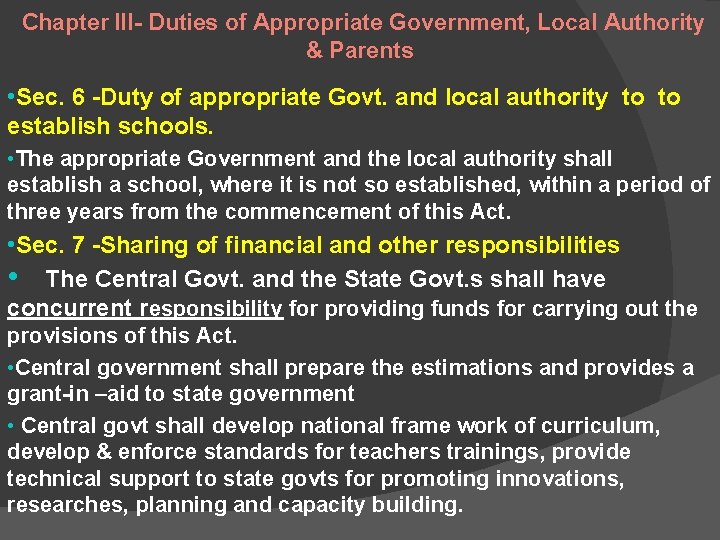
Chapter III- Duties of Appropriate Government, Local Authority & Parents • Sec. 6 -Duty of appropriate Govt. and local authority to to establish schools. • The appropriate Government and the local authority shall establish a school, where it is not so established, within a period of three years from the commencement of this Act. • Sec. 7 -Sharing of financial and other responsibilities • The Central Govt. and the State Govt. s shall have concurrent responsibility for providing funds for carrying out the provisions of this Act. • Central government shall prepare the estimations and provides a grant-in –aid to state government • Central govt shall develop national frame work of curriculum, develop & enforce standards for teachers trainings, provide technical support to state govts for promoting innovations, researches, planning and capacity building.
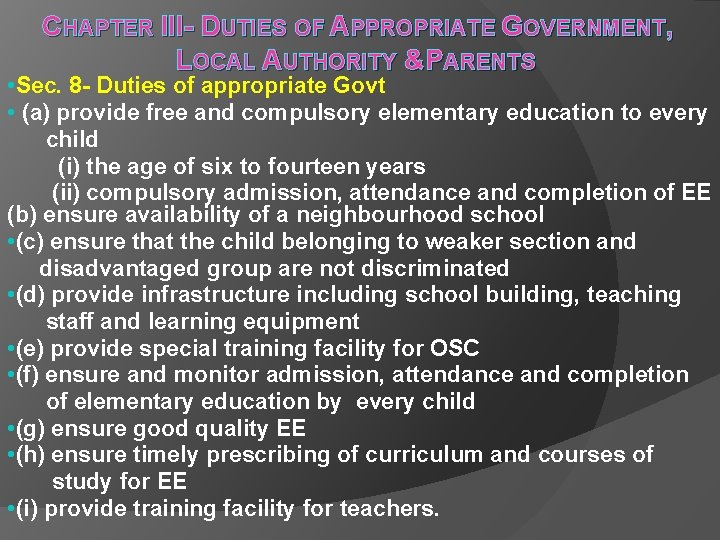
CHAPTER III- DUTIES OF APPROPRIATE GOVERNMENT, LOCAL AUTHORITY &PARENTS • Sec. 8 - Duties of appropriate Govt • (a) provide free and compulsory elementary education to every child (i) the age of six to fourteen years (ii) compulsory admission, attendance and completion of EE (b) ensure availability of a neighbourhood school • (c) ensure that the child belonging to weaker section and disadvantaged group are not discriminated • (d) provide infrastructure including school building, teaching staff and learning equipment • (e) provide special training facility for OSC • (f) ensure and monitor admission, attendance and completion of elementary education by every child • (g) ensure good quality EE • (h) ensure timely prescribing of curriculum and courses of study for EE • (i) provide training facility for teachers.
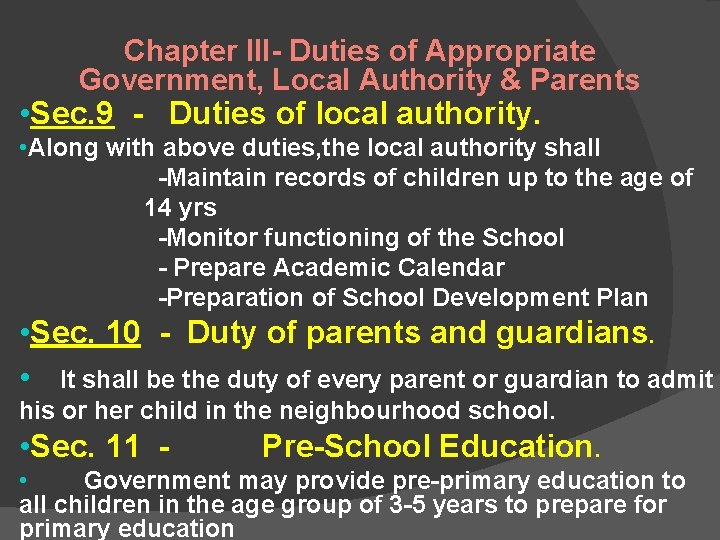
Chapter III- Duties of Appropriate Government, Local Authority & Parents • Sec. 9 - Duties of local authority. • Along with above duties, the local authority shall -Maintain records of children up to the age of 14 yrs -Monitor functioning of the School - Prepare Academic Calendar -Preparation of School Development Plan • Sec. 10 - Duty of parents and guardians. • It shall be the duty of every parent or guardian to admit his or her child in the neighbourhood school. • Sec. 11 - Pre-School Education. • Government may provide pre-primary education to all children in the age group of 3 -5 years to prepare for primary education
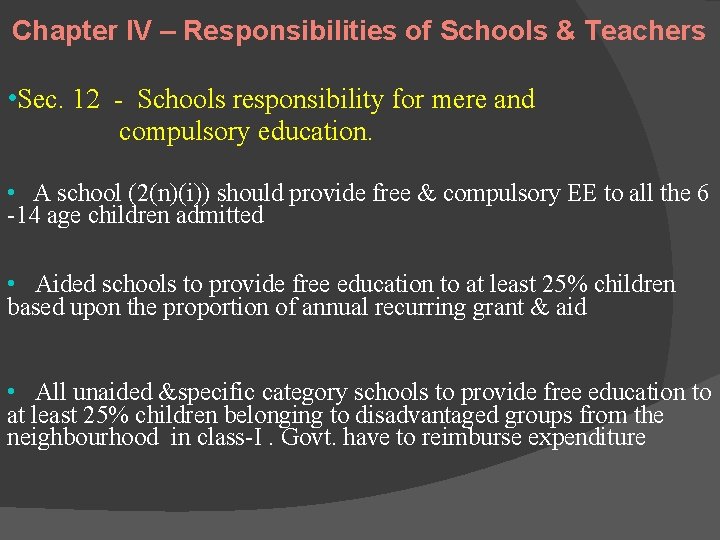
Chapter IV – Responsibilities of Schools & Teachers • Sec. 12 - Schools responsibility for mere and compulsory education. • A school (2(n)(i)) should provide free & compulsory EE to all the 6 -14 age children admitted • Aided schools to provide free education to at least 25% children based upon the proportion of annual recurring grant & aid • All unaided &specific category schools to provide free education to at least 25% children belonging to disadvantaged groups from the neighbourhood in class-I. Govt. have to reimburse expenditure
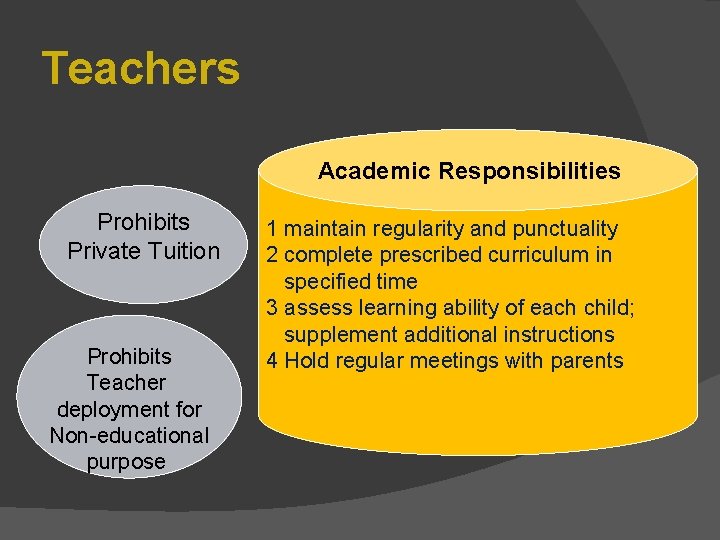
Teachers Academic Responsibilities Prohibits Private Tuition Prohibits Teacher deployment for Non-educational purpose 1 maintain regularity and punctuality 2 complete prescribed curriculum in specified time 3 assess learning ability of each child; supplement additional instructions 4 Hold regular meetings with parents
Teachers duties specified � For the first time a law has laid down the duties of a teacher (Section 24)
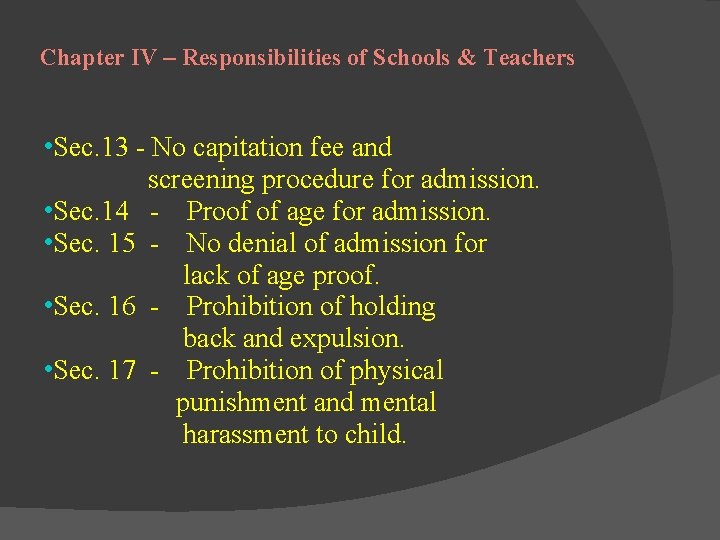
Chapter IV – Responsibilities of Schools & Teachers • Sec. 13 - No capitation fee and screening procedure for admission. • Sec. 14 - Proof of age for admission. • Sec. 15 - No denial of admission for lack of age proof. • Sec. 16 - Prohibition of holding back and expulsion. • Sec. 17 - Prohibition of physical punishment and mental harassment to child.
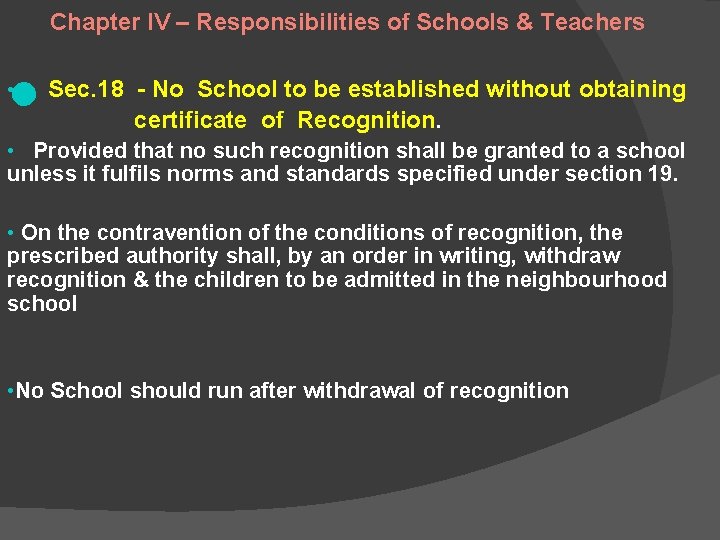
Chapter IV – Responsibilities of Schools & Teachers • • Sss Sec. 18 - No School to be established without obtaining certificate of Recognition. • Provided that no such recognition shall be granted to a school unless it fulfils norms and standards specified under section 19. • On the contravention of the conditions of recognition, the prescribed authority shall, by an order in writing, withdraw recognition & the children to be admitted in the neighbourhood school • No School should run after withdrawal of recognition
Chapter IV – Responsibilities of Schools & Teachers • Sec. 19 - Norms and standards for school • No school shall be established, unless it fulfill the norms and standards specified in the Schedule (Teachers, Infrastructure, no. of working days etc. ) • If already established, within a period of 3 yrs, it should take steps to fulfill norms & Standards • with effect from the date of withdrawal of recognition, no school shall continue to function Sec. 20 - Power to amend schedule • Central government may have the power to amend the schedule
CHAPTER IV – RESPONSIBILITIES OF SCHOOLS &TEACHERS • Sec. 21 - School management committee Formation of SMC with elected representatives and parents ( Atleast 3/4 of members of such Committee shall be parents or guardians) • (2) The School Management Committee shall perform the following functions : -(a) monitor the working of the school; (b) prepare and recommend school development plan; (c) monitor the utilization of the grants received from the appropriate Government or local authority or any other source; (d) perform such other functions as may be prescribed.
Parents to form 75% of School Managing Committee In Govt. Schools - School Management Committees to be formed, 75% of members to be parents (50% Mothers) School Managing Committee to prepare school development plans, basis of budget allocation to the school, will look into all aspects of the school
CHAPTER IV – RESPONSIBILITIES OF SCHOOLS &TEACHERS • Sec. 22 School Development Plan • Every School Management Committee constituted shall prepare a School Development Plan, in such manner as may be prescribed, shall be the basis for the plans and grants to be made by the appropriate Government or local authority. • Sec. 23 - Qualifications for appointment and terms and conditions of service of teachers. • Any person possessing such minimum qualifications, as laid down by an academic authority, authorized by the Central Government by notification, shall be eligible for appointment as a teacher
Chapter IV – Responsibilities of Schools & Teachers • Provided that a teacher who, at the commencement of the Act, does not possess minimum qualifications as laid down under sub-section (1) shall acquire such minimum qualifications within a period of five years. • The salary and allowance payable to teachers shall be such as may be prescribed. • Sec. 24 - Duties of teachers and redressal of grievances. • Maintain regularity and punctuality in attending the school, conduct and complete the curriculum, asses the learning ability of each child, conduct regular meetings with parents, giving additional instructions if required etc.
Chapter IV – Responsibilities of Schools & Teachers • Sec. 25 - Pupil - Teacher Ratio. • Within six months from the date of commencement of this Act the appropriate Government and the local authority shall ensure that the PTR as specified in the Schedule is maintained in each school. • No teacher posted in a school shall be made to serve in any other school or office or deployed for any non-educational purpose, other than those specified in section 27. • Sec. 26 - Filling up vacancies of teachers. • Appropriate Government or a local authority, shall ensure that vacancy of teacher in a school under its control shall not exceed ten percent of the total sanctioned strength.
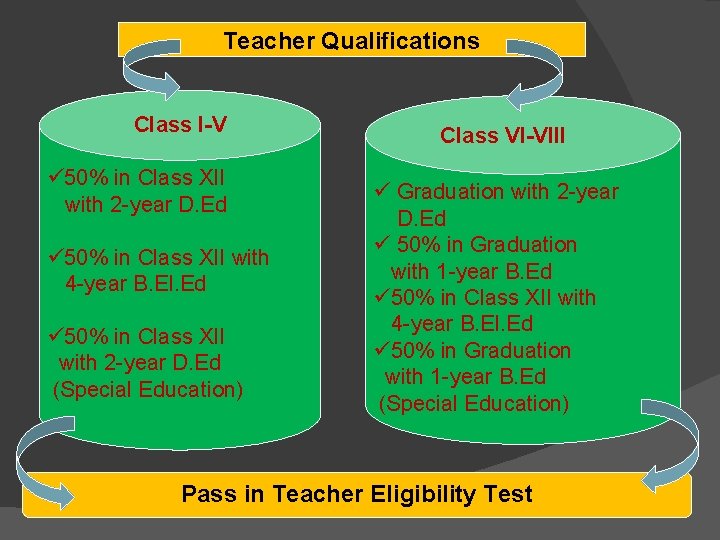
Teacher Qualifications Class I-V ü 50% in Class XII with 2 -year D. Ed ü 50% in Class XII with 4 -year B. El. Ed ü 50% in Class XII with 2 -year D. Ed (Special Education) Class VI-VIII ü Graduation with 2 -year D. Ed ü 50% in Graduation with 1 -year B. Ed ü 50% in Class XII with 4 -year B. El. Ed ü 50% in Graduation with 1 -year B. Ed (Special Education) Pass in Teacher Eligibility Test
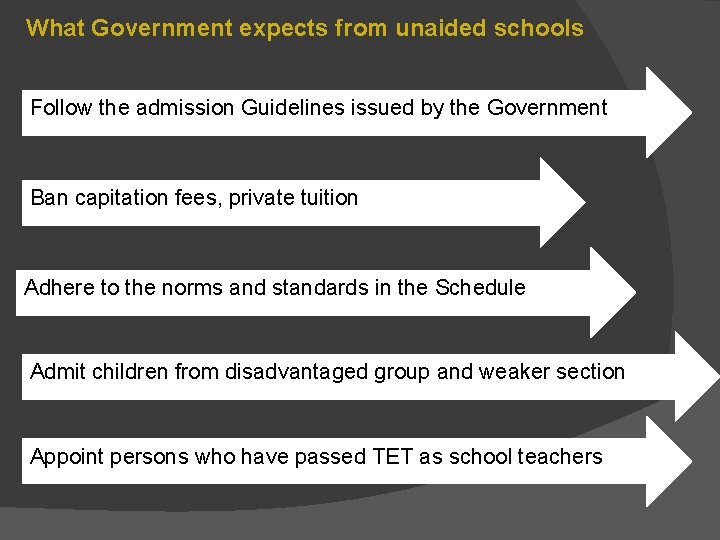
What Government expects from unaided schools Follow the admission Guidelines issued by the Government Ban capitation fees, private tuition Adhere to the norms and standards in the Schedule Admit children from disadvantaged group and weaker section Appoint persons who have passed TET as school teachers
What Government expects from unaided schools No detention, no expulsion of children in classes I-VIII No corporal punishment to children Seek recognition from the State Government Follow curriculum based on principles enshrined in section 29 Orient teachers towards their duties under the RTE Act
CHAPTER IV – RESPONSIBILITIES OF SCHOOLS & TEACHERS • Sec. 27 - Prohibition of deployment of teachers for non-educational purposes • Prohibits deployment of teachers for noneducation purpose, except: • Decennial census • Disaster relief • Elections to Parliament, State Legislatures, Local Bodies • Sec. 28 - Prohibition of private tuitions by teachers • No teacher shall engage himself or herself in private tuition or private teaching activity.
Chapter V – Curriculum and Completion of EE • Sec. 29 - Curricular and evaluation procedure. Curriculum by prescribed academic authority should: • Conform to constitutional values • Make child free from fear, trauma and anxiety • Be child centred, child friendly; provide for learning through activities • Medium of instruction – child mother tongue to the extent possible • Provide for comprehensive and continuous evaluation • Sec. 30 - Examination and completion certificate. • No Board examinations till completion of EE • Every child completing his EE shall be awarded a certificate, in such form and in such manner, as may be prescribed ( Cumulative Record)
Chapter VI- Protection of Rights of Children • Sec. 31 - Monitoring of child right to education. • Bill assigns NCPCR/SCPCR additional functions • Examine and review safeguards for rights under this Act, recommend measures for effective implementation • Inquire into complaints relating to child’s right to free and compulsory education • NCPCR/SCPCR have powers assigned under Section 14 and 24 of the Commissions for Protection of Child Rights Act • Where SCPCR not constituted, appropriate govt. may constitute an Authority
CHAPTER VI- PROTECTION OF RIGHTS OF C HILDREN • Sec. 32 - Redressal of grievances. • Any person have any grievance relating to the right of a child under this Act may make a written complaint to the local authority having jurisdiction • Any person aggrieved by the decision of the local authority may prefer an appeal to the State Commission for Protection of Child Rights or the authority prescribed • Sec. 33 - Constitution of National Advisory Council. • The Central Government shall constitute, by notification a National Advisory Council, consisting of members, not exceeding fifteen, to be appointed from amongst persons having knowledge and practical experience in the filed of EE and child development • To advise the Central Government on implementation of the provisions of the Act in an effective manner. • Sec. 34 - Constitution of State Advisory Council.
Chapter VII - Miscellaneous • Sec. 35 - Power to issue directions • Central govt. --State govt. --Local Authority-SMC • Sec. 36 - Previous sanction for prosecution • Sec. 37 - Protection of action taken in • good faith • Sec. 38 - Power of appropriate Govt. to • make rules • The appropriate Government may, by notification, make rules, for carrying out the provisions of this Act. , such as…
CHAPTER VII - MISCELLANEOUS • the manner of giving special training and the time limit thereof • the area or limits for establishment of a Neighbourhood school, under section 6; • the manner of maintenance of records of children upto the age of 14 years(9. d) • the manner and extent of reimbursement of expenditure, under 12(2) • any other document for determining the age of child under sub-section (1) of section 14; • the extended period for admission and the manner of completing study if admitted after the extended period under section 15; • the form, the period, the manner and the conditions for issuing certificate or recognition, under subsection (2) of section 18;
CHAPTER VII - MISCELLANEOUS • the other functions to be performed by SMC under clause (d) of sub-section (2) of section 21; • the manner of preparing School Development Plan under sub-section (1) of section 22; • the salary and allowances payable to, and the terms and conditions of service of, teacher, under sub-section(3) of section 23; • the duties to be performed by the teacher under clause (f) of sub-section (1) of section 24; • The manner of redressing grievances of teachers under sub-section (3) of section 24; • The form and manner of awarding certificate for completion of EE under sub-section (2) of section 30; • The allowances and other terms ad conditions of appointment of Members of the National Advisory Council/ State Advisory Council
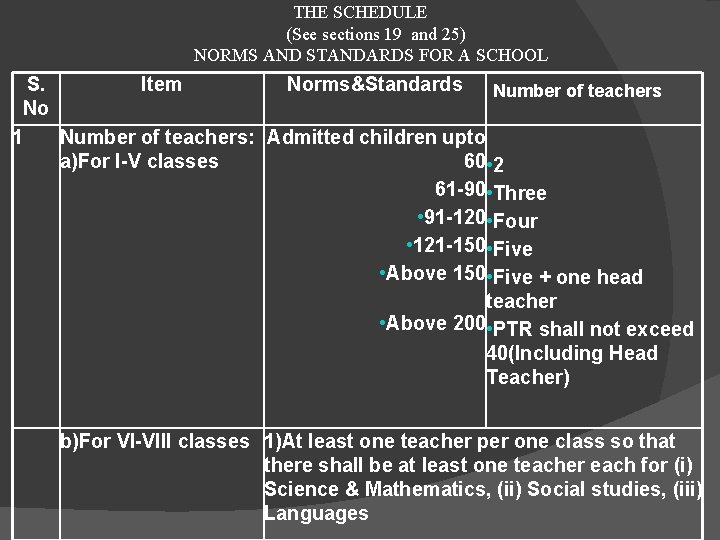
THE SCHEDULE (See sections 19 and 25) NORMS AND STANDARDS FOR A SCHOOL S. Item Norms&Standards Number of teachers No 1 Number of teachers: Admitted children upto a)For I-V classes 60 • 2 61 -90 • Three • 91 -120 • Four • 121 -150 • Five • Above 150 • Five + one head teacher • Above 200 • PTR shall not exceed 40(Including Head Teacher) b)For VI-VIII classes 1)At least one teacher per one class so that there shall be at least one teacher each for (i) Science & Mathematics, (ii) Social studies, (iii) Languages
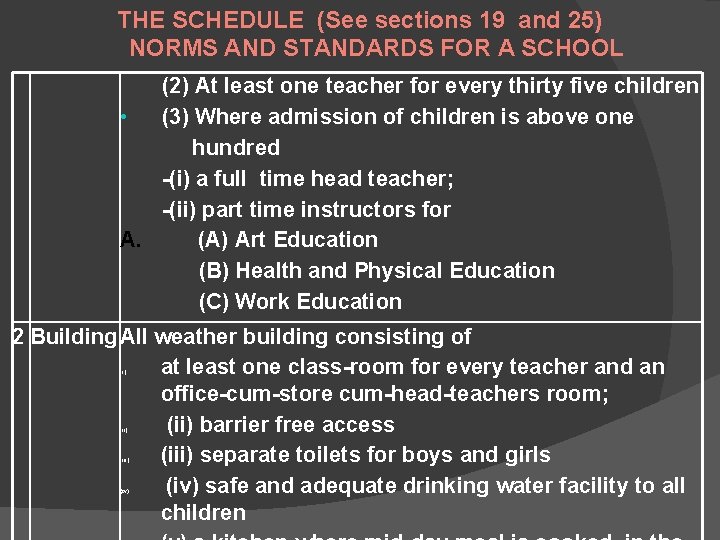
THE SCHEDULE (See sections 19 and 25) NORMS AND STANDARDS FOR A SCHOOL (2) At least one teacher for every thirty five children • (3) Where admission of children is above one hundred -(i) a full time head teacher; -(ii) part time instructors for A. (A) Art Education (B) Health and Physical Education (C) Work Education 2 Building. All weather building consisting of at least one class-room for every teacher and an office-cum-store cum-head-teachers room; (ii) barrier free access (iii) separate toilets for boys and girls (iv) safe and adequate drinking water facility to all children (i) (iii) (iv)
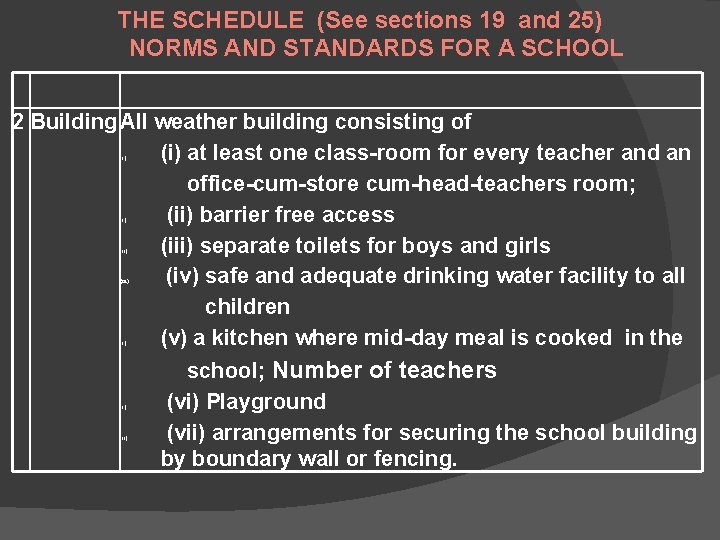
THE SCHEDULE (See sections 19 and 25) NORMS AND STANDARDS FOR A SCHOOL 2 Building. All weather building consisting of (i) at least one class-room for every teacher and an office-cum-store cum-head-teachers room; (ii) barrier free access (iii) separate toilets for boys and girls (iv) safe and adequate drinking water facility to all children (v) a kitchen where mid-day meal is cooked in the school; Number of teachers (vi) Playground (vii) arrangements for securing the school building by boundary wall or fencing. (i) (ii)
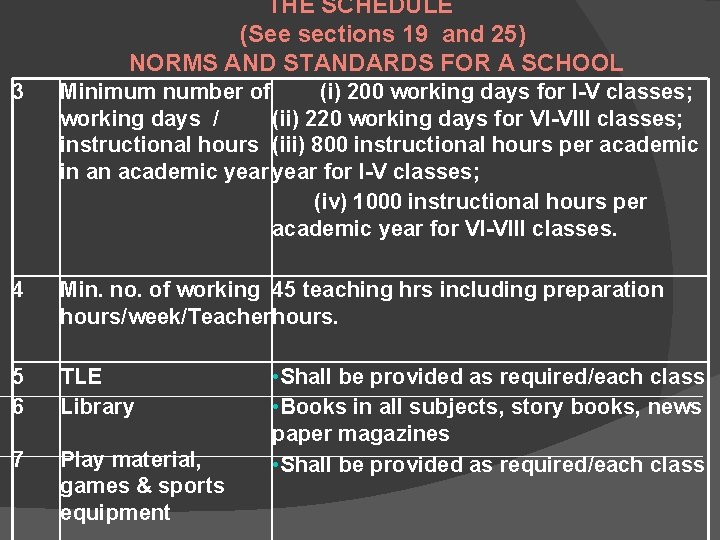
THE SCHEDULE (See sections 19 and 25) NORMS AND STANDARDS FOR A SCHOOL 3 Minimum number of (i) 200 working days for I-V classes; working days / (ii) 220 working days for VI-VIII classes; instructional hours (iii) 800 instructional hours per academic in an academic year for I-V classes; (iv) 1000 instructional hours per academic year for VI-VIII classes. 4 Min. no. of working 45 teaching hrs including preparation hours/week/Teacherhours. 5 6 TLE Library 7 Play material, games & sports equipment • Shall be provided as required/each class • Books in all subjects, story books, news paper magazines • Shall be provided as required/each class
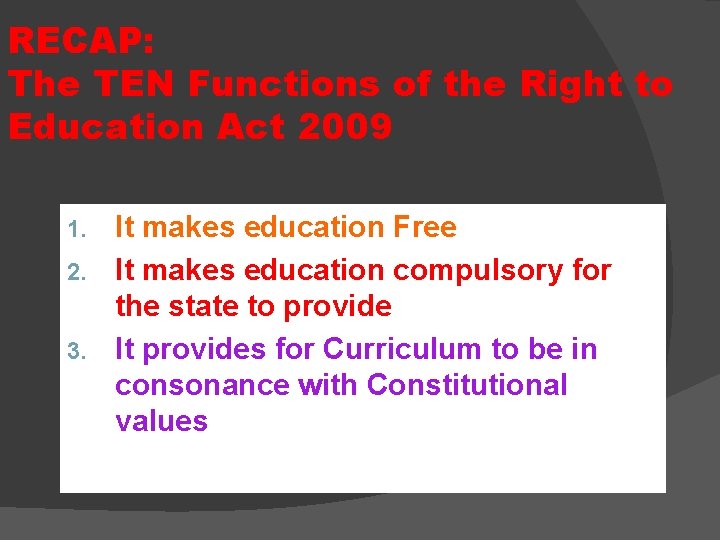
RECAP: The TEN Functions of the Right to Education Act 2009 It makes education Free 2. It makes education compulsory for the state to provide 3. It provides for Curriculum to be in consonance with Constitutional values 1.
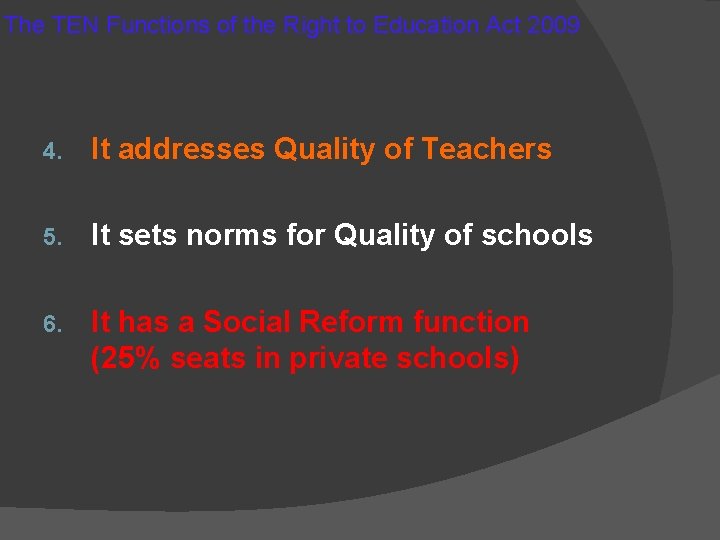
The TEN Functions of the Right to Education Act 2009 4. It addresses Quality of Teachers 5. It sets norms for Quality of schools 6. It has a Social Reform function (25% seats in private schools)
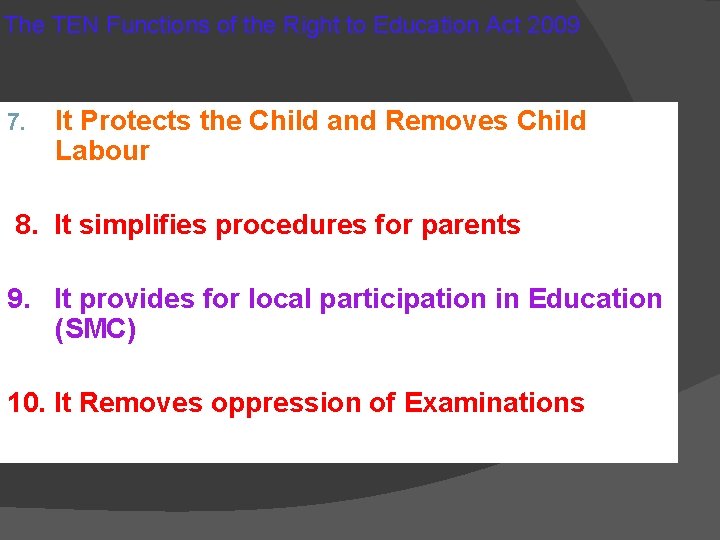
The TEN Functions of the Right to Education Act 2009 7. It Protects the Child and Removes Child Labour 8. It simplifies procedures for parents 9. It provides for local participation in Education (SMC) 10. It Removes oppression of Examinations
Thanks