
The RIASEC Game Matching Famous Personalities to Hollands
- Slides: 7
The RIASEC Game: Matching Famous Personalities to Holland’s Types Authors Kevin Glavin, Ph. D. , PC kg 585@nova. edu Pia Smal ps 617@nova. edu Jessica Gonzalez Jg 1124@nova. edu Nova Southeastern University, Fort Lauderdale FL
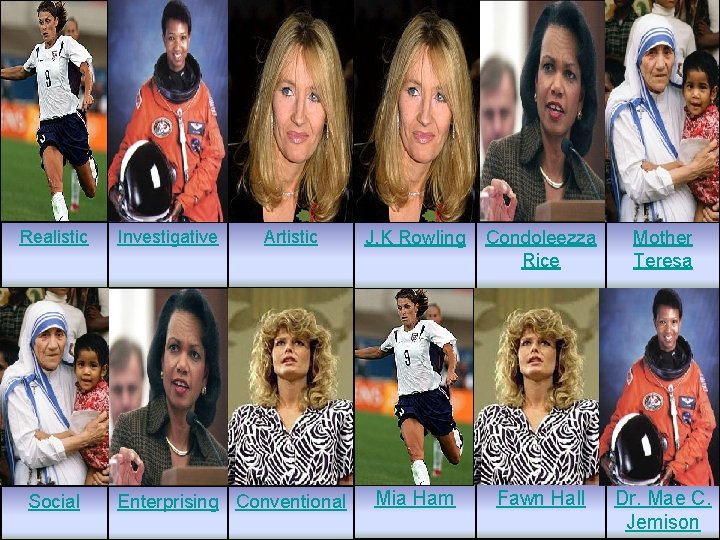
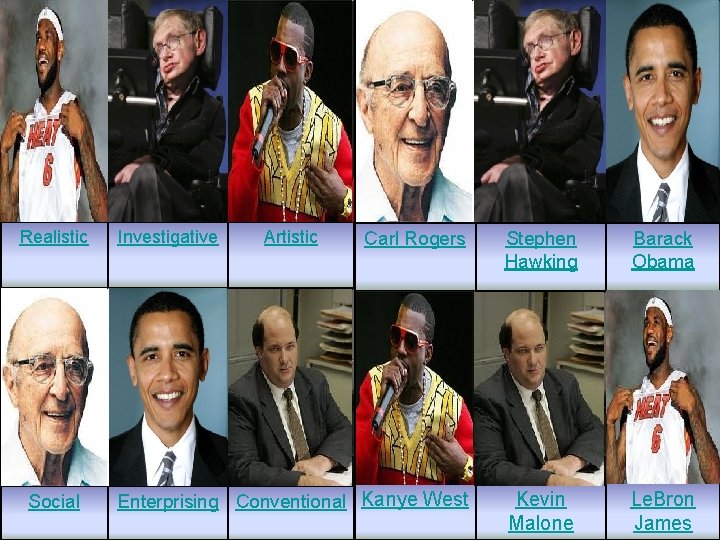
Instructions 1. Provide students/clients with a brief overview of John Holland’s theory of vocational choice and personality types 2. Explain several core constructs related to Holland’s theory: 1. Most people can be categorized as resembling one of 6 types (RIASEC) 2. Most work environments can be categorized using the same typology (RIASEC) 3. Explain Holland’s construct of congruence, which suggests that individuals will seek work environments that are congruent with their personality types. 4. Explain the idea that congruence is likely to lead to greater work satisfaction 3. 4. 5. 6. Describe each of the RIASEC types Arrange individuals into groups of 4 -6. Open the Power. Point Exercise for the RIASEC Game Give groups an appropriate amount of time (approximately 10 minutes) to determine the PRIMARY type of each individual, i. e. R, I, A, S, E or C. 7. Discussion: Have groups discuss why they choose to match a particular person to a RIASEC type.
R I A Realistic Investigative Artistic S E Social J. K Rowling Condoleezza Rice Mother Teresa Mia Ham Fawn Hall Dr. Mae C. Jemison C Enterprising Conventional
R I A Realistic Investigative Artistic Carl Rogers Stephen Hawking Barack Obama Enterprising Conventional Kanye West Kevin Malone Le. Bron James S E Social C
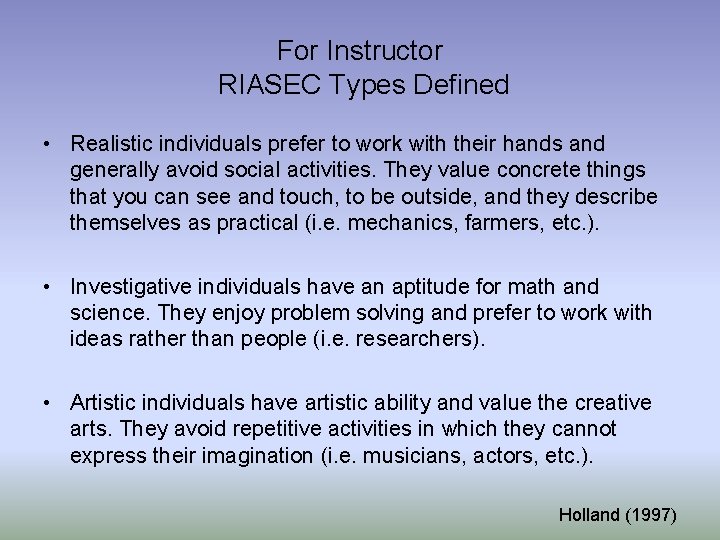
For Instructor RIASEC Types Defined • Realistic individuals prefer to work with their hands and generally avoid social activities. They value concrete things that you can see and touch, to be outside, and they describe themselves as practical (i. e. mechanics, farmers, etc. ). • Investigative individuals have an aptitude for math and science. They enjoy problem solving and prefer to work with ideas rather than people (i. e. researchers). • Artistic individuals have artistic ability and value the creative arts. They avoid repetitive activities in which they cannot express their imagination (i. e. musicians, actors, etc. ). Holland (1997)
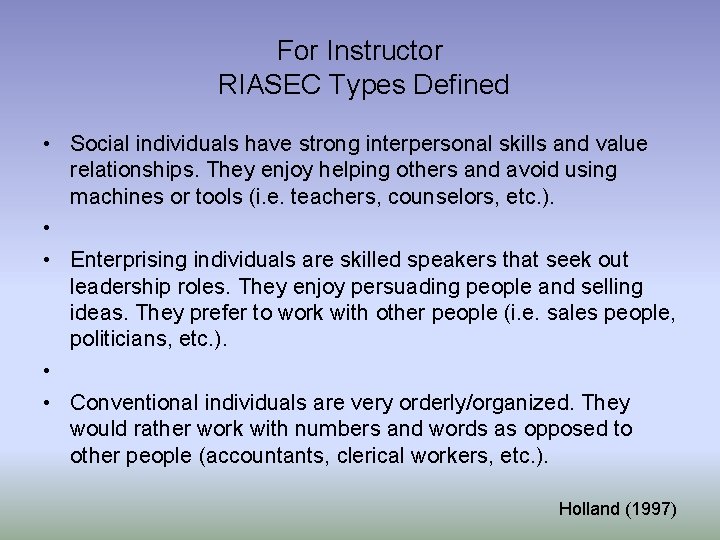
For Instructor RIASEC Types Defined • Social individuals have strong interpersonal skills and value relationships. They enjoy helping others and avoid using machines or tools (i. e. teachers, counselors, etc. ). • • Enterprising individuals are skilled speakers that seek out leadership roles. They enjoy persuading people and selling ideas. They prefer to work with other people (i. e. sales people, politicians, etc. ). • • Conventional individuals are very orderly/organized. They would rather work with numbers and words as opposed to other people (accountants, clerical workers, etc. ). Holland (1997)
References Gottfredson, G. D. , & Holland, J. L. (1996). Dictionary of Holland occupational codes (3 rd ed. ). Odessa, FL: Psychological Assessment Resources. Holland, J. L. (2000). Self-Directed Search occupations finder. Odessa, FL: Psychological Assessment Resources. Holland, J. L. (1997). Making vocational choices 3 rd ed. Odessa, FL: Psychological Assessment Resources, Inc. Holland, J. L. , Fritzsche, B. A. , & Powell, A. B. (1997). Self-Directed Search technical manual. Odessa, FL: Psychological Assessment Resources. Holland, J. L. , Powell, A. B. , & Fritzsche, B. A. (1997). Self-Directed Search professional user’s guide. Odessa, FL: Psychological Assessment Resources. Holland, J. L. (1994). The Self-Directed Search. Odessa, FL: Psychological Assessment Resources, Inc. Rayman, J. R. (1998). Interpreting Ellenore Flood's Self-Directed Search. Career Development Quarterly, 46, 330 -338.