
The RF Power Source for the High Beta
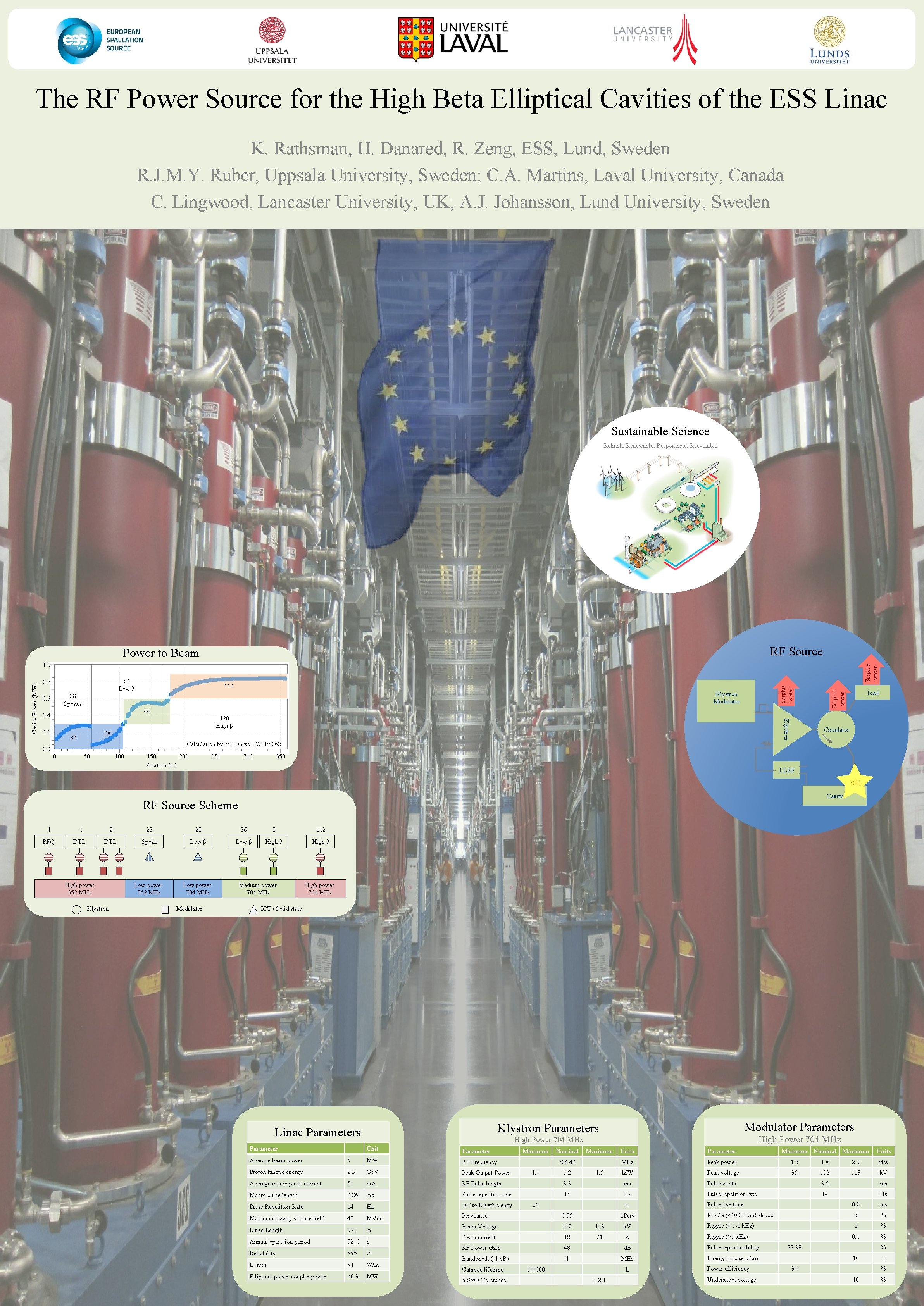
The RF Power Source for the High Beta Elliptical Cavities of the ESS Linac K. Rathsman, H. Danared, R. Zeng, ESS, Lund, Sweden R. J. M. Y. Ruber, Uppsala University, Sweden; C. A. Martins, Laval University, Canada C. Lingwood, Lancaster University, UK; A. J. Johansson, Lund University, Sweden Sustainable Science Reliable Renewable, Responsible, Recyclable RF Source Power to Beam Surplus water Klystron Modulator 28 Spokes 0. 6 44 0. 2 Surplus water 112 120 High β 28 28 Calculation by M. Eshraqi, WEPS 062 0. 0 0 50 100 150 200 Position (m) 250 300 load Surplus water 64 Low β 0. 8 Klystron Cavity Power (MW) 1. 0 Circulator 350 LLRF 30% Cavity RF Source Scheme 1 1 2 28 28 36 8 112 RFQ DTL Spoke Low β High β Low power 352 MHz Low power 704 MHz High power 352 MHz Klystron Modulator Medium power 704 MHz High power 704 MHz IOT / Solid state Linac Parameters Parameter Modulator Parameters Klystron Parameters High Power 704 MHz Unit Parameter Minimum Nominal Maximum Units MHz Peak power 1. 5 1. 8 2. 3 MW MW Peak voltage 95 102 113 k. V Average beam power 5 MW RF Frequency Proton kinetic energy 2. 5 Ge. V Peak Output Power Average macro pulse current 50 m. A RF Pulse length 3. 3 ms Pulse width 3. 5 ms Macro pulse length 2. 86 ms Pulse repetition rate 14 Hz Pulse Repetition Rate 14 Hz DC to RF efficiency % Pulse rise time Maximum cavity surface field 40 MV/m Perveance 0. 55 Linac Length 392 m Beam Voltage 102 113 Annual operation period 5200 h Beam current 18 21 Reliability >95 % RF Power Gain Losses <1 W/m Bandwidth (-1 d. B) Elliptical power coupler power <0. 9 MW Cathode lifetime VSWR Tolerance 704. 42 1. 0 1. 2 1. 5 0. 2 ms Ripple (<100 Hz) & droop 3 % k. V Ripple (0. 1 -1 k. Hz) 1 % A Ripple (>1 k. Hz) 0. 1 % 48 d. B Pulse reproducibility 4 MHz Energy in case of arc 65 μPerv 100000 h 1. 2: 1 Power efficiency Undershoot voltage 99. 98 % 10 90 J % 10 %
- Slides: 1