
The Revolutionary War The World Turned Upside Down

- Slides: 68
The Revolutionary War The World Turned Upside Down CICERO © 2010
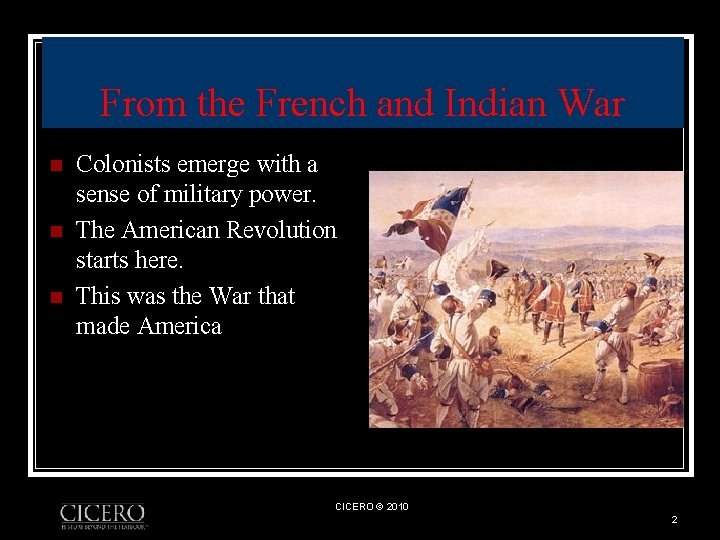
From the French and Indian War n n n Colonists emerge with a sense of military power. The American Revolution starts here. This was the War that made America CICERO © 2010 2
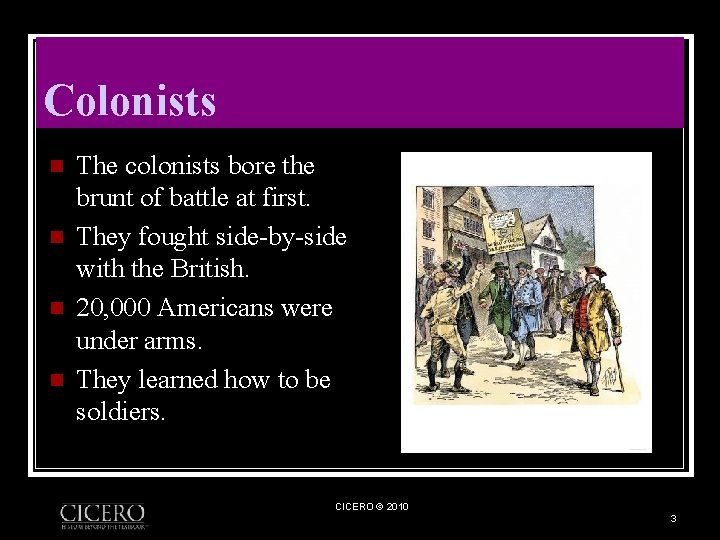
Colonists n n The colonists bore the brunt of battle at first. They fought side-by-side with the British. 20, 000 Americans were under arms. They learned how to be soldiers. CICERO © 2010 3
The war had shattered the myth of British invincibility in the minds of the colonists n n Sharp friction between British officers and the militia They called the colonists savages n n n Yankee Doodle Dandy Colonists still traded with the French and Spanish Militia would only fight in their home colony Some colonies would not fight or send money William Pitt had to bribe colonies to participate CICERO © 2010 4
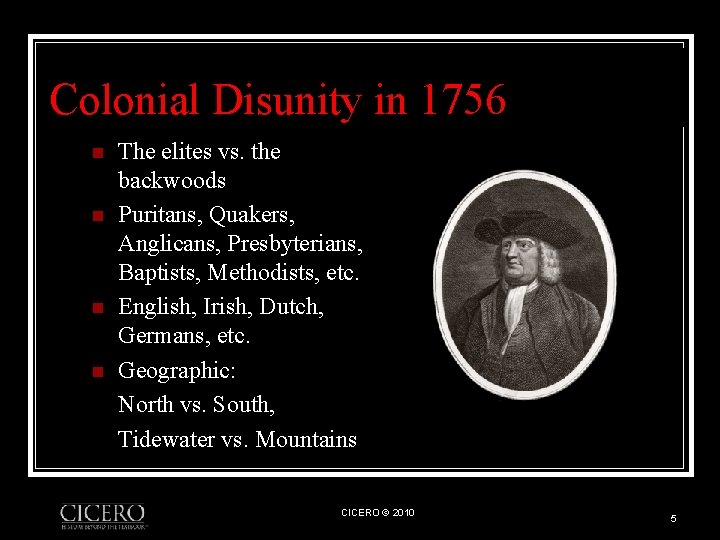
Colonial Disunity in 1756 n n The elites vs. the backwoods Puritans, Quakers, Anglicans, Presbyterians, Baptists, Methodists, etc. English, Irish, Dutch, Germans, etc. Geographic: North vs. South, Tidewater vs. Mountains CICERO © 2010 5
Colonial soldiers learn they have a lot in common when they fought together n The American militia bonded together and stood in opposition to the British soldiers. n n Colonial militia began to see themselves as American, not as simply New Yorkers, Virginians, Pennsylvanians, etc. A similar phenomena took place with American ethnics during World War II. n American ethnics began to see themselves as Americans, not as Irish-Americans, Italian-Americans, Westerners, Southerners, Catholics, Jews, etc. CICERO © 2010 6
1763 - Colonies no longer needed British protection from the French n n n 1763 former French ally, Chief Pontiac, revolted against British rule in the Ohio Valley Frontiersmen quickly retaliated Ulster Irish Presbyterian frontiersmen poured into the Ohio Valley That’s why they had fought the French Daniel Boone was already in Tennessee and Kentucky CICERO © 2010
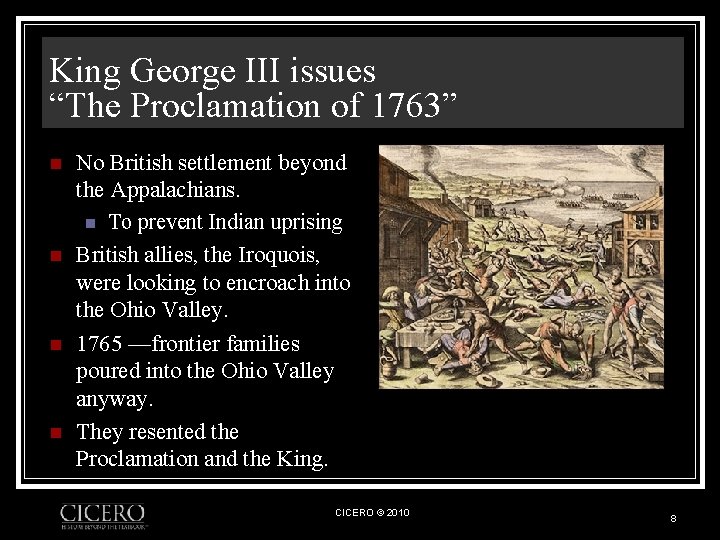
King George III issues “The Proclamation of 1763” n n No British settlement beyond the Appalachians. n To prevent Indian uprising British allies, the Iroquois, were looking to encroach into the Ohio Valley. 1765 —frontier families poured into the Ohio Valley anyway. They resented the Proclamation and the King. CICERO © 2010 8
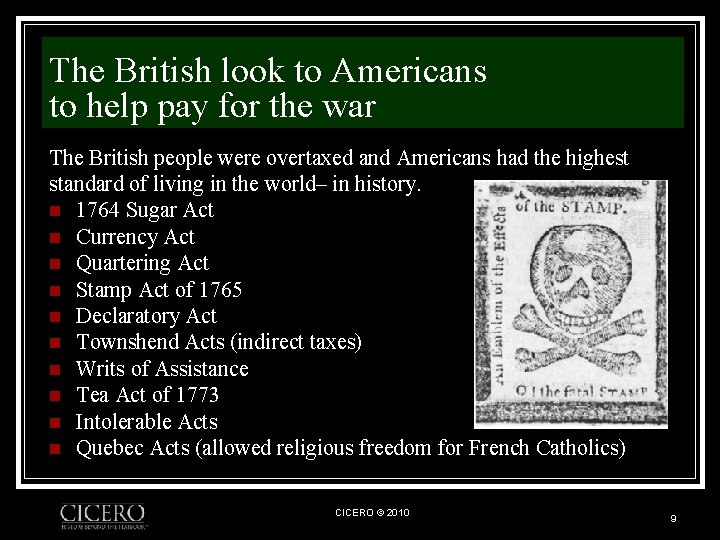
The British look to Americans to help pay for the war The British people were overtaxed and Americans had the highest standard of living in the world– in history. n 1764 Sugar Act n Currency Act n Quartering Act n Stamp Act of 1765 n Declaratory Act n Townshend Acts (indirect taxes) n Writs of Assistance n Tea Act of 1773 n Intolerable Acts n Quebec Acts (allowed religious freedom for French Catholics) CICERO © 2010 9
Intolerable (or Coercive) Acts n Because of the famous Boston Tea Party n n British closed Boston to all shipping until the tea was paid for Revoked Massachusetts’ charter of 1691 n n n No more town meetings New Quartering Act – Bostonians had to provide food and shelter to troops sent to enforce the laws British sent those accused of violating the law to England for trial CICERO © 2010
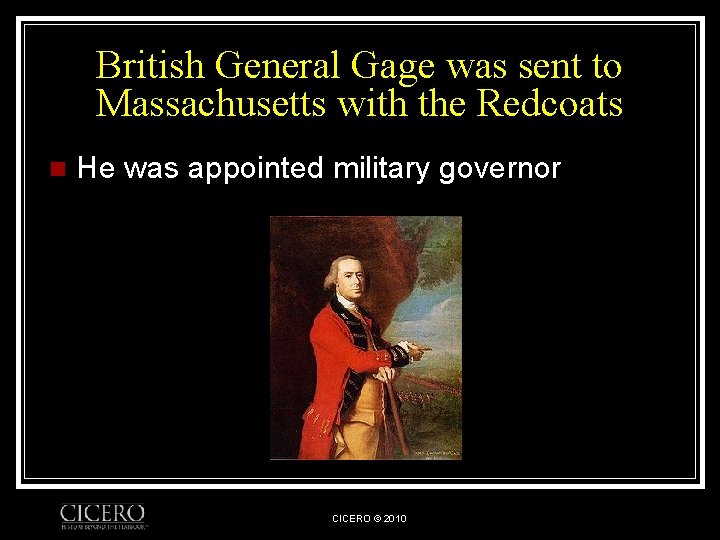
British General Gage was sent to Massachusetts with the Redcoats n He was appointed military governor CICERO © 2010
Continental Congress n September 1774 n n Congress tells colonies to mobilize for war Gates moves troops east to Boston n n He employs spies Benjamin Church informs Gates the colonists have stored guns at Concord CICERO © 2010
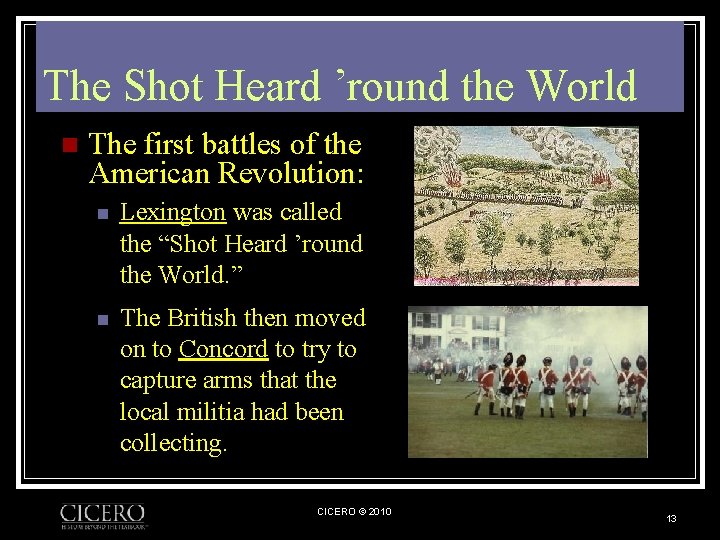
The Shot Heard ’round the World n The first battles of the American Revolution: n Lexington was called the “Shot Heard ’round the World. ” n The British then moved on to Concord to try to capture arms that the local militia had been collecting. CICERO © 2010 13
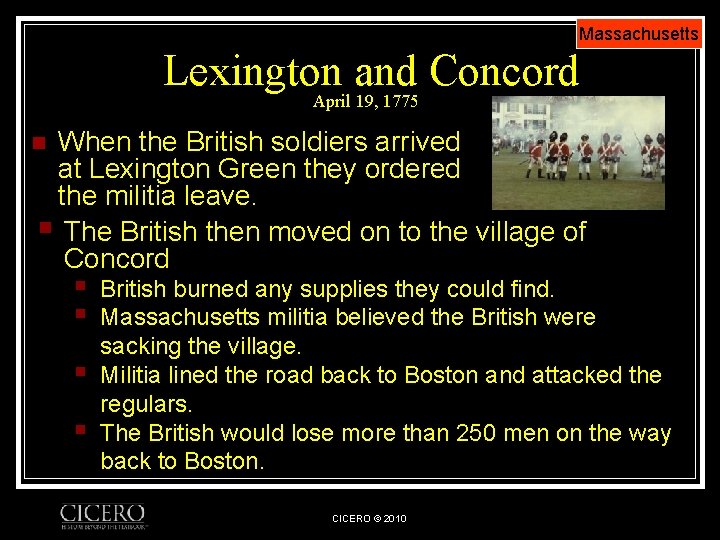
Massachusetts Lexington and Concord April 19, 1775 When the British soldiers arrived at Lexington Green they ordered the militia leave. § The British then moved on to the village of Concord n § § British burned any supplies they could find. Massachusetts militia believed the British were sacking the village. Militia lined the road back to Boston and attacked the regulars. The British would lose more than 250 men on the way back to Boston. Cicero © 2007 CICERO © 2010
Lexington and Concord April 19, 1775 n n n Paul Revere and William Dawes helped warn the militia of the British approach. They yelled “The regulars are coming!” Revere gave conflicting accounts of the battle at Lexington Green: n n n First, he claimed he saw smoke coming from the tree line where militiamen were gathered. Years later, he claimed he witnessed the British firing first. It is still unclear who actually fired the first shots. CICERO © 2010
The Odds n 2. 5 million population n n 8 million population The biggest navy in the world An inured standing army 20% enslaved n No navy n n No army n CICERO © 2010
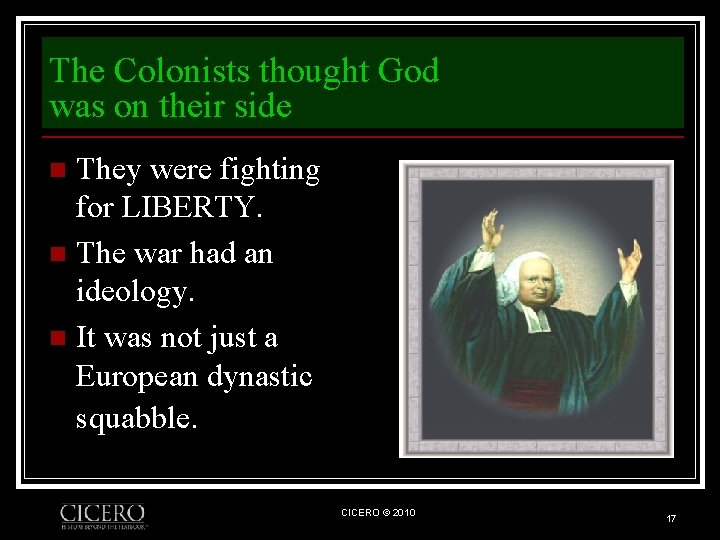
The Colonists thought God was on their side They were fighting for LIBERTY. n The war had an ideology. n It was not just a European dynastic squabble. n CICERO © 2010 17
The British had serious problems They thought the militia was weak n They never made a distinction between militia and wartime units n They believed the rebels were a very small minority n British counted on a large loyalist backing (but only had around 20%) n CICERO © 2010
More Problems: n n n Divided Centralized Colonies – No strategic heart They had major logistics and manpower problems 3, 000 miles across the Atlantic n n n n Includes, difficult communication Cumbersome administration bureaucracy Staffed with incompetent patronage appointees Little coordination between departments Bad roads in America During the French and Indian War, Americans fed the Brits – not now. British foraging became pillaging n Drove many colonists to the Patriot cause CICERO © 2010
And More: n n n British did not have full support at home William Pitt, Edmund Burke, Isaac Barre, John Wilkes and merchants were against the war. Difficult recruiting They had to hire 30, 000 Germans (not mercenaries) They used slaves and mobilized Indian tribes Unsure Parliament vacillated between conciliation and coercion CICERO © 2010
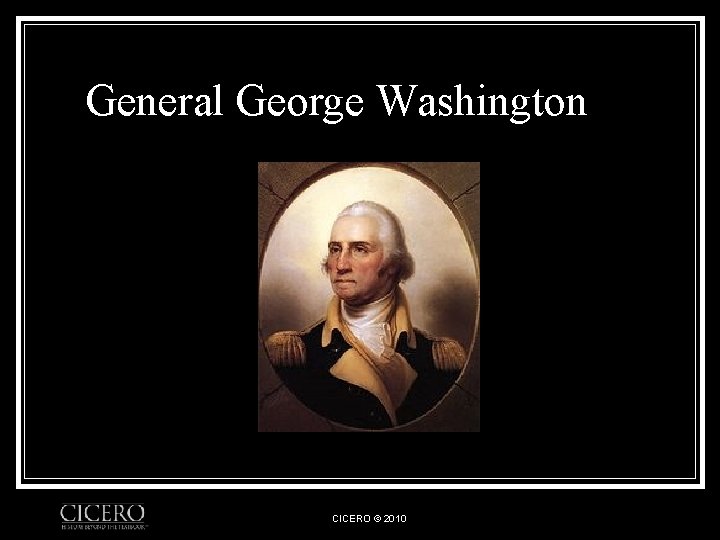
General George Washington CICERO © 2010
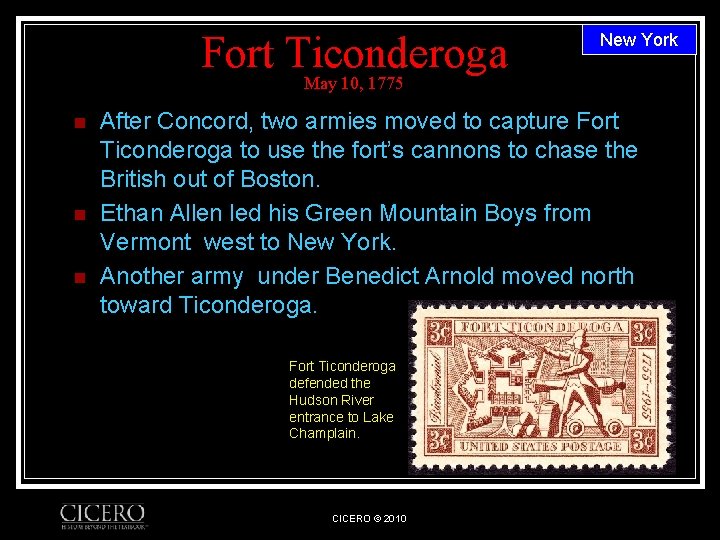
Fort Ticonderoga New York May 10, 1775 n n n After Concord, two armies moved to capture Fort Ticonderoga to use the fort’s cannons to chase the British out of Boston. Ethan Allen led his Green Mountain Boys from Vermont west to New York. Another army under Benedict Arnold moved north toward Ticonderoga. Fort Ticonderoga defended the Hudson River entrance to Lake Champlain. CICERO © 2010
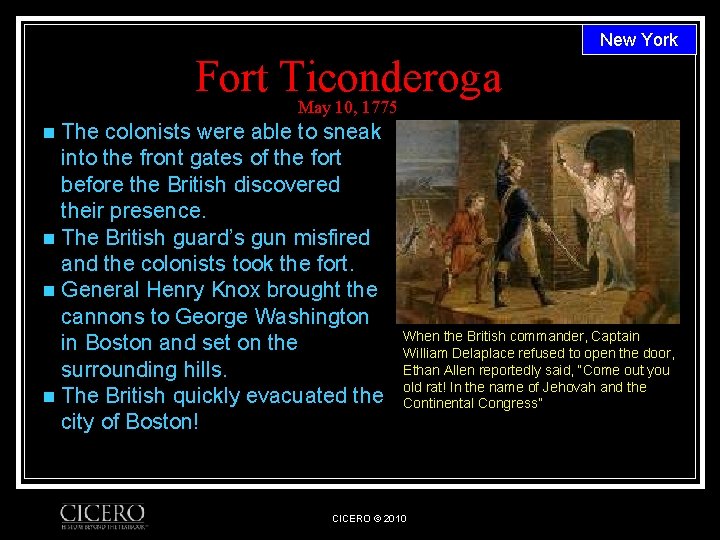
New York Fort Ticonderoga May 10, 1775 The colonists were able to sneak into the front gates of the fort before the British discovered their presence. n The British guard’s gun misfired and the colonists took the fort. n General Henry Knox brought the cannons to George Washington in Boston and set on the surrounding hills. n The British quickly evacuated the city of Boston! n When the British commander, Captain William Delaplace refused to open the door, Ethan Allen reportedly said, “Come out you old rat! In the name of Jehovah and the Continental Congress” CICERO © 2010
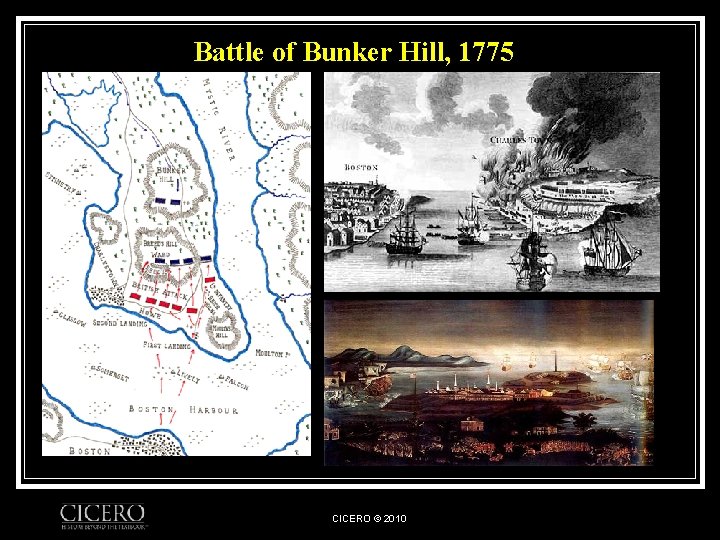
Battle of Bunker Hill, 1775 CICERO © 2010
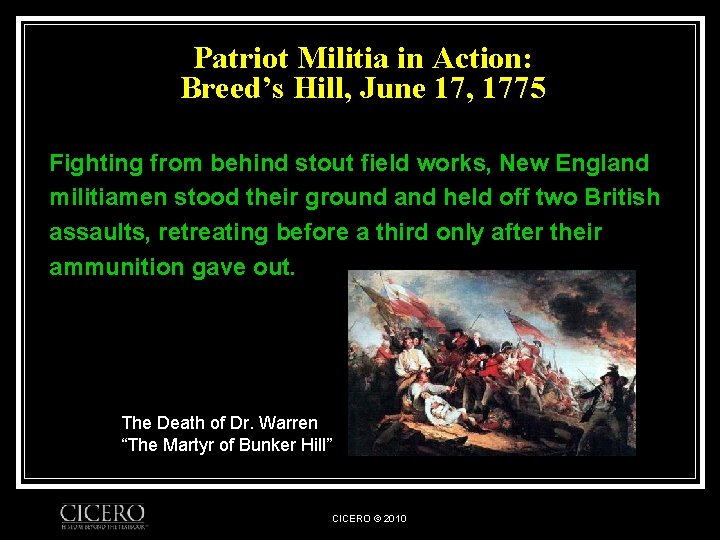
Patriot Militia in Action: Breed’s Hill, June 17, 1775 Fighting from behind stout field works, New England militiamen stood their ground and held off two British assaults, retreating before a third only after their ammunition gave out. The Death of Dr. Warren “The Martyr of Bunker Hill” CICERO © 2010
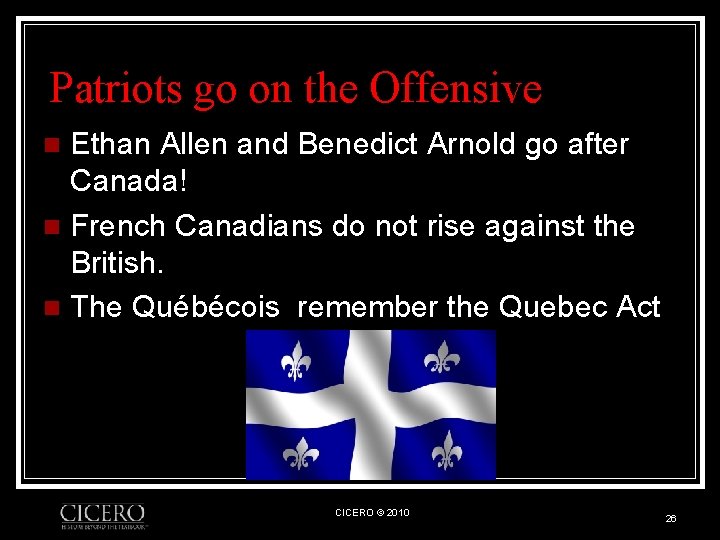
Patriots go on the Offensive Ethan Allen and Benedict Arnold go after Canada! n French Canadians do not rise against the British. n The Québécois remember the Quebec Act n CICERO © 2010 26
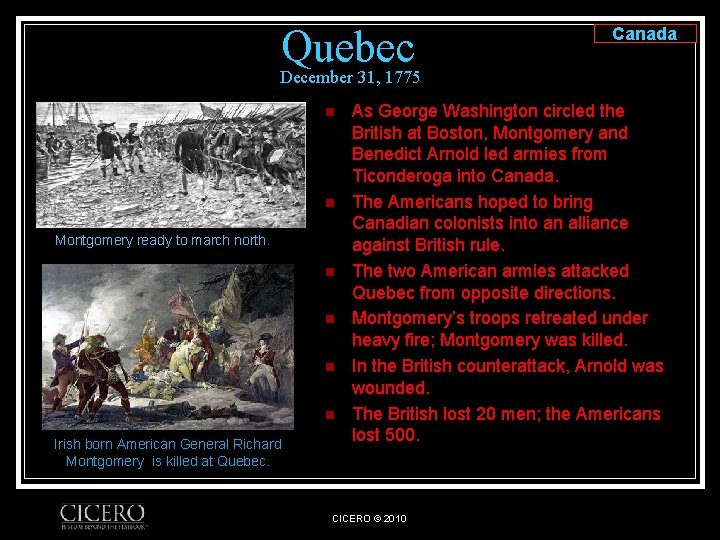
Quebec Canada December 31, 1775 n n Montgomery ready to march north. n n Irish born American General Richard Montgomery is killed at Quebec. As George Washington circled the British at Boston, Montgomery and Benedict Arnold led armies from Ticonderoga into Canada. The Americans hoped to bring Canadian colonists into an alliance against British rule. The two American armies attacked Quebec from opposite directions. Montgomery’s troops retreated under heavy fire; Montgomery was killed. In the British counterattack, Arnold was wounded. The British lost 20 men; the Americans lost 500. CICERO © 2010 Cicero © 2007
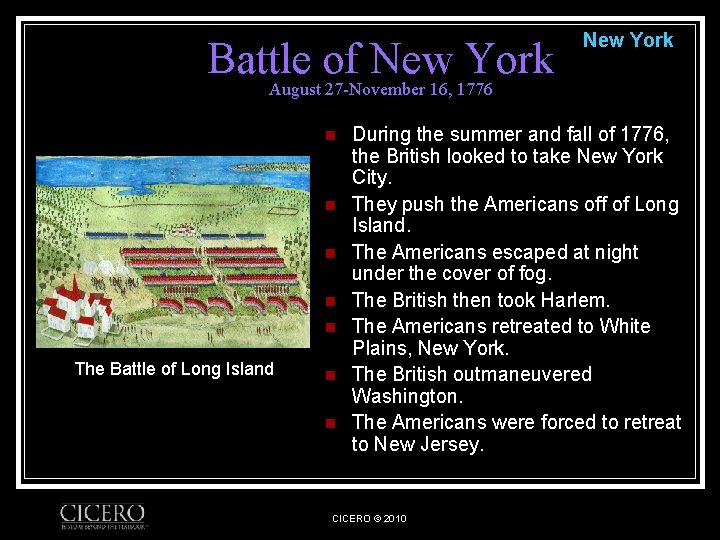
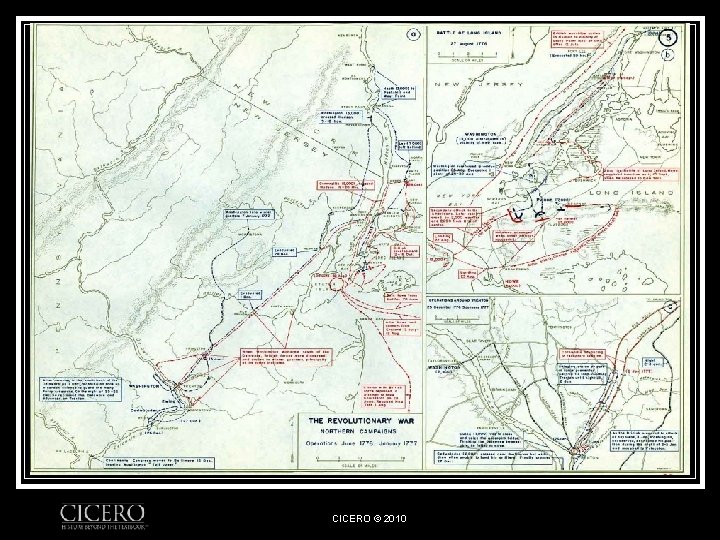
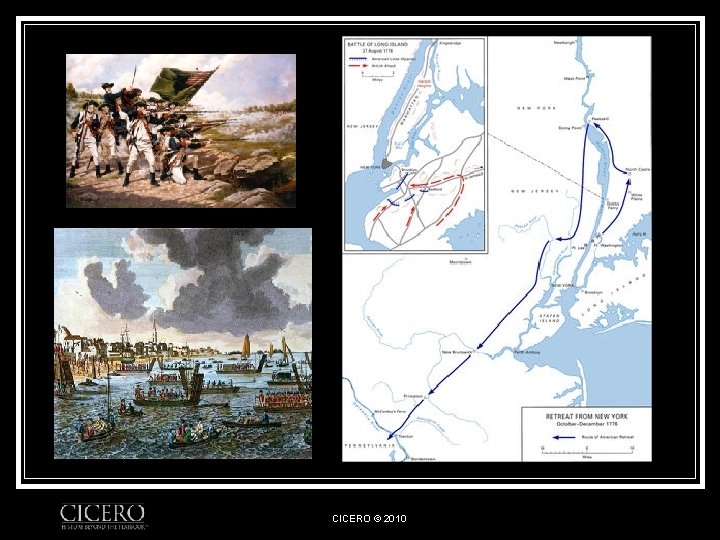
Battle of New York August 27 -November 16, 1776 n n n The Battle of Long Island n n During the summer and fall of 1776, the British looked to take New York City. They push the Americans off of Long Island. The Americans escaped at night under the cover of fog. The British then took Harlem. The Americans retreated to White Plains, New York. The British outmaneuvered Washington. The Americans were forced to retreat to New Jersey. CICERO © 2010 Cicero © 2007
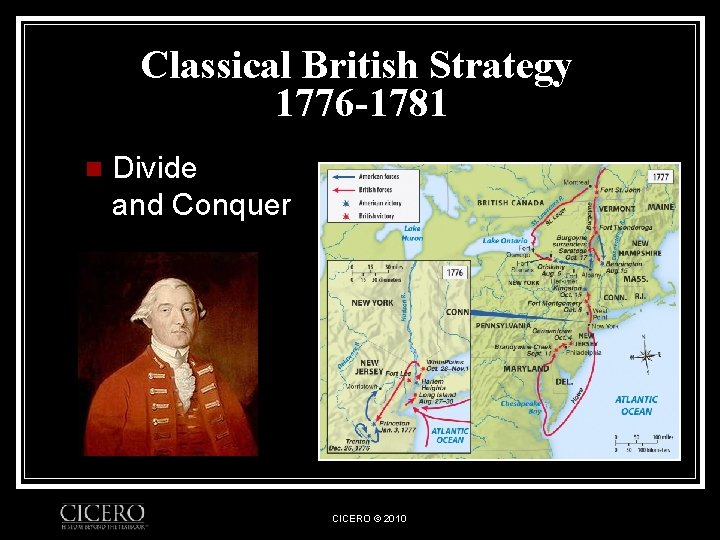
Classical British Strategy 1776 -1781 n Divide and Conquer CICERO © 2010
CICERO © 2010
CICERO © 2010
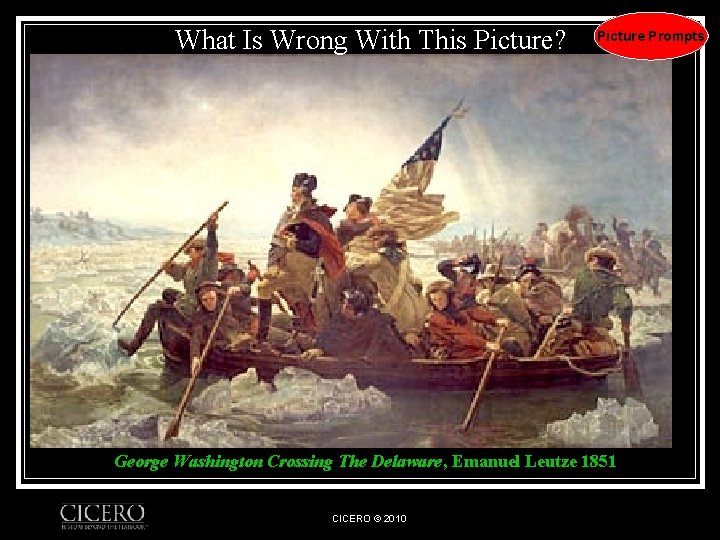
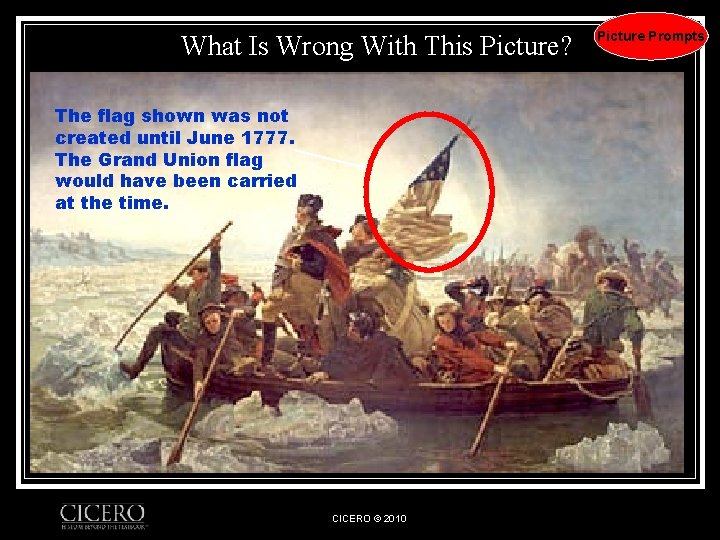
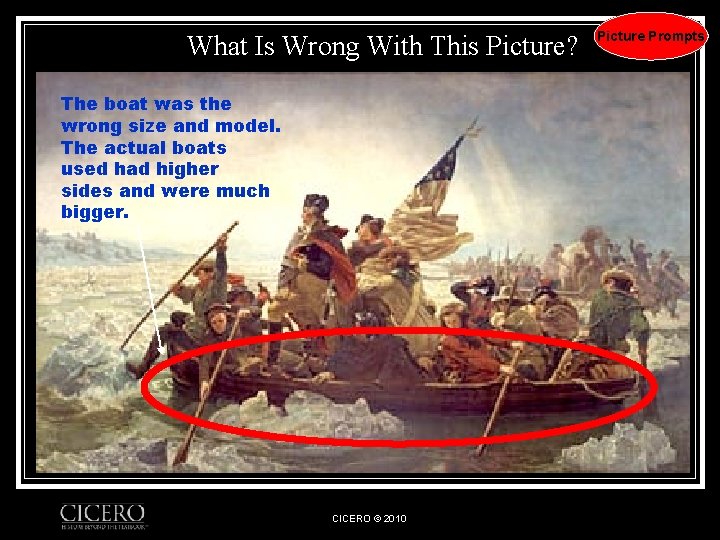
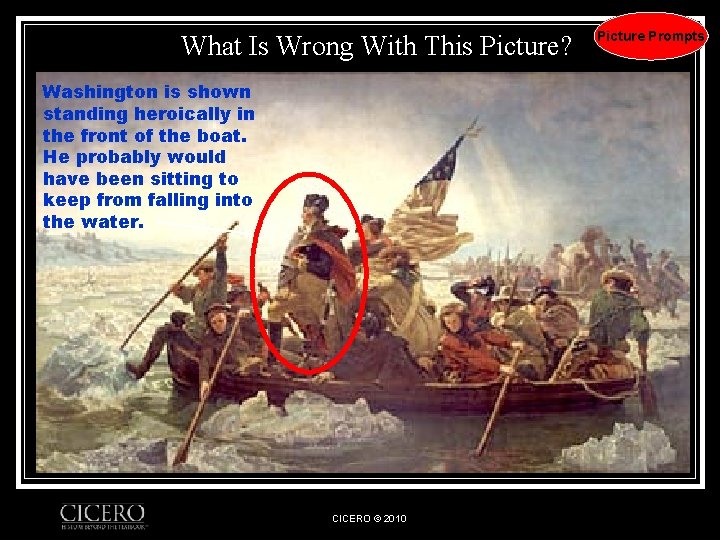
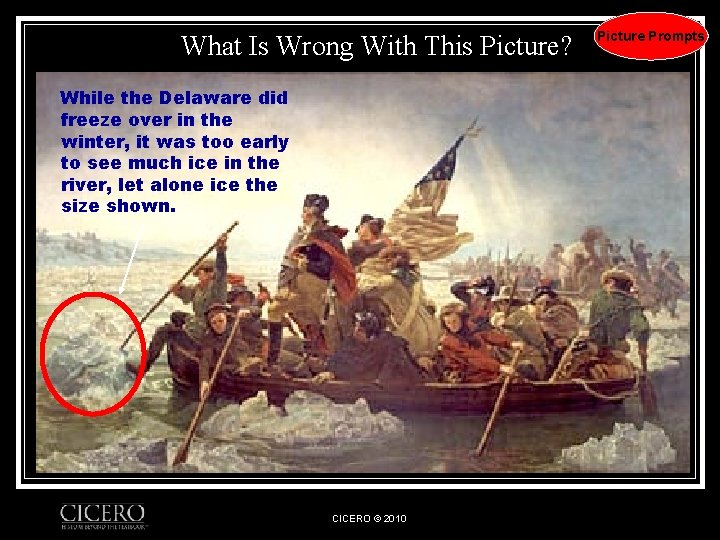
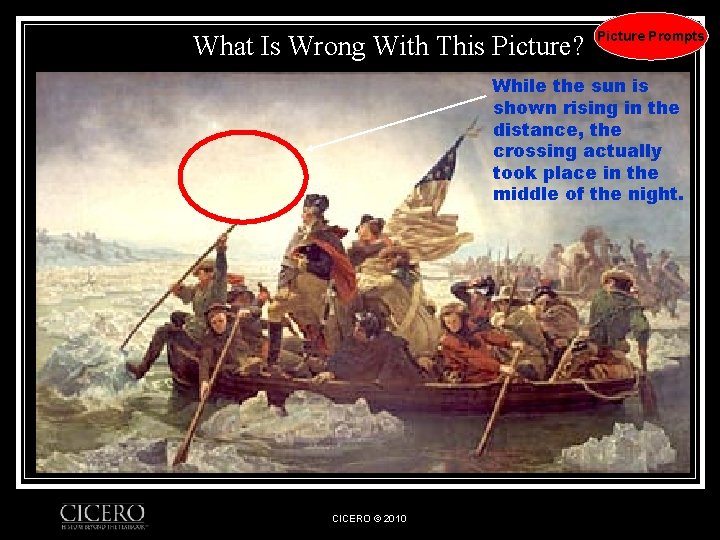
What Is Wrong With This Picture? Picture Prompts George Washington Crossing The Delaware, Emanuel Leutze 1851 CICERO © 2010
What Is Wrong With This Picture? The flag shown was not created until June 1777. The Grand Union flag would have been carried at the time. CICERO © 2010 Picture Prompts
What Is Wrong With This Picture? The boat was the wrong size and model. The actual boats used had higher sides and were much bigger. CICERO © 2010 Picture Prompts
What Is Wrong With This Picture? Washington is shown standing heroically in the front of the boat. He probably would have been sitting to keep from falling into the water. CICERO © 2010 Picture Prompts
What Is Wrong With This Picture? While the Delaware did freeze over in the winter, it was too early to see much ice in the river, let alone ice the size shown. CICERO © 2010 Picture Prompts
What Is Wrong With This Picture? Picture Prompts While the sun is shown rising in the distance, the crossing actually took place in the middle of the night. CICERO © 2010
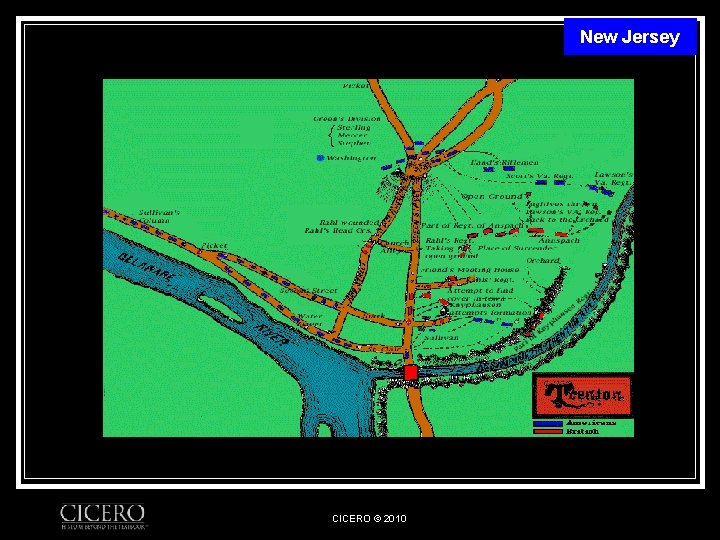
The Battle of Trenton New Jersey December 26, 1776 n n n German Soldiers at Trenton n Hessian Barracks at Trenton In December 1776, morale was low Enlistments of Continental soldiers were due to run out General Washington needed a quick victory to raise prospects for eventual success. Christmas night, Washington crossed the ice-filled Delaware River to attack unsuspecting German soldiers guarding Trenton. The Germans were surprised and defeated within a half hour. Washington’s troops took needed supplies, along with artillery. CICERO © 2010 Cicero © 2007
New Jersey CICERO © 2010
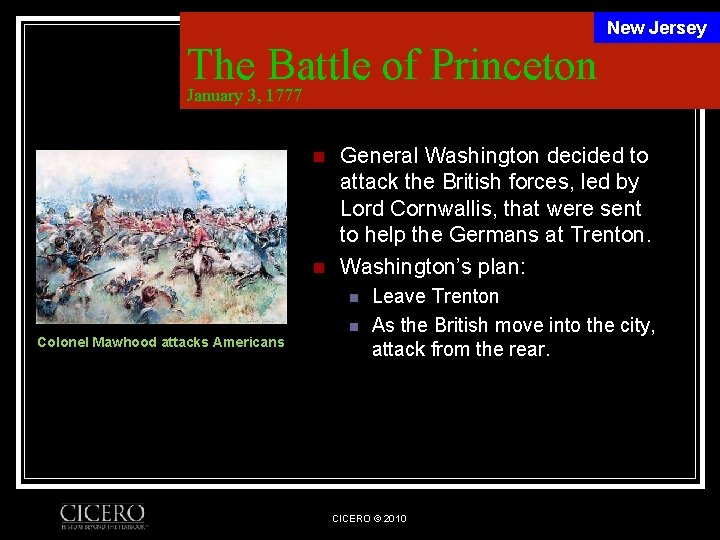
New Jersey The Battle of Princeton January 3, 1777 n n General Washington decided to attack the British forces, led by Lord Cornwallis, that were sent to help the Germans at Trenton. Washington’s plan: n Colonel Mawhood attacks Americans n Leave Trenton As the British move into the city, attack from the rear. CICERO © 2010 Cicero © 2007
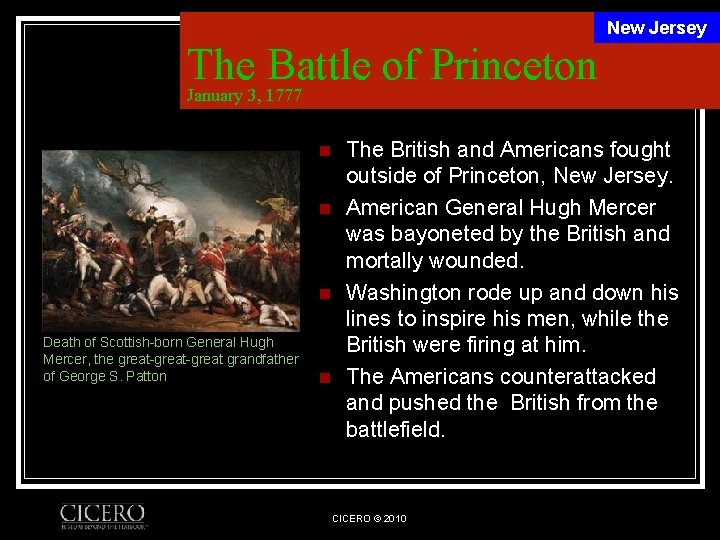
New Jersey The Battle of Princeton January 3, 1777 n n n Death of Scottish-born General Hugh Mercer, the great-great grandfather of George S. Patton n The British and Americans fought outside of Princeton, New Jersey. American General Hugh Mercer was bayoneted by the British and mortally wounded. Washington rode up and down his lines to inspire his men, while the British were firing at him. The Americans counterattacked and pushed the British from the battlefield. CICERO © 2010 Cicero © 2007
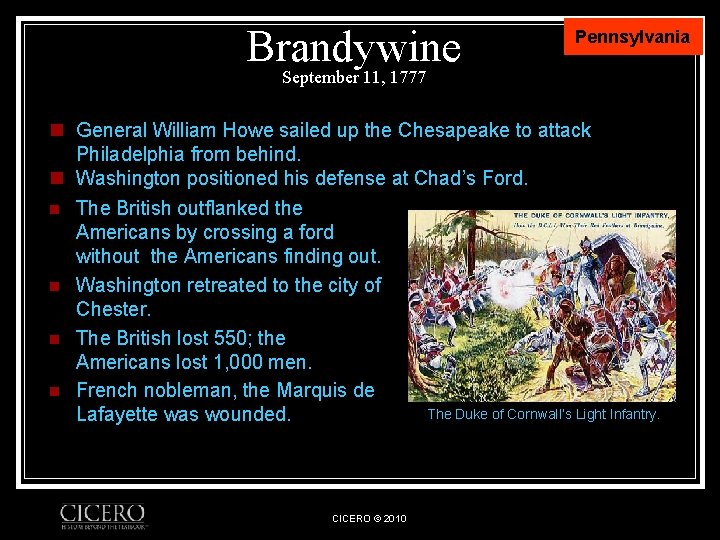
Brandywine Pennsylvania September 11, 1777 n General William Howe sailed up the Chesapeake to attack Philadelphia from behind. n Washington positioned his defense at Chad’s Ford. n The British outflanked the Americans by crossing a ford without the Americans finding out. n Washington retreated to the city of Chester. n The British lost 550; the Americans lost 1, 000 men. n French nobleman, the Marquis de The Duke of Cornwall’s Light Infantry. Lafayette was wounded. CICERO © 2010 Cicero © 2007
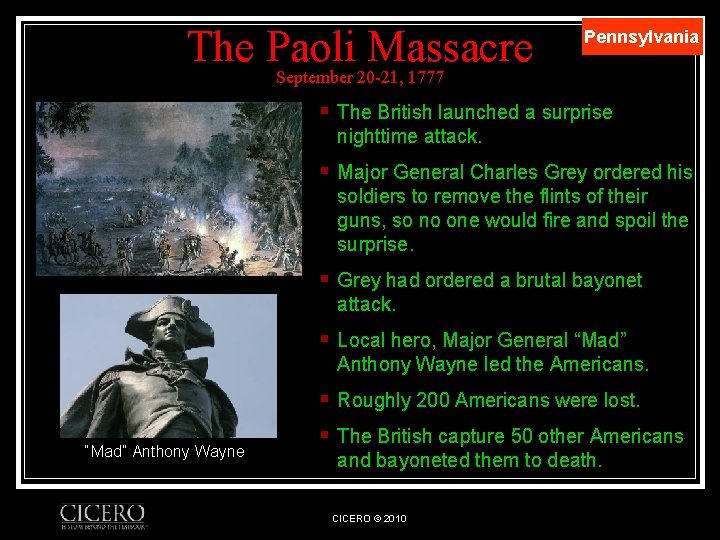
The Paoli Massacre Pennsylvania September 20 -21, 1777 § The British launched a surprise nighttime attack. § Major General Charles Grey ordered his soldiers to remove the flints of their guns, so no one would fire and spoil the surprise. § Grey had ordered a brutal bayonet attack. § Local hero, Major General “Mad” Anthony Wayne led the Americans. “Mad” Anthony Wayne § Roughly 200 Americans were lost. § The British capture 50 other Americans and bayoneted them to death. CICERO © 2010 Cicero © 2007
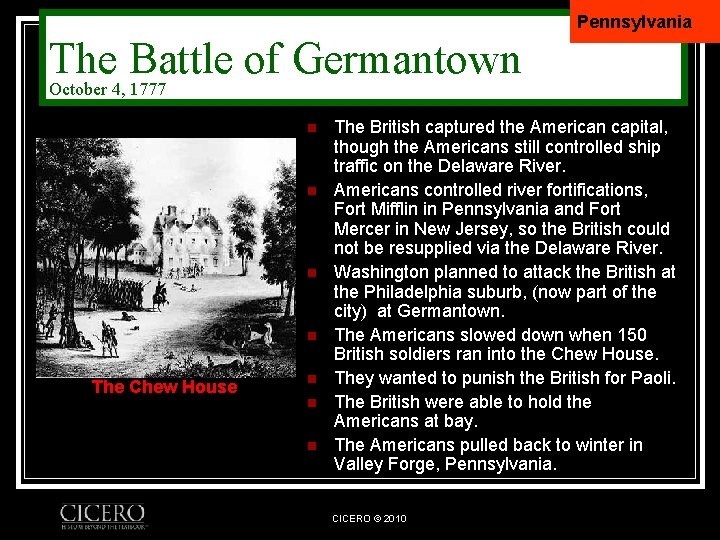
Pennsylvania The Battle of Germantown October 4, 1777 n n The Chew House n n n The British captured the American capital, though the Americans still controlled ship traffic on the Delaware River. Americans controlled river fortifications, Fort Mifflin in Pennsylvania and Fort Mercer in New Jersey, so the British could not be resupplied via the Delaware River. Washington planned to attack the British at the Philadelphia suburb, (now part of the city) at Germantown. The Americans slowed down when 150 British soldiers ran into the Chew House. They wanted to punish the British for Paoli. The British were able to hold the Americans at bay. The Americans pulled back to winter in Valley Forge, Pennsylvania. CICERO © 2010 Cicero © 2007
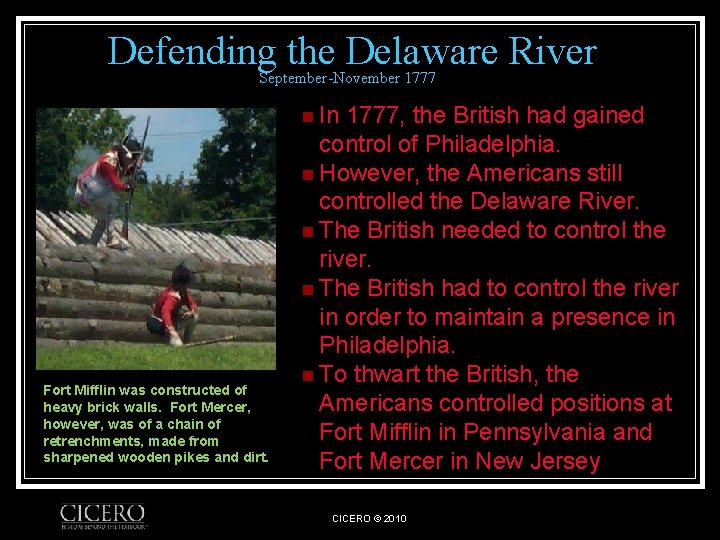
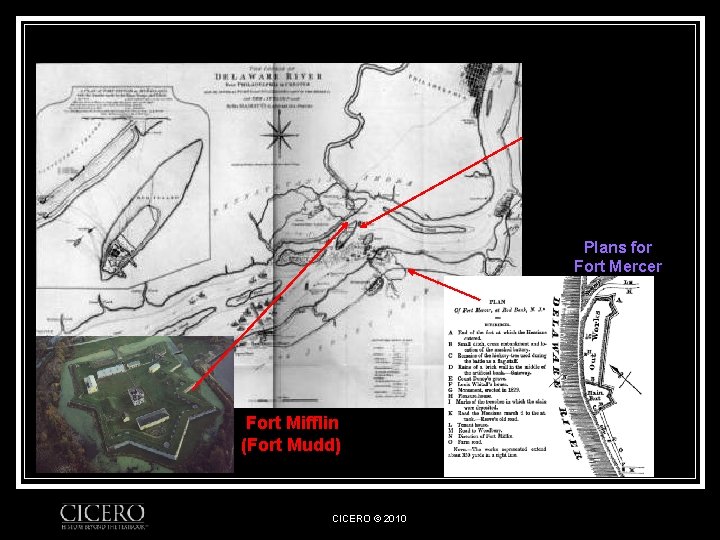
Defending the Delaware River September-November 1777 n In Fort Mifflin was constructed of heavy brick walls. Fort Mercer, however, was of a chain of retrenchments, made from sharpened wooden pikes and dirt. 1777, the British had gained control of Philadelphia. n However, the Americans still controlled the Delaware River. n The British needed to control the river. n The British had to control the river in order to maintain a presence in Philadelphia. n To thwart the British, the Americans controlled positions at Fort Mifflin in Pennsylvania and Fort Mercer in New Jersey CICERO © 2010
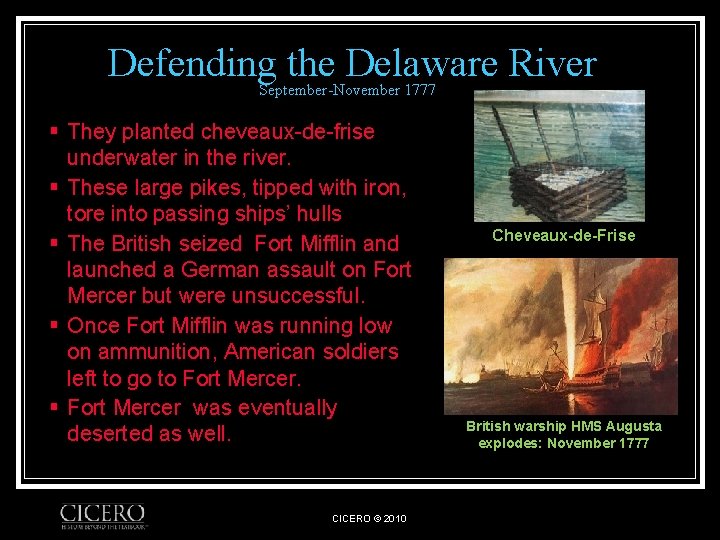
Defending the Delaware River September-November 1777 § They planted cheveaux-de-frise underwater in the river. § These large pikes, tipped with iron, tore into passing ships’ hulls § The British seized Fort Mifflin and launched a German assault on Fort Mercer but were unsuccessful. § Once Fort Mifflin was running low on ammunition, American soldiers left to go to Fort Mercer. § Fort Mercer was eventually deserted as well. CICERO © 2010 Cheveaux-de-Frise British warship HMS Augusta explodes: November 1777
Plans for Fort Mercer Fort Mifflin (Fort Mudd) CICERO © 2010
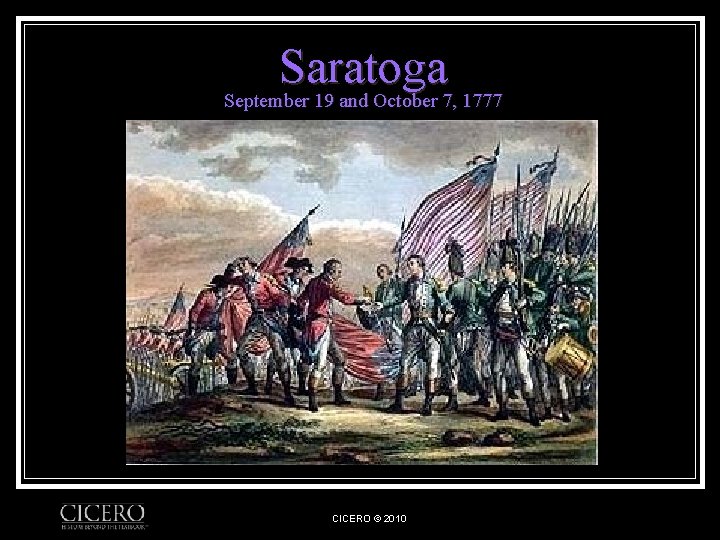
Saratoga September 19 and October 7, 1777 CICERO © 2010
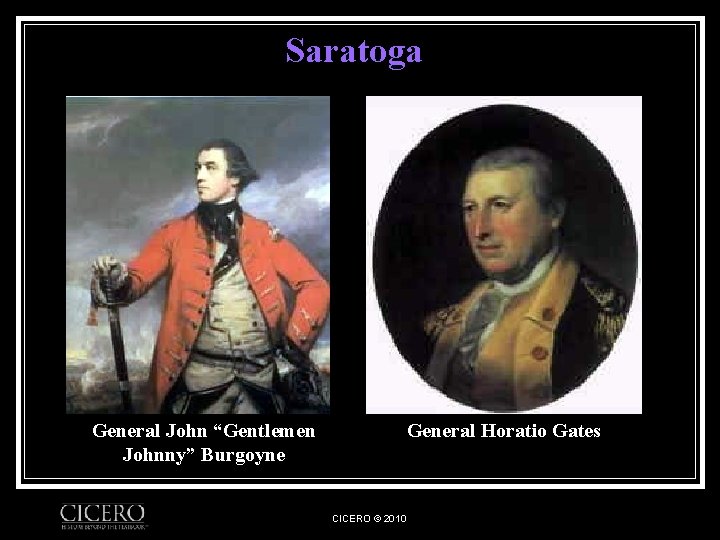
Saratoga General John “Gentlemen Johnny” Burgoyne General Horatio Gates CICERO © 2010
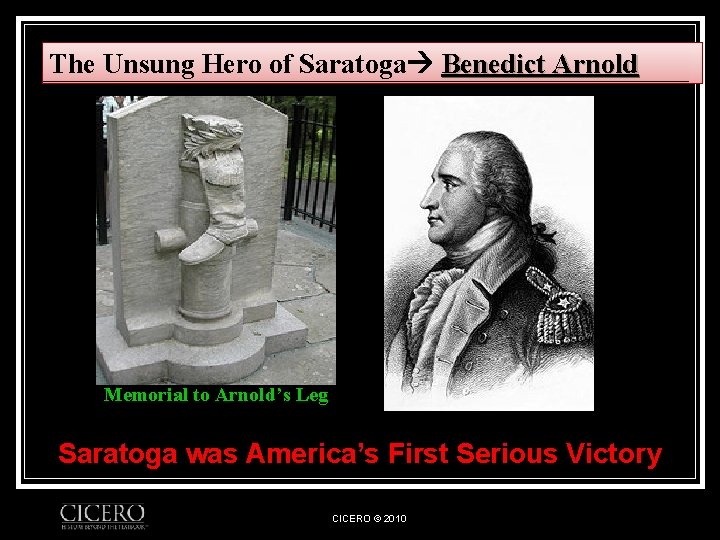
The Unsung Hero of Saratoga Benedict Arnold Memorial to Arnold’s Leg Saratoga was America’s First Serious Victory CICERO © 2010
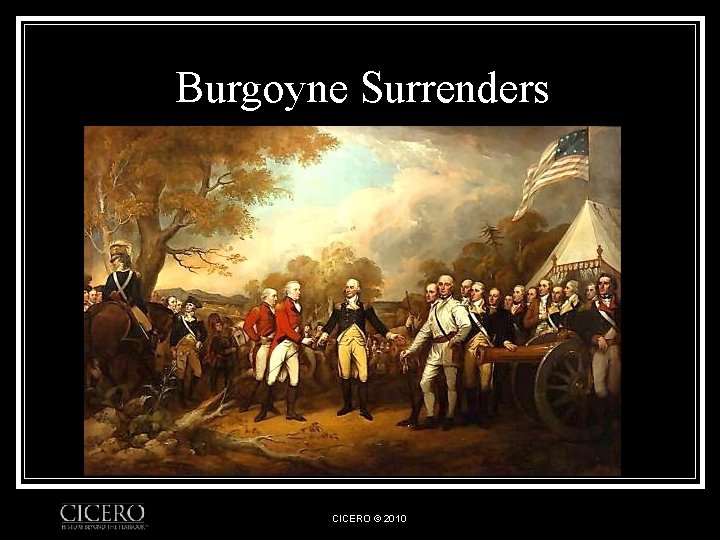
Burgoyne Surrenders CICERO © 2010
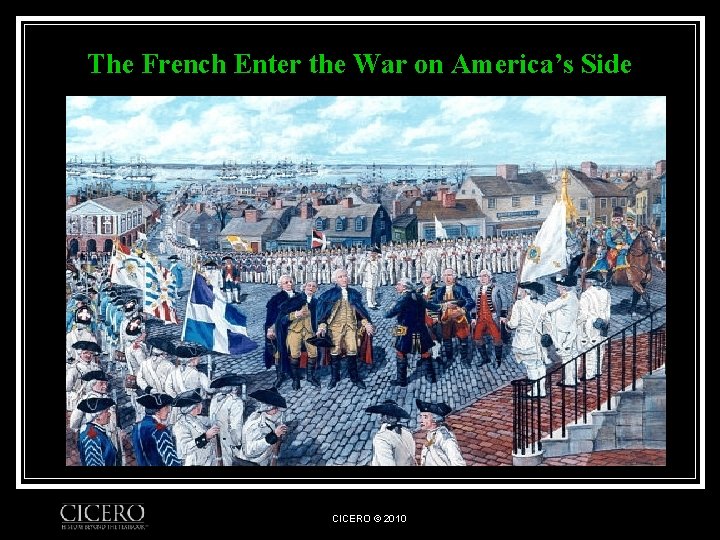
The French Enter the War on America’s Side CICERO © 2010
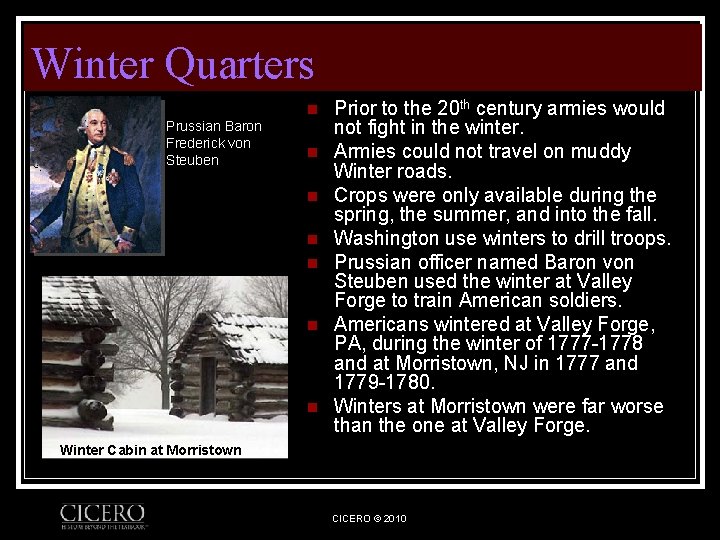
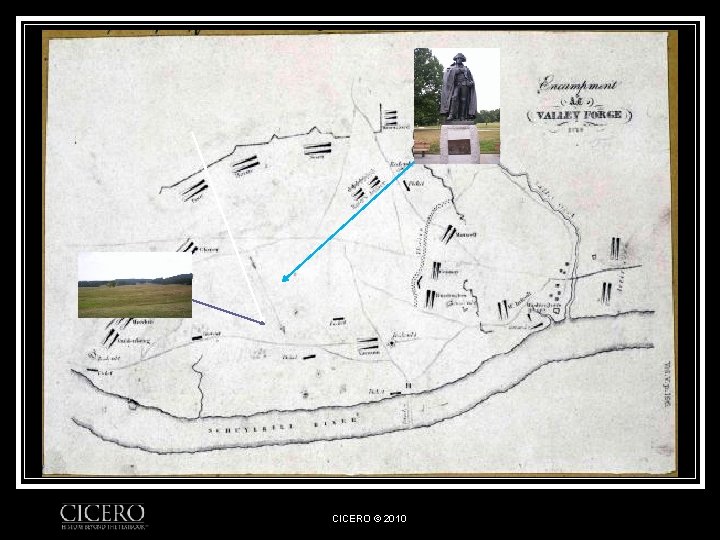
Winter Quarters n Prussian Baron Frederick von Steuben n n n Prior to the 20 th century armies would not fight in the winter. Armies could not travel on muddy Winter roads. Crops were only available during the spring, the summer, and into the fall. Washington use winters to drill troops. Prussian officer named Baron von Steuben used the winter at Valley Forge to train American soldiers. Americans wintered at Valley Forge, PA, during the winter of 1777 -1778 and at Morristown, NJ in 1777 and 1779 -1780. Winters at Morristown were far worse than the one at Valley Forge. Winter Cabin at Morristown Twelve men to a cabin CICERO © 2010 Cicero © 2007
CICERO © 2010
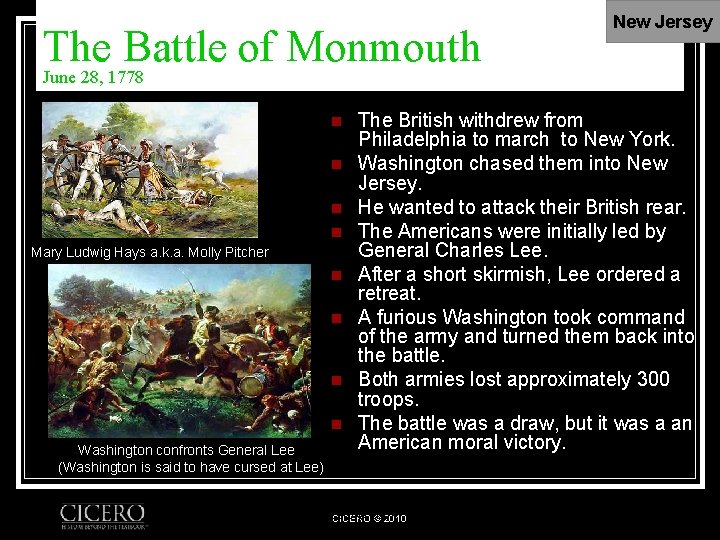
The Battle of Monmouth New Jersey June 28, 1778 n n Mary Ludwig Hays a. k. a. Molly Pitcher n n Washington confronts General Lee (Washington is said to have cursed at Lee) The British withdrew from Philadelphia to march to New York. Washington chased them into New Jersey. He wanted to attack their British rear. The Americans were initially led by General Charles Lee. After a short skirmish, Lee ordered a retreat. A furious Washington took command of the army and turned them back into the battle. Both armies lost approximately 300 troops. The battle was a draw, but it was a an American moral victory. Cicero © 2007 CICERO © 2010
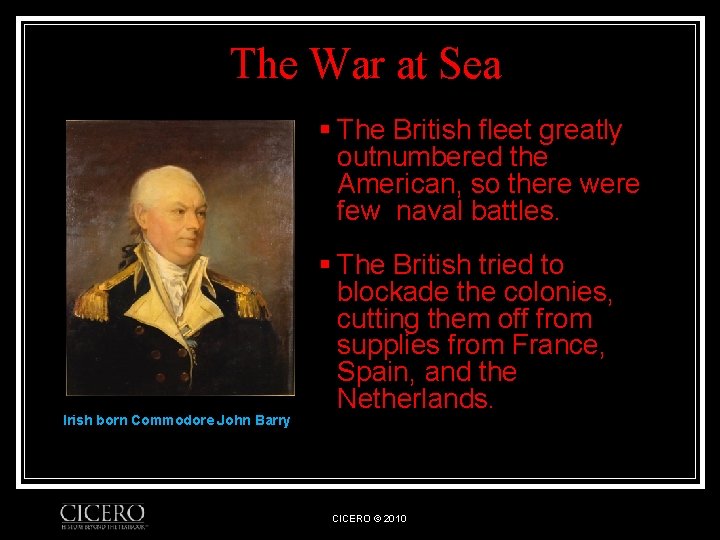
The War at Sea § The British fleet greatly outnumbered the American, so there were few naval battles. Irish born Commodore John Barry § The British tried to blockade the colonies, cutting them off from supplies from France, Spain, and the Netherlands. CICERO © 2010
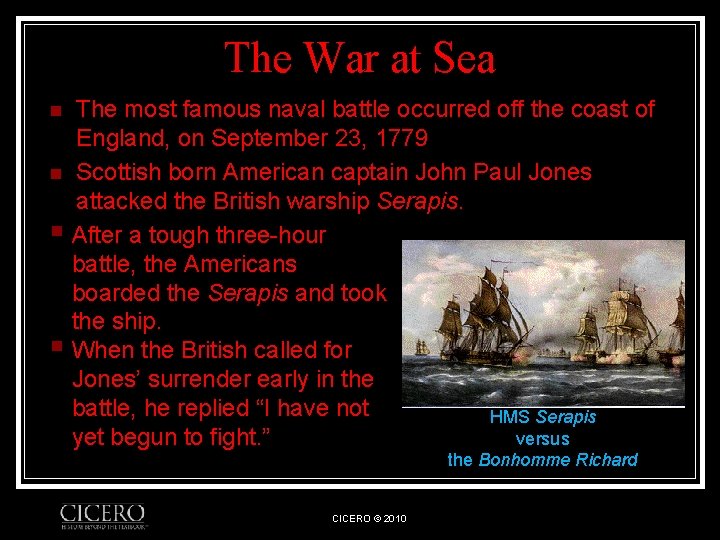
The War at Sea n n § § The most famous naval battle occurred off the coast of England, on September 23, 1779 Scottish born American captain John Paul Jones attacked the British warship Serapis. After a tough three-hour battle, the Americans boarded the Serapis and took the ship. When the British called for Jones’ surrender early in the battle, he replied “I have not HMS Serapis yet begun to fight. ” versus the Bonhomme Richard CICERO © 2010 Cicero © 2007
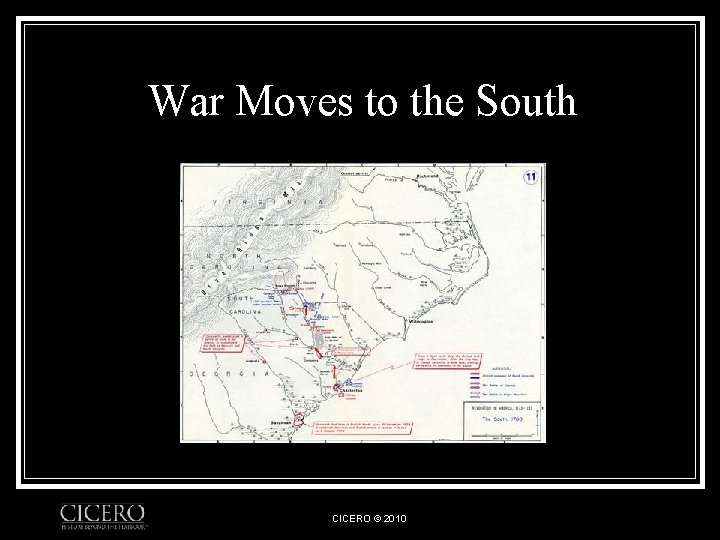
War Moves to the South CICERO © 2010
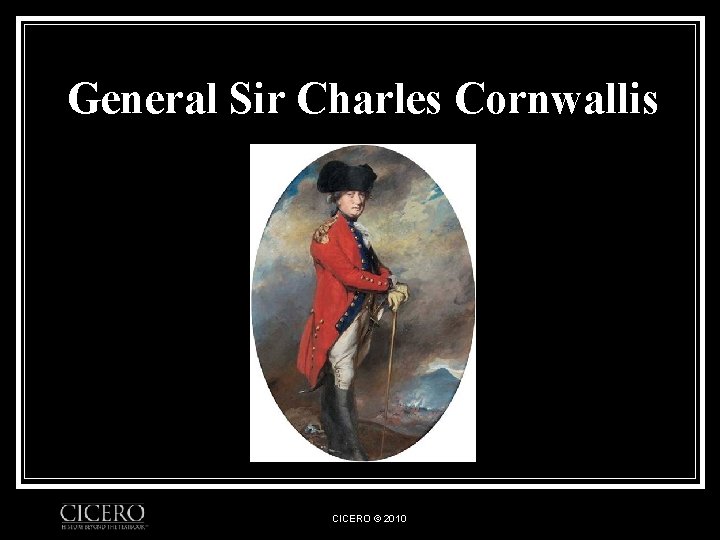
General Sir Charles Cornwallis CICERO © 2010
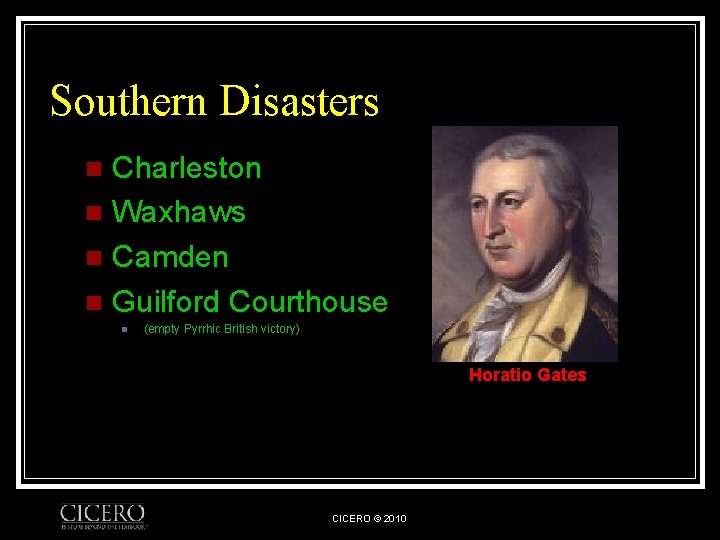
Southern Disasters Charleston n Waxhaws n Camden n Guilford Courthouse n n (empty Pyrrhic British victory) Horatio Gates CICERO © 2010
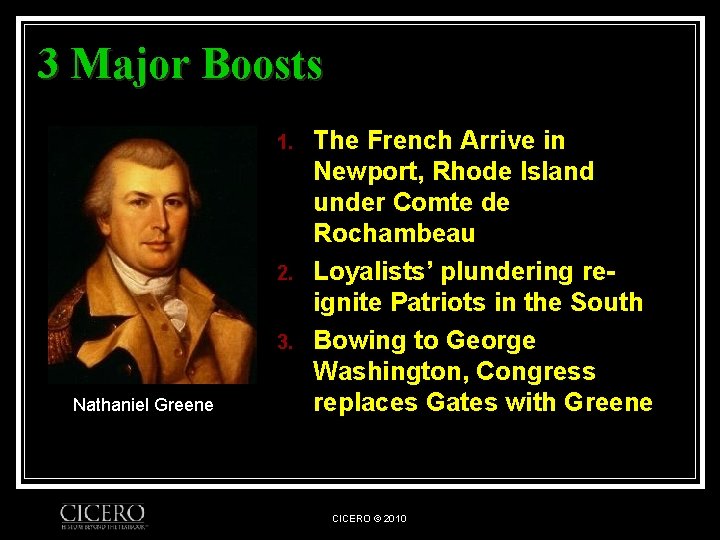
3 Major Boosts 1. 2. 3. Nathaniel Greene The French Arrive in Newport, Rhode Island under Comte de Rochambeau Loyalists’ plundering reignite Patriots in the South Bowing to George Washington, Congress replaces Gates with Greene CICERO © 2010
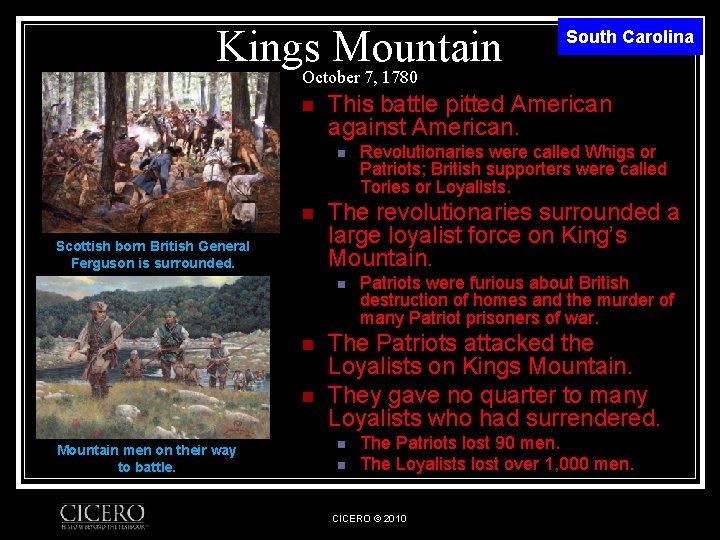
Kings Mountain South Carolina October 7, 1780 n This battle pitted American against American. n n Scottish born British General Ferguson is surrounded. The revolutionaries surrounded a large loyalist force on King’s Mountain. n n n Mountain men on their way to battle. Revolutionaries were called Whigs or Patriots; British supporters were called Tories or Loyalists. Patriots were furious about British destruction of homes and the murder of many Patriot prisoners of war. The Patriots attacked the Loyalists on Kings Mountain. They gave no quarter to many Loyalists who had surrendered. n n The Patriots lost 90 men. The Loyalists lost over 1, 000 men. CICERO © 2010
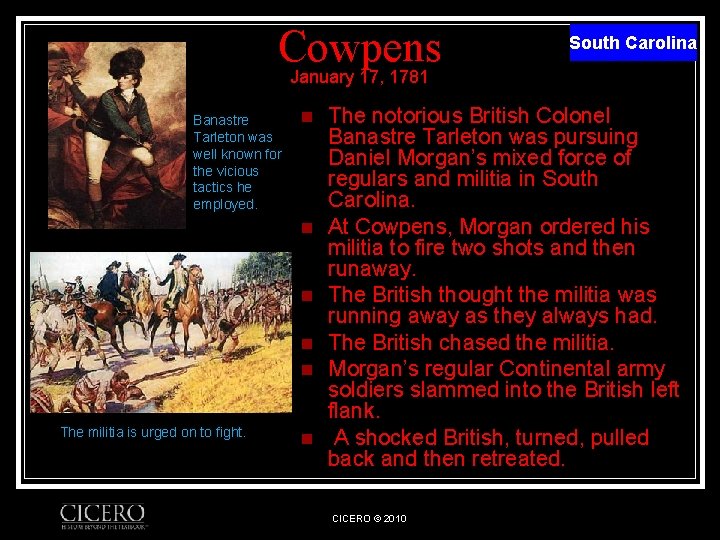
Cowpens South Carolina January 17, 1781 Banastre Tarleton was well known for the vicious tactics he employed. n n n The militia is urged on to fight. n The notorious British Colonel Banastre Tarleton was pursuing Daniel Morgan’s mixed force of regulars and militia in South Carolina. At Cowpens, Morgan ordered his militia to fire two shots and then runaway. The British thought the militia was running away as they always had. The British chased the militia. Morgan’s regular Continental army soldiers slammed into the British left flank. A shocked British, turned, pulled back and then retreated. CICERO © 2010
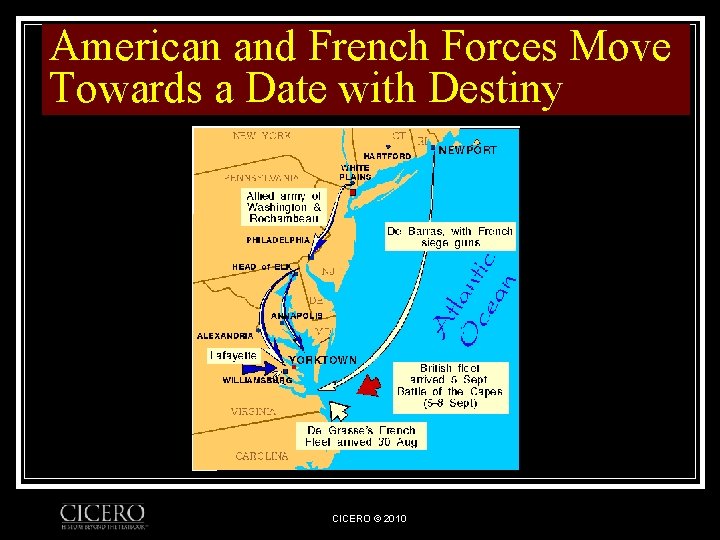
American and French Forces Move Towards a Date with Destiny CICERO © 2010
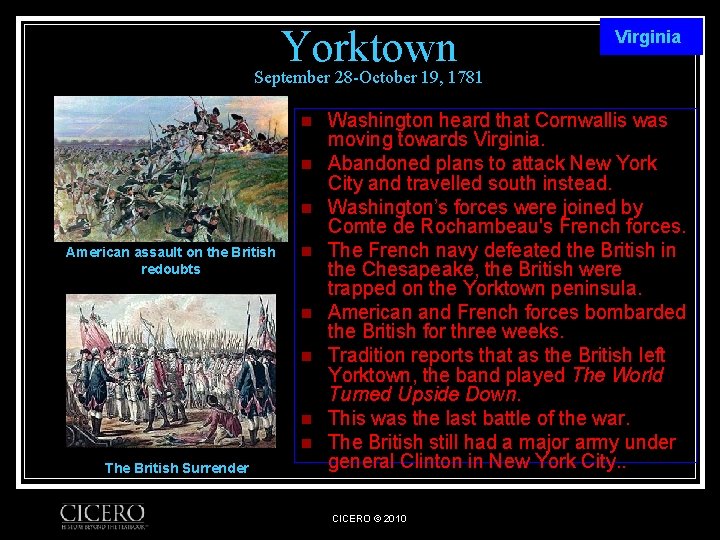
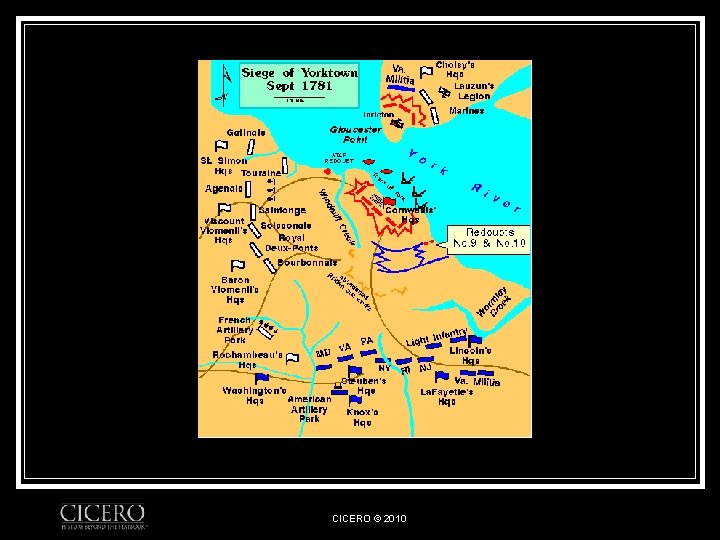
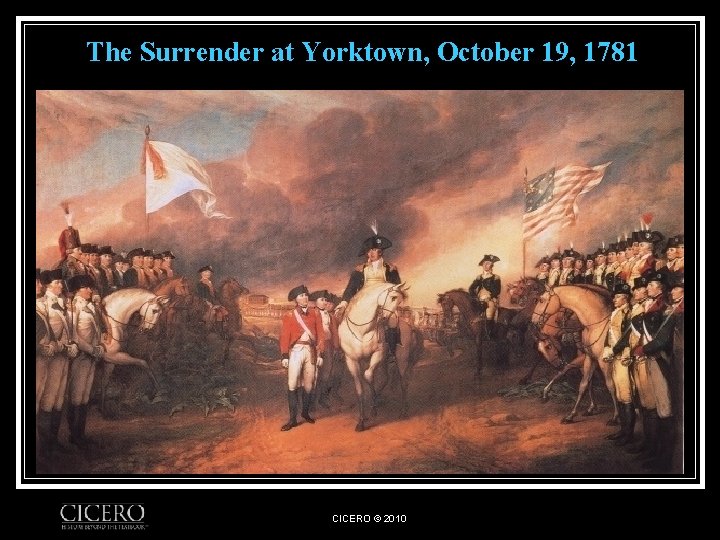
Yorktown Virginia September 28 -October 19, 1781 n n n American assault on the British redoubts n n n The British Surrender Washington heard that Cornwallis was moving towards Virginia. Abandoned plans to attack New York City and travelled south instead. Washington’s forces were joined by Comte de Rochambeau's French forces. The French navy defeated the British in the Chesapeake, the British were trapped on the Yorktown peninsula. American and French forces bombarded the British for three weeks. Tradition reports that as the British left Yorktown, the band played The World Turned Upside Down. This was the last battle of the war. The British still had a major army under general Clinton in New York City. . CICERO © 2010
CICERO © 2010
The Surrender at Yorktown, October 19, 1781 CICERO © 2010
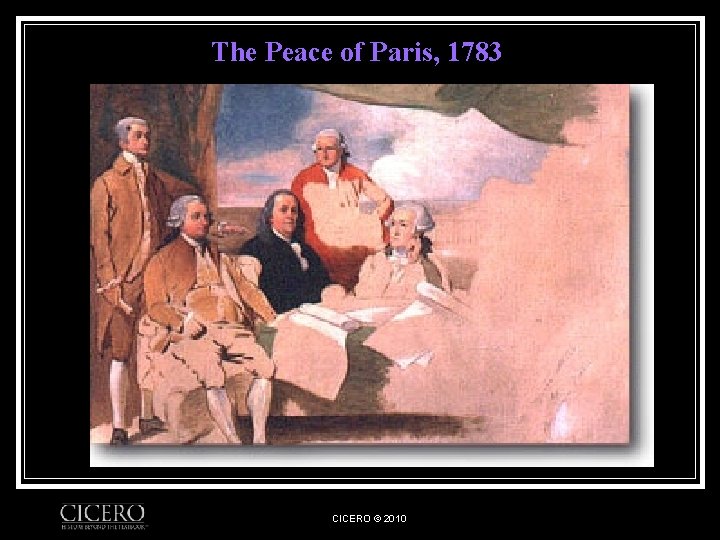
The Peace of Paris, 1783 CICERO © 2010