
The Revolution Begins Chapter 4 Section 1 First

The Revolution Begins Chapter 4 Section 1
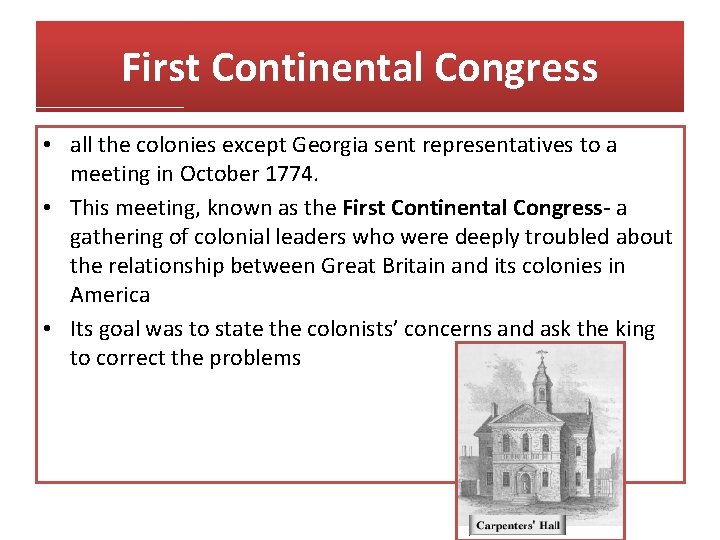
First Continental Congress • all the colonies except Georgia sent representatives to a meeting in October 1774. • This meeting, known as the First Continental Congress- a gathering of colonial leaders who were deeply troubled about the relationship between Great Britain and its colonies in America • Its goal was to state the colonists’ concerns and ask the king to correct the problems
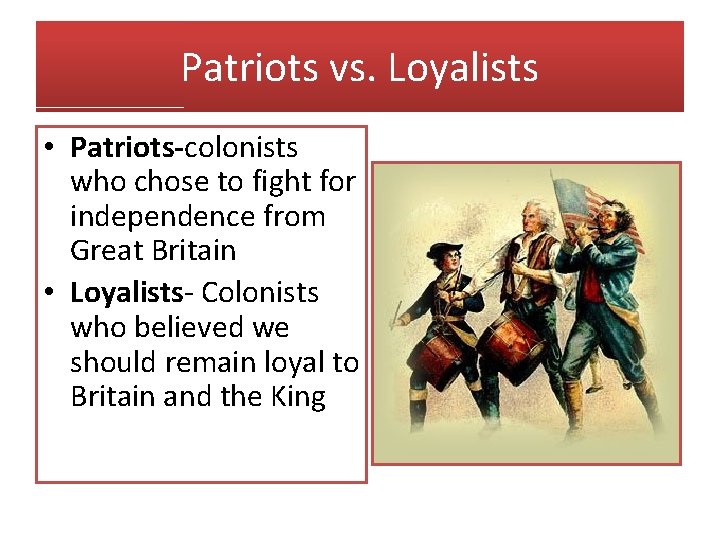
Patriots vs. Loyalists • Patriots-colonists who chose to fight for independence from Great Britain • Loyalists- Colonists who believed we should remain loyal to Britain and the King
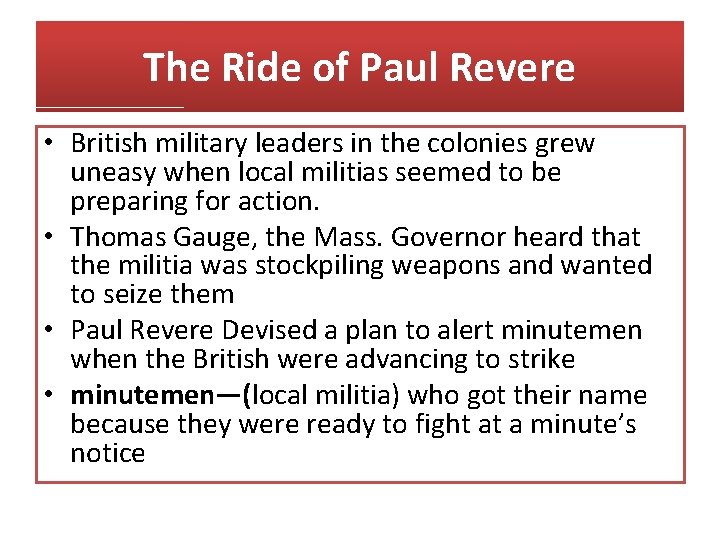
The Ride of Paul Revere • British military leaders in the colonies grew uneasy when local militias seemed to be preparing for action. • Thomas Gauge, the Mass. Governor heard that the militia was stockpiling weapons and wanted to seize them • Paul Revere Devised a plan to alert minutemen when the British were advancing to strike • minutemen—(local militia) who got their name because they were ready to fight at a minute’s notice
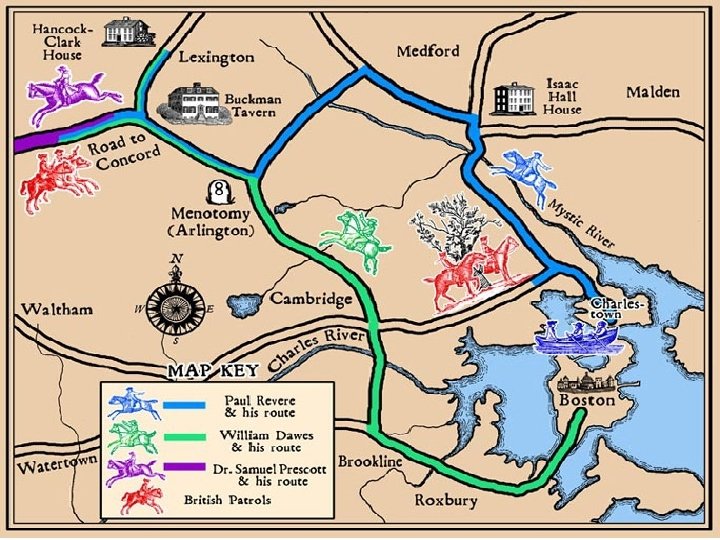
Battle at Lexington • At dawn on April 19, the British troops arrived at the town of Lexington, near Concord, where 70 armed minutemen waited. • Suddenly a shot rang out. • To this day, no one knows who fired this “shot heard ‘round the world. ” • When the smoke cleared, 8 of the badly outnumbered minutemen lay dead, and 10 were wounded. • The British, with only one soldier wounded, marched on to Concord
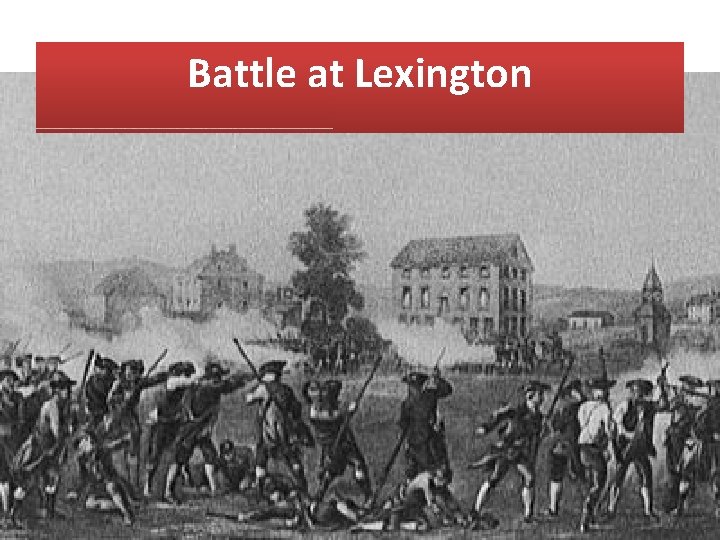
Battle at Lexington
Battle at Concord • When the British troops arrived most of the weapons in Concord had already been hidden • The British set fire to a few buildings during the siege which caused the minutemen to advance • For the skilled colonial marksmen of Concord, the British soldiers made an easy target • The British were forced to retreat to Boston, suffering many casualties along the way • Redcoat- nickname given to British soldiers
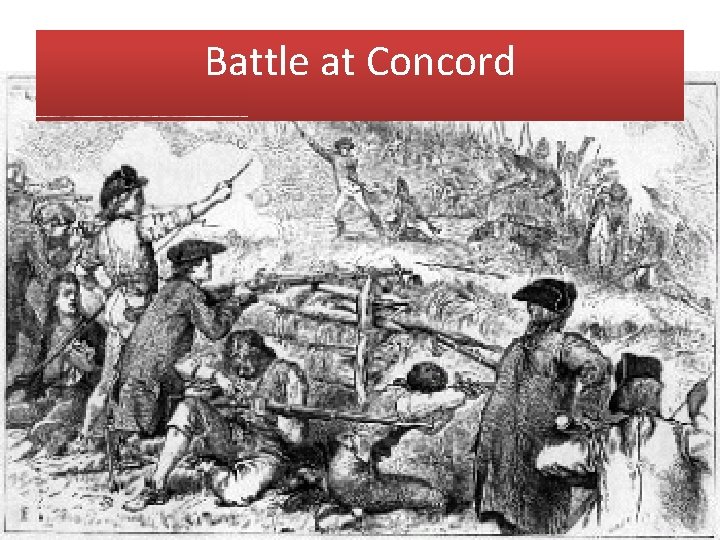
Battle at Concord
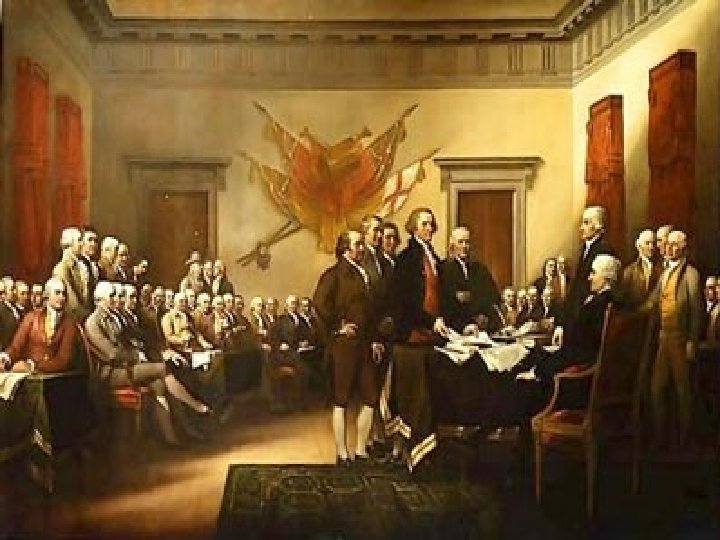
Second Continental Congress • In May 1775, delegates from 12 colonies met again in Philadelphia for the Second Continental Congress-which represented the first attempt at a Republican government in the colonies • They decided: – To begin writing state constitutions – To create the continental army – Put George Washington in charge of the army
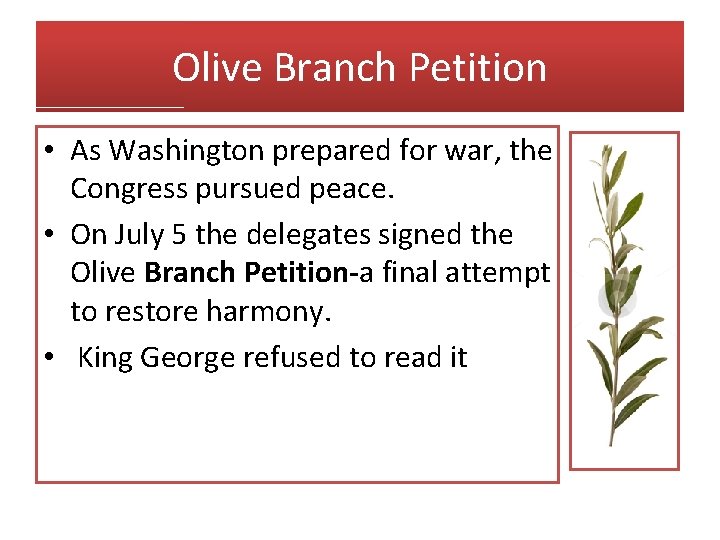
Olive Branch Petition • As Washington prepared for war, the Congress pursued peace. • On July 5 the delegates signed the Olive Branch Petition-a final attempt to restore harmony. • King George refused to read it
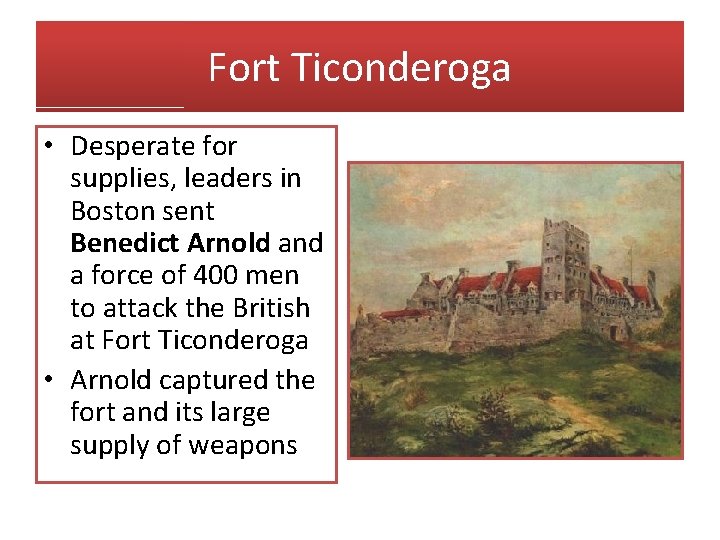
Fort Ticonderoga • Desperate for supplies, leaders in Boston sent Benedict Arnold and a force of 400 men to attack the British at Fort Ticonderoga • Arnold captured the fort and its large supply of weapons
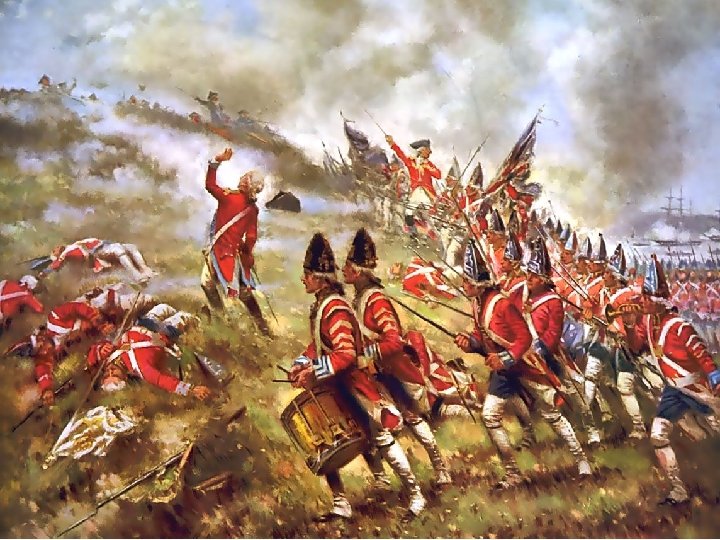
Bunker Hill • The colonial forces dug in at Breed’s Hill, a point overlooking north Boston • As the British force of 2, 400 advanced, 1, 600 militia members waited • They advance up the hill 3 times and finally the colonists ran out of gun powder • This famous conflict is now known as the Battle of Bunker Hill , although it was actually launched from Breed’s Hill
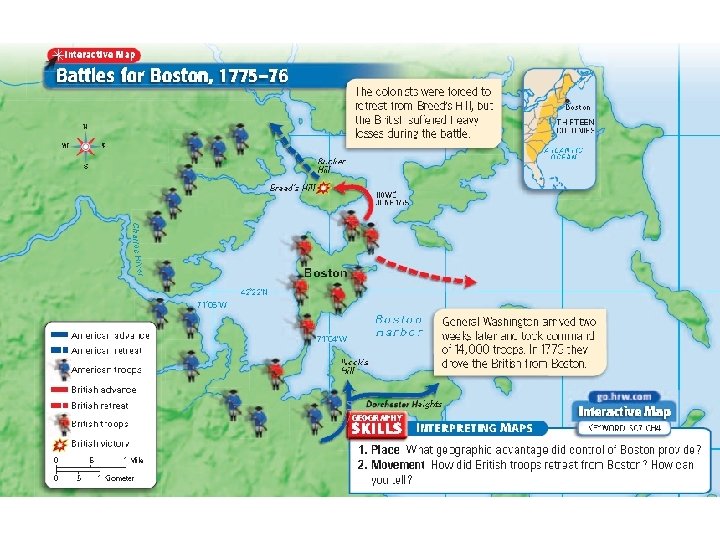
Dorchester Heights • On March 4, 1776, Washington moved his army to Dorchester Heights- an area that overlooked Boston from the south. • He stationed the cannons from Fort Ticonderoga and his troops overlooking British general William Howe’s position • On March 7 Howe retreated from Boston to Canada
Declaring Independence Chapter 4 Section 2
Paine’s Common Sense • Common Sense-a 47 -page pamphlet was distributed in Philadelphia in January 1776. – Common Sense was published anonymously—that is, without the author’s name. • The author, Thomas Paine, argued that citizens, not kings and queens, should make laws • It wanted: – Economic freedom – A military self defense. – No tyranny—that is, the abuse of government power
A New Philosophy of Government • Many colonial leaders agreed with Paine • The Declaration of Independence -formally announced the colonies’ break from Great Britain • It expressed three main ideas: – Thomas Jefferson-the document’s main author, argued that all people possess unalienable rights – That King George III had violated the colonists’ rights by taxing them without their consent – the colonies had the right to break from Britain
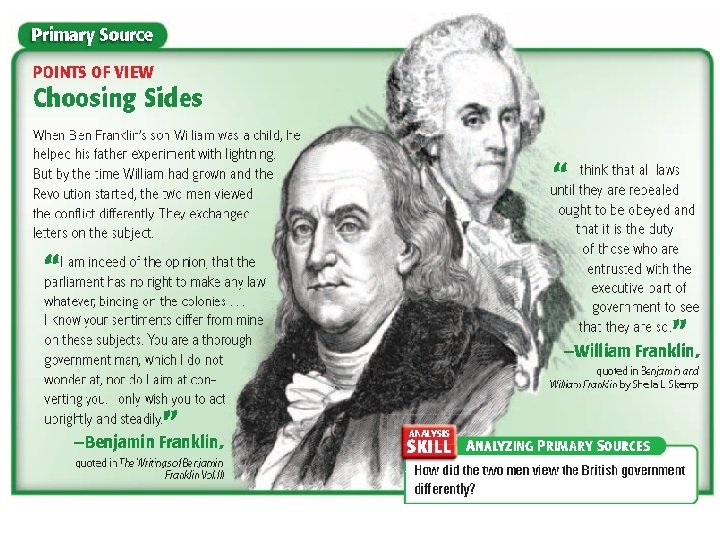
Choosing Sides • The signing of the Declaration made the rebellion a full-scale revolt against Britain • Patriots-colonists who chose to fight for independence from Great Britain • Loyalists- Colonists who believed we should remain loyal to Britain and the King • Historians estimate that: – 40 to 45 percent of Americans were Patriots – 20 to 30 percent were Loyalists – The rest were neutral.
Native Americans • Native Americans were at first encouraged by both sides to remain neutral. • By the summer of 1776, however, both Patriots and the British were aggressively recruiting Indian fighters. • Most sided with the British. • The Oneida and Tuscarora helped the Patriots
Unfinished Business • Today we recognize that the Declaration of Independence excluded many colonists • Although many women were Patriots, the Declaration did not address their rights. • At least one delegate’s wife, Abigail Adams, tried to influence her husband, John, to include women’s rights in the Declaration • The Declaration did not recognize the rights of enslaved Africans, either. • Even Thomas Jefferson, the main author of the Declaration, was a slaveholder
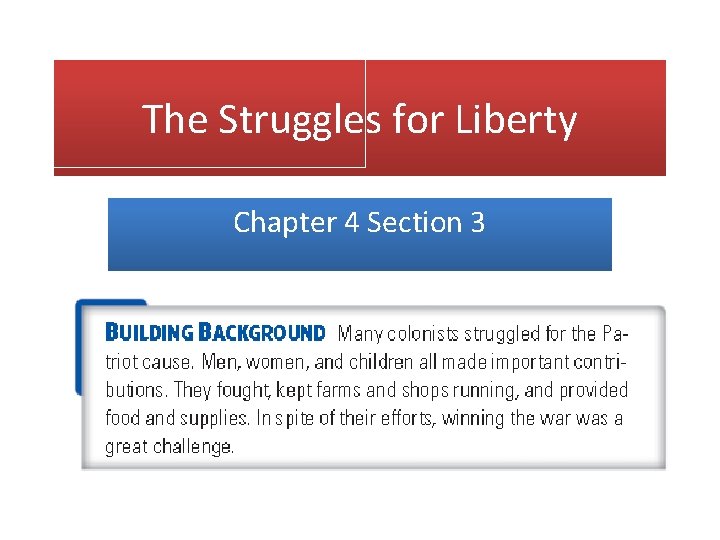
The Struggles for Liberty Chapter 4 Section 3
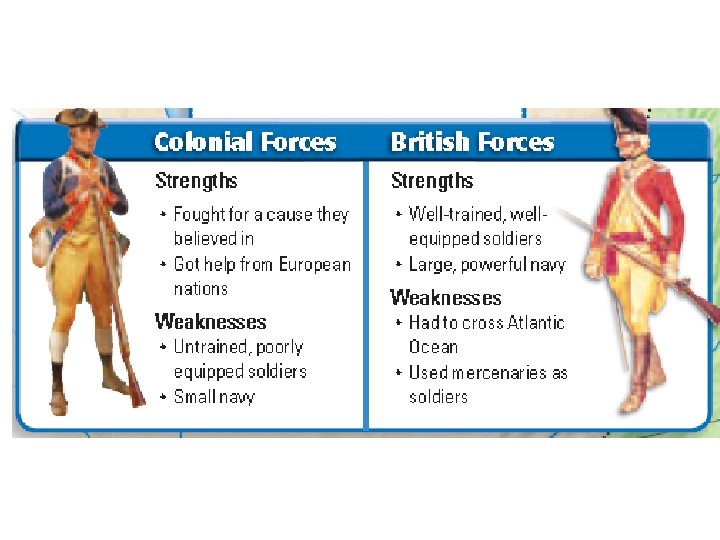
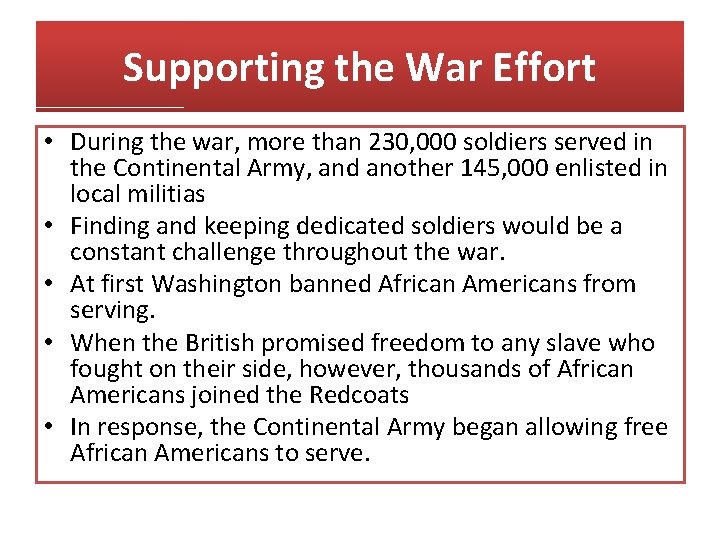
Supporting the War Effort • During the war, more than 230, 000 soldiers served in the Continental Army, and another 145, 000 enlisted in local militias • Finding and keeping dedicated soldiers would be a constant challenge throughout the war. • At first Washington banned African Americans from serving. • When the British promised freedom to any slave who fought on their side, however, thousands of African Americans joined the Redcoats • In response, the Continental Army began allowing free African Americans to serve.
Molly Pitcher • Perhaps the best known woman to fight in the war was Mary Ludwig Hays. • She was called Molly Pitcher because she brought water to the troops. • When her husband was wounded in a 1778 battle, she took his place loading cannons
Canada • Patriot troops led by General Richard Montgomery captured Montreal in November 1775 • Benedict Arnold, now a general, led his troops north on a remarkable trek to capture Quebec • Taking an immense chance, the combined armies attacked during a fierce blizzard on New Year’s Eve • They were quickly defeated
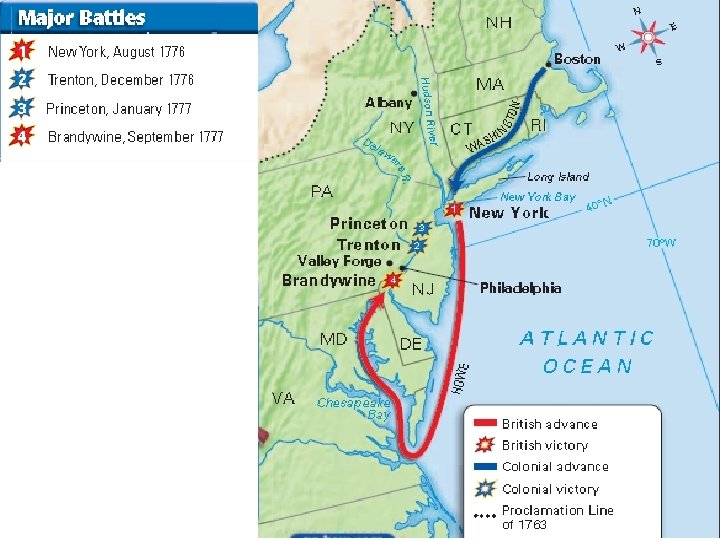
New York • General Washington had moved his troops to New York, expecting the British arrival • General Howe’s troops arrived in Long Island • The 32, 000 soldiers were much better equipped than Washington’s 23, 000 men, most of whom were militia • Eventually, the British pushed Washington across the Hudson River into New Jersey
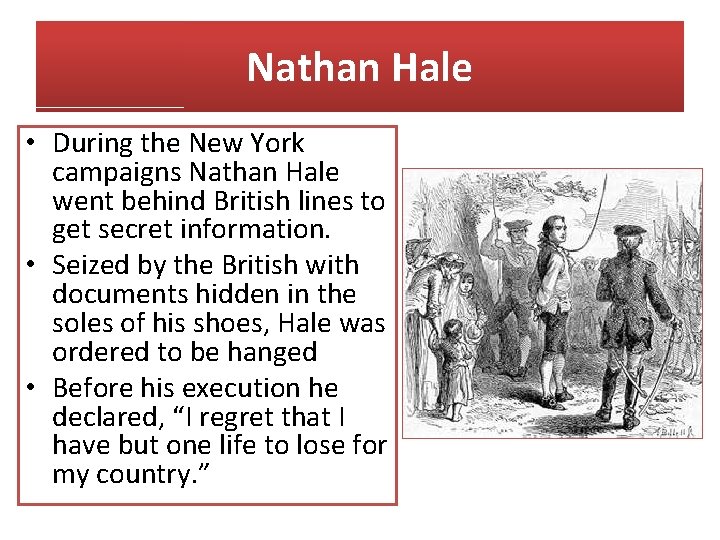
Nathan Hale • During the New York campaigns Nathan Hale went behind British lines to get secret information. • Seized by the British with documents hidden in the soles of his shoes, Hale was ordered to be hanged • Before his execution he declared, “I regret that I have but one life to lose for my country. ”
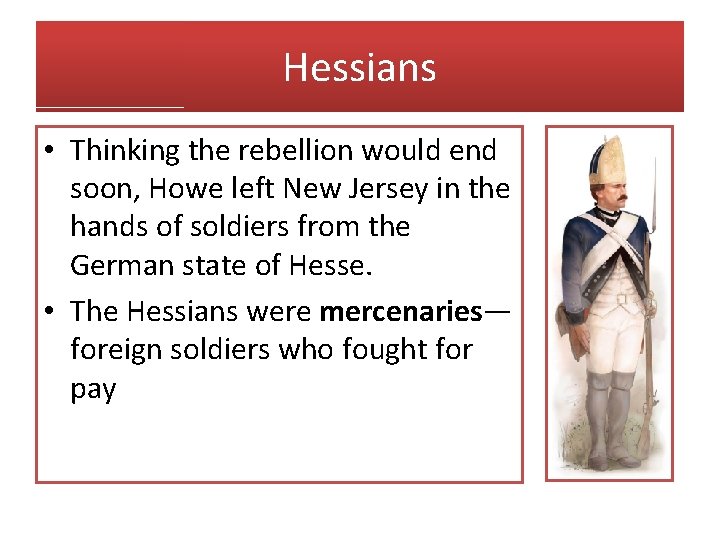
Hessians • Thinking the rebellion would end soon, Howe left New Jersey in the hands of soldiers from the German state of Hesse. • The Hessians were mercenaries— foreign soldiers who fought for pay
New Jersey • On December 7 Washington retreated across the Delaware River into Pennsylvania • Without a convincing victory, Washington knew he would lose his army. • He decided to take a big chance and go on the offensive. • The Americans would attack the Hessians at Trenton, New Jersey
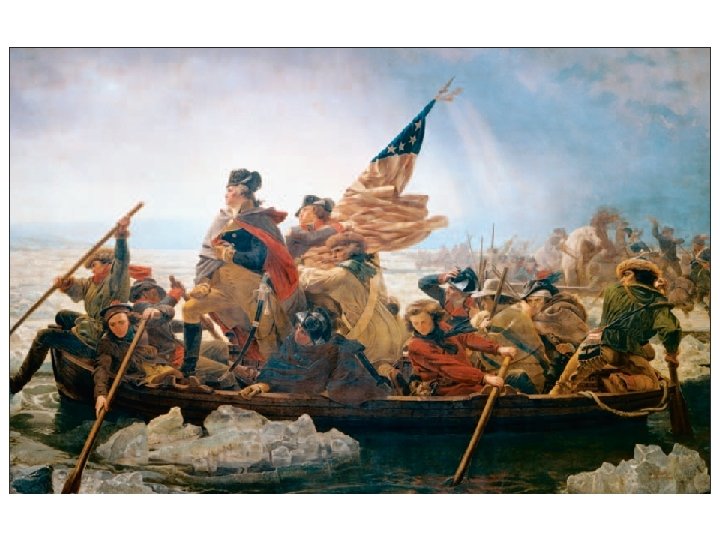
Battle of Trenton • On Christmas night, 1776, during a winter Storm, Washington and 2, 400 soldiers silently rowed across the Delaware River • The Hessians, having celebrated the holiday the night before, were fast asleep when the Patriots Attacked • The Battle of Trenton-was an important Patriot victory. • American soldiers took more than 900 prisoners
Princeton • British general Charles Cornwallis rushed to stop Washington as he marched northeast to Princeton. • On the night of January 2, 1777, the Patriots left their campfires burning, and slipped into the darkness and circled behind the British troops. • In the morning, Washington attacked and won
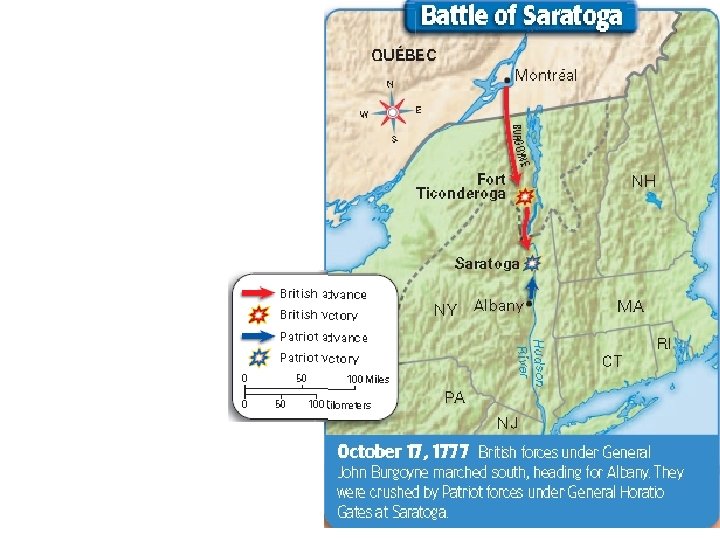
Saratoga • British general John Burgoyne decided to push through New York State and cut off New England from the other colonies • All along the route, the militia hid to attack the Redcoats. • As Burgoyne neared Saratoga, New York, he found himself surrounded • The Battle of Saratoga in New York was the turning point of the Revolutionary War
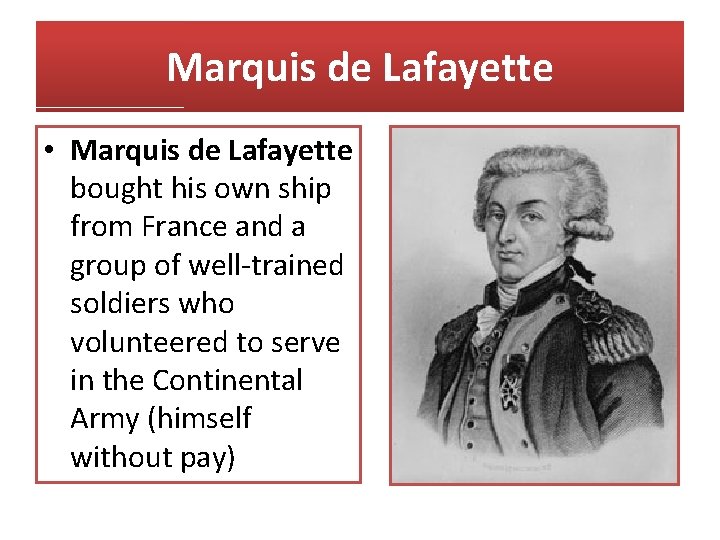
Marquis de Lafayette • Marquis de Lafayette bought his own ship from France and a group of well-trained soldiers who volunteered to serve in the Continental Army (himself without pay)
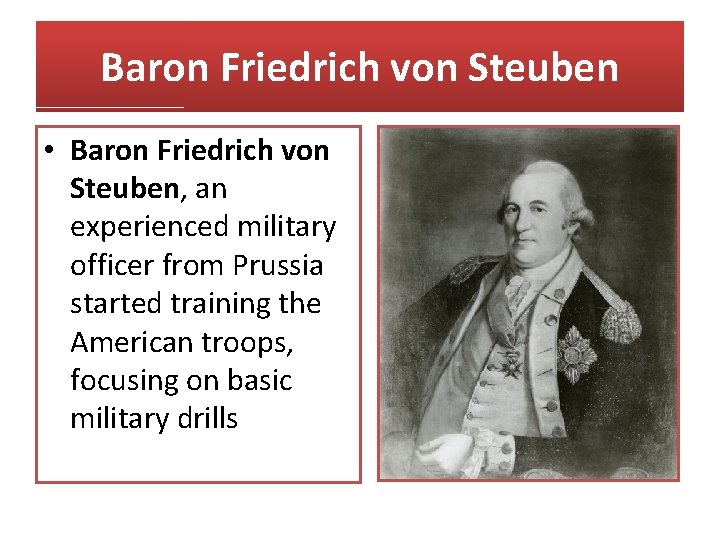
Baron Friedrich von Steuben • Baron Friedrich von Steuben, an experienced military officer from Prussia started training the American troops, focusing on basic military drills
Help from France • The Battle of Saratoga in 1777 persuaded the French king (Louis XIV) that the colonists could win the war • the French increased the level of supplies and agreed to provide soldiers and ships to the Colonists • The French naval support would be a key ingredient in defeating the British
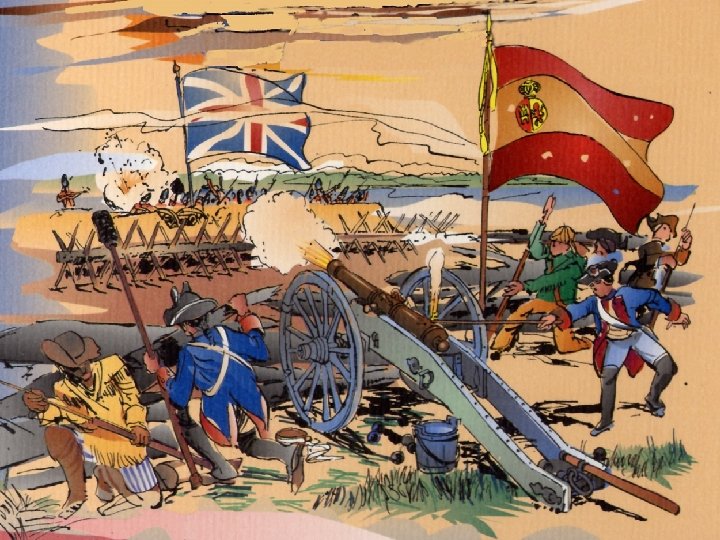
Help from Spain • Spain, also a bitter enemy of Britain, joined the war in 1779. • Bernardo de Gálvez, the governor of Spanish Louisiana, became a key ally to the Patriots. • Gálvez gathered a small army of Spanish soldiers, French Americans, colonists, and Native Americans. • Together they made their way east from Louisiana. • Gálvez seized British posts all the way to Pensacola, Florida
Winter at Valley Forge • In December 1777, Washington settled his 12, 000 men at Valley Forge • As winter roared in, soldiers quickly built crude shelters that offered little protection against the weather • During that terrible winter, some 2, 000 soldiers died of disease and malnutrition. • Amazingly, the survivors not only stayed— they drilled and marched to the orders of Baron von Steuben
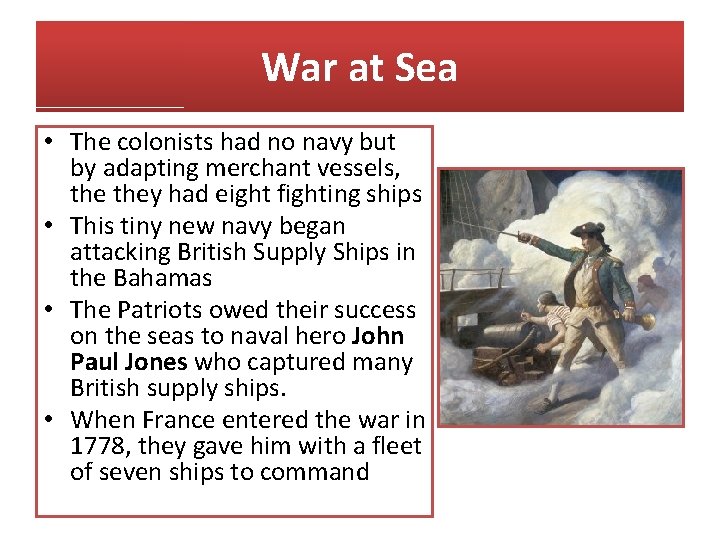
War at Sea • The colonists had no navy but by adapting merchant vessels, they had eight fighting ships • This tiny new navy began attacking British Supply Ships in the Bahamas • The Patriots owed their success on the seas to naval hero John Paul Jones who captured many British supply ships. • When France entered the war in 1778, they gave him with a fleet of seven ships to command
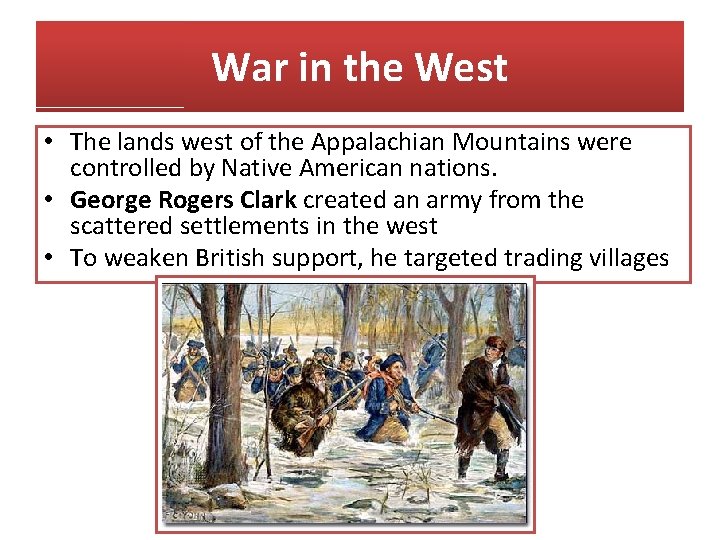
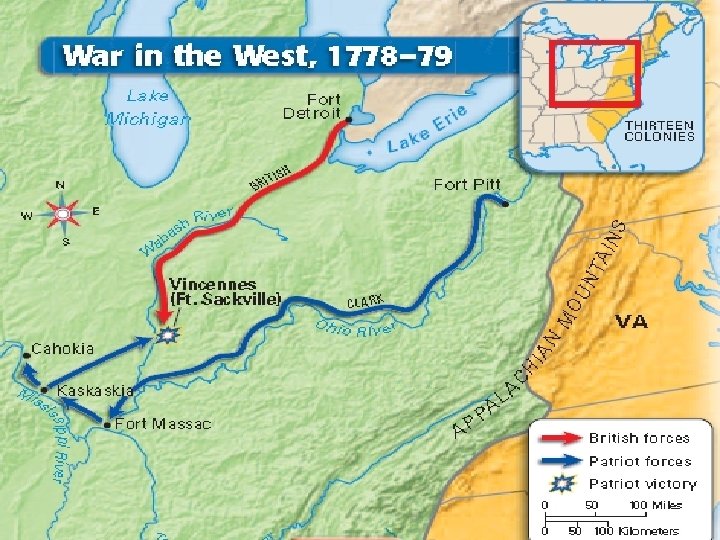
War in the West • The lands west of the Appalachian Mountains were controlled by Native American nations. • George Rogers Clark created an army from the scattered settlements in the west • To weaken British support, he targeted trading villages
Independence! Chapter 4 Section 4
War in the South • The British hoped to find support from the large Loyalist populations living in Georgia, the Carolinas, and Virginia. • As they moved across the South, the British also planned to free enslaved Africans and enlist them as British soldiers
Brutal Fighting • The southern war was particularly brutal because it resulted in “Patriots versus Loyalists” • The British also destroyed crops, farm animals, and other property as they marched through the South. • One British officer, Banastre Tarleton, killed all soldiers that surrendered • A force of 3, 500 Redcoats easily took Savannah and Charleston
A Failed Attack • In August 1780, Patriot forces led by Horatio Gates tried to drive the British out of Camden, South Carolina. • Gates had only half as many soldiers as he had planned for, and in the heat of battle, many panicked and ran. • General Nathanael Greene arrived to reorganize the army.
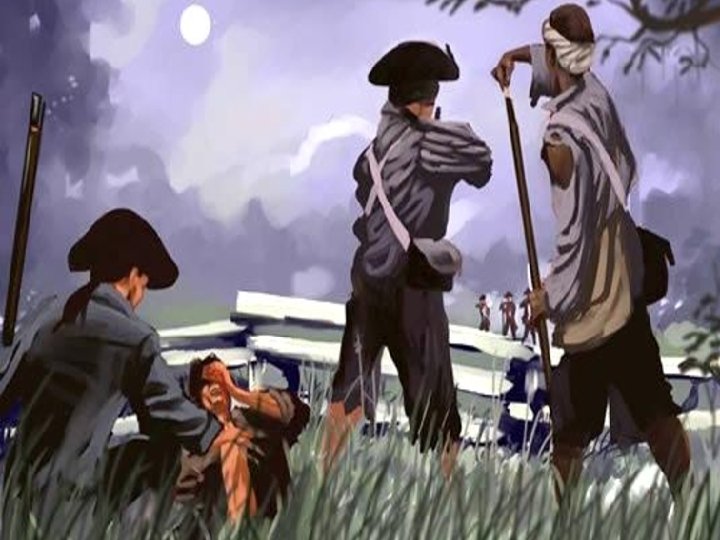
Guerrilla Warfare • The southern Patriots switched to swift hitand-run attacks known as guerrilla warfare. • Francis Marion- Nicknamed “The Swamp Fox, ” he organized a group of guerrilla soldiers • Marion’s Brigade used surprise attacks to disrupt British communication and supply lines. • Despite their great efforts, the British could not catch Marion and his men
Battle of Yorktown • Regrouped under Nathanael Greene, the Continental Army began harassing British general Charles Cornwallis in the Carolinas. • Hoping to stay in communication with the British naval fleet, Cornwallis moved his force of 7, 200 men to Yorktown, Virginia • General Washington, in New York, saw a chance to trap Cornwallis at Yorktown. • He ordered Lafayette to block Cornwallis’s escape by land
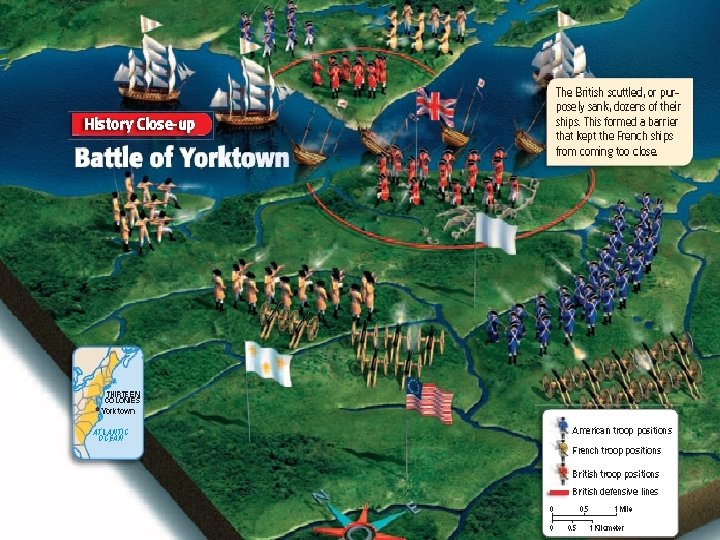
Americans and French at Yorktown • Comte de Rochambeau and Washington led the French-American force on a swift march to Virginia to cut off all escape routes. • The Patriots surrounded Cornwallis with some 16, 000 soldiers. • Meanwhile, a French naval fleet seized control of the Chesapeake Bay, preventing British ships from rescuing Cornwallis’s stranded army
The British Surrender • For weeks, the fighting steadily wore down the British defenses • Facing defeat, in 1781, Cornwallis sent a soldier with a white flag of surrender to Washington’s camp • The Battle of Yorktown was the last major battle of the American Revolution
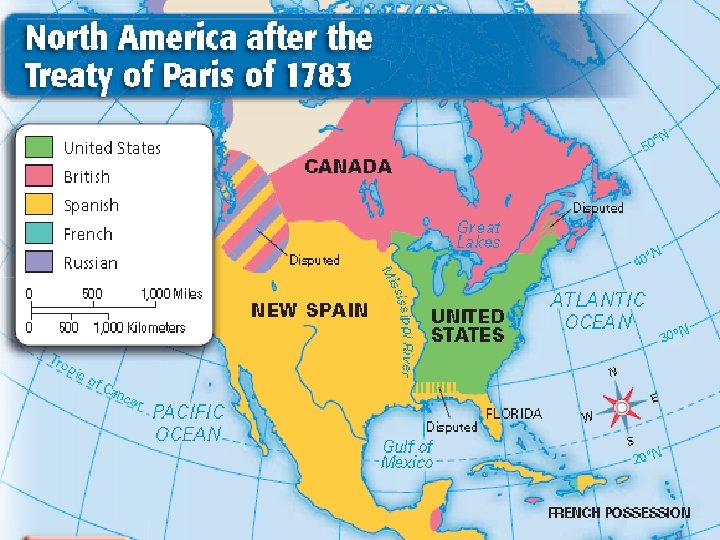
The Treaty of Paris • Great Britain entered into peace talks with America. • Benjamin Franklin had a key role in the negotiations which took over two years • In the Treaty of Paris of 1783, Great Britain recognized the independence of the United States
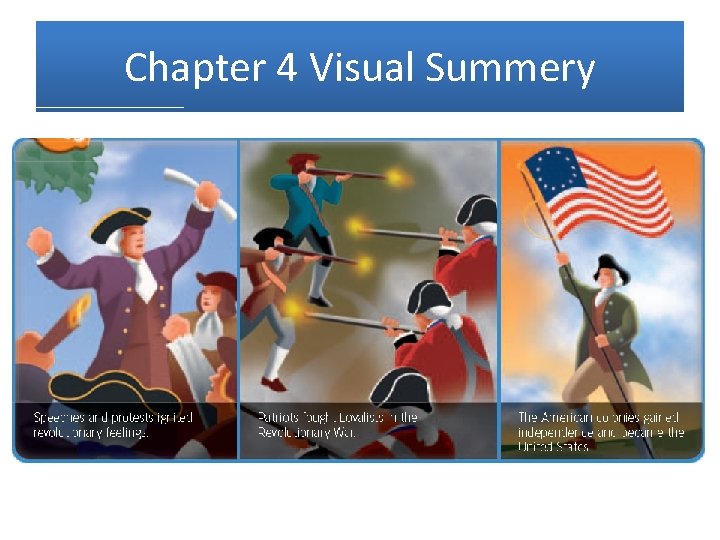
Chapter 4 Visual Summery
- Slides: 62