
The Return of the Inverted Pyramid WEB What

The Return of the Inverted Pyramid WEB
What is the inverted pyramid? ● A story structure commonly used in newspaper stories from the late 1800 s through today ● Summarizes the most important facts at the very beginning ● Gives the reader the WHO, WHAT, WHEN, WHERE at the beginning, followed by the WHY or HOW (5 W+H)
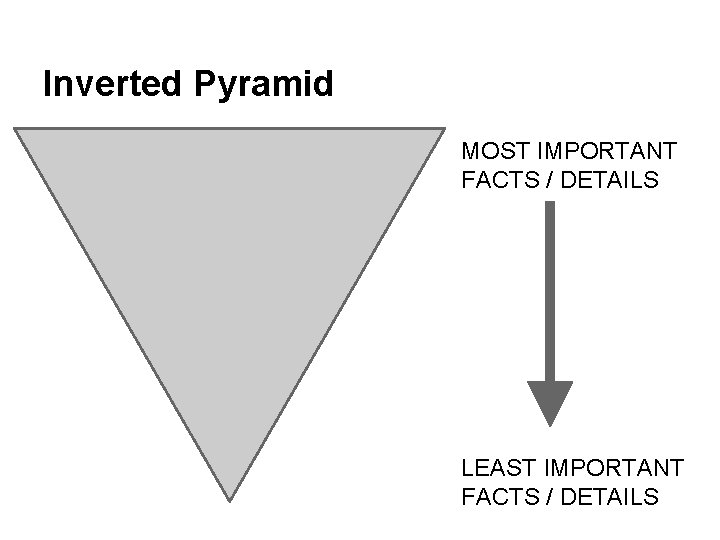
Inverted Pyramid MOST IMPORTANT FACTS / DETAILS LEAST IMPORTANT FACTS / DETAILS
Why did some newspapers move away from it? ● Story could be a little boring ● Does not always draw the reader in as well as a creative approach ● No reason for reader to continue reading to the end ● Some publications (especially weekly or monthly pubs, like most high school newspapers) were published after the reader already knew the basic facts of a story
Why return to the structure online? ● High school publications can now “break news” using their online news Websites. ● Online readers move through information quickly and may not finish everything they begin reading. ● Online readers seek factual information from credible sources to balance out the overwhelming amount of information they are presented with online.

Recent example “The Obama administration announced Monday that it expects the number of people who will have gained health coverage in the next year through the Affordable Care Act’s insurance marketplaces to be significantly lower than previous government predictions. ” — Amy Goldstein, The Washington Post, Nov. 10, 2014 ‘Obama administration predicts significantly lower health-care enrollment’
Recent example “The Postal Service on Monday became the latest government agency to announce a major theft of data from its computer systems, telling its roughly 800, 000 employees and retirees that an attack “potentially compromised” databases containing postal employees’ names, birth dates, addresses and Social Security numbers. ” — David E. Sanger, The New York Times, Nov. 10, 2014 ‘Postal Service Discloses Major Data Theft’
How to produce an inverted pyramid story for the Web 1. Gather facts and information, including the 5 W+H. 2. Decide which information is most important and write a summary lead for the story. 3. Fill in the remainder of the story with the other relevant quotations and details. 4. Post the story online, then continue to follow the story and update readers as needed.
- Slides: 8