
The Restoration of the Monarchy Cromwell died in
- Slides: 8
The Restoration of the Monarchy Ø Cromwell died in 1658 Ø Cromwell’s son, Richard, was an inept leader Ø Parliament drove Richard Cromwell away and restored the monarchy The Restoration of the monarchy with Charles II ended the so-called Interregnum (1649 -1660)
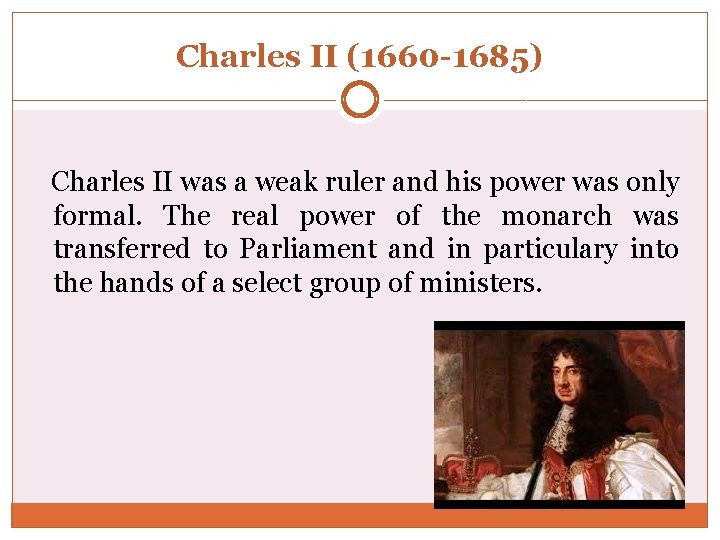
Charles II (1660 -1685) Charles II was a weak ruler and his power was only formal. The real power of the monarch was transferred to Parliament and in particulary into the hands of a select group of ministers.
Whigs and Tories: two opposing parties formed The interests of the landed aristocracy and those of the trading bourgeoisie did not coincide. Two political parties were founded The Tories favoured the royalist Restauration (Cavalier) and were supported by the landed gentry the Anglican Church; The Whigs continued the Roundhead support for Parliament and mainly represented by the urban middle classes (mercantile class). They were traditionally Puritans.
The growing power of the Whigs �In the election of 1679, the Whigs won the majority. However Charles II dissolved Parliament and, taking advantage of the division of the two parties, ruled as an absolute monarch. � 1665 The Plague and the Great Fire. �The rise of the Mercantile Classes
James II (1685 -1688) v. Absolutist aims: Ø he wanted to impose the Anglicanism Ø he wanted to rule as an absolute monarch Both two parties, the Tories and the Whigs, opposed him and invited James’s Protestant daughter, Mary, to return from Holland take throne, along with her Dutch husband William of Orange.
The Glorious Revolution The deposition of James II and the succession of William of Orange are known as the Bloodless or Glorious Revolution. �The Bill of Rights (1689) �The Toleration Act (1689) �The Act of Settlement (1689)
Bill of Rights (1689) Parliament and monarch created by common agreement this contract, that limited the monarch’s power: �The king could no longer raise taxes; �The king couldn’t form an army or suspend laws without Parliament’s consent.
The Toleration Act (1689) �Religious tolerance was introduced and freedom of worship was guaranteed The Act of the Settlement • Parliament excluded James’s Catholic son from the succession.