
The Responsive Classroom RC Approach Presentation by Samantha
The Responsive Classroom (RC) Approach Presentation by Samantha Bremekamp, Development and Behavior Management Fall 2016
Who and When? The Responsive Classroom approach was created and founded by four public educators in the 1980’s, since then the Responsive Classroom organization was created and continues to be the center for this continually used educational practice. (https: //www. responsiveclassroom. org/sites/default/files/pdf_files/rc_fact_sheet. pdf)
What is a responsive classroom education? The responsive classroom focuses on how students learn going beyond just what students learn, taking into account emotional and social engagement combined with academic education to create a stronger school community. This style of learning takes academics and directly links it to socialemotional competencies (Oberle and co, 2014) enhancing the traditional style of learning. (https: //www. responsiveclassroom. org/about/)
Social-emotional Influences A study utilizing 179 handbook chapters and reviews, 91 research syntheses and survey results from 61 educational researchers came up with 28 areas of focus regarding influences on educational learning. “Among the top 11 categories that affected learning, 8 involved social– emotional influences: classroom management, parental support, student–teacher social interactions, social– behavioral attributes, motivational–affective attributes, the peer group, school culture, and classroom climate. ” (Greenberg, 2007)
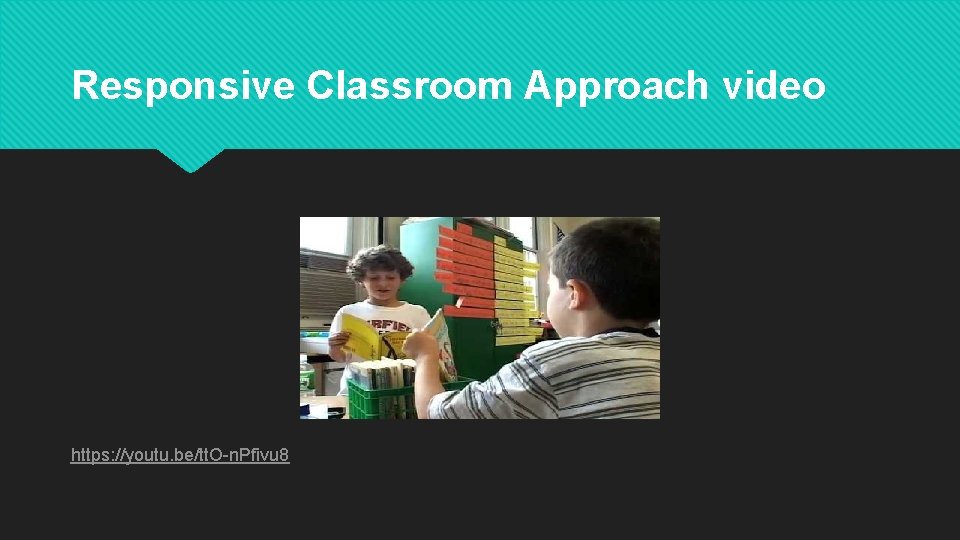
Responsive Classroom Approach video https: //youtu. be/tt. O-n. Pfivu 8
Guiding Principles based on social skills The Responsive Classroom approach is focused on the following seven principles: 1. 2. 3. 4. “The social and emotional curriculum is as important as the academic curriculum. How children learn is as important as what they learn. Great cognitive growth occurs through social interaction. To be successful academically and socially, children need to learn a set of social and emotional skills: cooperation, assertiveness, responsibility, empathy, and self-control. 5. Knowing the children we teach—individually, culturally, and developmentally—is as important as knowing the content we teach. 6. Knowing the families of the children we teach is as important as knowing the children we teach. 7. How we, the adults at school, work together is as important as our individual competence: Lasting change begins with the adult community. ” (https: //www. responsiveclassroom. org/about/principles-practices/)
Shared Practices (K– 8) Interactive Modeling—Teaching procedures and routines like entering and exiting the room plus academic and social skills with engaged feedback. (Interpersonal learners, Gardner’s Multiple Intelligences; VAKT visual and auditory learners) Teacher Language—The use of language that enables students to engage within their learning and development of the academic, social, and emotional skills needed to be successful in and out of their school careers. (Linguistic learners, Gardner’s Multiple Intelligences; VAKT auditory learners) Logical Consequences—Teacher’s set clear limits and then teach students how to learn from their mistakes and also how to fix it while keeping their dignity. There is no shaming but a more practical approach to learning from the mistake. (Intrapersonal learners as well as Logical-mathematics learners Gardener’s Multiple Intelligences) Interactive Learning Structures— Hands on and social activities. (Bodily-kinesthetic intelligence learners, Gardner’s multiple intelligences; VAKT Kinesthetic and Tactile learners. ) (https: //www. responsiveclassroom. org/about/principles-practices/)
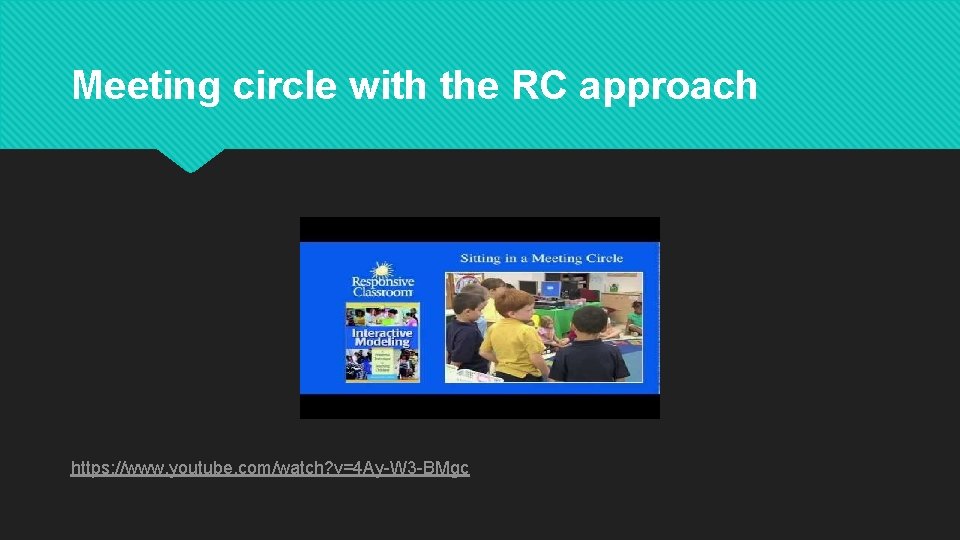
Meeting circle with the RC approach https: //www. youtube. com/watch? v=4 Ay-W 3 -BMgc
Elementary Practices (K– 6) Morning Meeting—The class sits together in a circle for half an hour and goes over the “four sequential components: greeting, sharing, group activity, and morning message. ” Establishing Rules—The class works as a cohesive unit, with teacher and students having equal stock, to establish individual goals for the year and create the rules that will help everyone reach those goals. Energizers—Short activities that engage the whole group for playful breaks from lessons. Quiet Time—A short reflection period of transition after lunch and recess to refocus for the rest of the school day. Closing Circle—The groups gathers once again for a few minutes at the end of the day to reflect and celebrate what they each accomplished through an activity. (https: //www. responsiveclassroom. org/about/principles-practices/)
Choosing a partner with the RC approach https: //www. youtube. com/watch? v=q. EQBVAX 9684
Middle School Practices (5– 8) Responsive Advisory Meeting—A next level circle time, engaging social skills and promoting positivity and teacher to student bonding. This also includes regular components: arrival welcome, announcements, acknowledgements, and activity. Investing Students in the Rules—Again students collaborate with the teacher to establish classroom rules setting the expectations based on individual goals. Class buy-in. Brain Breaks—Quick and lifting activities meant to increase focus, motivation, learning, and memory. Active Teaching— Going beyond the traditional classroom to engage students in being active learners. Components: teacher presentation, explanation, illustration, and demonstration. Student Practice—Taking what is learned and putting it into practice. (https: //www. responsiveclassroom. org/about/principles-practices/)
Calming down with the RC approach https: //www. youtube. com/watch? v=3 DQ 4 NBYX-EE
Responsive Classrooms showcase Howard Gardner’s Multiple Intelligences as well as Visual, Auditory, Kinesthetic, and Tactile (VAKT) learners Gardner, H. (1983). Frames of mind: The theory of multiple intelligences. New York: Basic. http: //infed. org/mobi/howard-gardner-multiple-intelligences-and-education/
Gardner’s Multiple Intelligences focus on different learning styles of each student: • Linguistic intelligence (those who use language as their basis of connecting through learning) • Logical-mathematical intelligence (analytical learners) • Musical intelligence (patterns, performance, and composition learners) • Bodily-kinesthetic intelligence (hands on, practical learners) • Spatial intelligence (ability to utilize both wide and confided space learners) • Interpersonal intelligence (peer and social learners) • Intrapersonal intelligence (great understanding of oneself and limitations learners)
Multiple Intelligences applied through RC Responsive classrooms go hand in hand with the multiple intelligences of different learners. Primarily evident are those intrapersonal, interpersonal, bodily-kinesthetic, linguistic, and musical intelligences. As seen in the videos of different aspects of RC, peer and social learning is a major factor of the learning style. There is a great deal of movement, interaction, collaboration and self reflection. The idea of RC is to create a healthy, safe, and stimulating environment with principal buy in supporting teachers implementation of RC.
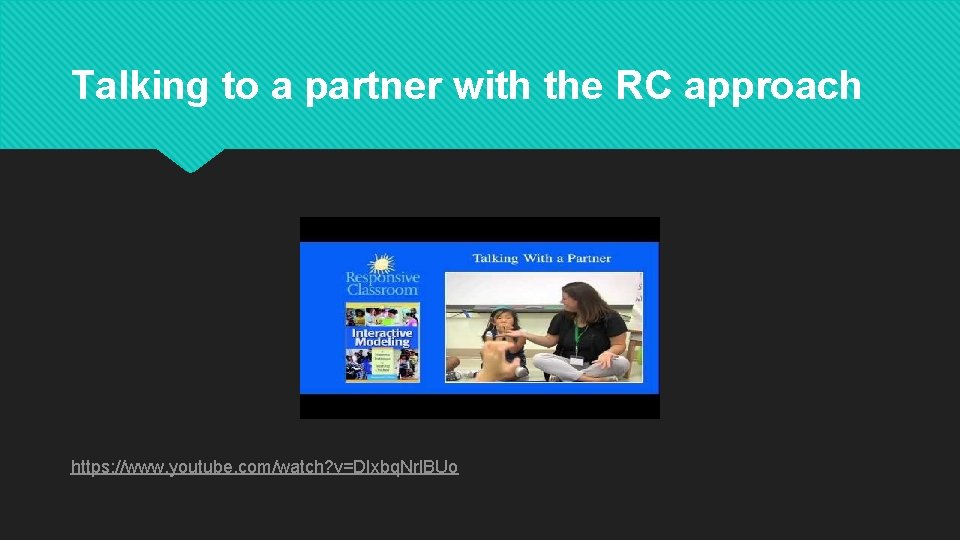
Talking to a partner with the RC approach https: //www. youtube. com/watch? v=DIxbq. Nrl. BUo
Visual, auditory, kinesthetic, and tactile learners (VAKT) Beyond the traditional classroom that would only work for visual or auditory learners, responsive classrooms engage all styles of learning including touching and moving around the classroom to engage each style of learning. There is more of a sense of community as each grade level begins the day with a morning meeting, showing equal stock among the students with the teacher, taking a step back from the traditional lecturer and classroom and an enlightened step forward in group engagement.
Working with a Science Partner: the RC approach https: //www. youtube. com/watch? v=k. K 4 FSFu. SGPQ
Responsive Classroom helps with discipline From an early time, news from schools, and research studies have shown that utilizing responsive classroom teaching has helped focus students misbehaviors and changed it into teaching the value of taking leadership roles and having meaning behind actions. It has also shown that a sense of community and self-worth taught through socialemotional competencies makes a significant difference in students behavior. (Greenberg, 2003)
Pros and Cons of RC: Studies and critiques Pros Cons Studies prove positive results (Rimm-Kaufman and co, 2014) Critique on studies of RC allege to glossing over difficult experiences, and being overly positive. (Stearns, 2016) Principal sees 75% decrease in disciplinary action across school after RC implemented (Kaplan, 2014) Teachers see RC working in the No Child Left Behind era (Blahus, 2013) Social-emotional growth increases Greater self-efficacy (Rimm-Kaufman and co, 2004) Anxiety towards math and science lessened (Griggs and co, 2014) (Ottmar. 2013)
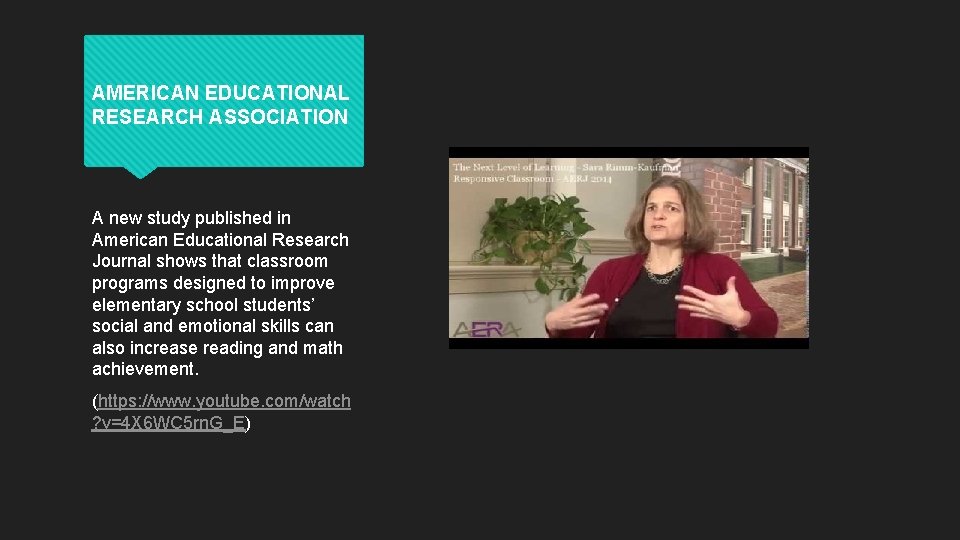
AMERICAN EDUCATIONAL RESEARCH ASSOCIATION A new study published in American Educational Research Journal shows that classroom programs designed to improve elementary school students’ social and emotional skills can also increase reading and math achievement. (https: //www. youtube. com/watch ? v=4 X 6 WC 5 rn. G_E)
What will studies show years from now? Studies that are currently underway are spread over many years following specific classes through the years, to see how responsive classroom’s effect students throughout their careers in education and beyond. Early studies do show promising evidence, however until the long term studies are completed we do not know the lasting effects outside of theory.
Does the responsive classroom gloss over difficult experiences? In the article “Responsive classroom? : A critique of the social emotional learning program, ” Stearns points out a proposed negative side effect from responsive classroom learning, glossing over difficult experiences, by focusing too much on positivity, although there haven’t been long term studies to provide evidence of this.
References Abry, T. , Rimm-Kaufman, S. , Larsen, R. A. , Brewer, A. J. , Griggs, M. S. , Rimm-Kaufman, S. , . . . Patton, C. L. (2013). The influence of fidelity of implementation on teacher–student interaction quality in the context of a randomized controlled trial of the responsive classroom approach Elsevier Ltd. doi: 10. 1016/j. jsp. 2013. 001 American News Service (1997, May 11). Teachers try a new strategy; Discipline: Responsive Classroom brings orderby allowing; students to make the rules. Sun, The (Baltimore, MD). Blahus, R. A. (2013). Perceptions of Primary Teachers Using Responsive Classroom in the Era of No Child Left Behind. Pro. Quest LLC Bragg, M. (2016). Responsive classroom Charney, R. S. , & Northeast Foundation, f. C. (1993). Teaching children to care: Management in the responsive classroom
Gardner, H. (1983). Frames of mind: The theory of multiple intelligences. New York: Basic. Gardner, H. (2000). Intelligence reframed: Multiple intelligences for the 21 st century. New York: Basic. Gardner, H. (2003). Multiple intelligences after 20 years. Paper presented at the American Educational Research Association, April 21, 2003. Retrieved July 4, 2007, from http: //www. pzweb. harvard. edu/PIs/HG&#x 005 F; MI&#x 005 F; after&#x 005 F; 20&#x 005 F; years&#x 005 F; pdf Gardner, H. (2006). Multiple Intelligences: New Horizons. New York: Basic Books. Gardner, H. (2007). Five minds for the future. Boston: Harvard Business School Publishing. Greenberg, M. T. , Weissberg, R. P. , O’Brien, M. U. , Zins, J. E. , Fredericks, L. , Resnik, H. , et al. (2003). Enhancing schoolbased prevention and youth development through coordinated social, emotional, and academic learning. American Psychologist, 58(6/7), 466– 474. Hurst, C. O. , & Otis, R. (2000). Friends and relations: Using literature with social themes, grades 3 -5. the responsive classroom series #4
Jankens, A. (2015). Responsive classroom ecologies: Supporting student inquiry and rhetorical awareness in college writing courses. Dissertation Abstracts International, 75(8) Kaplan, D. (2014). Bedford principal cuts disciplinary referals 75% in three years; Susan Mele says Responsive Classroom works. CBS - 7 WDBJ (Roanoke-Lynchburg, VA). La. Brusciano, R. (1993). Teaching children to care: Management in the responsive classroom. Holistic Education Review, 6(3), 68 -69. Northeast Foundation, f. C. (1997). Off to a good start: Launching the school year. excerpts from the responsive classroom newsletter no. 1 Oberle, E. , Schonert-Reichl, K. A. , Hertzman, C. , & Zumbo, B. D. (2014). Social–emotional competencies make the grade: Predicting academic success in early adolescence. Journal Of Applied Developmental Psychology, 35138 -147. doi: 10. 1016/j. appdev. 2014. 02. 004
Oldfather, P. , National Reading, R. C. , & National Reading, R. C. (1994). When students do not feel motivated for literacy learning: How a responsive classroom culture helps. reading research report no. 8. Ottmar, E. , Rimm-Kaufman, S. , Berry, R. , & Larsen, R. (2013). Does the responsive classroom approach affect the use of standards-based mathematics teaching practices? : Results from a randomized controlled trial. Elementary School Journal, 113(3), 434 -457. doi: 10. 1086/668768 Ottmar, E. R. (. 1. ). , Rimm-Kaufman, S. , Berry, R. Q. (. 2. ). , Larsen, R. A. (. 3. ). , Rimm-Kaufman, S. , Larsen, R. , . . . De. Coster, J. (2014). Mathematical knowledge for teaching, standards-based mathematics teaching practices, and student achievement in the context of the responsive classroom approach SAGE Publications Inc. doi: 10. 3102/0002831215579484 Paxton, C. L. C. , Wanless, S. B. , Rimm-Kaufman, S. , Society for Research on, Educational Effectiveness, Baroody, A. E. , Rimm-Kaufman, S. , . . . Curby, T. W. (2014). Coaching support, context, and fidelity of implementation in "responsive classroom"® schools Society for Research on Educational Effectiveness. Rayder, N. F. , Far West Lab for Educational Research, and Development, & Others, A. (1975). The responsive classroom observation schedule--background and development.
Reena Singh, J. N. (2012). Elementary school to implement responsive classroom Reynolds-Hawkins, M. , & Fortune, J. C. (1994). Affirming the pilot study's value in responsive classroom research. Riley, B. (2007). The Library Media Center and Responsive Classroom Practices. Library Media Connection, 26(3), 22 -23. Rimm-Kaufman, S. , Larsen, R. , Baroody, A. , Curby, T. , Ko, M. , Thomas, J. , &. . . De. Coster, J. , (2014) Efficacy of the Responsive Classroom Approach: Results From a 3 -Year, Longitudinal Randomized Controlled Trial. American Educational Research Journal, 51(3), 567 -603. Rimm-Kaufman, S. E. , & Sawyer, B. E. (2004). Primary-Grade Teachers' Self-Efficacy Beliefs, Attitudes toward Teaching, and Discipline and Teaching Practice Priorities in Relation to the 'Responsive Classroom' Approach. The Elementary School Journal, (4). 321. Smith, Mark K. (2002, 2008) ‘Howard Gardner and multiple intelligences’, the encyclopedia of informal education, http: //www. infed. org/mobi/howard-gardner-multiple-intelligences-and-education.
Stearns, C. (2016). Responsive classroom? : A critique of a social emotional learning program. Critical Studies in Education, 57(3), 330 -341. doi: 10. 1080/17508487. 2015. 1076493 Stensrud, M. , (Author). (2014). A complimentary combination: Responsive classroom and orff schulwerk. The Orff Echo, 46(3), 34 -41. Wanless, S. B. , Rimm-Kaufman, S. , Abry, T. , Larsen, R. A. , & Patton, C. L. (2015). Erratum to: Engagement in training as a mechanism to understanding fidelity of implementation of the responsive classroom approach. Prevention Science: The Official Journal of the Society for Prevention Research, 16(8), 1117 -1117. doi: 10. 1007/s 11121 -014 -0536 -5 Winterman, K. G. , & Sapona, R. H. (2002). Everyone's included: Supporting young children with autism spectrum disorders in a responsive classroom learning environment. TEACHING Exceptional Children, 35(1), 30 -35.
- Slides: 29