
The Respiratory System How it contributes to homeostasis
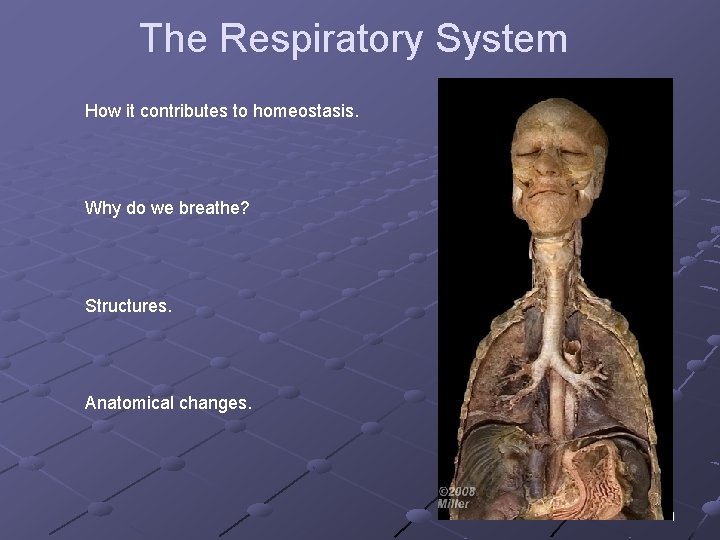
The Respiratory System How it contributes to homeostasis. Why do we breathe? Structures. Anatomical changes. 1
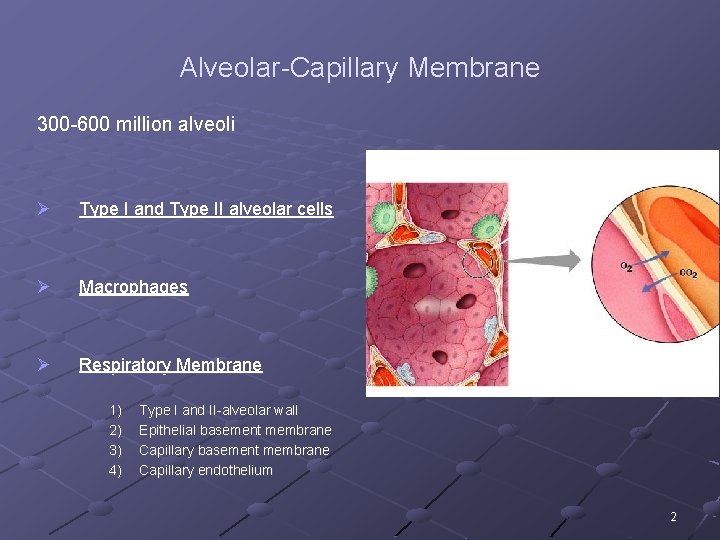
Alveolar-Capillary Membrane 300 -600 million alveoli Ø Type I and Type II alveolar cells Ø Macrophages Ø Respiratory Membrane 1) 2) 3) 4) Type I and II-alveolar wall Epithelial basement membrane Capillary endothelium 2
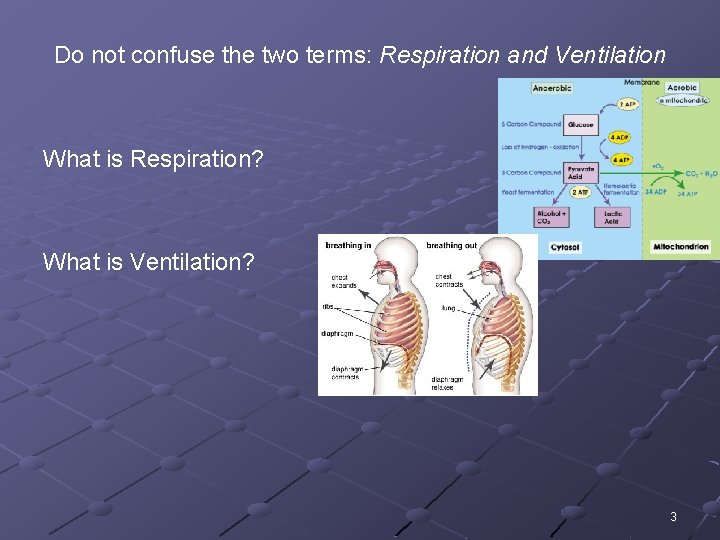
Do not confuse the two terms: Respiration and Ventilation What is Respiration? What is Ventilation? 3
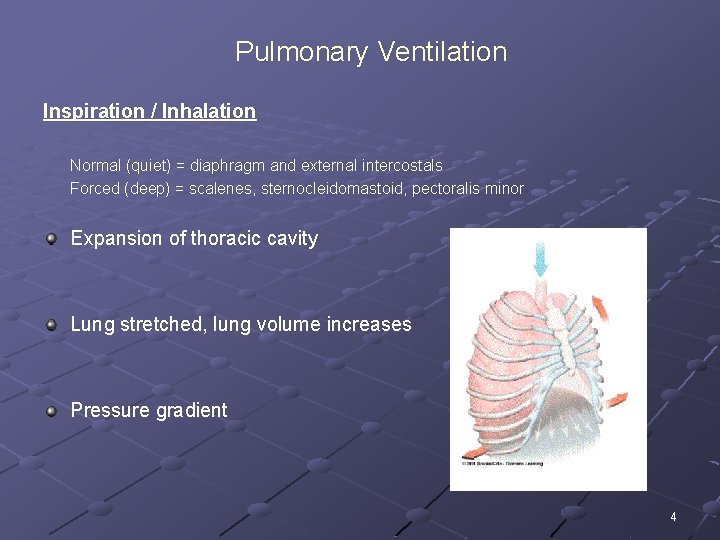
Pulmonary Ventilation Inspiration / Inhalation Normal (quiet) = diaphragm and external intercostals Forced (deep) = scalenes, sternocleidomastoid, pectoralis minor Expansion of thoracic cavity Lung stretched, lung volume increases Pressure gradient 4

Pulmonary Ventilation Expiration / Exhalation Normal (quiet) = diaphragm and internal intercostals Forced (deep) = abdominal obliques and transverse Relaxation and Retraction of thoracic cavity – -Elastic recoil Lung volume decreases Pressure gradient 5
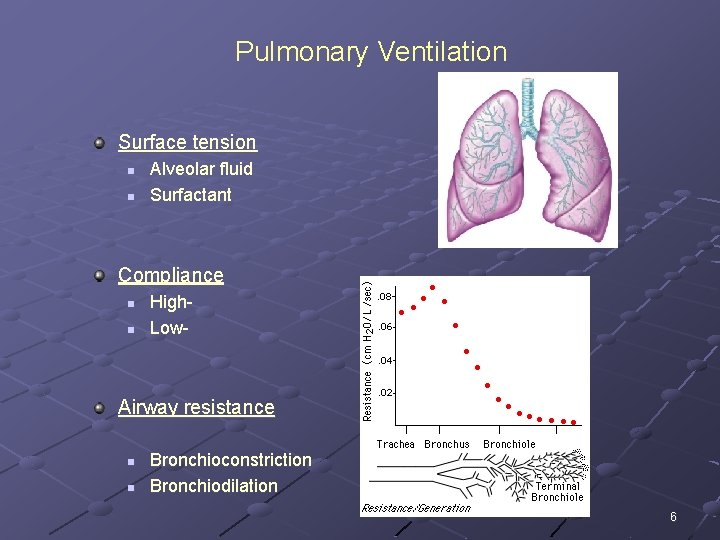
Pulmonary Ventilation Surface tension n n Alveolar fluid Surfactant Compliance n n High. Low- Airway resistance n n Bronchioconstriction Bronchiodilation 6
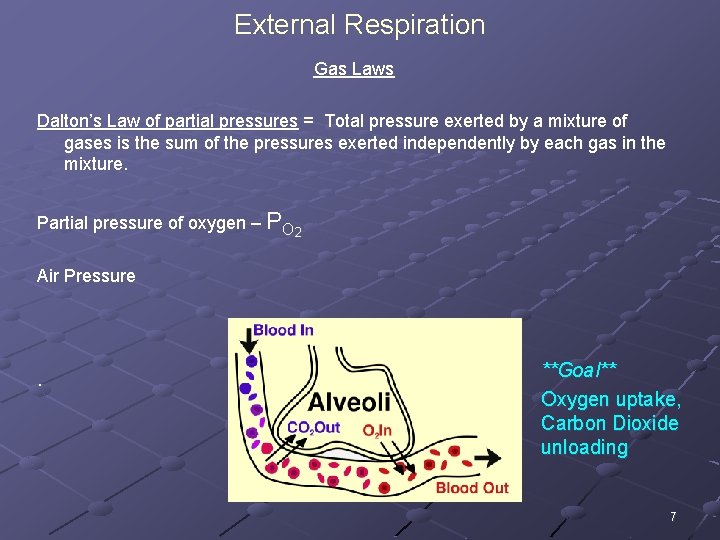
External Respiration Gas Laws Dalton’s Law of partial pressures = Total pressure exerted by a mixture of gases is the sum of the pressures exerted independently by each gas in the mixture. Partial pressure of oxygen – PO 2 Air Pressure . **Goal** Oxygen uptake, Carbon Dioxide unloading 7
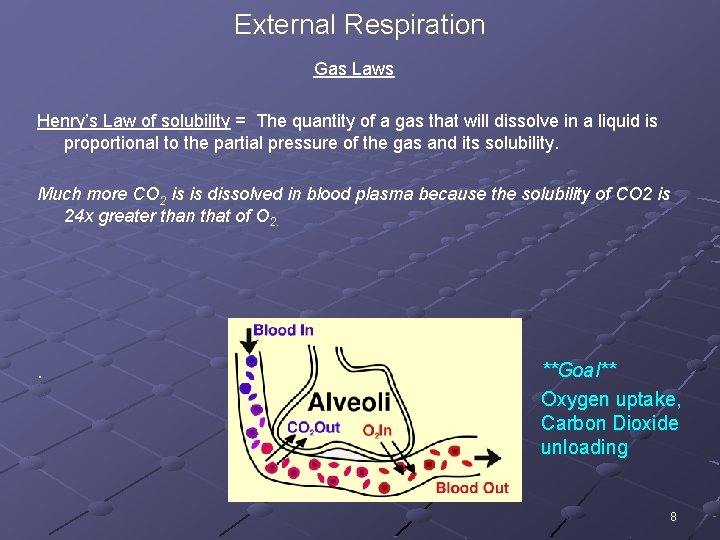
External Respiration Gas Laws Henry’s Law of solubility = The quantity of a gas that will dissolve in a liquid is proportional to the partial pressure of the gas and its solubility. Much more CO 2 is is dissolved in blood plasma because the solubility of CO 2 is 24 x greater than that of O 2. . **Goal** Oxygen uptake, Carbon Dioxide unloading 8
Questions for you. . O 2 diffuses rapidly from the alveoli into the blood. CO 2 diffuses slower. Why? But wait!! In our bodies, equal amounts must be exchanged. How does this happen? 9
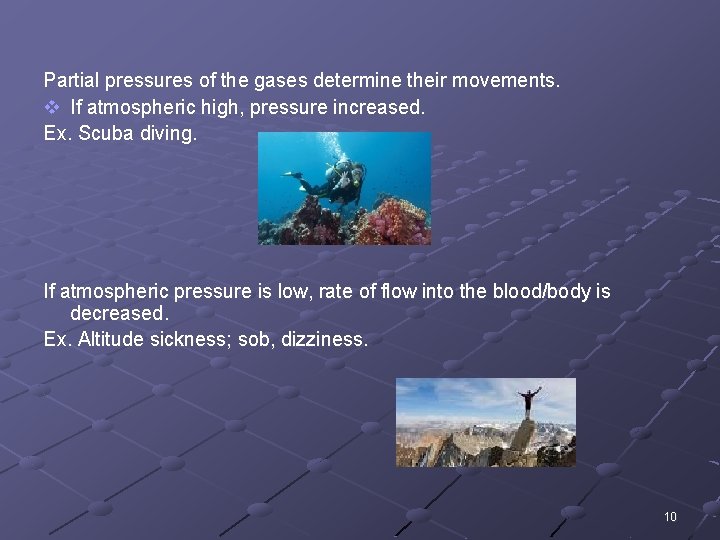
Partial pressures of the gases determine their movements. v If atmospheric high, pressure increased. Ex. Scuba diving. If atmospheric pressure is low, rate of flow into the blood/body is decreased. Ex. Altitude sickness; sob, dizziness. 10
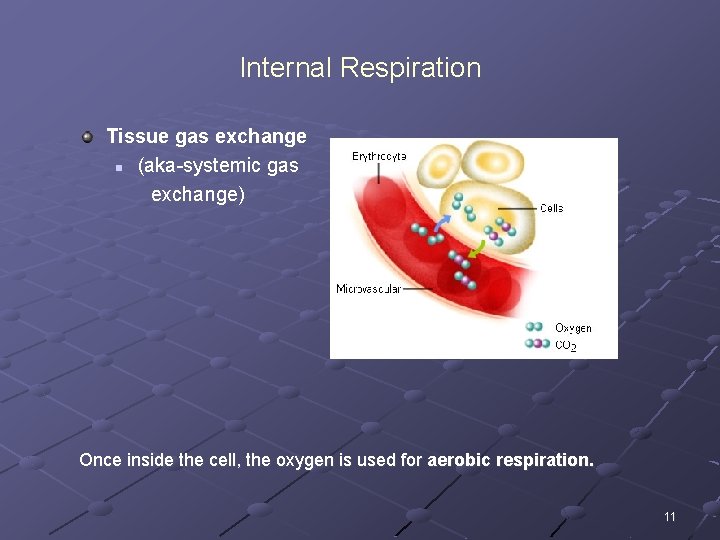
Internal Respiration Tissue gas exchange n (aka-systemic gas exchange) Once inside the cell, the oxygen is used for aerobic respiration. 11
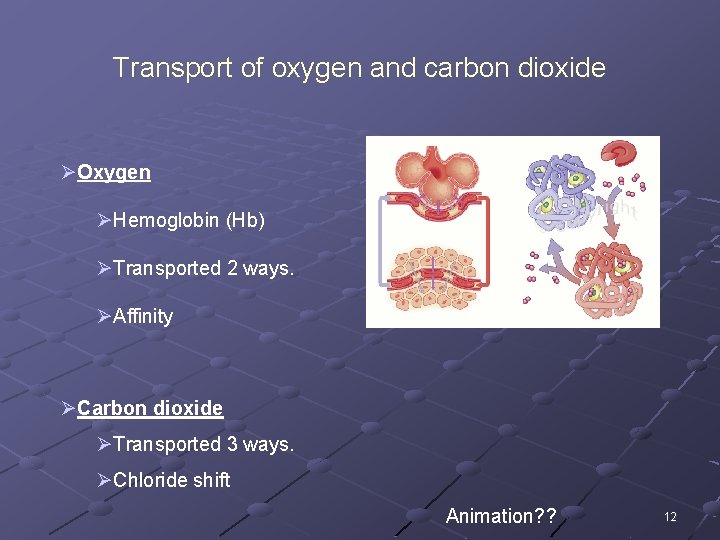
Transport of oxygen and carbon dioxide ØOxygen ØHemoglobin (Hb) ØTransported 2 ways. ØAffinity ØCarbon dioxide ØTransported 3 ways. ØChloride shift Animation? ? 12
The rate of internal and external respiration is determined by: 1. The partial pressures 2. The surface area 3. Solubility of the gasses 4. Diffusion distance 13
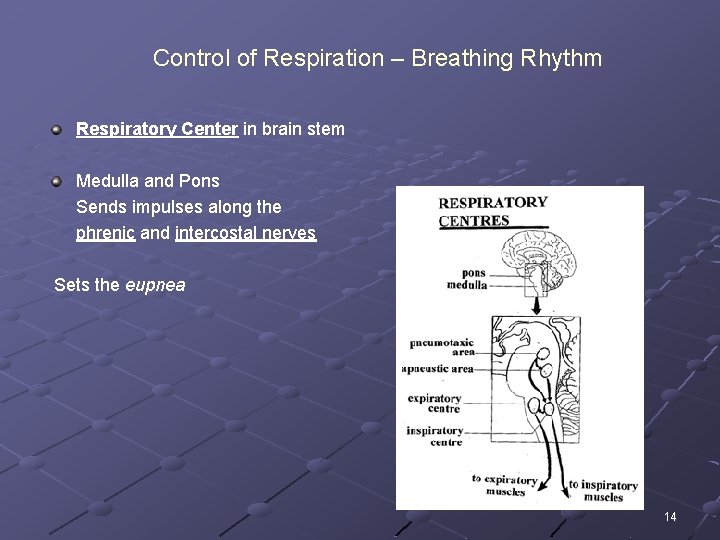
Control of Respiration – Breathing Rhythm Respiratory Center in brain stem Medulla and Pons Sends impulses along the phrenic and intercostal nerves Sets the eupnea 14
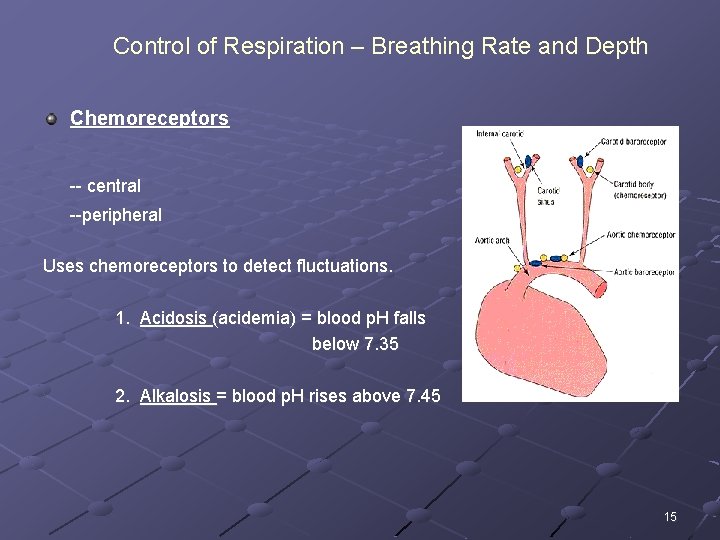
Control of Respiration – Breathing Rate and Depth Chemoreceptors -- central --peripheral Uses chemoreceptors to detect fluctuations. 1. Acidosis (acidemia) = blood p. H falls below 7. 35 2. Alkalosis = blood p. H rises above 7. 45 15
Control of Respiration – Breathing Rate and Depth Cortical influences -- cerebral cortex 1. voluntary control 2. emotions -hypothalamus -lymbic system 16

Control of Respiration – Breathing Rate and Depth Proprioceptor stimulation n Detect movement of joints and muscles Inflation reflex n Baroreceptors Ø More on table 22. 2 in textbook 17

Disorders 18

Questions: 22. 13 If the volume of the cylinder in Figure 22. 12 decreased from 1 liter to ¼ liter, how would the pressure change? 22. 15 Would contraction of the external intercostals increase or decrease alveolar pressure? Would it cause air to enter or leave the lungs? Would contraction of the internal intercostals increase or decrease alveolar pressure? Would it cause air to enter or leave the lungs? 22. 18 Would airflow into alveoli be greater with higher or lower compliance of the lungs? Larger or smaller bronchioles? 22. 25 What are the diffusion paths of O 2 and CO 2 during external and internal respiration? 22. 26 What causes O 2 to enter pulmonary capillaries from alveolar air and to enter tissue cells from systemic capillaries? 22. 27 Which factors affect the rates of diffusion of O 2 and CO 2? 22. 35 Which nerves convey impulses from the respiratory center to the diaphragm? 22. 40 Which chemicals stimulate peripheral chemoreceptors? 22. 42 What happens to the rate and depth of breathing when the PCO 2 becomes elevated? 19
- Slides: 19