
The Respiratory System Angie Guggino MS ATC LAT
- Slides: 52
The Respiratory System Angie Guggino, MS, ATC, LAT
Essential Questions �What is the structure and function of the respiratory system? �What is the common pathology of the respiratory system?
Course Standard 5 Examine the anatomy, physiology and basic pathophysiology of the respiratory system, and evaluate and monitor respirations. � 5. 1 Analyze the basic structures and functions of the respiratory system. � 5. 2 Identify and explain medical terms related to the respiratory system, and utilize when documenting in electronic medical record. � 5. 3 Research common diseases, disorders, and emerging diseases of the respiratory system including the pathophysiology, prevention, diagnosis and treatment (including biomedical therapies) that might be utilized in each. � 5. 4 Differentiate between the upper and lower respiratory tract while tracing the pathway of air into and out of the respiratory system. � 5. 5 Explain the physiology of breathing, to include the process of gas exchange. � 5. 6 Analyze the interdependence of the cardiovascular and respiratory systems as they relate to gas exchange, circulation, and the support of vital organs of the human body. � 5. 7 Demonstrate measuring and recording respirations, and
Purpose �Gas Exchange �Provide a constant supply of oxygen, while at the same time eliminating carbon dioxide, a waste product, from the body
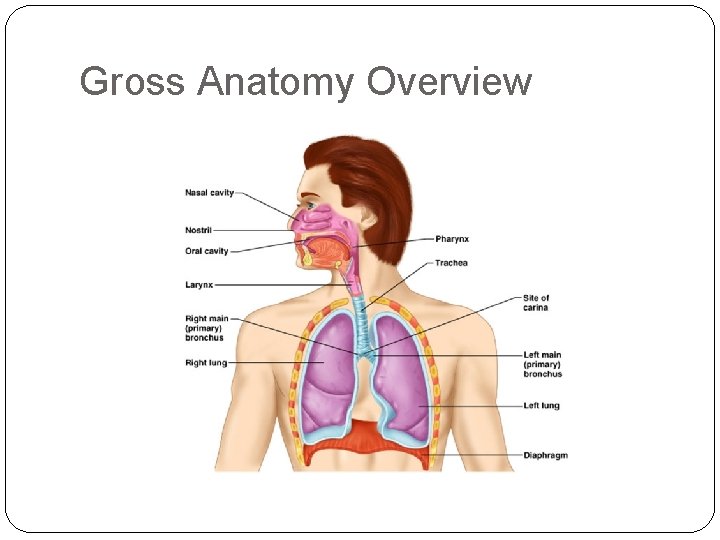
Gross Anatomy Overview
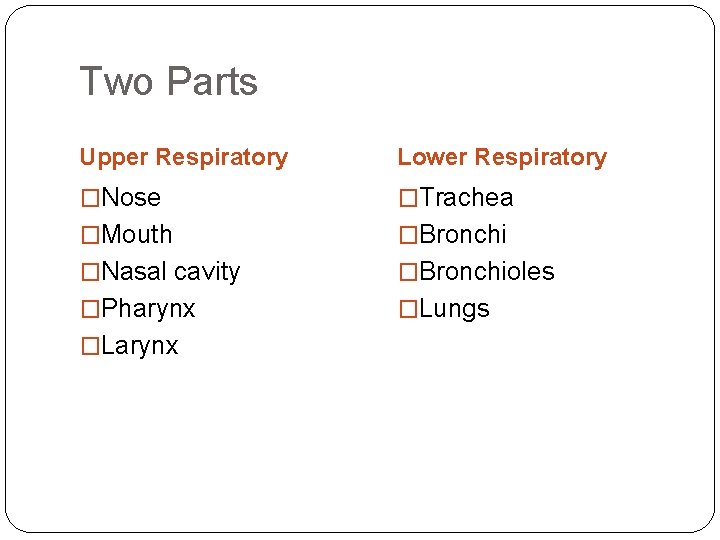
Two Parts Upper Respiratory Lower Respiratory �Nose �Trachea �Mouth �Bronchi �Nasal cavity �Bronchioles �Pharynx �Lungs �Larynx
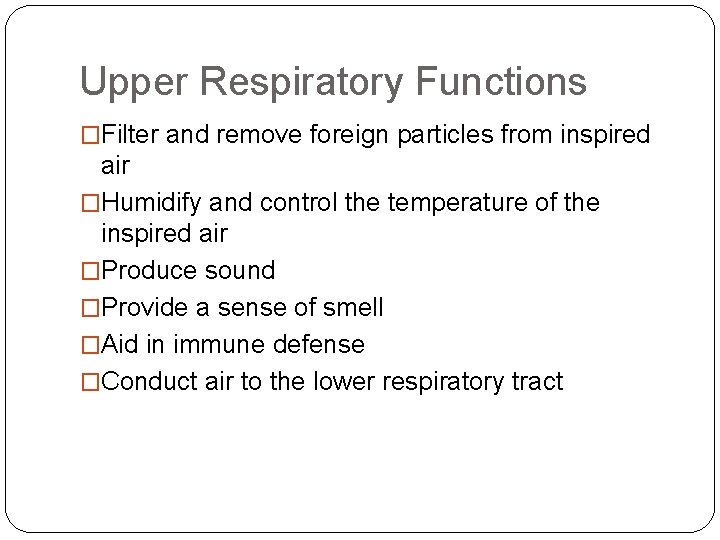
Upper Respiratory Functions �Filter and remove foreign particles from inspired air �Humidify and control the temperature of the inspired air �Produce sound �Provide a sense of smell �Aid in immune defense �Conduct air to the lower respiratory tract
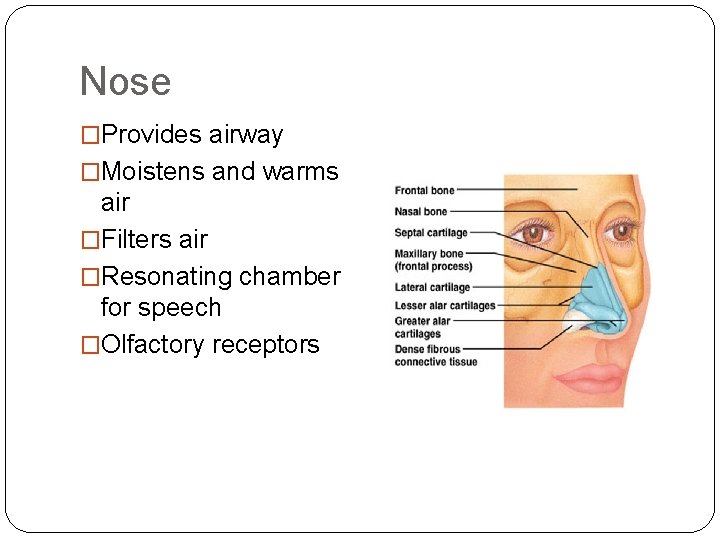
Nose �Provides airway �Moistens and warms air �Filters air �Resonating chamber for speech �Olfactory receptors
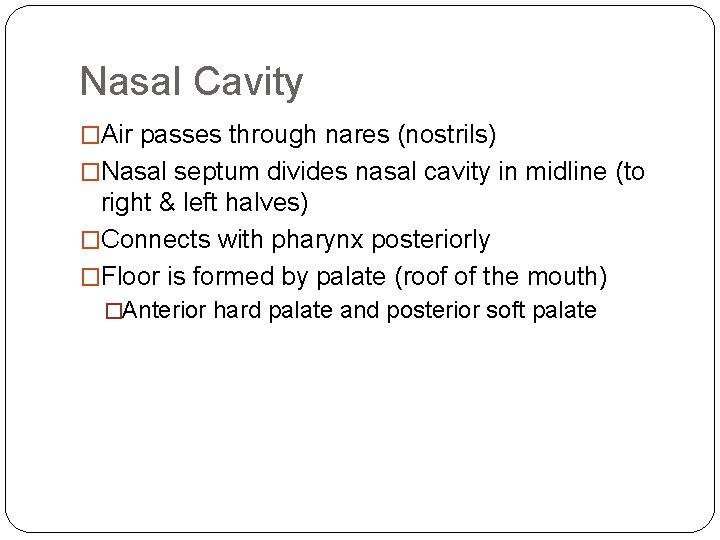
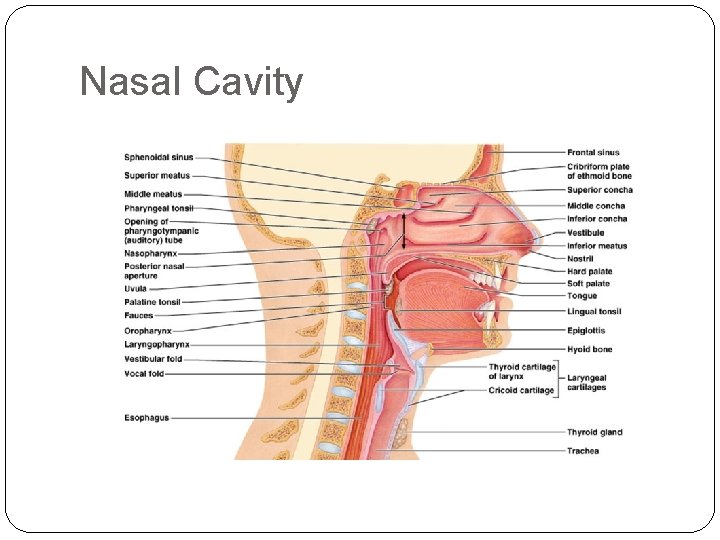
Nasal Cavity �Air passes through nares (nostrils) �Nasal septum divides nasal cavity in midline (to right & left halves) �Connects with pharynx posteriorly �Floor is formed by palate (roof of the mouth) �Anterior hard palate and posterior soft palate
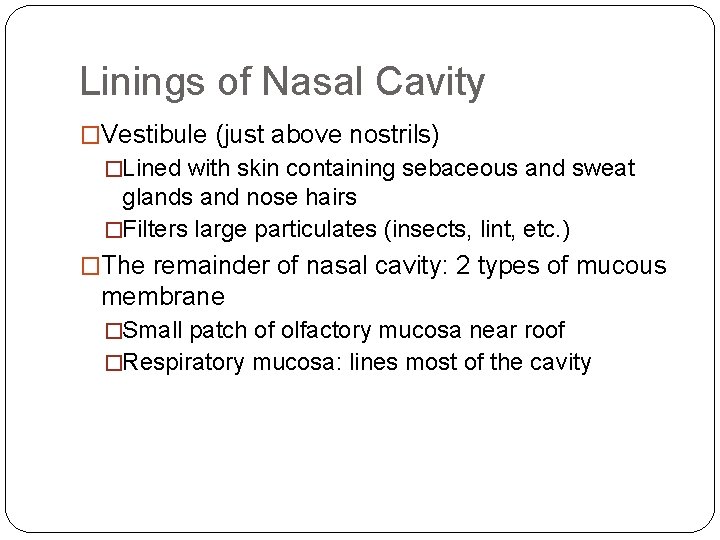
Linings of Nasal Cavity �Vestibule (just above nostrils) �Lined with skin containing sebaceous and sweat glands and nose hairs �Filters large particulates (insects, lint, etc. ) �The remainder of nasal cavity: 2 types of mucous membrane �Small patch of olfactory mucosa near roof �Respiratory mucosa: lines most of the cavity
Nasal Cavity
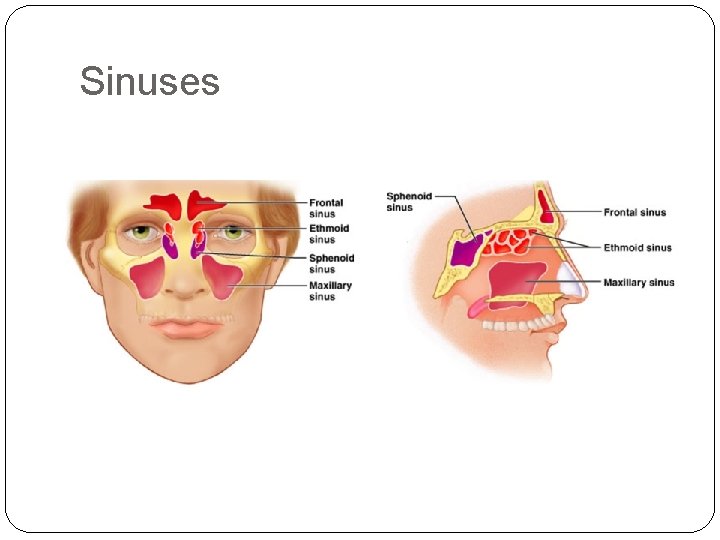
Sinuses
Sinuses �Frontal, sphenoid, ethmoidal, and maxillary �Open into nasal cavity �Lined by same mucosa as nasal cavity �lighten the skull �What is it called when they get infected? �sinusitis
Pharynx
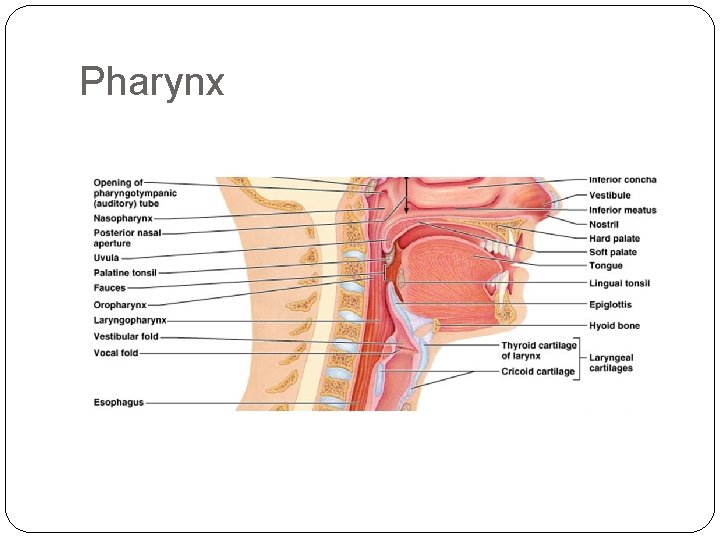
Pharynx � 3 parts: naso-, oro- and laryngopharynx �Houses tonsils �respond to inhaled antigens �Uvula �closes off nasopharynx during swallowing so food doesn’t go into nose �Epiglottis posterior to the tongue �keeps food out of airway �Oropharynx and laryngopharynx serve as common passageway for food and air
Larynx
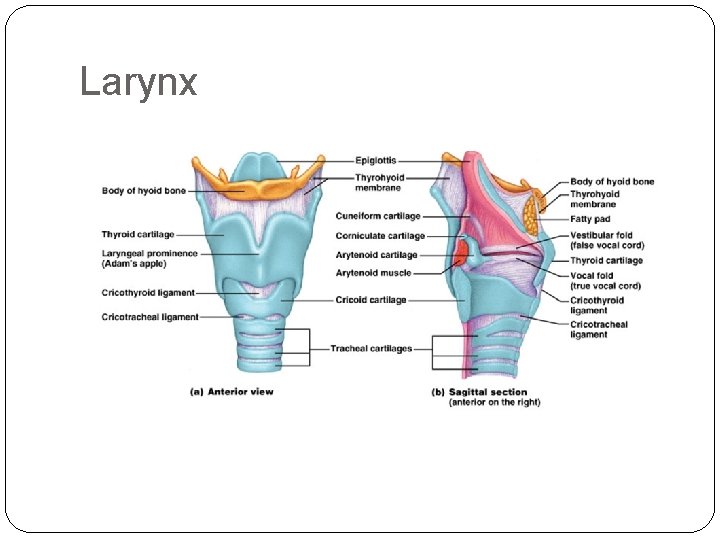
Larynx �Extends from the level of the 4 th to the 6 th cervical vertebrae �Attaches to hyoid bone superiorly �Inferiorly is continuous with trachea (windpipe) �Three functions: 1. Produces vocalizations (speech) 2. Provides an open airway (breathing) 3. Switching mechanism to route air and food into proper channels �Closed during swallowing �Open during breathing
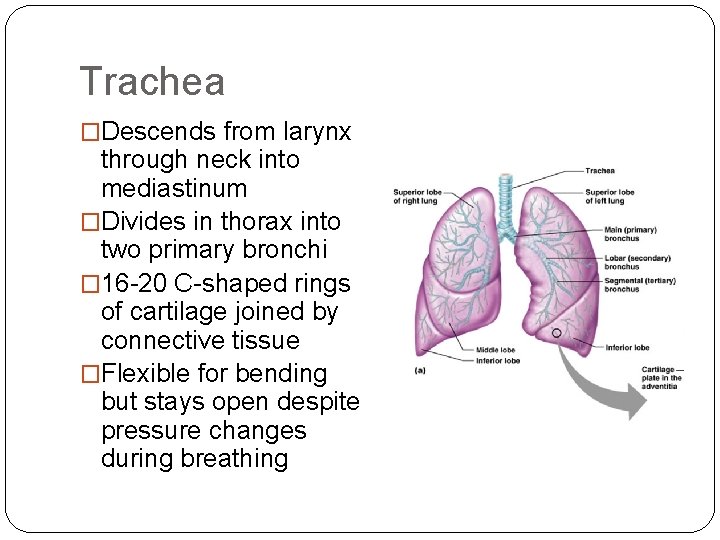
Trachea �Descends from larynx through neck into mediastinum �Divides in thorax into two primary bronchi � 16 -20 C-shaped rings of cartilage joined by connective tissue �Flexible for bending but stays open despite pressure changes during breathing
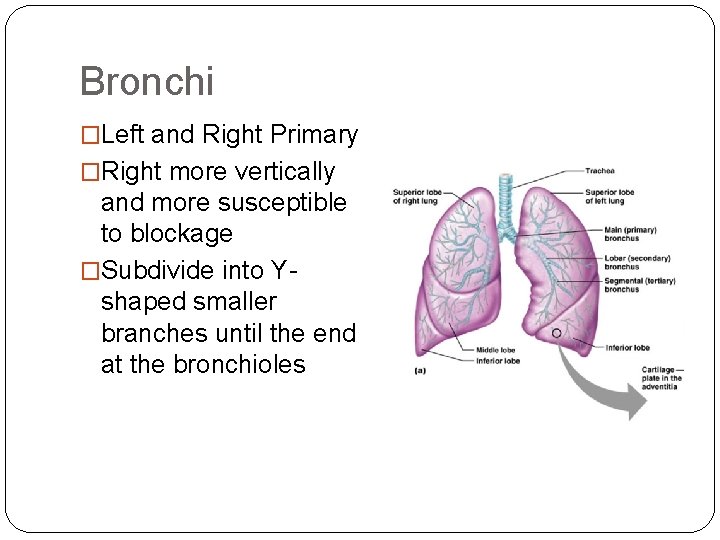
Bronchi �Left and Right Primary �Right more vertically and more susceptible to blockage �Subdivide into Yshaped smaller branches until the end at the bronchioles
Alveoli
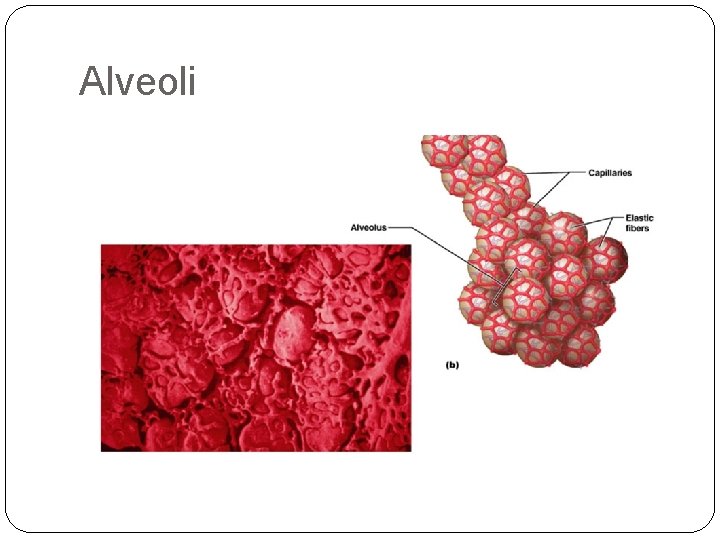
Alveoli �Air filled sacs �Main site for gas exchange �Millions of alveoli cluster make up the bulk of the lung tissue
Surfactant �Surfactant is a detergent-like substance which is secreted in fluid coating alveolar surfaces – it decreases tension �Without it the walls would stick together during exhalation �Prevents them from collapsing �Premature babies – problem breathing is largely because lack surfactant
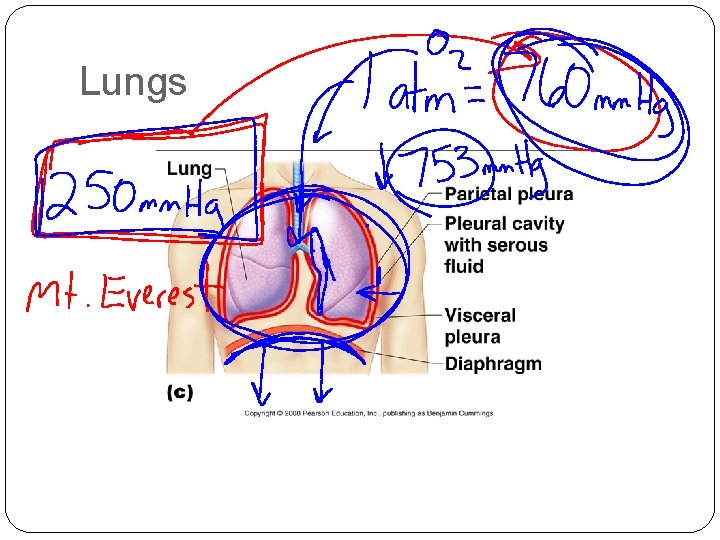
Lungs
Respiration The Respiratory System
Respiration Article Questions � 1. What keeps the alveolar from collapsing? � 2. What is the average tidal volume of an individual? � 3. Which parts of respiration make up the vital capacity? � 4. What is the partial pressure of O 2 as it enters the body? � 5. Which enzyme helps CO 2 become bicarbonate? � 6. What is the most common adjustment by the respiratory system at altitude? � 7. Which disease causes an enlargement of the alveolar sacs causing the walls to disappear? � 8. Explain how cystic fibrosis affects changes in the respiratory system. � 9. What is the most efficient carrier of oxygen and how many molecules of oxygen can be carried on each of its molecules?
Respiration (breathing) �Pulmonary ventilation �Air is continuously moved into and out to the lungs �External respiration �Fresh oxygen from outside the body fills the lungs and alveoli, allowing gas exchange between the alveoli and pulmonary blood �Respiratory gas transport �Oxygen and carbon dioxide gases in the blood are transported between the lungs and different body tissues �Internal respiration �Gas exchange occurs inside the body between the tissues and capillaries
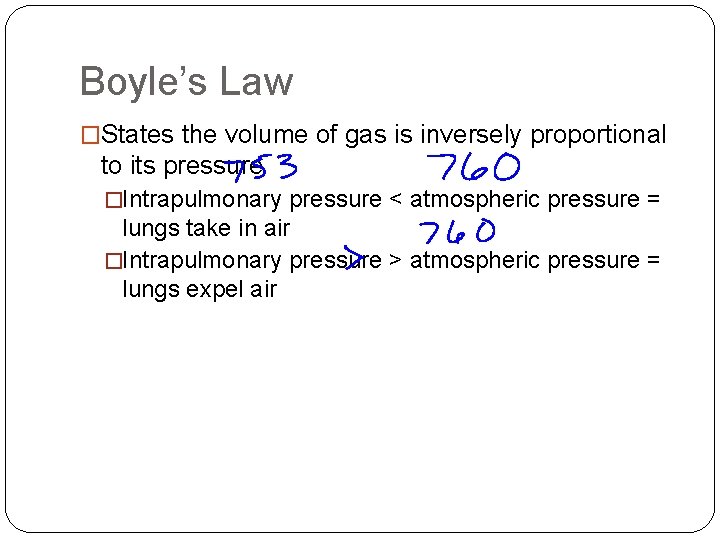
Boyle’s Law �States the volume of gas is inversely proportional to its pressure �Intrapulmonary pressure < atmospheric pressure = lungs take in air �Intrapulmonary pressure > atmospheric pressure = lungs expel air
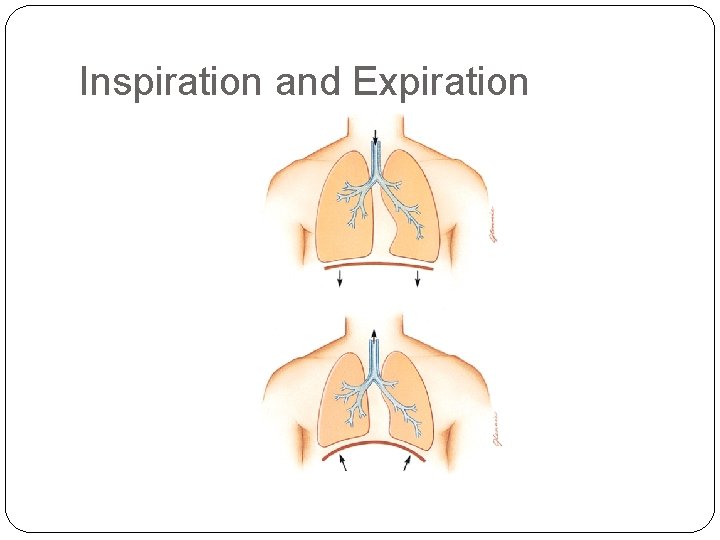
Inspiration �Intercostal muscles contract, lifting the ribs upward and outward �Diaphragm muscle contracts at the same time �These contractions expand the thoracic cavity and decreasing the internal air pressure �As the thoracic cavity expands the lungs go with it and expand
Expiration �Intercostal muscles and diaphragm relax decreasing space in the thoracic cavity and increase intrapulmonary pressure �At rest this is a passive process (no muscle contraction) �When exercising the process is active (intercostal and abdominal muscles contract to help force air out of the lungs)
Inspiration and Expiration
What about. . . �Cough �Clears lower respiratory tract; deep breath closes the epiglottis and a forceful exhalation �Sneeze �Clear the upper respiratory tract; uvula closes off oral cavity and routes air through the nose �Hiccup �Diaphragm muscle spasm; sudden inspirations against the vocal cords of the closed glottis �Yawn �Need for increased oxygen; saturate the alveoli with fresh air
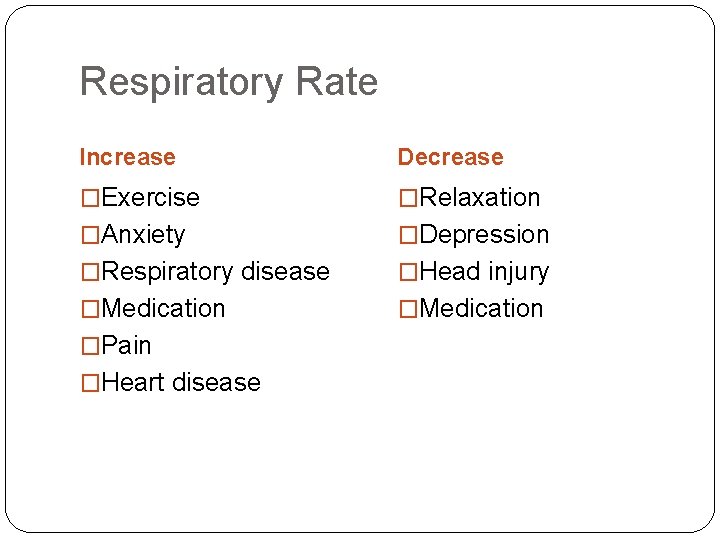
Respiratory Rate �Average adult 12 -20 bpm �Average child 20 -40 bpm �Newborn Infants can be 40 -60 bpm
Respiratory Rate Increase Decrease �Exercise �Relaxation �Anxiety �Depression �Respiratory disease �Head injury �Medication �Pain �Heart disease
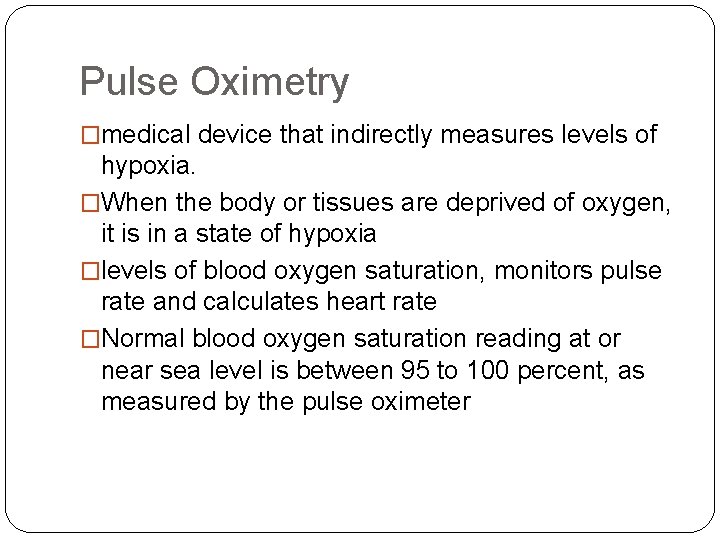
Pulse Oximetry �medical device that indirectly measures levels of hypoxia. �When the body or tissues are deprived of oxygen, it is in a state of hypoxia �levels of blood oxygen saturation, monitors pulse rate and calculates heart rate �Normal blood oxygen saturation reading at or near sea level is between 95 to 100 percent, as measured by the pulse oximeter
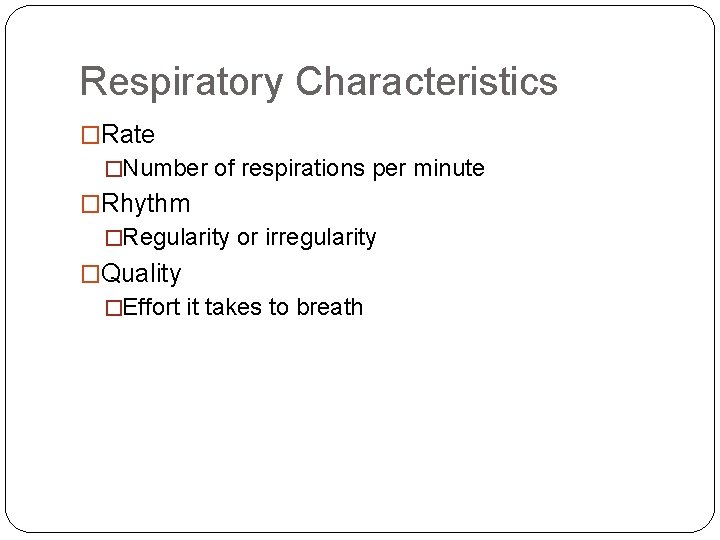
Respiratory Characteristics �Rate �Number of respirations per minute �Rhythm �Regularity or irregularity �Quality �Effort it takes to breath
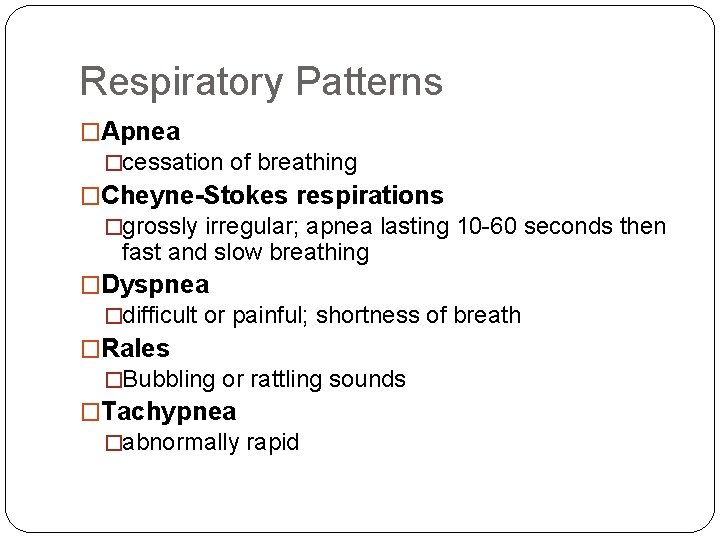
Respiratory Patterns �Apnea �cessation of breathing �Cheyne-Stokes respirations �grossly irregular; apnea lasting 10 -60 seconds then fast and slow breathing �Dyspnea �difficult or painful; shortness of breath �Rales �Bubbling or rattling sounds �Tachypnea �abnormally rapid
Teamwork �How do we determine breathing rate? �Why and how do breathing rates change as we age? �What would happen to the breathing rate of an individual as they become more physically fit?
Teamwork �Even people in “good shape, ” can have trouble breathing at high altitudes. Explain why this can happen, even when ventilation of the lungs increases. �Atmospheric pressure decreases at high altitudes and less oxygen diffusion into lung tissue resulting in a decrease ability to oxygenate the blood
Control of Breathing �Neural Factors �Brain stem (medulla oblongata and pons) �Chemical Factors �Chemoreceptors throughout the body are sensitive to the amount of oxygen and carbon dioxide in the blood �Mechanoreceptors located in muscles and joints detect muscle contraction and can increase respiration
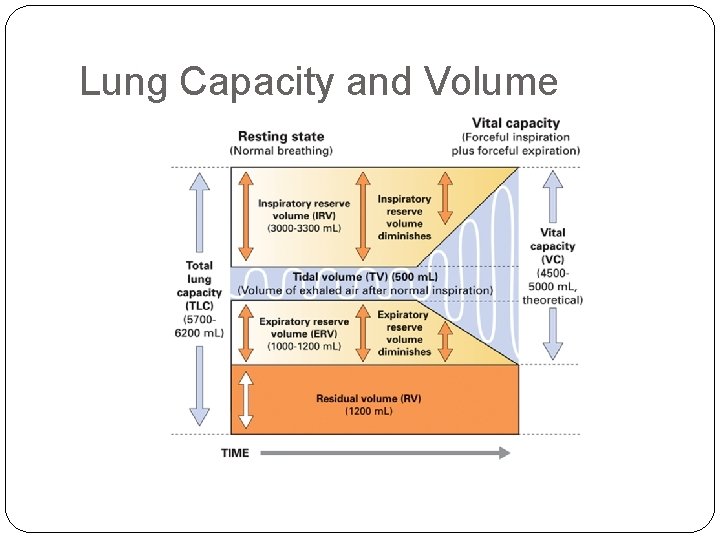
Lung Capacity and Volume �Spirometer �Tidal Volume = amount of air in and out with each breath �Vital Lung Capacity = tidal volume + inspiratory reserve + expiratory reserve �Residual Volume = amount of air that cannot be expelled from the lungs �Total Lung Capacity = tidal volume + inspiratory reserve + expiratory reserve + residual air (6, 000 m. L total)
Lung Capacity and Volume
Pathology Respiratory System
Asthma �Airway obstruction caused by an inflammatory reaction to a stimulus �Exercise alone can trigger the attack �Wheezing, coughing, dyspnea, chest tightness �Bronchoconstriction occurs �Rescue inhaler needed to decrease the inflammation in the bronchi
Pneumothorax �Condition in which air has entered the space between the lung and chest wall �Change in pressure causes lungs to collapse �Shortness of breath, severe chest pain, cyanosis, absence of breathing sounds on one side �Medical Emergency
Pneumothorax �Sucking chest wound �Caused by an open wound �Treat with occlusive dressing �Spontaneous pneumothorax �Caused by a rupture of the weakened area of the lung �Tension pneumothorax �Air in the space puts pressure on the heart and lungs
Hemothorax �Blood within the pleural space �Can be a complication from rib fracture for pneumothorax �Signs and symptoms similar to pneumothorax �Breathlessness, pain on injured side of chest and upper abdomen �rapid pulse and other signs of severe internal bleeding �Medical Emergency
Pulmonary Contusions �Bruise to the lung from a direct blow �Signs and symptoms occur about 24 -48 hours after �Shortness of breath, chest pain, rales, hemoptysis �Treat for shock and transport to hospital
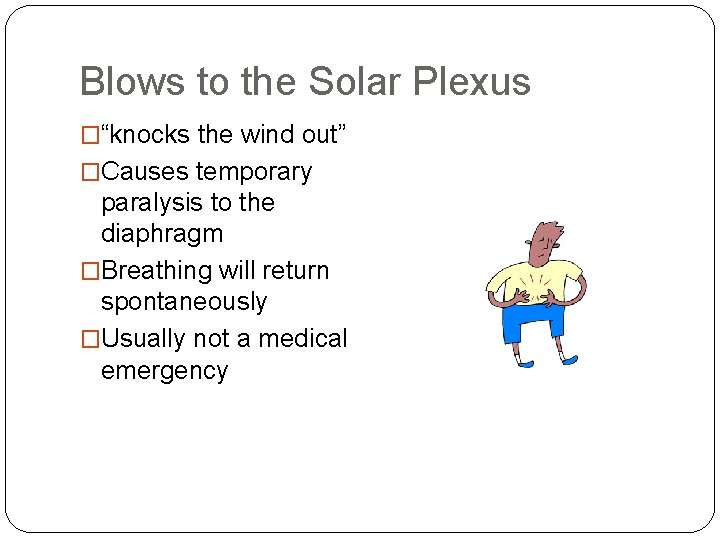
Blows to the Solar Plexus �“knocks the wind out” �Causes temporary paralysis to the diaphragm �Breathing will return spontaneously �Usually not a medical emergency
Hyperventilation �Prolonged, deep, and rapid breathing, resulting in decreased levels of CO 2 in the blood �Causes include: excitement, anxiety, pain, asthma �Not necessarily a medical emergency
Side Stitches �Pain in the side brought on by physical activity �More common in novice runners �Unknown as to the exact cause
Pulmonary Diseases Salem Health Article Password: northcobb 1. 2. 3. 4. 5. 6. 7. 8. 9. 10. 11. 12. 13. 14. 15. Explain why diseases of the pulmonary system are the most common. How are pulmonary diseases categorized? What are the common causes of bronchitis? Explain why pneumonia can become life threatening. How is tuberculosis different from bronchitis and pneumonia? How does emphysema affect the lungs? Where do tumors typically form with lung cancer? What are the common symptoms associated with pulmonary disease? What tests are typically used to diagnose pulmonary disease? How are bronchitis, pneumonia, and tuberculosis typically treated? Describe three categories of drugs used to treat asthma. What is the mainstay treatment for emphysema? Why are fatality rates high with lung cancer? What treatment modality plays an important role in treating pulmonary disease? List 7 pulmonary viral illnesses which can be prevented with vaccination.
The End