
The Research Question Comparison of Osteoporosis Risk Assessment
- Slides: 4
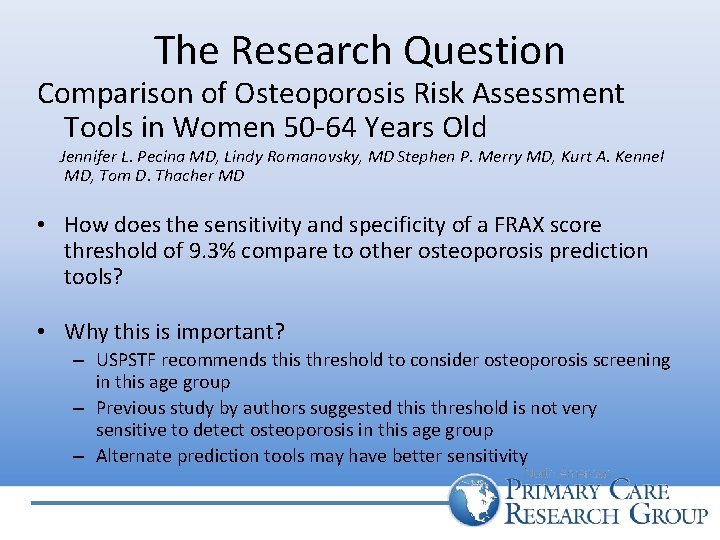
The Research Question Comparison of Osteoporosis Risk Assessment Tools in Women 50 -64 Years Old Jennifer L. Pecina MD, Lindy Romanovsky, MD Stephen P. Merry MD, Kurt A. Kennel MD, Tom D. Thacher MD • How does the sensitivity and specificity of a FRAX score threshold of 9. 3% compare to other osteoporosis prediction tools? • Why this is important? – USPSTF recommends this threshold to consider osteoporosis screening in this age group – Previous study by authors suggested this threshold is not very sensitive to detect osteoporosis in this age group – Alternate prediction tools may have better sensitivity
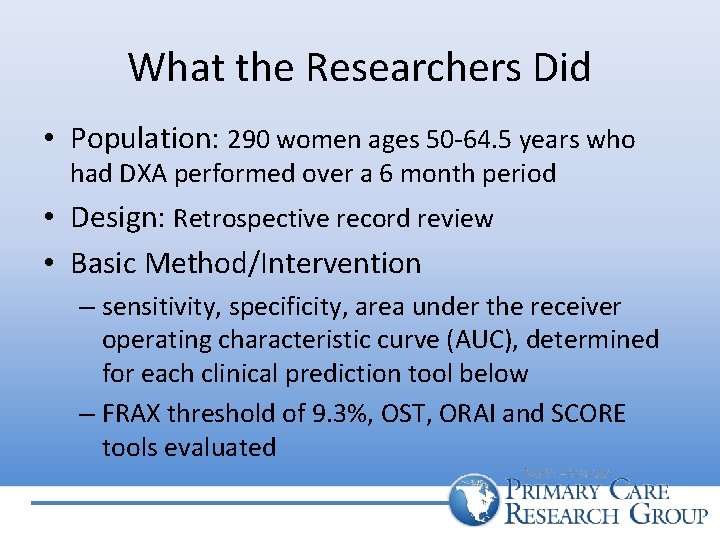
What the Researchers Did • Population: 290 women ages 50 -64. 5 years who had DXA performed over a 6 month period • Design: Retrospective record review • Basic Method/Intervention – sensitivity, specificity, area under the receiver operating characteristic curve (AUC), determined for each clinical prediction tool below – FRAX threshold of 9. 3%, OST, ORAI and SCORE tools evaluated
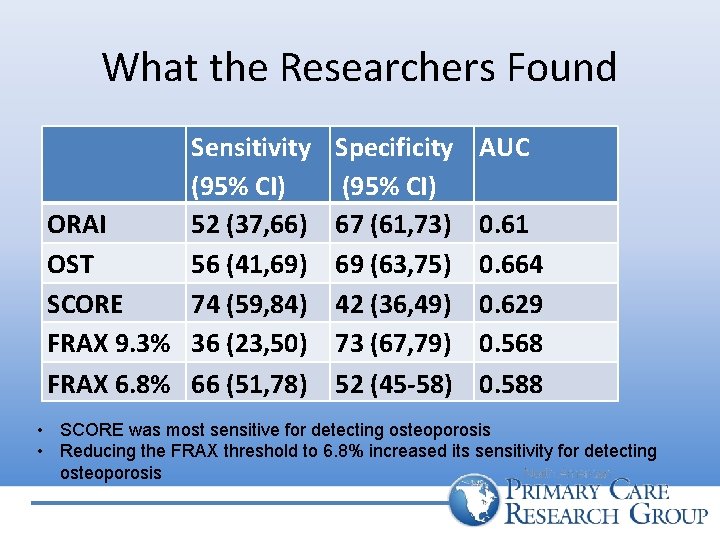
What the Researchers Found Sensitivity (95% CI) ORAI 52 (37, 66) OST 56 (41, 69) SCORE 74 (59, 84) FRAX 9. 3% 36 (23, 50) FRAX 6. 8% 66 (51, 78) Specificity (95% CI) 67 (61, 73) 69 (63, 75) 42 (36, 49) 73 (67, 79) 52 (45 -58) AUC 0. 61 0. 664 0. 629 0. 568 0. 588 • SCORE was most sensitive for detecting osteoporosis • Reducing the FRAX threshold to 6. 8% increased its sensitivity for detecting osteoporosis
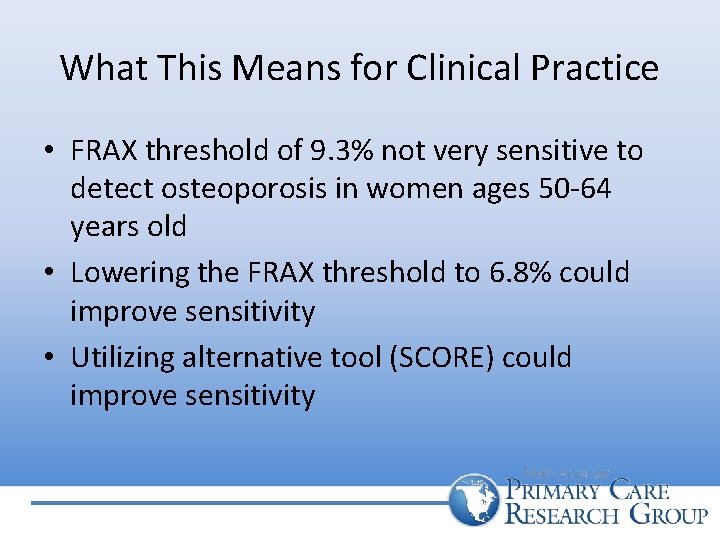
What This Means for Clinical Practice • FRAX threshold of 9. 3% not very sensitive to detect osteoporosis in women ages 50 -64 years old • Lowering the FRAX threshold to 6. 8% could improve sensitivity • Utilizing alternative tool (SCORE) could improve sensitivity