
THE RESEARCH QUEST Types of Sources and How



- Slides: 49
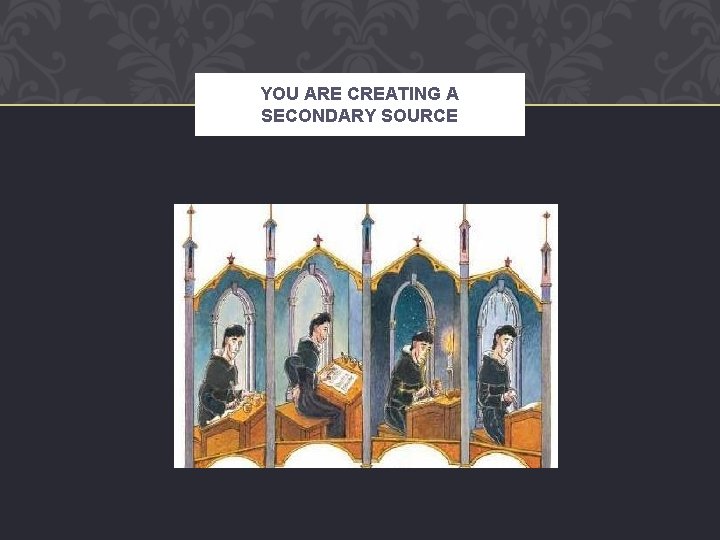
THE RESEARCH QUEST: Types of Sources and How to Find Them Detail of a miniature of a hermit at work on a manuscript, from the Estoire del Saint Graal, France (Saint-Omer or Tournai? ), c. 1315 – 1325, Royal MS 14 E III, f. 6 v
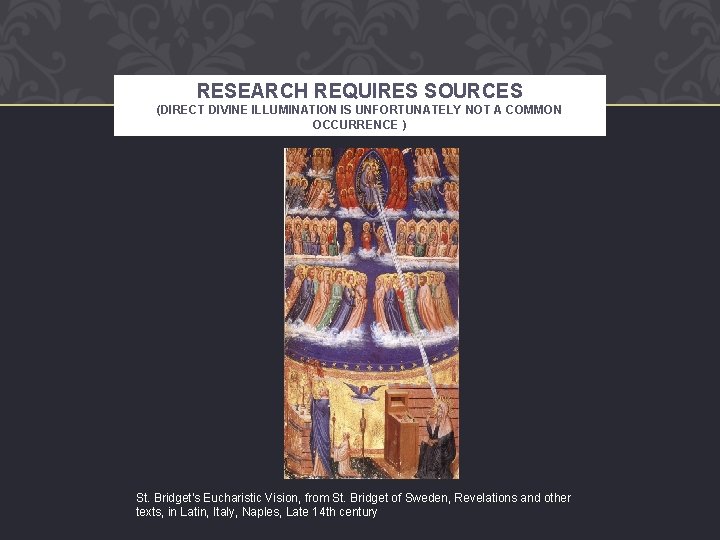
RESEARCH REQUIRES SOURCES (DIRECT DIVINE ILLUMINATION IS UNFORTUNATELY NOT A COMMON OCCURRENCE ) St. Bridget's Eucharistic Vision, from St. Bridget of Sweden, Revelations and other texts, in Latin, Italy, Naples, Late 14 th century
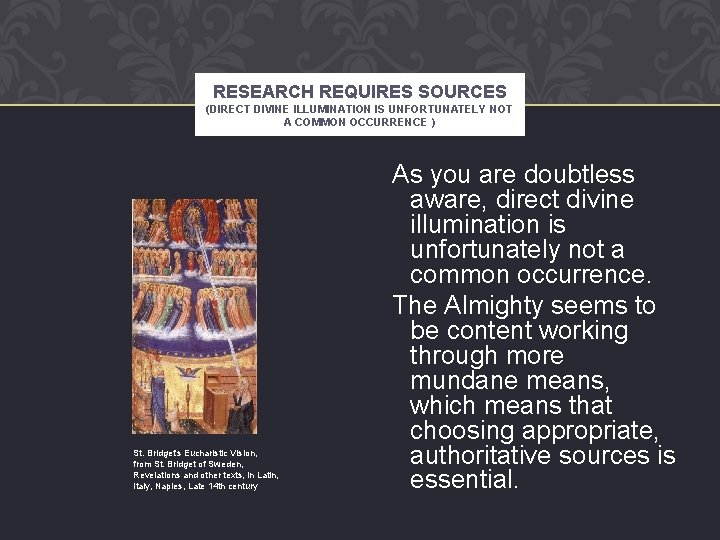
RESEARCH REQUIRES SOURCES (DIRECT DIVINE ILLUMINATION IS UNFORTUNATELY NOT A COMMON OCCURRENCE ) St. Bridget's Eucharistic Vision, from St. Bridget of Sweden, Revelations and other texts, in Latin, Italy, Naples, Late 14 th century As you are doubtless aware, direct divine illumination is unfortunately not a common occurrence. The Almighty seems to be content working through more mundane means, which means that choosing appropriate, authoritative sources is essential.
RESEARCH IS LIKE A SPIRAL Like a good conversation, research is a give-and-take process of asking questions, going to sources for information, which leads to further questions and additional research FOREVER (not really – that is why God has graciously given us deadlines)
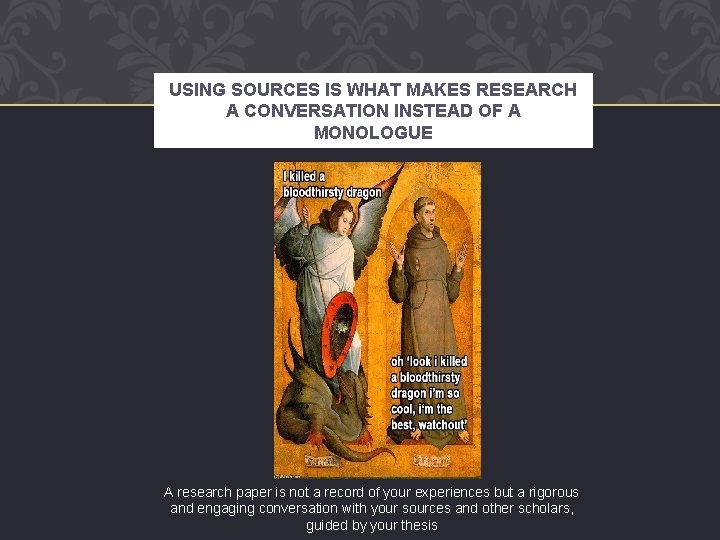
USING SOURCES IS WHAT MAKES RESEARCH A CONVERSATION INSTEAD OF A MONOLOGUE A research paper is not a record of your experiences but a rigorous and engaging conversation with your sources and other scholars, guided by your thesis
THREE TYPES OF SOURCES
THREE TYPES OF SOURCES You can find information on your topic in three types of sources: tertiary, primary, and secondary. These are sort of like third, second, and first person conversations: • I can speak about myself (first person - primary), • I can say something about “them” (third person – tertiary), • or you and I can have a conversation (second person – secondary).
TERTIARY SOURCES (DICTIONARIES, ENCYCLOPEDIAS, ETC. ) Has anyone here started a research project by going to the library and checking out a stack of books? If so, how many of the books that you checked out did you wind up actually using? The Long Room, Trinity College, Dublin, Ireland
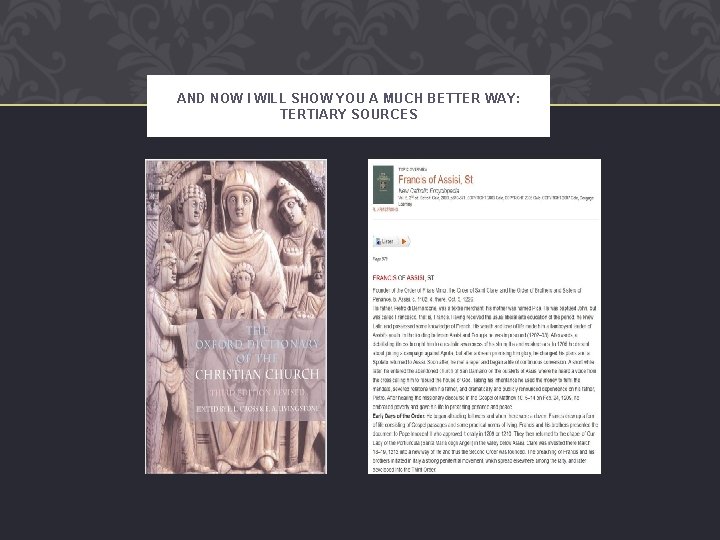
AND NOW I WILL SHOW YOU A MUCH BETTER WAY: TERTIARY SOURCES
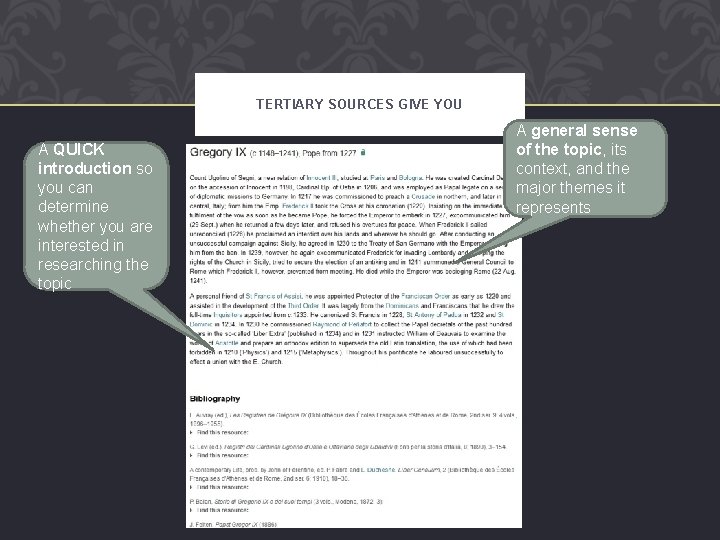
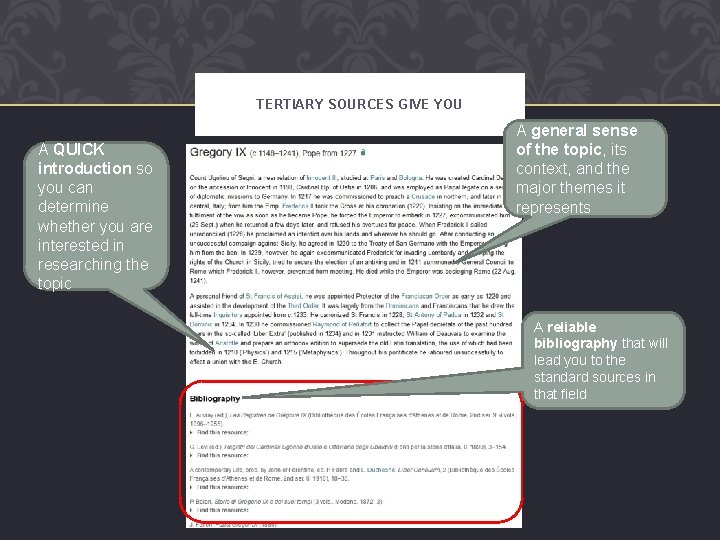
TERTIARY SOURCES GIVE YOU A QUICK introduction so you can determine whether you are interested in researching the topic
TERTIARY SOURCES GIVE YOU A QUICK introduction so you can determine whether you are interested in researching the topic A general sense of the topic, its context, and the major themes it represents
TERTIARY SOURCES GIVE YOU A QUICK introduction so you can determine whether you are interested in researching the topic A general sense of the topic, its context, and the major themes it represents A reliable bibliography that will lead you to the standard sources in that field
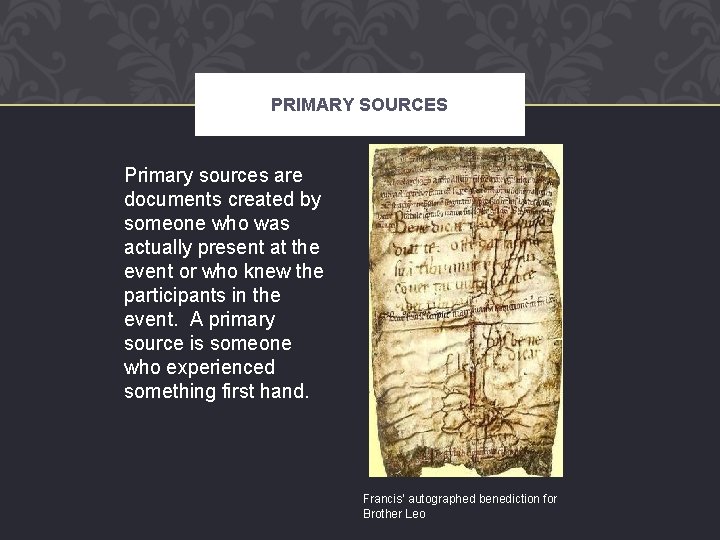
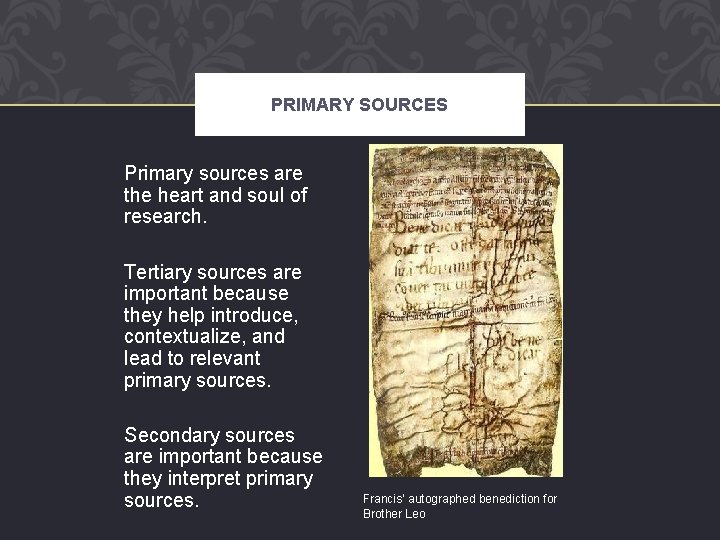
PRIMARY SOURCES Primary sources are documents created by someone who was actually present at the event or who knew the participants in the event. A primary source is someone who experienced something first hand. Francis’ autographed benediction for Brother Leo
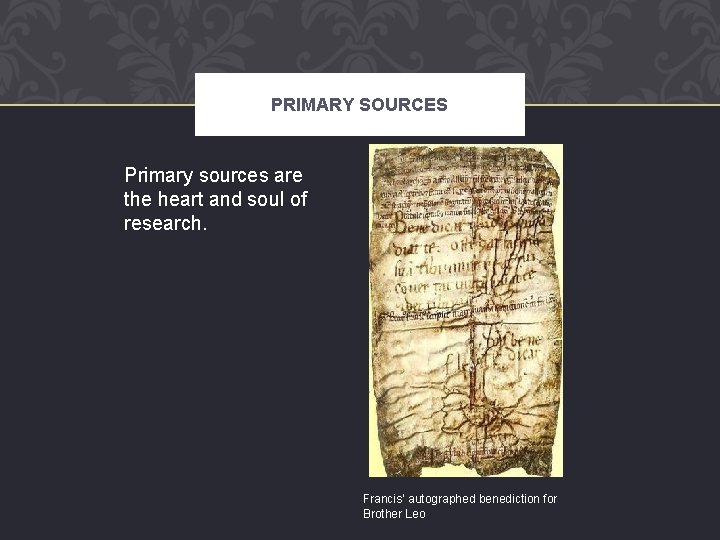
PRIMARY SOURCES Primary sources are the heart and soul of research. Francis’ autographed benediction for Brother Leo
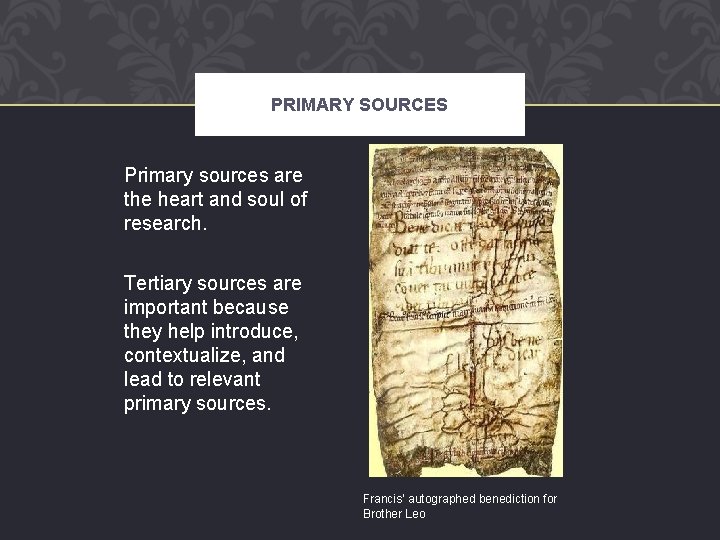
PRIMARY SOURCES Primary sources are the heart and soul of research. Tertiary sources are important because they help introduce, contextualize, and lead to relevant primary sources. Francis’ autographed benediction for Brother Leo
PRIMARY SOURCES Primary sources are the heart and soul of research. Tertiary sources are important because they help introduce, contextualize, and lead to relevant primary sources. Secondary sources are important because they interpret primary sources. Francis’ autographed benediction for Brother Leo
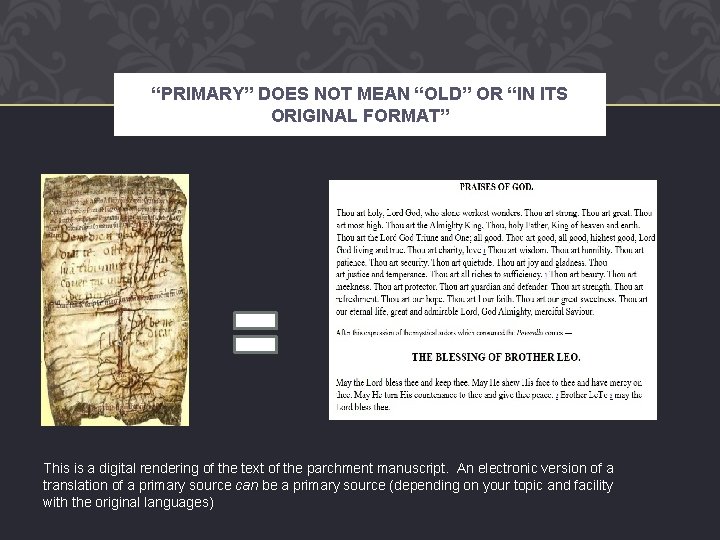
“PRIMARY” DOES NOT MEAN “OLD” OR “IN ITS ORIGINAL FORMAT” This is a digital rendering of the text of the parchment manuscript. An electronic version of a translation of a primary source can be a primary source (depending on your topic and facility with the original languages)
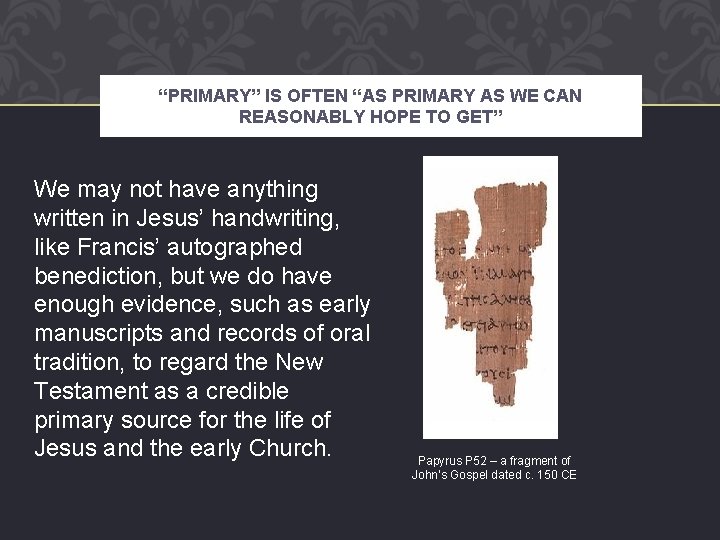
“PRIMARY” IS OFTEN “AS PRIMARY AS WE CAN REASONABLY HOPE TO GET” We may not have anything written in Jesus’ handwriting, like Francis’ autographed benediction, but we do have enough evidence, such as early manuscripts and records of oral tradition, to regard the New Testament as a credible primary source for the life of Jesus and the early Church. Papyrus P 52 – a fragment of John’s Gospel dated c. 150 CE
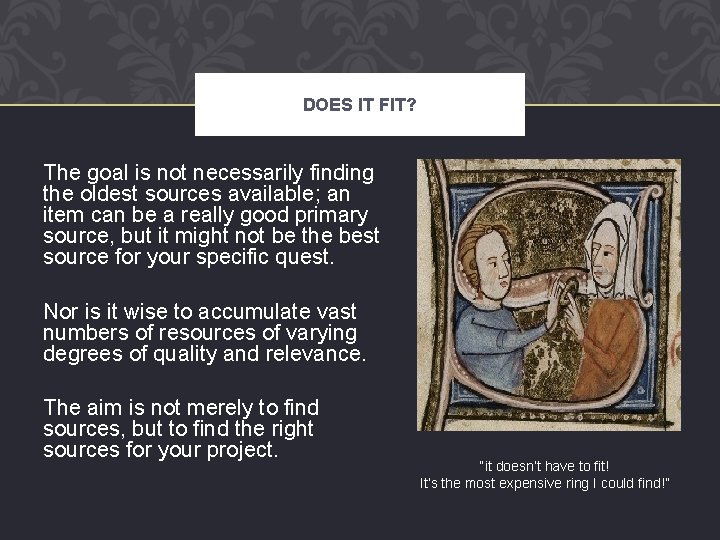
DOES IT FIT? The goal is not necessarily finding the oldest sources available; an item can be a really good primary source, but it might not be the best source for your specific quest. Nor is it wise to accumulate vast numbers of resources of varying degrees of quality and relevance. The aim is not merely to find sources, but to find the right sources for your project. “it doesn’t have to fit! It’s the most expensive ring I could find!”
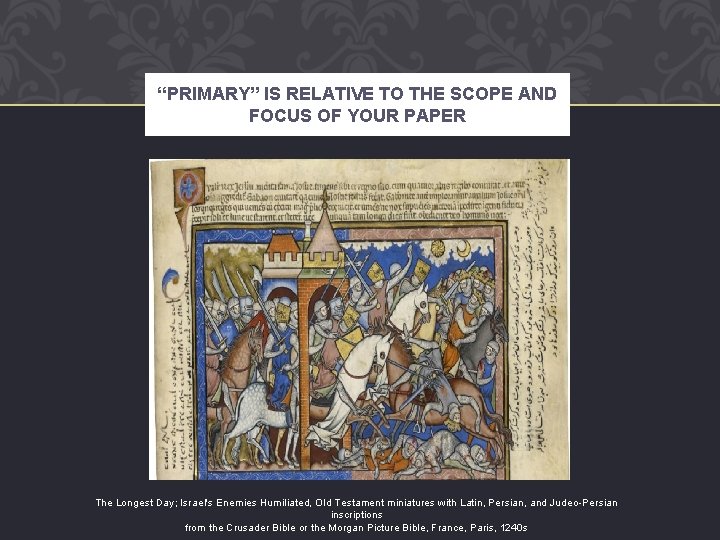
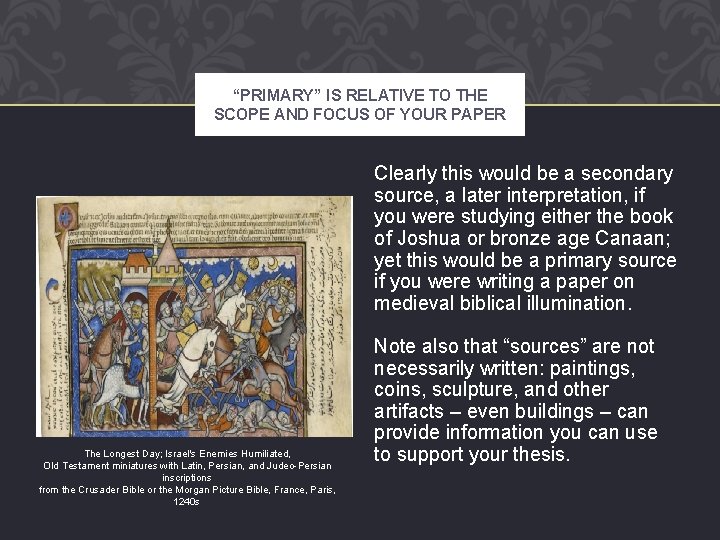
“PRIMARY” IS RELATIVE TO THE SCOPE AND FOCUS OF YOUR PAPER The Longest Day; Israel's Enemies Humiliated, Old Testament miniatures with Latin, Persian, and Judeo-Persian inscriptions from the Crusader Bible or the Morgan Picture Bible, France, Paris, 1240 s
“PRIMARY” IS RELATIVE TO THE SCOPE AND FOCUS OF YOUR PAPER Clearly this would be a secondary source, a later interpretation, if you were studying either the book of Joshua or bronze age Canaan; yet this would be a primary source if you were writing a paper on medieval biblical illumination. The Longest Day; Israel's Enemies Humiliated, Old Testament miniatures with Latin, Persian, and Judeo-Persian inscriptions from the Crusader Bible or the Morgan Picture Bible, France, Paris, 1240 s Note also that “sources” are not necessarily written: paintings, coins, sculpture, and other artifacts – even buildings – can provide information you can use to support your thesis.
SECONDARY SOURCES ARE SYNTHESES BY SCHOLARS IN THE FIELD. THEY ARE BASED ON PRIMARY SOURCES, BUT ARE NOT PRIMARY SOURCES THEMSELVES. “On second thought, let’s not go to Camelot. ‘tis a silly place. ”
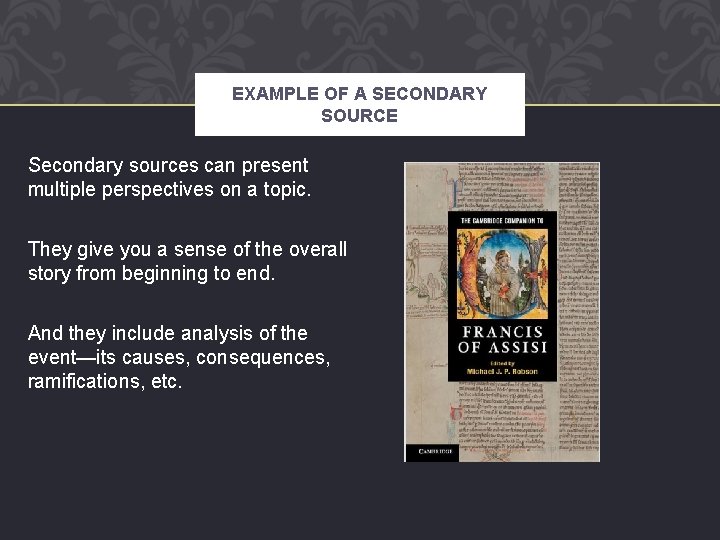
EXAMPLE OF A SECONDARY SOURCE Secondary sources can present multiple perspectives on a topic. They give you a sense of the overall story from beginning to end. And they include analysis of the event—its causes, consequences, ramifications, etc.
TANGENT: PRESUPPOSITIONS
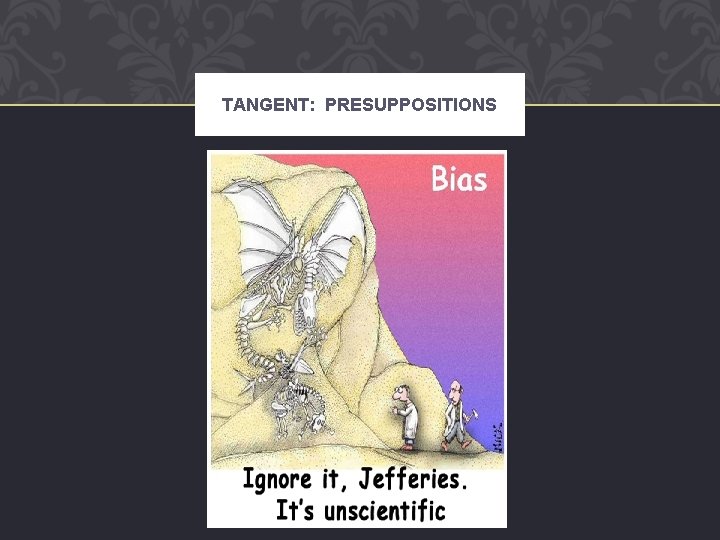
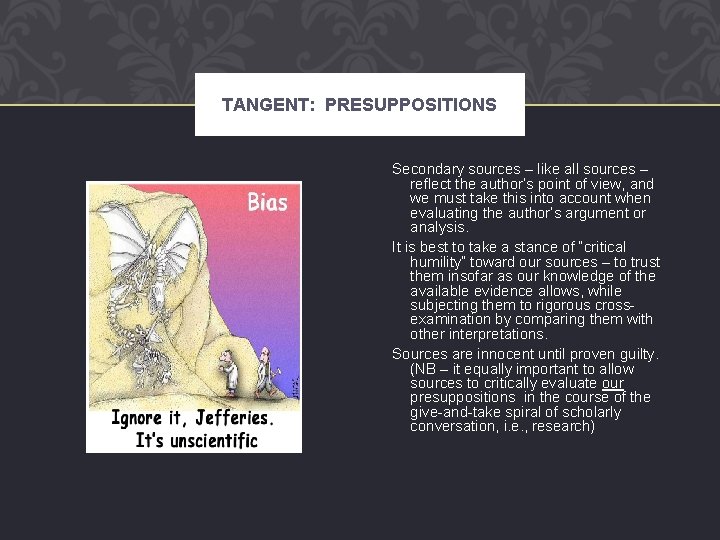
TANGENT: PRESUPPOSITIONS Secondary sources – like all sources – reflect the author’s point of view, and we must take this into account when evaluating the author’s argument or analysis. It is best to take a stance of “critical humility” toward our sources – to trust them insofar as our knowledge of the available evidence allows, while subjecting them to rigorous crossexamination by comparing them with other interpretations. Sources are innocent until proven guilty. (NB – it equally important to allow sources to critically evaluate our presuppositions in the course of the give-and-take spiral of scholarly conversation, i. e. , research)
YOU ARE CREATING A SECONDARY SOURCE
FINDING SOURCES
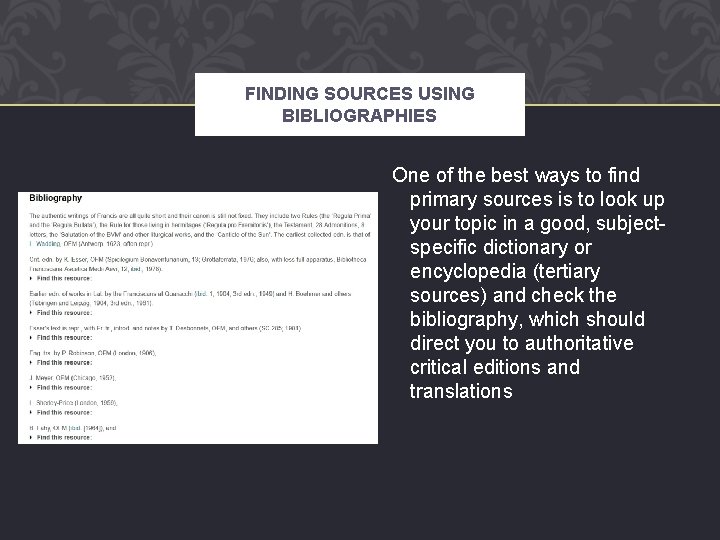
FINDING SOURCES USING BIBLIOGRAPHIES One of the best ways to find primary sources is to look up your topic in a good, subjectspecific dictionary or encyclopedia (tertiary sources) and check the bibliography, which should direct you to authoritative critical editions and translations
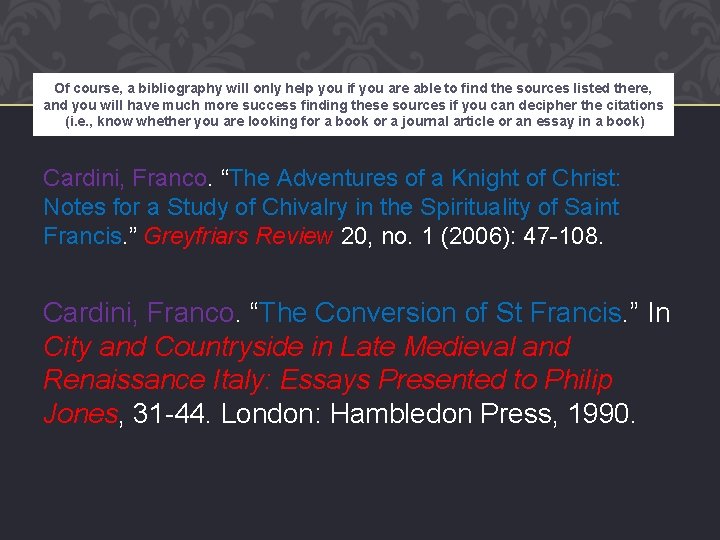
Of course, a bibliography will only help you if you are able to find the sources listed there, and you will have much more success finding these sources if you can decipher the citations (i. e. , know whether you are looking for a book or a journal article or an essay in a book) Cardini, Franco. “The Adventures of a Knight of Christ: Notes for a Study of Chivalry in the Spirituality of Saint Francis. ” Greyfriars Review 20, no. 1 (2006): 47 -108. Cardini, Franco. “The Conversion of St Francis. ” In City and Countryside in Late Medieval and Renaissance Italy: Essays Presented to Philip Jones, 31 -44. London: Hambledon Press, 1990.
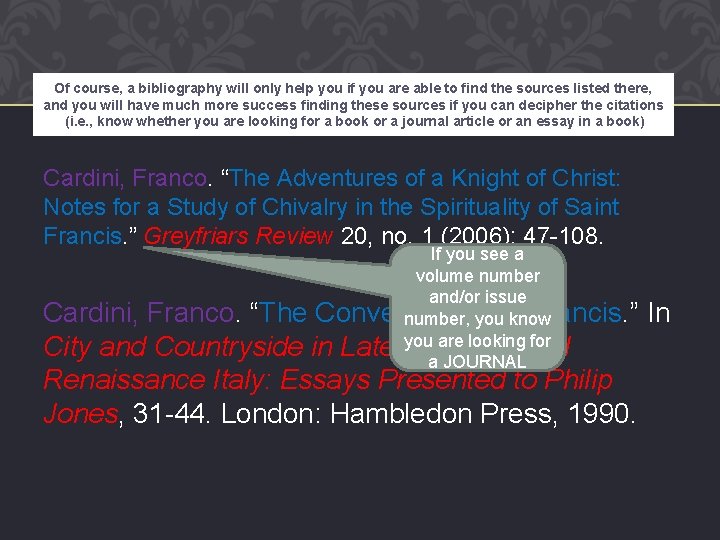
Of course, a bibliography will only help you if you are able to find the sources listed there, and you will have much more success finding these sources if you can decipher the citations (i. e. , know whether you are looking for a book or a journal article or an essay in a book) Cardini, Franco. “The Adventures of a Knight of Christ: Notes for a Study of Chivalry in the Spirituality of Saint Francis. ” Greyfriars Review 20, no. 1 (2006): 47 -108. If you see a volume number and/or issue Cardini, Franco. “The Conversion Francis. ” number, of you. St know you are lookingand for City and Countryside in Late Medieval a JOURNAL Renaissance Italy: Essays Presented to Philip Jones, 31 -44. London: Hambledon Press, 1990. In
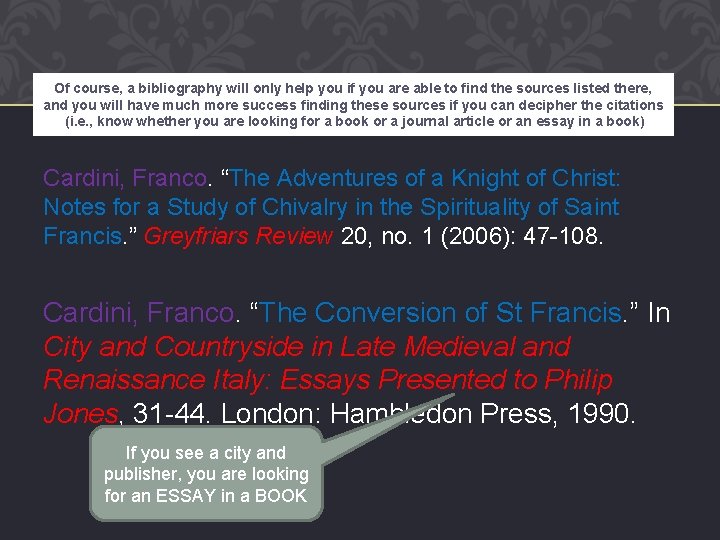
Of course, a bibliography will only help you if you are able to find the sources listed there, and you will have much more success finding these sources if you can decipher the citations (i. e. , know whether you are looking for a book or a journal article or an essay in a book) Cardini, Franco. “The Adventures of a Knight of Christ: Notes for a Study of Chivalry in the Spirituality of Saint Francis. ” Greyfriars Review 20, no. 1 (2006): 47 -108. Cardini, Franco. “The Conversion of St Francis. ” In City and Countryside in Late Medieval and Renaissance Italy: Essays Presented to Philip Jones, 31 -44. London: Hambledon Press, 1990. If you see a city and publisher, you are looking for an ESSAY in a BOOK
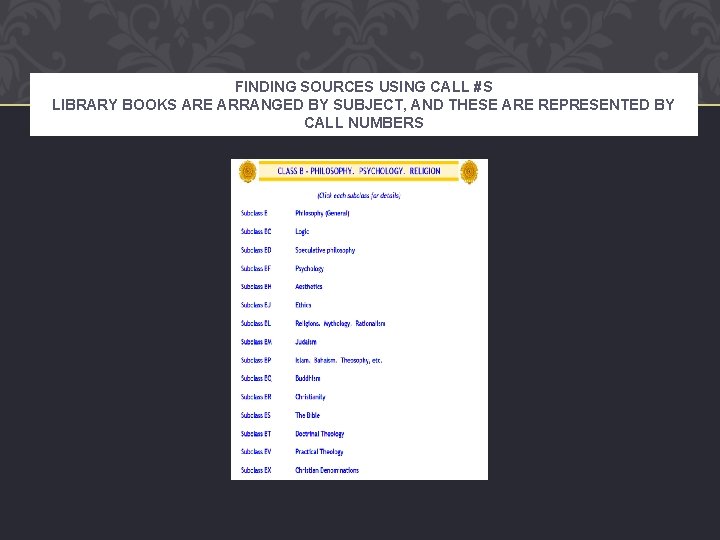
FINDING SOURCES USING CALL #S LIBRARY BOOKS ARE ARRANGED BY SUBJECT, AND THESE ARE REPRESENTED BY CALL NUMBERS
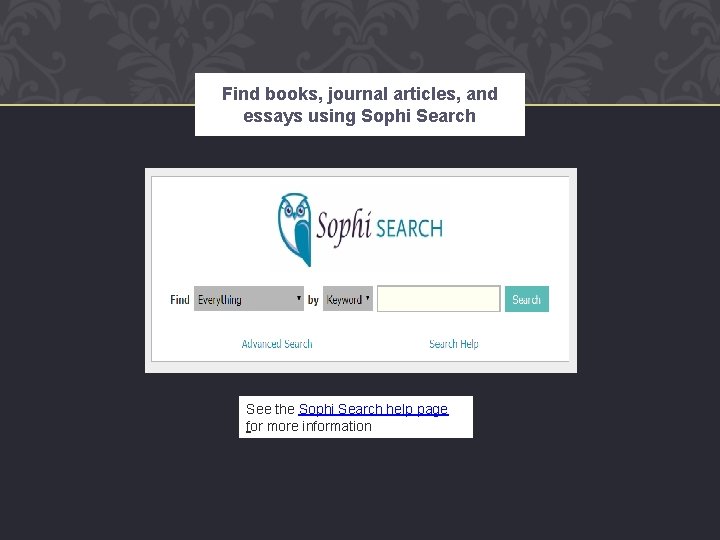
Find books, journal articles, and essays using Sophi Search See the Sophi Search help page for more information
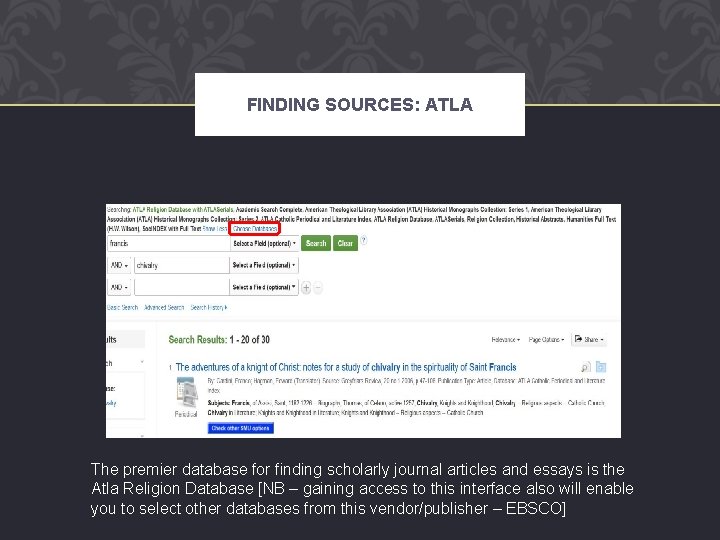
FINDING SOURCES: ATLA The premier database for finding scholarly journal articles and essays is the Atla Religion Database [NB – gaining access to this interface also will enable you to select other databases from this vendor/publisher – EBSCO]
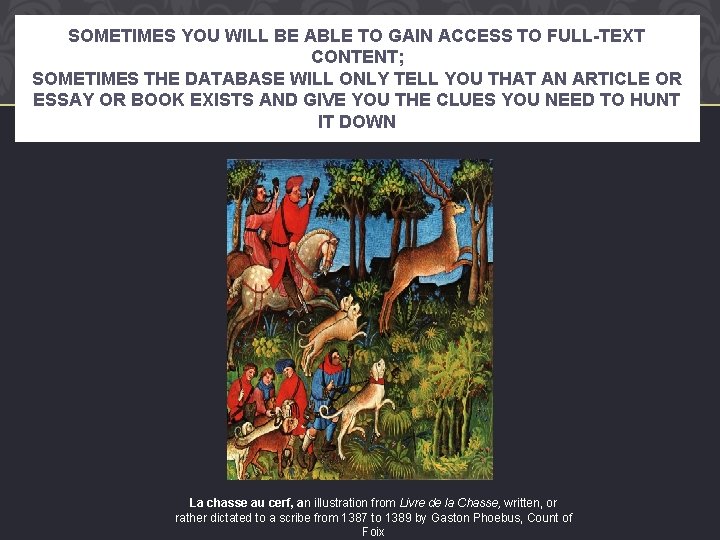
SOMETIMES YOU WILL BE ABLE TO GAIN ACCESS TO FULL-TEXT CONTENT; SOMETIMES THE DATABASE WILL ONLY TELL YOU THAT AN ARTICLE OR ESSAY OR BOOK EXISTS AND GIVE YOU THE CLUES YOU NEED TO HUNT IT DOWN La chasse au cerf, an illustration from Livre de la Chasse, written, or rather dictated to a scribe from 1387 to 1389 by Gaston Phoebus, Count of Foix
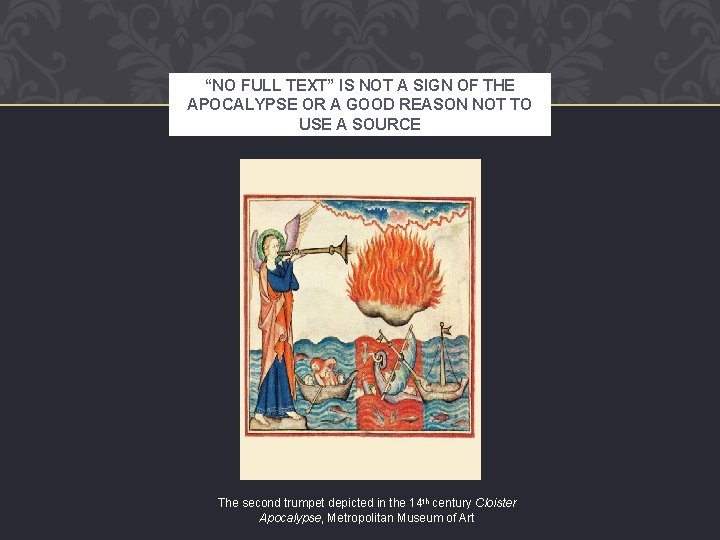
“NO FULL TEXT” IS NOT A SIGN OF THE APOCALYPSE OR A GOOD REASON NOT TO USE A SOURCE The second trumpet depicted in the 14 th century Cloister Apocalypse, Metropolitan Museum of Art
USING SOURCES While it can be useful to know the difference between types of sources, just like it can be useful to know the difference between different building materials, they mainly useful because of what you can do with them.
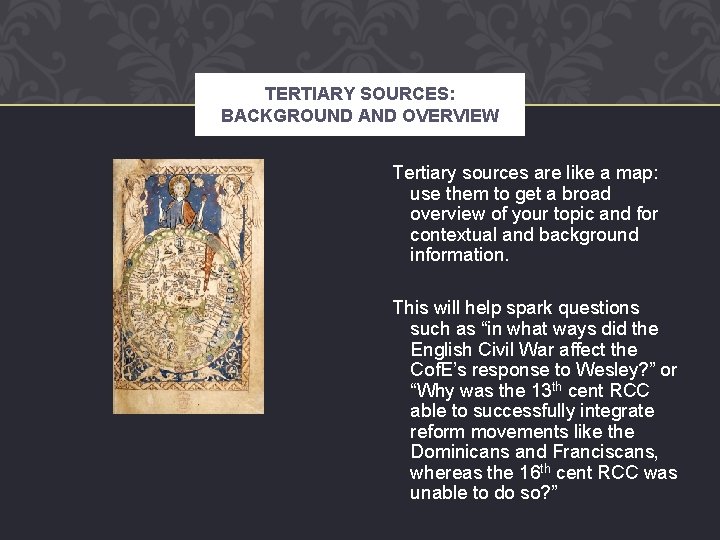
TERTIARY SOURCES: BACKGROUND AND OVERVIEW Tertiary sources are like a map: use them to get a broad overview of your topic and for contextual and background information. This will help spark questions such as “in what ways did the English Civil War affect the Cof. E’s response to Wesley? ” or “Why was the 13 th cent RCC able to successfully integrate reform movements like the Dominicans and Franciscans, whereas the 16 th cent RCC was unable to do so? ”
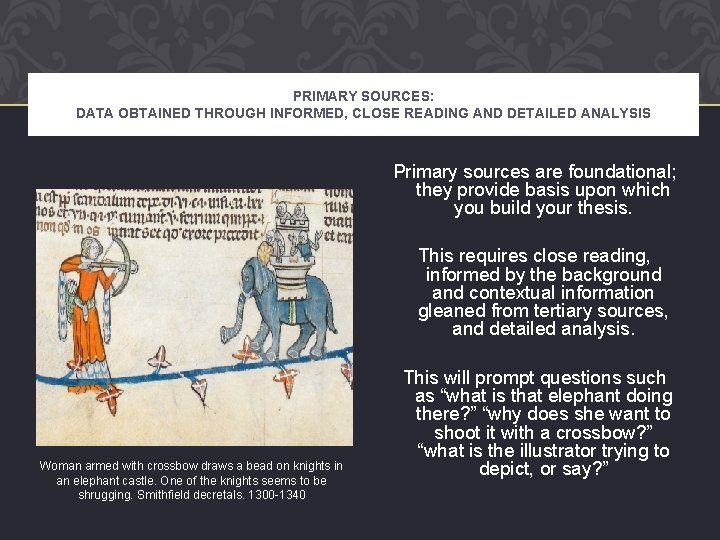
PRIMARY SOURCES: DATA OBTAINED THROUGH INFORMED, CLOSE READING AND DETAILED ANALYSIS Primary sources are foundational; they provide basis upon which you build your thesis. This requires close reading, informed by the background and contextual information gleaned from tertiary sources, and detailed analysis. Woman armed with crossbow draws a bead on knights in an elephant castle. One of the knights seems to be shrugging. Smithfield decretals. 1300 -1340 This will prompt questions such as “what is that elephant doing there? ” “why does she want to shoot it with a crossbow? ” “what is the illustrator trying to depict, or say? ”
SECONDARY SOURCES: CONVERSATION PARTNERS
USING SOURCES IS WHAT MAKES RESEARCH A CONVERSATION INSTEAD OF A MONOLOGUE It is OK – even necessary – to critically analyze the writings of authorities in your field; research is not a matter of humbly groveling before lofty immortals, nor should it be a thoughtless exercise of revolutionary iconoclasm
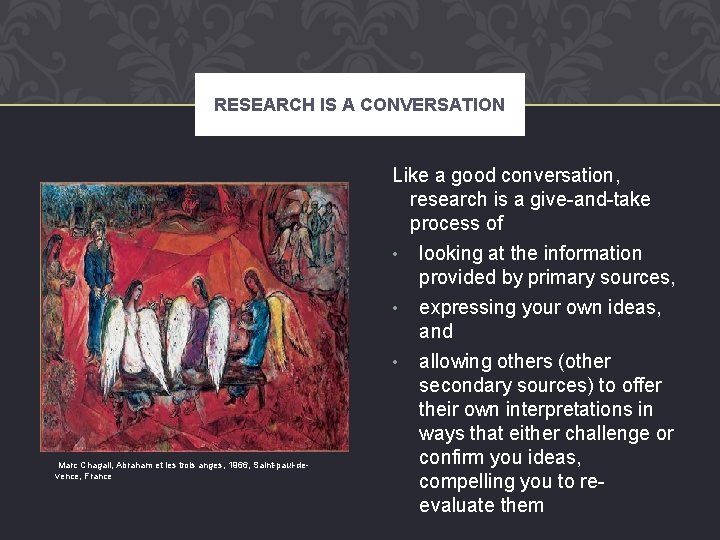
RESEARCH IS A CONVERSATION Marc Chagall, Abraham et les trois anges, 1966, Saint-paul-devence, France Like a good conversation, research is a give-and-take process of • looking at the information provided by primary sources, • expressing your own ideas, and • allowing others (other secondary sources) to offer their own interpretations in ways that either challenge or confirm you ideas, compelling you to reevaluate them
AD FONTES – TO THE SOURCE This is why it is essential to base your research on direct interaction with primary sources, and to keep going back to your primary sources, so when you enter into the conversation with other researchers and interpreters, you will have something to say, and a basis for saying it.
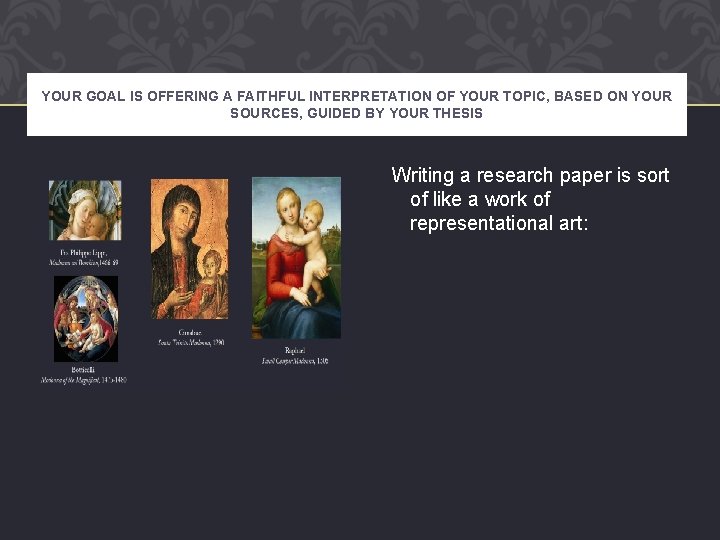
YOUR GOAL IS OFFERING A FAITHFUL INTERPRETATION OF YOUR TOPIC, BASED ON YOUR SOURCES, GUIDED BY YOUR THESIS Writing a research paper is sort of like a work of representational art:
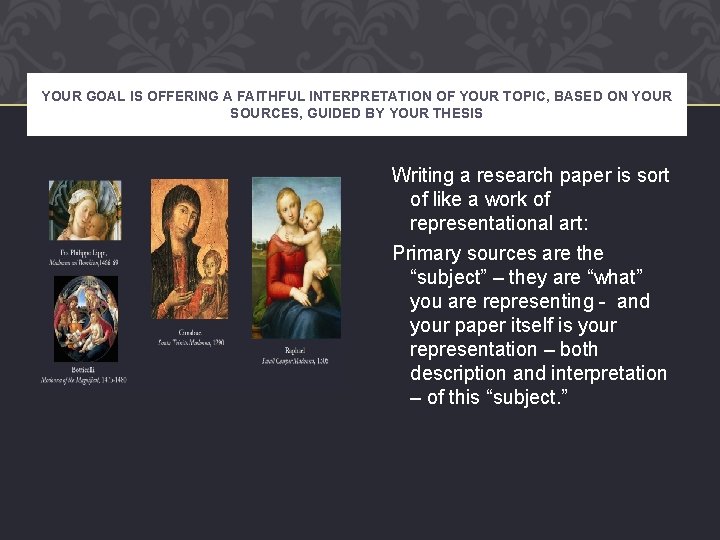
YOUR GOAL IS OFFERING A FAITHFUL INTERPRETATION OF YOUR TOPIC, BASED ON YOUR SOURCES, GUIDED BY YOUR THESIS Writing a research paper is sort of like a work of representational art: Primary sources are the “subject” – they are “what” you are representing - and your paper itself is your representation – both description and interpretation – of this “subject. ”
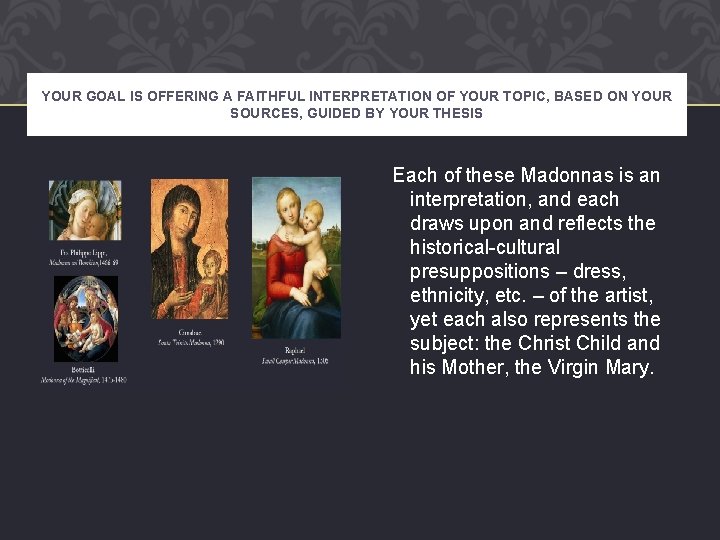
YOUR GOAL IS OFFERING A FAITHFUL INTERPRETATION OF YOUR TOPIC, BASED ON YOUR SOURCES, GUIDED BY YOUR THESIS Each of these Madonnas is an interpretation, and each draws upon and reflects the historical-cultural presuppositions – dress, ethnicity, etc. – of the artist, yet each also represents the subject: the Christ Child and his Mother, the Virgin Mary.
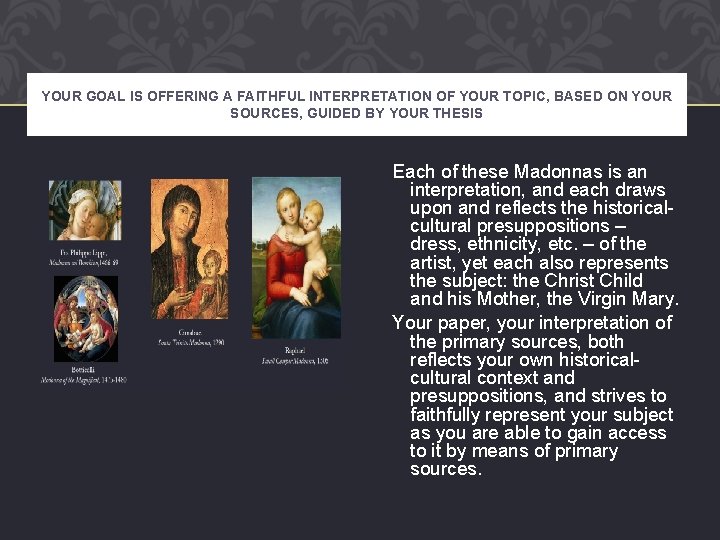
YOUR GOAL IS OFFERING A FAITHFUL INTERPRETATION OF YOUR TOPIC, BASED ON YOUR SOURCES, GUIDED BY YOUR THESIS Each of these Madonnas is an interpretation, and each draws upon and reflects the historicalcultural presuppositions – dress, ethnicity, etc. – of the artist, yet each also represents the subject: the Christ Child and his Mother, the Virgin Mary. Your paper, your interpretation of the primary sources, both reflects your own historicalcultural context and presuppositions, and strives to faithfully represent your subject as you are able to gain access to it by means of primary sources.
PUTTING IT ALL TOGETHER: AN EXAMPLE Until the 20 th century, the scholarly consensus seems to have been that the Crusades were primarily motivated by religious zeal, manifest in violence toward members of other religions. Under the influence of Marxism, Jones and other 20 th century scholars began to appreciate the economic factors that may have motivated some to go on crusade. For example, Rameous compares the economic activity evidenced in Venice before and after the period of the crusades (11 th-13 th centuries). However, based on close readings of contemporary chronicles and first -hand accounts, more recent scholars have found that neither economics, nor religious hatred were primary motivations. Rather, the primary impetus seems to have been piety, and the crusaders largely thought of themselves as pilgrims and crusades as a form of penance. As Flemmish knight Guy de’Orlean relates to his personal chronicler. . .
ASK (FOR HELP), AND YE SHALL RECEIVE Your librarians are here to help! David Schmersal dschmersal@austinseminary. edu Contact us any time at libraryiq@austinseminary. edu with any questions.