
The Research Project Outcome WHAT IS IT The




- Slides: 31
The Research Project Outcome
WHAT IS IT?
• The research outcome is the second significant part of your research project and is worth 40% of your grade. • It is the opportunity for you to use the key findings of your research to produce a product / research outcome. • It is where you highlight the main points of what you have learnt and support this with evidence and examples from your research.
In the outcome you will be assessed on: • Your synthesis of knowledge, skills and ideas to produce a resolution to the research question • Your substantiation of the key findings relevant to the research outcome • The clarity and coherence of your expression of your ideas
SYNTHESIS
is the bringing together of all the key points of your evidence in a coherent and logical manner to demonstrate what you have discovered
SUBSTANTIATION
is providing evidence and examples from your research to demonstrate that your key findings are founded on valid and reliable information
• Substantiation should be relevant to the research outcome, and can be provided in one or both of the following ways: – by referencing the aspects of the research outcome to sources, and thereby demonstrating the origin of ideas and thoughts; – or by explaining the validity of the methodology adopted and thereby demonstrating that it is able to be reproduced.
Typical examples of evidence to substantiate your key findings could include in-text referencing of sources (whatever their origin) quotes from expert sources; Statistics from surveys statistics from secondary sources photographs with annotations descriptions of observations or results from experiments • personal observations • sketches and diagrams • annotated samples from your research • • •
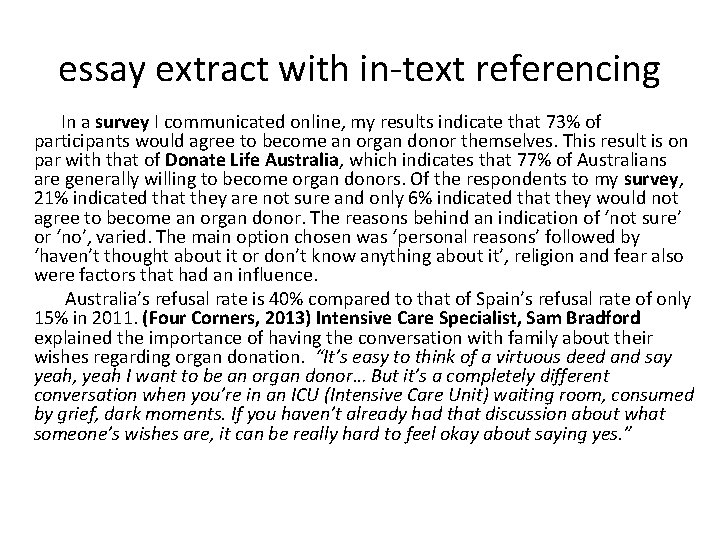
essay extract with in-text referencing In a survey I communicated online, my results indicate that 73% of participants would agree to become an organ donor themselves. This result is on par with that of Donate Life Australia, which indicates that 77% of Australians are generally willing to become organ donors. Of the respondents to my survey, 21% indicated that they are not sure and only 6% indicated that they would not agree to become an organ donor. The reasons behind an indication of ‘not sure’ or ‘no’, varied. The main option chosen was ‘personal reasons’ followed by ‘haven’t thought about it or don’t know anything about it’, religion and fear also were factors that had an influence. Australia’s refusal rate is 40% compared to that of Spain’s refusal rate of only 15% in 2011. (Four Corners, 2013) Intensive Care Specialist, Sam Bradford explained the importance of having the conversation with family about their wishes regarding organ donation. “It’s easy to think of a virtuous deed and say yeah, yeah I want to be an organ donor… But it’s a completely different conversation when you’re in an ICU (Intensive Care Unit) waiting room, consumed by grief, dark moments. If you haven’t already had that discussion about what someone’s wishes are, it can be really hard to feel okay about saying yes. ”
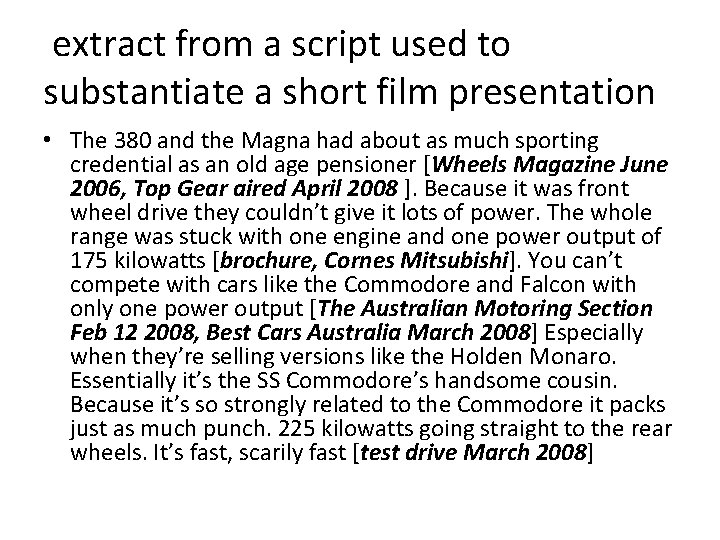
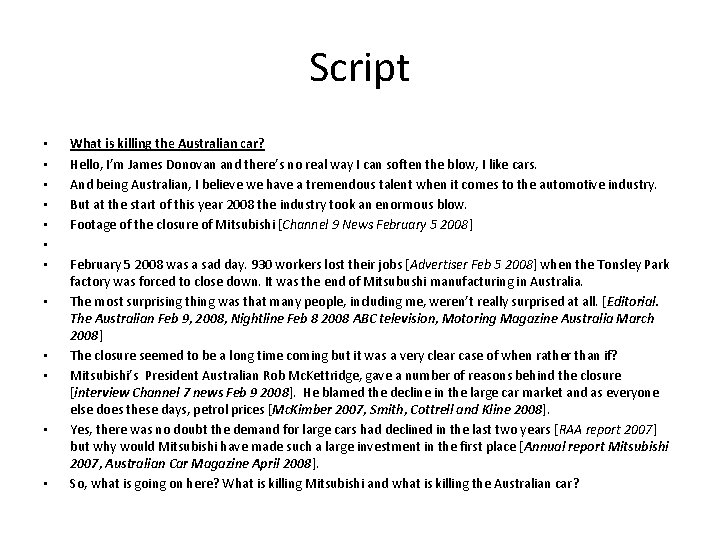
extract from a script used to substantiate a short film presentation • The 380 and the Magna had about as much sporting credential as an old age pensioner [Wheels Magazine June 2006, Top Gear aired April 2008 ]. Because it was front wheel drive they couldn’t give it lots of power. The whole range was stuck with one engine and one power output of 175 kilowatts [brochure, Cornes Mitsubishi]. You can’t compete with cars like the Commodore and Falcon with only one power output [The Australian Motoring Section Feb 12 2008, Best Cars Australia March 2008] Especially when they’re selling versions like the Holden Monaro. Essentially it’s the SS Commodore’s handsome cousin. Because it’s so strongly related to the Commodore it packs just as much punch. 225 kilowatts going straight to the rear wheels. It’s fast, scarily fast [test drive March 2008]
WHAT FORM SHOULD IT TAKE?
• The outcome can be presented in a variety of ways • and should be negotiated with your teacher. It could be… – the key findings and evidence, which together form a product For example……
• an essay, • a report, • a booklet, • an article, • a multi media presentation • or a documented experiment
Alternatively…. . It could be…. the key findings and substantiation, with elements of or reference to a separate product – a good example of this would be a supporting statement and annotated photographs of a product that you have created
or the key findings presented as annotations on a product, and substantiated by evidence and examples of the research • a product (e. g. an artifact, a manufactured article, or a work of art or literature) with an annotated record which substantiates the key findings • a display or exhibition with annotation or voice over of key findings and evidence • a multimedia presentation with voice over • a performance (live or recorded) with a statement of key findings and evidence • a combination of any of the above.
HOW BIG SHOULD IT BE?
• Evidence of the research outcome must be either – a maximum of 2000 words if written or – a maximum of 12 minutes for an oral presentation or – the equivalent in multimodal form
5 TIPS FOR SUCCESS WITH YOUR RESEARCH PROJECT OUTCOME
1. Synthesis is not just a recount of all the research you did - you must clearly present the key findings from your research
2. Bring all aspects of your research together to demonstrate your new knowledge and understanding as it relates to your research question.
• 3. Ensure your outcome is logically structured, fluently expressed and skillfully brought together with evidence and examples
• 4. If you make a statement then provide evidence to support it - this is substantiation
• 5. Each of your key findings should be substantiated from several different processes and / or sources
USING FILM AS YOUR OUTCOME • SACE encourages the use of alternate and multimedia outcomes. The requirement is that the film should contain 12 minutes of spoken commentary directly linked to your research. • If you choose this multimedia method, only the film is assessed – but you should also present the script with citations (references) as backup. The script will not be assessed but the moderator can use it to substantiate what you are saying.
• In this example, the film is the OUTCOME and contains references to the research either as direct speech or as quotes on the screen. • This film is only 5 minutes long as it was never intended to be an exemplar for the Research Project, – however, it is an excellent example of how to go about creating a multimedia outcome.
Script • • • What is killing the Australian car? Hello, I’m James Donovan and there’s no real way I can soften the blow, I like cars. And being Australian, I believe we have a tremendous talent when it comes to the automotive industry. But at the start of this year 2008 the industry took an enormous blow. Footage of the closure of Mitsubishi [Channel 9 News February 5 2008] February 5 2008 was a sad day. 930 workers lost their jobs [Advertiser Feb 5 2008] when the Tonsley Park factory was forced to close down. It was the end of Mitsubushi manufacturing in Australia. The most surprising thing was that many people, including me, weren’t really surprised at all. [Editorial. The Australian Feb 9, 2008, Nightline Feb 8 2008 ABC television, Motoring Magazine Australia March 2008] The closure seemed to be a long time coming but it was a very clear case of when rather than if? Mitsubishi’s President Australian Rob Mc. Kettridge, gave a number of reasons behind the closure [interview Channel 7 news Feb 9 2008]. He blamed the decline in the large car market and as everyone else does these days, petrol prices [Mc. Kimber 2007, Smith, Cottrell and Kline 2008]. Yes, there was no doubt the demand for large cars had declined in the last two years [RAA report 2007] but why would Mitsubishi have made such a large investment in the first place [Annual report Mitsubishi 2007, Australian Car Magazine April 2008]. So, what is going on here? What is killing Mitsubishi and what is killing the Australian car?