
The research process Dr Carine Sonntag Executive MBA
The research process Dr. Carine Sonntag Executive MBA
The research process 1) Research topic – research problem – specific question Find a research problem 2) Narrow a research problem 1) 2) 3) 4) Delimiting the research trough literature Define the terms Evaluate, organize and synthetise the literature 5) Define sub-problems 6) Decide methodology and identify theoretical framework
1) Research topic – research problem ► Research studied topic: phenomenon or theme to be Ex : how firms organize their activities, how firms conduct R&D, how firms enter foreign makets Important to be worth pursuing and praticable ► Research problem: a more specific question is adressed after having reviewed the literature Ex : Are firms organized in a bureaucratic way less innovative than firms organised in an organic way?
Research problem How to find it? Develop the Attribute of Curiosity ► Constantly observe! - Ask questions: What, Why, Which, Where, When, Who, How, and If. Visualize what might be. ► Accept nothing as "fact. " ► Be an innovator! - Cultivate curiosity to find and develop new ideas. ► Read, skip, and skim publications for data, ideas, and triggers for ideas. Having found something, continue on now and define the problem. If necessary, gather more information before trying to define the problem.
Research problem How to find it? Some advices ► State the problem clearly and completely ► Think through the feasability of the project that the problem implies
Things to Help You Define and Understand the Problem Properly Consider purpose, goals, criteria, and significance. Ask What? , Why? , Which? , Where? , When? , Who? , How? , If? ► Know the domains in which the problem falls. ► If you don't know enough about the subject, you may have to search for information to help define the problem. ► If problem was assigned to you, review its origin. Read and reread it. ► Define the problem's deep (or basic) structure. Juggle the elements. ► End with a question that is brief, clear, purposeful, and thought-provoking. ► Plan to revise the definition as your research proceeds. Again, read and reread it! ► ►
Research problem How to define it? ► Define the problem carefully so you know what direction to take: ► It prevents you from wasting time and may indicate whether it is solvable. ► A wide enough (but not too wide) definition allows for alternate solutions. ► "A problem properly defined is often half-solved. "

Research problem How to define it? An idea, problem, decision or tentative theory should be presented in the form of a question because: § It encourages you to keep an open mind, and thus seek the "truth" and not to prove a statement § A question is a tool and a guide for productive thinking about problem solving and investigation of a new subject.
Research problem How to define it? ► Say precisely what you mean (you cannot assume that others will be able to read your mind) ► Occasionally, people talk about the problem but never actually state what the problem is.
Research problem How to narrow it? SEARCH, EXPLORE, & GATHER THE EVIDENCE This is the heart of problem solving. You start to search everywhere, explore all angles, leads, clues, and sources of information. Pick out the basic principles of the material you read, see, or hear. Gather all the evidence that will help or solve the problem, always trying to use innovation and creativity, thus building your list of possible tentative solutions. Learn how to process information productively. Put your thoughts in writing.
Research problem How to narrow it? ► Before loading your mind with data, other people's opinions, and so-called "facts, " list all possible tentative solutions you can think of for your main problem and any sub-problems. ► Reasons: § Provides you with direction and scope in your search. § Enables you to utilize imagination before being influenced by prevailing thoughts and theories.
2) Defining the terms – It’s a matter of words 3) Delimiting the research
4) Evaluate, organize and synthetise the literature STRUCTURE THE PROBLEM THROUGH PHASES 1 TO 4 Broad exposure to information and incubation are considered important in most creative techniques
4) Evaluate, organize and synthetise the literature ► Reviewing past literature: § Use of relevant theory to apply relevant parts of the knowledge that you are exposed to in the actual program. ► Purposes of literature review: § Frame the problem under scrutiny § Identify relevant concepts, methods and facts § Position the study (intended contribution)
4) Evaluate, organize and synthetise the literature ► The report or the oral presentation should answer the problem ► The structure of the report is then the answer to the problem ► Scientific management: Elements included in the report are challengeable by the reader ► Remember pp 40 -41
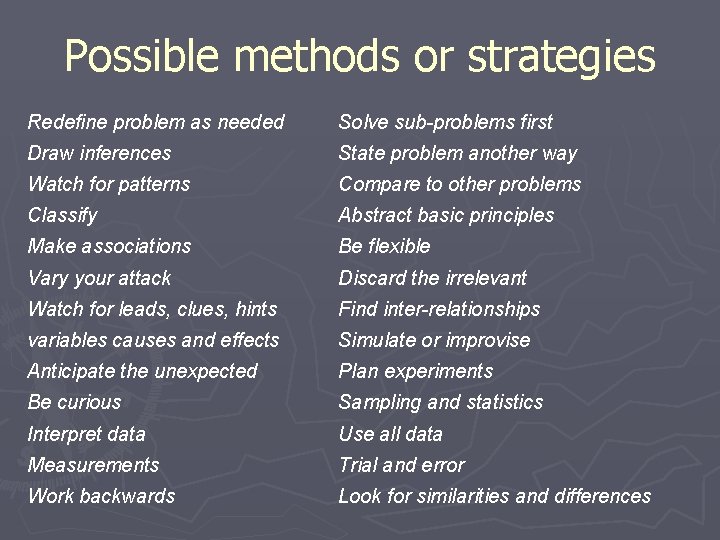
Possible methods or strategies Redefine problem as needed Solve sub-problems first Draw inferences State problem another way Watch for patterns Compare to other problems Classify Abstract basic principles Make associations Be flexible Vary your attack Discard the irrelevant Watch for leads, clues, hints Find inter-relationships variables causes and effects Simulate or improvise Anticipate the unexpected Plan experiments Be curious Sampling and statistics Interpret data Use all data Measurements Trial and error Work backwards Look for similarities and differences
5) Dividing the problem into subproblems Caracteristics of subproblems: § Each subproblem should be a completely researchable unit (separate subproject with a research goal) § Each subproblem must be clearly tied to the interpretation of the data § The subproblem must add up to the totality of the problem § Subproblems should be small in numbers
6) Decide methodology and identify theoretical framework If you do not ask appropriate questions, you will not be able to collect suitable data. Questions which identify the nature of the research problem or the issue you wish to focus on.
Sources of the lecture and Gronhaug (2005), Research Methods in Business Studies, Prentice hall Eds, 3 rd Edition, 257 pages. ► Leedy and Ormrod (2005), Practical Research, Prentice hall Eds, 8 th Edition, 319 pages. ► Collis and Hussey (2004), Business Research, Prentice hall Eds, 2 nd Edition, 374 pages. ► Ghauri ► http: //www. scientificmethod. com/b_index. html The scientific Method by Norman W. Edmund. « These pages contain today’s most up-to-date, clear, concise and reliable information about the scientific method that has ever been offered. »
- Slides: 19