
The Research Paper An extended formal composition presenting
- Slides: 20
The Research Paper ¨ An extended, formal composition presenting information gathered from a number of sources. ¨ Informational – summarizes factual information from a variety of sources. The OPINION writer’s task – focus the topic, find the information, and produce a coherent paper. ¨ Analytical – analyzes and makes a conclusion OPINION about information. The writer’s task – use persuasive writing to present an opinion.
Step One - Topic ¨Choose and limit a topic. ¨This has already been done for you.
¨ Step 4: ¨ Step 5: ¨ Bibliography ¨ Note Cards – Contain information from the source about the topic – direct quote, summary, paraphrase Cards – Contain info on how to find the source – title, author, URL, date of publication, etc.
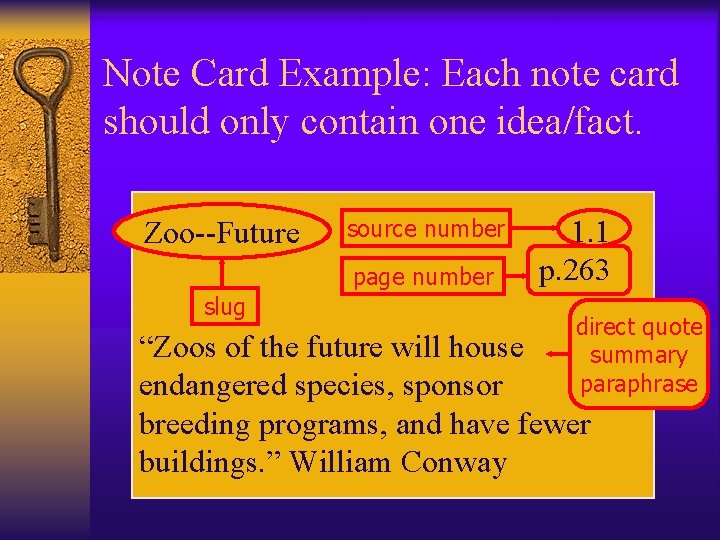
Note Card Example: Each note card should only contain one idea/fact. Zoo—Future Zoo--Future source number page number slug 1. 1 p. 263 direct quote summary paraphrase “Zoos of the future will house endangered species, sponsor breeding programs, and have fewer buildings. ” William Conway
¨ Direct Quote – ideas and words taken verbatim from the source, must be enclosed in quotation marks ¨ Summary – main ideas only taken from the source and written in your own words – Credit must still be given to the source ¨ Paraphrase – all ideas taken from the source in the order in which they appeared and written in your own words – Credit must still be given to the source
Step Five – Working Thesis ¨ Thesis Statement – A one sentence summary of the paper which must appear in the first paragraph. This will guide your entire paper, so it must be direct, clear, and logical. Step Six - Outline ¨Outline - A specific format to graphically organize your points and supporting evidence. See the following example.
Step Seven – Drafting ¨ Organize your note cards to correspond with your outline. ¨ The introduction must include your thesis statement and an attention getter. ¨ Each paragraph in the body should be restricted to one idea and have a topic sentence. ¨ Use transitional phrases. (I will give you a separate handout for practice) ¨ The conclusion should restate thesis statement and more… We’ll talk. ¨ Avoid PLAGIARISM –
Step Eight - Revision (First) 1. 2. 3. 4. 5. 6. 7. 8. Is thesis stated in the first paragraph? Does the introduction catch the reader’s interest? Is it clear how the topic sentence of each subsequent paragraph relates to thesis? Is each unfamiliar term or idea explained in simple language? Is there any unnecessary repetition? Are sentence patterns varied? Do topic changes flow logically from one to the next? Is there more active vs. passive language?
Final Revision 1. 2. 3. 4. 5. Each item of information in the final paper explains or develops the topic in some way. Important theories, unusual or specific facts, and quotations are cited in the text. If quotations are used, they are placed correctly in the paper. See MLA guidelines in notes and NT. In-text citations and works cited page are correct and standard to MLA format – see step 6. Does your conclusion make sense and is the paper still interesting?
Step Nine - MLA Format ¨In-Text Citations – refer to the MLA guidelines. ¨Works Cited Page
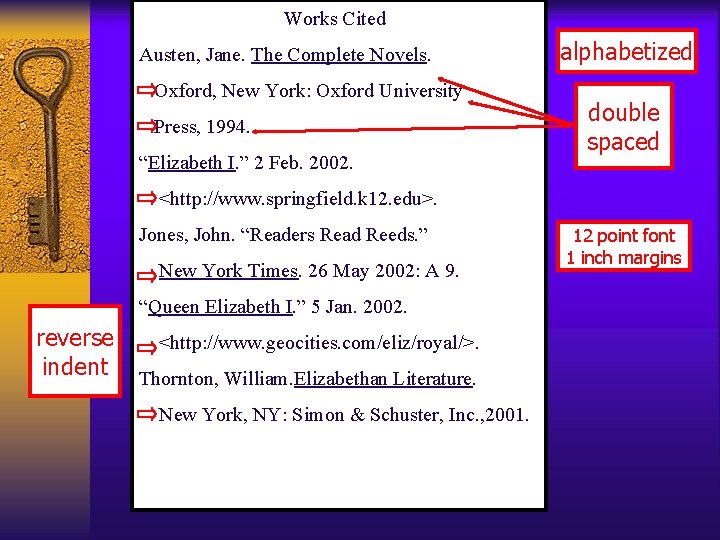
Works Cited Page ¨ The works cited page is a typed, alphabetized list of the sources used in the paper. It is reverse indented, single spaced, and double spaced between entries. Noodle Tools will format it for you. You have already done the work in Step 4! ¨ It is the last page of the paper, and does not count toward the minimum page requirement.
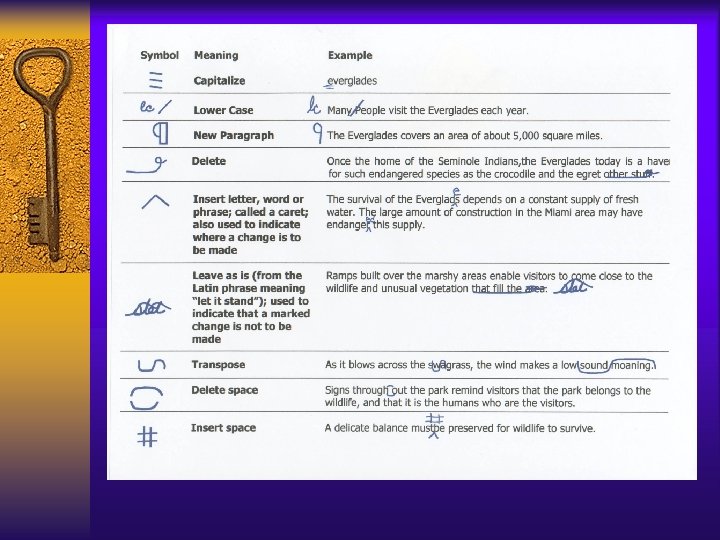
Step Ten– Proofread 1. Sentence structure is accurate. 2. Verb tenses are correct, and verbs agree with 3. 4. 5. 6. ¨ their subjects. Pronouns are the correct subject or object forms and agree with their antecedents. The writer avoids unnecessary shifts in pronouns, such as I to you or they to you. Capitalization, spelling, and punctuation are correct. Slang and other words or phrases not part of Standard English are used only when appropriate. See proofreader’s marks.
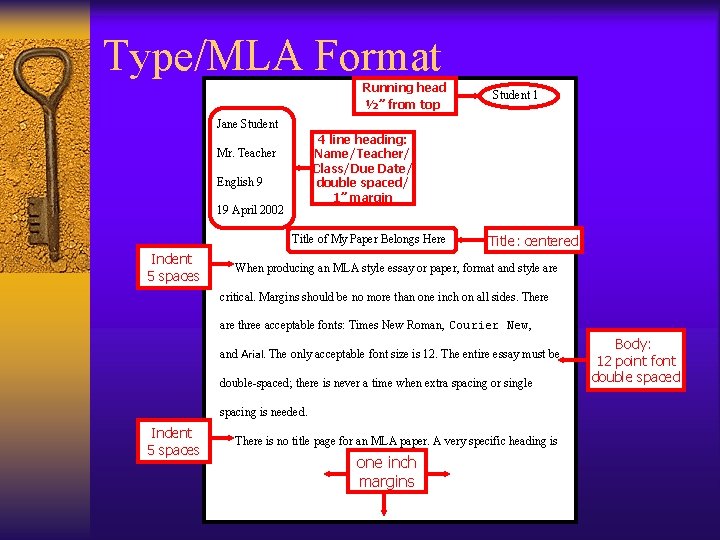
Type/MLA Format Running head ½” from top Student 1 Jane Student 4 line heading: Name/Teacher/ Class/Due Date/ double spaced/ 1” margin Mr. Teacher English 9 19 April 2002 Title of My Paper Belongs Here Indent 5 spaces Title: centered When producing an MLA style essay or paper, format and style are critical. Margins should be no more than one inch on all sides. There are three acceptable fonts: Times New Roman, Courier New, and Arial. The only acceptable font size is 12. The entire essay must be double-spaced; there is never a time when extra spacing or single spacing is needed. Indent 5 spaces There is no title page for an MLA paper. A very specific heading is one inch margins Body: 12 point font double spaced
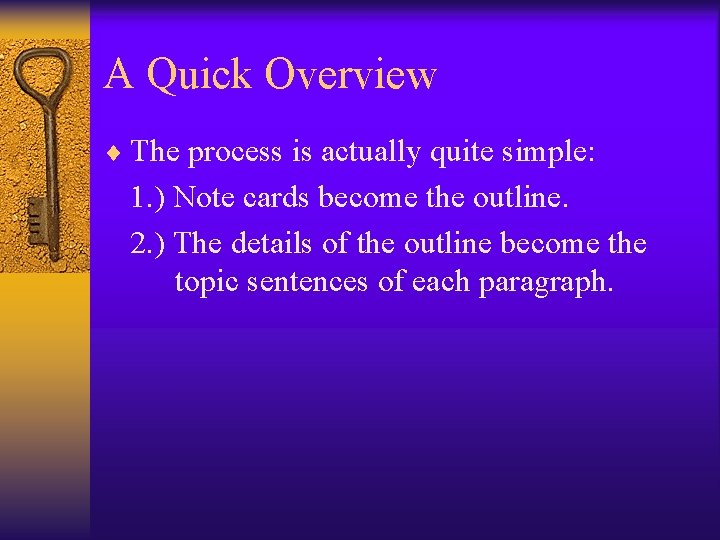
A Quick Overview ¨ The process is actually quite simple: 1. ) Note cards become the outline. 2. ) The details of the outline become the topic sentences of each paragraph.
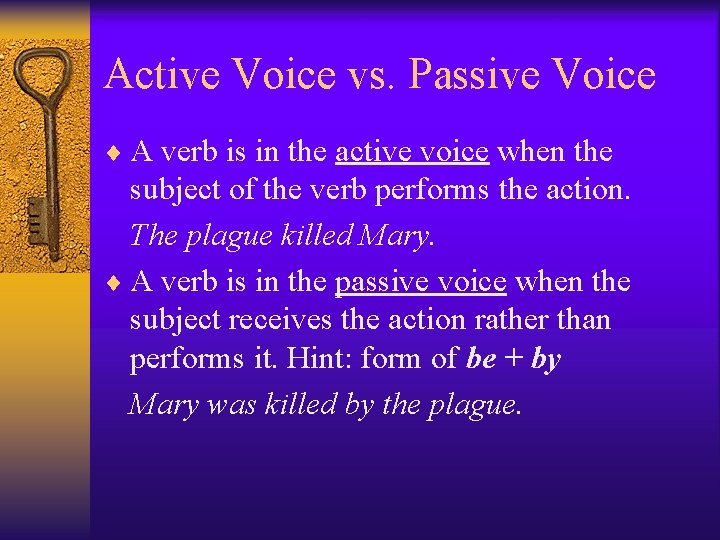
Active Voice vs. Passive Voice ¨ A verb is in the active voice when the subject of the verb performs the action. The plague killed Mary. ¨ A verb is in the passive voice when the subject receives the action rather than performs it. Hint: form of be + by Mary was killed by the plague.
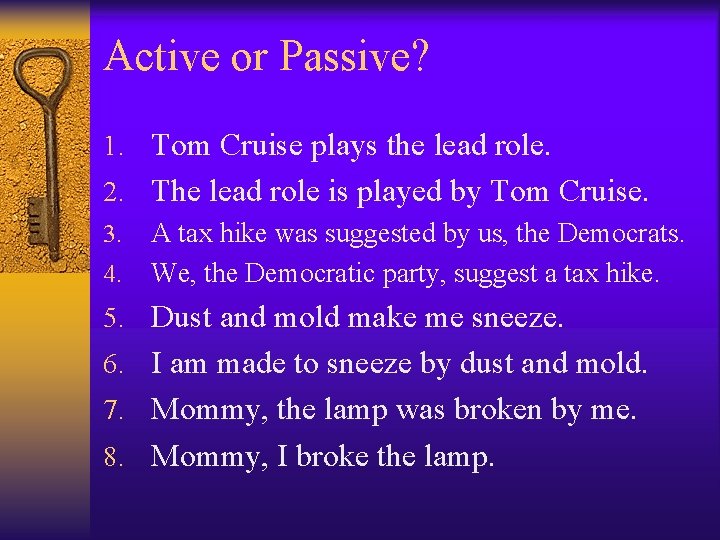
Active or Passive? 1. Tom Cruise plays the lead role. 2. The lead role is played by Tom Cruise. 3. A tax hike was suggested by us, the Democrats. 4. We, the Democratic party, suggest a tax hike. 5. Dust and mold make me sneeze. 6. I am made to sneeze by dust and mold. 7. Mommy, the lamp was broken by me. 8. Mommy, I broke the lamp.
Works Cited Austen, Jane. The Complete Novels. Oxford, New York: Oxford University Press, 1994. “Elizabeth I. ” 2 Feb. 2002. alphabetized double spaced <http: //www. springfield. k 12. edu>. Jones, John. “Readers Read Reeds. ” New York Times. 26 May 2002: A 9. “Queen Elizabeth I. ” 5 Jan. 2002. reverse indent <http: //www. geocities. com/eliz/royal/>. Thornton, William. Elizabethan Literature. New York, NY: Simon & Schuster, Inc. , 2001. 12 point font 1 inch margins
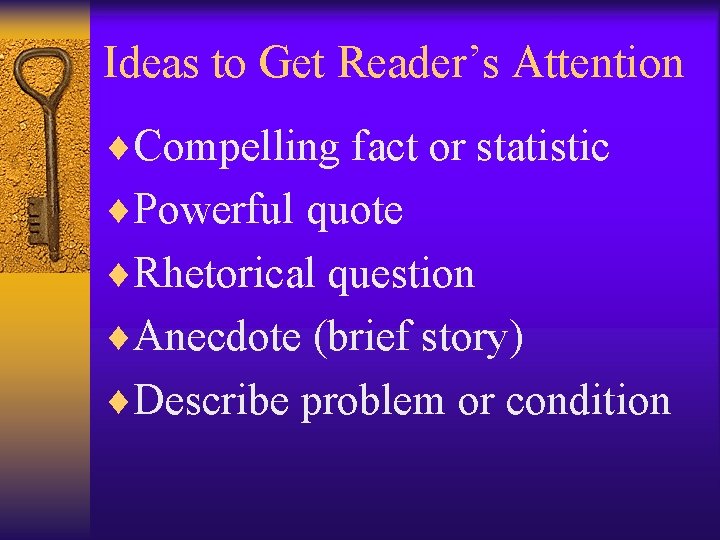
Ideas to Get Reader’s Attention ¨Compelling fact or statistic ¨Powerful quote ¨Rhetorical question ¨Anecdote (brief story) ¨Describe problem or condition
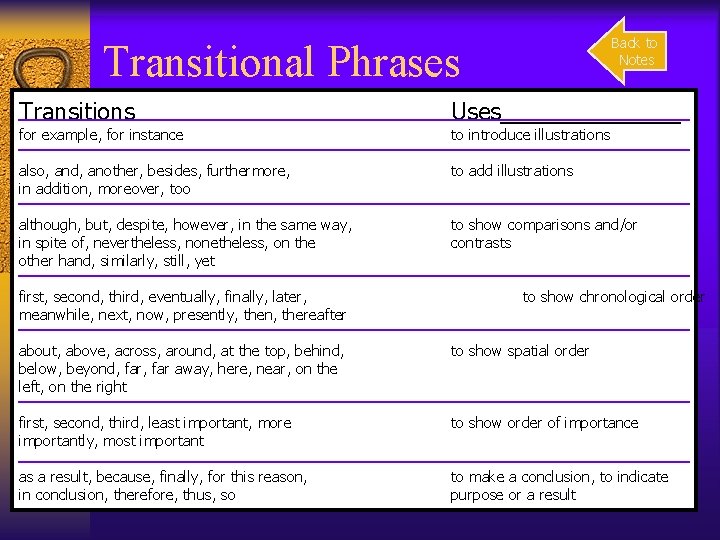
Back to Notes Transitional Phrases Transitions Uses also, and, another, besides, furthermore, in addition, moreover, too to add illustrations although, but, despite, however, in the same way, in spite of, nevertheless, nonetheless, on the other hand, similarly, still, yet to show comparisons and/or contrasts for example, for instance first, second, third, eventually, finally, later, meanwhile, next, now, presently, then, thereafter to introduce illustrations to show chronological order about, above, across, around, at the top, behind, below, beyond, far away, here, near, on the left, on the right to show spatial order first, second, third, least important, more importantly, most important to show order of importance as a result, because, finally, for this reason, in conclusion, therefore, thus, so to make a conclusion, to indicate purpose or a result